
博时基金

Search documents
加仓,股票ETF过去一周吸金超490亿元
Zhong Guo Ji Jin Bao· 2025-10-20 07:22
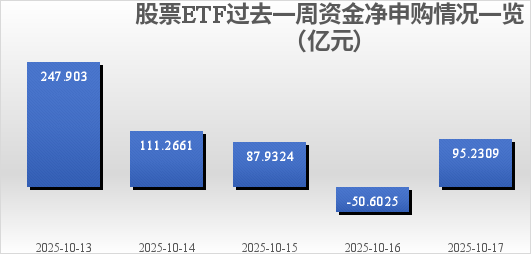
Core Viewpoint - The A-share market experienced a significant correction last week, with major indices declining, particularly the CSI 300 index, which fell by 2.22%, marking the largest weekly drop since April 18 of this year. Despite this, the stock ETF market showed a contrary trend, with substantial inflows of capital, indicating a preference for buying during market dips [1][2]. Fund Flows - During the period from October 13 to October 17, stock ETFs (including cross-border ETFs) saw a net inflow of 491.73 billion yuan, with all trading days except October 16 showing net inflows [4]. - On October 17, commodity and Hong Kong stock ETFs led the inflows, with net inflows of 55.71 billion yuan and 47.91 billion yuan, respectively [4]. - ETFs tracking the SGE Gold 9999 index had the highest single-day net inflow of 49.26 billion yuan, while those tracking the CSI A500 index saw a net outflow of 21.24 billion yuan [4]. - Over the last five trading days, ETFs tracking the SGE Gold 9999 index attracted over 18.3 billion yuan, and those tracking the Hang Seng Technology index saw inflows exceeding 11.6 billion yuan [4]. Popular ETFs - Major fund companies reported continued net inflows for several ETFs, with E Fund's ETF reaching a scale of 794.72 billion yuan, an increase of 194.07 billion yuan since 2025 [4]. - Specific ETFs such as the Gold ETF, Hang Seng Technology ETF, and Hong Kong Securities ETF saw net inflows of 9.5 billion yuan, 4.1 billion yuan, and 3.4 billion yuan, respectively [4]. - The Huaxia Fund's Sci-Tech 50 ETF and Hang Seng Technology Index ETF had notable single-day net inflows of 10.76 billion yuan and 7.61 billion yuan, respectively [5]. Market Preferences - The recent market style shift has favored safe-haven assets, particularly Gold ETFs and Bank ETFs, which have seen significant inflows [6][8]. - The Huaxia Fund indicated that while gold may be overbought in the short term, its long-term outlook remains positive due to factors such as interest rate cuts and geopolitical conflicts [8]. - The Bank ETF also attracted over 5 billion yuan in net inflows, reflecting investor confidence in the banking sector's stability and performance [8]. Outflows - The ETFs that experienced the largest net outflows included those tracking the ChiNext index, CSI 300 index, and CSI A500 index, indicating a shift in investor sentiment away from these sectors [9].

香农芯创股价跌5.11%,博时基金旗下1只基金重仓,持有3100股浮亏损失1.59万元
Xin Lang Cai Jing· 2025-10-20 06:44
Group 1 - The core point of the news is that Shannon Semiconductor experienced a decline of 5.11% in its stock price, reaching 95.41 CNY per share, with a trading volume of 3.747 billion CNY and a turnover rate of 8.56%, resulting in a total market capitalization of 44.249 billion CNY [1] - Shannon Semiconductor was established on September 16, 1998, and went public on June 10, 2015. The company is primarily engaged in the distribution of electronic components, with 97.03% of its revenue coming from this segment [1] - The revenue composition of Shannon Semiconductor includes 1.93% from electronic component manufacturing, 0.93% from reducer business, and 0.11% from other supplementary activities [1] Group 2 - From the perspective of fund holdings, only one fund under Bosera Fund has a significant position in Shannon Semiconductor. The Bosera CSI 1000 Enhanced ETF (561780) held 3,100 shares in the second quarter, accounting for 0.85% of the fund's net value, ranking as the fifth-largest holding [2] - The Bosera CSI 1000 Enhanced ETF (561780) was established on November 2, 2023, with a latest scale of 13.0547 million CNY. Year-to-date, it has achieved a return of 33.78%, ranking 1101 out of 4219 in its category [2] - The fund manager, Yang Zhenjian, has been in charge for 6 years and 324 days, with the total asset scale of 17.222 billion CNY. During his tenure, the best fund return was 63.47%, while the worst was -0.01% [2]

加仓!又见加仓
中国基金报· 2025-10-20 06:12
Core Viewpoint - The A-share market experienced a significant correction recently, with major indices declining, while stock ETFs attracted substantial inflows as investors adopted a "buy the dip" strategy, indicating a preference for safe-haven assets like gold and bank ETFs [2][4][12]. Fund Flows - During the week from October 13 to October 17, stock ETFs (including cross-border ETFs) saw a net inflow of 491.73 billion yuan, with all trading days except October 16 showing net inflows [6]. - On October 17, the leading inflows were seen in commodity and Hong Kong stock ETFs, with net inflows of 55.71 billion yuan and 47.91 billion yuan, respectively [6]. - Gold ETFs tracking the SGE Gold 9999 index had a notable single-day net inflow of 49.26 billion yuan, while ETFs tracking the CSI A500 index saw a significant outflow of 21.24 billion yuan [6]. Performance of Specific ETFs - Major fund companies continued to see net inflows in their ETFs, with E Fund's ETF reaching a scale of 794.72 billion yuan, increasing by 194.07 billion yuan since 2025 [7]. - Specific ETFs such as the Gold ETF from Huaxia and the Hang Seng Technology ETF saw net inflows exceeding 10 billion yuan, indicating strong investor interest [7][10]. - The top ten ETFs by net inflow included multiple gold ETFs, with the Huaan Gold ETF alone attracting over 63.48 billion yuan [10]. Market Sentiment and Outlook - The recent market style shift has favored safe-haven assets, with gold and bank ETFs receiving significant attention from investors [8][9]. - Analysts from Huaxia Fund noted that while gold may be overbought in the short term, its long-term outlook remains positive due to factors like interest rate expectations and geopolitical tensions [11]. - The banking sector is expected to maintain stable performance, with analysts predicting that the sector's relative and absolute returns will improve, making it an attractive investment option [12].

财政部将开展国债做市支持操作,30年国债ETF博时(511130)今日小幅回调
Sou Hu Cai Jing· 2025-10-20 03:19
Group 1 - The 30-year government bond ETF from Bosera has seen a slight decline of 0.18% as of October 20, 2025, with a latest price of 106.93 yuan, but has accumulated a rise of 1.68% over the past week as of October 17, 2025 [1] - The trading volume for the 30-year government bond ETF reached 1.566 billion yuan with a turnover rate of 9.07%, and the average daily trading volume over the past week was 4.167 billion yuan [1] - The Ministry of Finance announced measures to support government bond market making and enhance liquidity in the secondary market, indicating a proactive approach to manage the yield curve [1] Group 2 - Guojin Securities reported that the fixed income market indicators show a balanced outlook with half of the 49 high-frequency indicators signaling positive trends, despite some negative signals from bill financing [2] - The latest scale of the 30-year government bond ETF from Bosera is 17.291 billion yuan, closely tracking the Shanghai Stock Exchange's 30-year government bond index [3]
金价高位回调,黄金ETF基金(159937)回调超2%,是为逢低加仓好时机?
Sou Hu Cai Jing· 2025-10-20 03:13
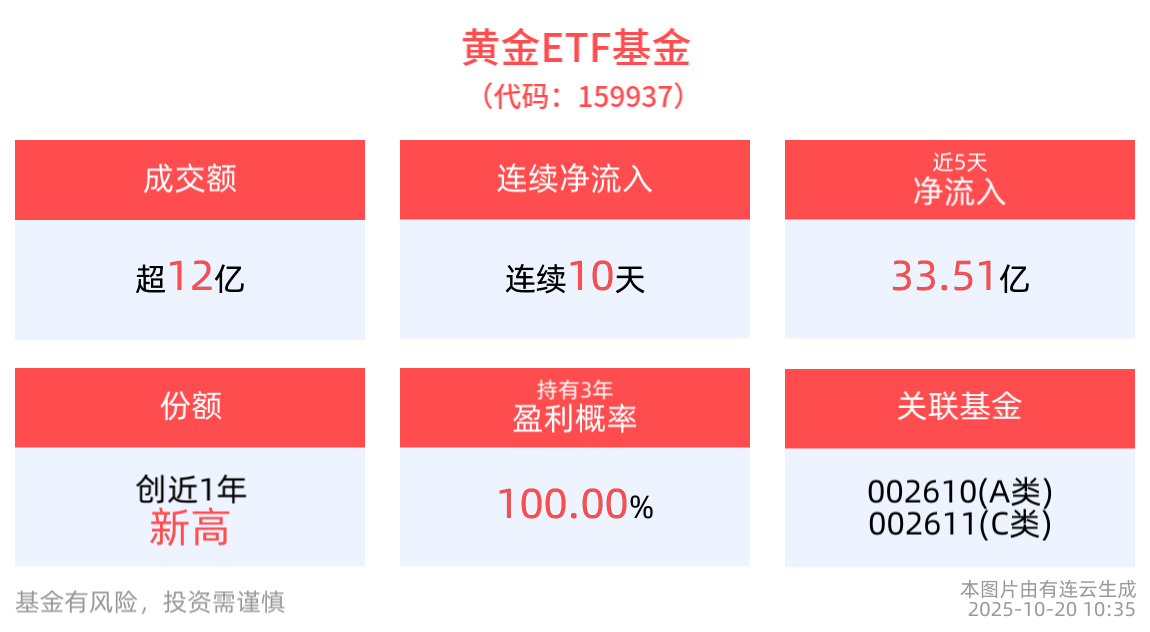
Core Viewpoint - The recent performance of gold ETFs reflects a significant increase in gold prices driven by geopolitical risks and changes in global liquidity expectations, with a notable rise in trading volume and net inflows into gold ETFs [4][5]. Group 1: Gold ETF Performance - As of October 20, 2025, the gold ETF (159937) has decreased by 2.36%, with a latest price of 9.33 yuan, while showing an 11.33% increase over the past week as of October 17 [3]. - The trading volume for the gold ETF reached 12.23 billion yuan, with a turnover rate of 3.14%, and an average daily trading volume of 31.28 billion yuan over the past week, ranking it among the top three comparable funds [4]. Group 2: Market Drivers - The recent surge in international gold prices is attributed to a combination of geopolitical risk, a weakening global credit system, and changing liquidity expectations, with multiple factors contributing to the current market dynamics [4][5]. - Key pressures on the gold market include a high concentration of long positions and the potential for speculative funds to take profits, which could lead to increased volatility and a possible price correction [4]. Group 3: Institutional Trends - There has been a consistent net inflow into the largest gold ETF, SPDR, and the People's Bank of China has increased its gold holdings for 11 consecutive months, although its reserves remain lower than the global average of 15%-20% [5]. - The trend of reducing U.S. Treasury holdings while increasing gold investments is observed across both institutional and individual investors [5]. Group 4: Future Outlook - The long-term outlook for gold remains positive due to factors such as a weakening U.S. dollar and ongoing geopolitical instability, which are expected to support continued central bank purchases of gold [5]. - The latest share count for the gold ETF reached 4.166 billion, marking a one-year high [5].
多因素推动资金持续涌入,黄金类ETF“吸金”又“吸睛”
证券时报· 2025-10-20 02:14
Core Viewpoint - The recent surge in international gold prices is driven by geopolitical risks, global credit system instability, and liquidity factors, leading to increased investment in gold-related ETFs [1][5][6]. Group 1: Gold Price Performance - International gold prices reached a record high of $4,380.79 per ounce on October 17, before closing at $4,251.45 per ounce [3]. - The strong performance of gold has led to significant inflows into gold-related ETFs, with several funds experiencing substantial growth in management scale over the past week [4]. Group 2: ETF Growth - Major gold ETFs have seen remarkable increases in their management scales: - Huaan Gold ETF grew to ¥85.235 billion, up ¥14.418 billion in a week - Bosera Gold ETF expanded to ¥39.667 billion, increasing by ¥7.061 billion - E Fund Gold ETF reached ¥33.906 billion, up ¥6.588 billion - Guotai Gold ETF rose to ¥26.849 billion, increasing by ¥5.723 billion - Yongying CSI Hong Kong and Shanghai Gold Industry Stock ETF grew to ¥14.060 billion, up ¥1.649 billion [4]. Group 3: Investment Drivers - The rise in gold prices is attributed to multiple factors, including geopolitical risk, a weakening global credit system, and changing liquidity expectations [6]. - Recent global events, such as the U.S. government shutdown and European fiscal concerns, have further catalyzed the upward movement in gold prices [6]. Group 4: Long-term Outlook - Despite potential short-term fluctuations, the long-term value of gold as a core asset remains strong, with predictions of gold prices potentially reaching between $4,600 and $5,000 per ounce next year [9][10]. - Gold has shown robust performance over the past three years, with a favorable Sharpe ratio, indicating its increasing value as a hedge against currency credit risks and geopolitical uncertainties [7][9].

机构研究周报:资产重估延续,关注高股息与高成长
Wind万得· 2025-10-19 22:35
Core Viewpoints - The article discusses the impact of recent U.S. tariffs on China, indicating that while there may be short-term disruptions in global assets, the medium-term trend of asset revaluation in China remains unaffected [1][6]. Credit Market - In September, M2 growth was 8.4%, down 0.4 percentage points from August, while M1 increased by 7.2%, up 1.2 percentage points from August, indicating a narrowing gap between M1 and M2 [3]. - New RMB loans in September were 1.29 trillion yuan, below the market expectation of 1.46 trillion yuan, reflecting a decrease of approximately 300 billion yuan compared to the same period last year [3]. Equity Market - Traditional manufacturing in China is poised to gain global pricing power due to a shift in capital expenditure structures and a slowdown in domestic capital spending [5]. - High-dividend blue-chip stocks and high-growth stocks are highlighted as key investment opportunities for the fourth quarter, with a focus on sectors like banking and utilities for stable returns, and new energy and AI for long-term growth potential [7]. Industry Research - The rebound in inbound tourism in China is expected to significantly boost the tourism sector, with total inbound tourism revenue projected to grow from $94 billion in 2024 to $525 billion by 2034 [11]. - The coal industry is anticipated to rebound in the fourth quarter due to supply constraints and increased demand, with expectations of higher coal prices supported by improved supply-demand dynamics [12]. - The non-ferrous metals sector is identified as a strong performer, driven by global political factors and trade disruptions, presenting investment opportunities in related resource sectors [13]. Macro and Fixed Income - The bond market is entering a recovery phase, with increased attractiveness for low-risk assets amid a declining risk appetite in the market [18]. - The bond market is expected to perform well in the fourth quarter, supported by a weak domestic demand environment and potential monetary policy easing [19]. - Interest rates are projected to remain low and volatile, influenced by economic recovery dynamics and the real estate market's stabilization [20]. Asset Allocation - The stock market is viewed positively in the long term, but caution is advised in the short term, with a focus on undervalued sectors and credit bonds offering yield spread opportunities [22].



陆家嘴财经早餐2025年10月20日星期一
Wind万得· 2025-10-19 22:35
Group 1 - The Trump administration is signaling a willingness to ease trade tensions by exempting more products from tariffs, which may impact the upcoming Supreme Court hearing on "reciprocal tariffs" [1] - The only silver futures fund in the market, Guotou Ruijin Silver Futures, has implemented purchase limits due to soaring silver prices, which have increased by 58.10% year-to-date as of October 17 [1] Group 2 - Hong Kong's Financial Secretary expressed concerns about the economic outlook during discussions at the IMF and World Bank meetings, emphasizing the importance of stable US-China relations for global economic development [2] Group 3 - A total of 1,163 new funds have been established this year, surpassing the total for 2024, indicating a strong recovery in the fund market, with stock funds accounting for 661 of these and a total issuance scale of 906.27 billion yuan [3] - The ETF market has seen a net inflow of 99.16 billion yuan since October, primarily driven by equity ETFs, which contributed over 92.46 billion yuan [3] Group 4 - The People's Bank of China has introduced monetary policy tools to support the capital market, injecting thousands of billions into the market and stabilizing A-share volatility [4] - Several companies have completed restructuring, with a focus on industrial integration, as seen in notable acquisitions in the automotive and optical communication sectors [4] Group 5 - Current structural fundamentals in A-shares are influenced by Chinese companies going abroad, with market dynamics affected by US-China relations [5] - The market is in a consolidation phase, with a focus on sectors such as precious metals, finance, and technology [5] Group 6 - A private equity product managed by Wu Yuefeng has shown significant recovery, nearing breakeven, while prominent investors express optimism about the A-share market [6] Group 7 - Companies like Silan Microelectronics and China Life are projecting significant profit growth, with China Life expecting a 50%-70% increase in net profit [7] Group 8 - Silver prices have surged nearly 70% this year, leading to shortages in local markets, with prices for silver bars increasing from over 8,000 yuan to 13,000 yuan [8] - Banks are preparing for a decisive fourth quarter, with some smaller banks initiating early promotional activities for the next year [8] Group 9 - The China Shipowners' Association has signed cooperation agreements with major international shipping organizations, marking a new phase in the collaboration of China's shipping industry [9] Group 10 - The People's Bank of China emphasizes the need for a financial system that aligns with the country's technological development stage [10] Group 11 - Kering Group plans to sell its beauty division to L'Oréal for approximately 4 billion USD, which includes ownership of the Creed perfume brand [11] Group 12 - Australian Prime Minister is expected to discuss rare earth supply chains with US President Trump [12] Group 13 - South Korean investors are increasingly betting on leveraged VIX investments to hedge against their US stock holdings [13] Group 14 - There is a significant performance disparity among "fixed income +" products, with some achieving over 20% returns while others have negative returns [14] Group 15 - International gold prices have surged, leading to increased investment in gold ETFs, driven by geopolitical risks and liquidity factors [15]

公募基金精准破局多元诉求 生动践行养老金融高质量发展
Zheng Quan Shi Bao· 2025-10-19 22:33
Core Insights - The personal pension fund count in China has surpassed 300 for the first time, indicating significant growth in the third pillar of retirement products [1][2] - The personal pension system is approaching its three-year anniversary, marking a transformative phase in its development [2] - Public funds play a crucial role in the construction and operation of China's pension finance system, contributing to the high-quality development of the public fund industry [1][2] Fund Growth and Performance - As of September 2023, the number of personal pension funds reached 302, with a total market size exceeding 12 billion yuan, reflecting a 35.72% increase from the end of the previous year [2][3] - The average annual return for personal pension funds is 15.13%, with some funds achieving returns over 40% [3] - The rapid growth in fund size and performance indicates increasing market acceptance and the effectiveness of the personal pension system [2][3] Regulatory and Strategic Directions - The "Action Plan for Promoting High-Quality Development of Public Funds" emphasizes enhancing service capabilities for various long-term funds and creating more suitable investment products for personal pensions [4] - Public funds are focusing on developing stable, clear-strategy pension target funds to meet the long-term investment needs of retirees [4] Collaborative Ecosystem Development - China's pension system is evolving into a comprehensive framework, integrating basic pension insurance, enterprise annuities, and personal commercial pensions [5] - Public funds are actively participating in the construction and management of this pension finance system, with a significant number of institutions holding qualifications for managing various pension funds [5][6] Challenges and Innovations - The aging population poses significant challenges to the pension system, including fragmentation between different pension schemes and insufficient product innovation [6] - There is a need for institutional innovation to create a "safe, stable, and adaptable" investment system for pensions [6] - Public funds are urged to deepen their pension finance services and address development bottlenecks by leveraging their unique resources [6] Technological Empowerment - The application of advanced technologies like AI and big data is accelerating the digital transformation of pension financial products and services [9][10] - Fund companies are enhancing their product innovation and service quality through increased technological investment, aiming for a more efficient and responsive service model [10] Investor Education and Engagement - There is a recognized gap in investor education regarding personal pension products, which needs to be addressed through improved product design and educational services [12][13] - Fund companies are implementing various educational initiatives to enhance public understanding of pension finance, aiming to align investor needs with appropriate risk profiles [12][13]
年内新发基金数量超去年全年 股基占比创近15年新高
Zheng Quan Shi Bao· 2025-10-19 22:30
Core Insights - The A-share market is experiencing a strong influx of funds through equity funds, with a total of 1,163 new funds established by October 19, 2025, surpassing the total of 1,135 for the entire year of 2024, indicating a robust recovery in the fund market [1] - The number of newly established equity funds has reached 661, with a total issuance scale of 339.396 billion yuan, accounting for 37.45% of the total issuance scale, marking the highest proportion in nearly 15 years since 2011 [1] - The high proportion of equity funds in 2025 reflects investors' desire for higher returns during a bull market and indicates that fund companies are responding to market demand by increasing the issuance of equity funds [1] Fund Issuance Trends - The total issuance scale for the year has reached 906.273 billion yuan, with seven products exceeding 6 billion yuan in initial fundraising, and 50 funds surpassing 3 billion yuan [1] - The top mixed FOF fund, Dongfanghong Yingfeng, has raised 6.573 billion yuan, leading the market, followed by several other funds with similar fundraising scales, indicating strong institutional interest in bond index tools and stable strategy products [2] - Passive index bond funds have become the mainstay in the 3 billion to 6 billion yuan range, with several bond ETFs achieving over 3 billion yuan in fundraising, highlighting the demand for low-volatility assets [2] Market Dynamics - The rebound in the equity market has led to increased issuance of active equity funds, with several products surpassing 2 billion yuan in scale, reflecting a growing demand for equity assets [3] - The issuance scale of bond funds has decreased compared to last year, as the attractiveness of the stock market increases amid narrowing interest rate space, demonstrating a "stock-bond seesaw" effect [3] - The structural changes in the fund issuance market indicate a shift in capital flow, with public funds becoming a significant channel for capital inflow into the A-share market, suggesting a potential continuation of the equity investment golden period [3]