
蔚来

Search documents
黄仁勋的“物理 AI 革命”:Alpamayo 让自动驾驶学会 “思考”
3 6 Ke· 2026-01-07 03:48
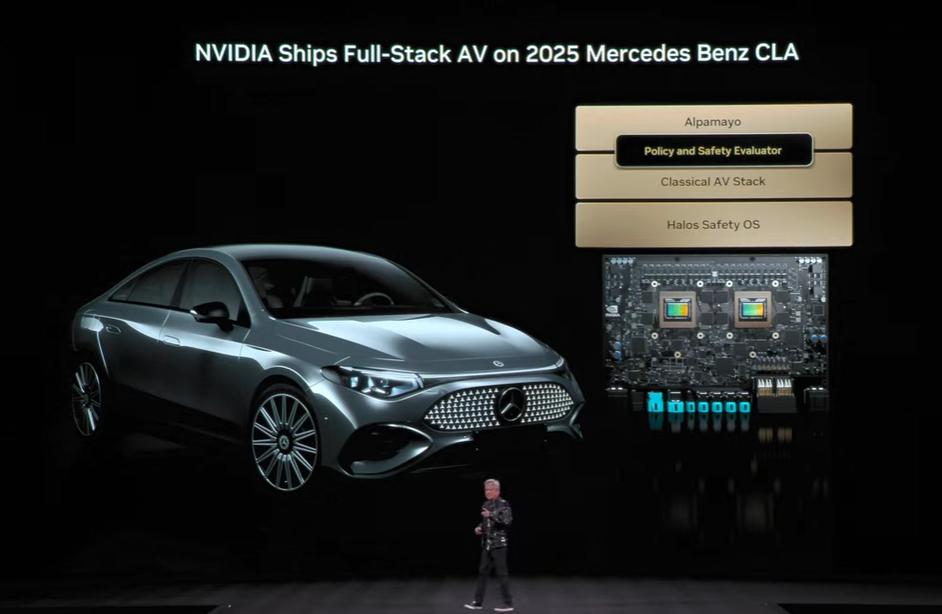
Core Insights - Nvidia's CEO Jensen Huang announced the arrival of "physical AI" at CES 2026, highlighting the transformative potential of the Alpamayo autonomous driving AI system, which signifies a shift from "data-driven" to "reasoning-driven" autonomous driving [1][10] Group 1: Alpamayo's Technological Breakthrough - Alpamayo addresses the "long tail problem" in autonomous driving, where 99% of scenarios can be covered by data, but the remaining 1% poses significant safety risks. Traditional solutions focused on accumulating vast amounts of data, which are costly and insufficient for unprecedented scenarios [2] - Alpamayo is the first visual-language-action (VLA) model that enables autonomous systems to possess "human-like reasoning capabilities." It breaks down problems similarly to human drivers, enhancing decision-making safety and providing clear directions for system optimization [2][3] Group 2: Development Ecosystem and Partnerships - Alpamayo employs a 10 billion parameter architecture and supports trajectory generation and reasoning logic from video inputs. Nvidia has created a comprehensive development ecosystem, including the open-source AlpaSim simulation framework and a dataset of over 1,700 hours of physical AI data [3][5] - The first vehicle equipped with Alpamayo will be launched in the first quarter of 2026 in partnership with luxury car manufacturer Mercedes-Benz, marking a significant step in Nvidia's dominance in the autonomous driving sector [5][7] Group 3: Market Position and Competitive Landscape - Nvidia's strategy combines "hardware dominance" with "algorithmic ecosystem dominance," allowing automakers to quickly access advanced autonomous driving capabilities without starting from scratch [7][10] - The introduction of Alpamayo shifts the competitive focus in the autonomous driving industry from "computational power" and "data volume" to "reasoning capabilities," potentially redefining the competitive landscape [10][11] Group 4: Implications for the Industry - For traditional automakers, Alpamayo presents both opportunities and challenges. The open-source ecosystem lowers the barrier for high-level autonomous driving development, enabling smaller companies to compete without massive R&D investments [11] - Tech companies like Google Waymo and Baidu Apollo must accelerate their reasoning model development to remain competitive, while chip manufacturers need to adapt to the new demands of integrating reasoning models with computational power [11][9]


恒指三连扬,后市续望2万7
Guodu Securities Hongkong· 2026-01-07 03:32
Group 1: Market Overview - The Hang Seng Index has shown strong performance, rising 4.2% in the first three trading days of 2026, with a notable increase of 363 points on the last trading day, closing at 26,710 points [3][4] - The A-share Shanghai Composite Index has reached a 10-year high, contributing to the positive momentum in the Hong Kong market [3] - The total market turnover was approximately 291.76 billion HKD, with a net inflow of 2.879 billion HKD from northbound trading [3] Group 2: Currency and Economic Outlook - Citigroup forecasts that the Chinese yuan will strengthen to 6.8 against the US dollar within the next 6 to 12 months, driven by the internationalization of the yuan and easing trade tensions [7] - The report anticipates that the People's Bank of China may implement a managed appreciation of the yuan, with GDP growth target set around 5% for the year [7] Group 3: Fund Performance - The Mandatory Provident Fund (MPF) recorded a net return of 16.5% for the year 2025, marking the third consecutive year of positive returns [8] - Stock and mixed asset funds accounted for nearly 80% of the total MPF assets, with average net returns of 24.8% and 16.8% respectively over the past year [8] Group 4: Company News - Hesai Technology has been selected by Nvidia as a partner for the NVIDIA DRIVE AGX Hyperion 10 platform, aimed at supporting L4 autonomous driving [10] - BrainCo has signed cooperation agreements with Peking University Sixth Hospital and Shandong Provincial Mental Health Center to advance digital therapy products for mental health [11] - NIO aims for annual sales growth of 40% to 50%, with plans to expand its battery swap station network significantly by 2030 [12]
蔚来(NIO)盘前升2.26% 上季度新车交付量按年升7成
Xin Lang Cai Jing· 2026-01-07 03:29
Core Viewpoint - NIO's stock price increased by 2.26% to $4.97 ahead of market opening, following the production of its one millionth vehicle at the new manufacturing facility in Hefei, Anhui [1] Group 1: Production and Growth - NIO's CEO, Li Bin, stated that the company aims to maintain an annual sales growth of 40% to 50% [1] - The company delivered a record 124,807 vehicles in the fourth quarter, representing a year-on-year increase of 71.7% [1] - Deliveries for the NIO brand reached 67,433 units, up 27.8% year-on-year; the Ladao brand delivered 38,290 units, a 92.1% increase; and the Firefly brand delivered 19,084 units, with a quarter-on-quarter growth of 52.8% [1]

港股科技股普跌,恒生科技指数跌1.5%!腾讯音乐跌5%,阿里巴巴跌3%,比亚迪股份、快手跌超2%,腾讯网易跌2%



Ge Long Hui· 2026-01-07 03:18
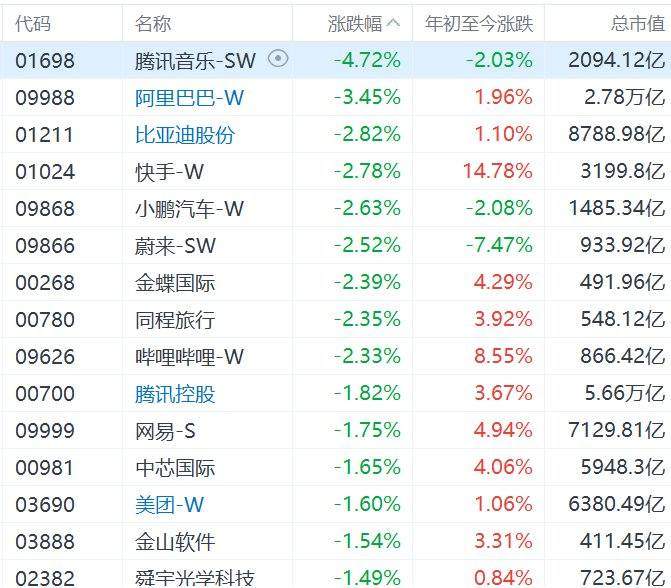
Group 1 - The Hong Kong stock market experienced a decline in technology stocks, with the Hang Seng Technology Index falling by 1.5% [1] - Notable declines among major companies include Tencent Music down nearly 5%, Alibaba down over 3%, and BYD, Kuaishou, Xpeng Motors, NIO, Kingdee International, Tongcheng Travel, and Bilibili all down over 2% [1] Group 2 - Tencent Music's stock decreased by 4.72%, with a year-to-date decline of 2.03%, and a total market capitalization of 209.41 billion [2] - Alibaba's stock fell by 3.45%, with a year-to-date increase of 1.96%, and a total market capitalization of 2.78 trillion [2] - BYD's stock dropped by 2.82%, with a year-to-date increase of 1.10%, and a total market capitalization of 878.90 billion [2] - Kuaishou's stock decreased by 2.78%, with a year-to-date increase of 14.78%, and a total market capitalization of 319.98 billion [2] - Xpeng Motors' stock fell by 2.63%, with a year-to-date decline of 2.08%, and a total market capitalization of 148.53 billion [2] - NIO's stock decreased by 2.52%, with a year-to-date decline of 7.47%, and a total market capitalization of 93.39 billion [2] - Kingdee International's stock fell by 2.39%, with a year-to-date increase of 4.29%, and a total market capitalization of 49.20 billion [2] - Tongcheng Travel's stock decreased by 2.35%, with a year-to-date increase of 3.92%, and a total market capitalization of 54.81 billion [2] - Bilibili's stock fell by 2.33%, with a year-to-date increase of 8.55%, and a total market capitalization of 86.64 billion [2] - Tencent Holdings' stock decreased by 1.82%, with a year-to-date increase of 3.67%, and a total market capitalization of 5.66 trillion [2] - NetEase's stock fell by 1.75%, with a year-to-date increase of 4.94%, and a total market capitalization of 712.98 billion [2]
港股异动丨汽车股普跌 机构预计2026年车市销量下滑+车圈开年狂打价格战
Ge Long Hui· 2026-01-07 03:04
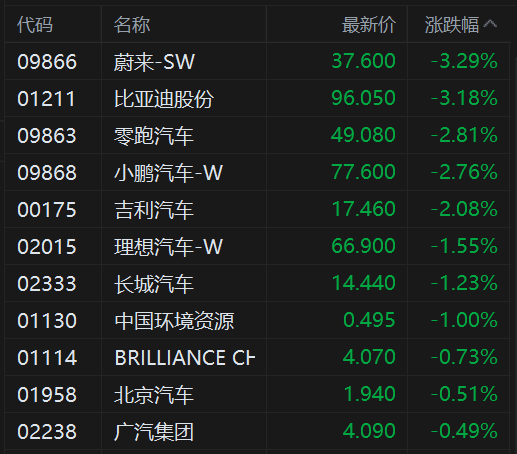
Group 1 - The core viewpoint of the news is that Hong Kong automotive stocks have experienced a significant decline, with major players like NIO and BYD dropping over 3% due to reduced subsidies and a weak outlook for the Chinese auto market in Q4 [1] - Multiple institutions predict a 7% decline in China's auto sales by 2026, marking the first anticipated annual drop since 2020 [1] - A price war has commenced in the Chinese auto market, with over 76 models from various brands, including both domestic and foreign manufacturers, launching promotional policies at the start of the year [1] Group 2 - Specific stock performance shows NIO down 3.29% at 37.600, BYD down 3.18% at 96.050, and other companies like Leap Motor and Xpeng also experiencing declines of around 2.8% [2] - The decline in stock prices is widespread among major automotive companies, including Geely down 2.08%, Li Auto down 1.55%, and Great Wall Motors down 1.23% [2] - The overall sentiment in the market reflects concerns over the sustainability of growth in the automotive sector, influenced by changing subsidy policies and market conditions [1][2]




国补\降价\购置税兜底全堆上,新车咋还卖不动?
3 6 Ke· 2026-01-07 02:55
Core Viewpoint - The domestic passenger car market is experiencing a significant decline in demand, with consumer sentiment remaining cautious despite government subsidies. Major brands are facing substantial order drops, while only a few have managed to maintain order volumes through temporary incentives [1][3][4]. Group 1: Market Performance - The overall customer traffic in the domestic passenger car market has decreased significantly compared to the same period last year, indicating a contraction in market demand [1]. - Major brands like BYD, Leap Motor, and Chery have seen order volumes drop by over 50% in the first three days of January compared to the last weekend of December, primarily due to unmet policy expectations and reduced brand subsidies [1]. - In contrast, Geely Galaxy has shown resilience with orders reaching 8-10 units per store, while Tesla maintained orders at 15-18 units, albeit down over 30% from December [1]. Group 2: Pricing Strategies - BMW has initiated a price war by reducing the prices of 31 models, with discounts reaching up to 301,000 yuan for the flagship 7 Series, marking a significant shift for a luxury brand that rarely engages in large-scale price cuts [3][4]. - Following BMW's lead, numerous automakers have introduced various incentives, including tax rebates and cash discounts, in an attempt to stimulate demand, although these measures have not effectively countered the market's cold reception during the New Year period [3][4]. Group 3: Subsidy Policies - The automotive industry is witnessing a surge in subsidy policies across various brands, with a focus on counteracting the reduction of national subsidies and adjusting purchase tax incentives [4][6]. - Luxury brands are adopting aggressive subsidy strategies, with BMW and Volvo offering substantial direct discounts and additional benefits such as free maintenance and financing options [4][6]. - Domestic brands are implementing targeted subsidies for mid-to-low-end models, with Geely Galaxy and Wuling providing significant purchase tax rebates and trade-in bonuses to attract budget-conscious consumers [6][7]. Group 4: Consumer Behavior - The market is experiencing a clear divide in consumer response, with luxury brands facing a relatively stable order decline due to lower price sensitivity among their target customers, while mass-market vehicles under 150,000 yuan are seeing the most significant drops in orders [10][12]. - The anticipated reduction in national subsidies for 2026 has led to increased consumer hesitance, particularly among mid-to-low-end buyers, who are now facing higher costs for vehicle purchases [17][19]. - The reliance on subsidies has created a false sense of demand, leading to a market correction as consumers delay purchases in anticipation of better deals [19][20].

1盒内存条价格堪比上海1套房!内存暴涨,闪迪股价一夜飙升27%,李斌喊话“大家买车要早一点”
Xin Lang Cai Jing· 2026-01-07 02:53
Core Viewpoint - The price of memory modules, particularly DDR5 server memory, has surged dramatically, with a single 256G module exceeding 40,000 yuan, surpassing the value of many properties in Shanghai [1] Group 1: Memory Market Dynamics - The price of memory is highly volatile, changing almost daily, as indicated by industry expert Wu Shen [1] - On January 6, 2023, the U.S. storage sector experienced significant gains, with SanDisk's stock rising by 27%, marking its largest single-day increase in ten months, while Micron Technology increased by nearly 7% to reach a historical high [1] - Other companies in the sector, such as Seagate and Western Digital, also saw stock increases of nearly 10% [1] Group 2: Price Increases and Industry Impact - Samsung and SK Hynix have announced price increases for DRAM used in servers, PCs, and smartphones, with first-quarter quotes expected to rise by 60%-70% compared to the fourth quarter of the previous year [1] - The rising memory prices are exerting significant pressure on the automotive industry, as highlighted by NIO's founder Li Bin, who noted that the automotive sector is competing with AI, data centers, and the smartphone industry for memory resources [1] - Currently, the cost pressures from rising memory prices have not yet been passed on to end consumers, remaining within the tolerable limits for companies like NIO [1]
港股科技股普跌,恒生科技指数跌1.5%
Jin Rong Jie· 2026-01-07 02:30
本文源自:金融界AI电报 港股市场科技股普跌,恒生科技指数跌1.5%。成分股中,腾讯音乐跌近5%,阿里巴巴跌超3%,比亚迪 股份、快手、小鹏汽车、蔚来、金蝶国际、同程旅行、哔哩哔哩跌超2%,腾讯、网易跌近2%。 ...
港股汽车股震荡走低
Jin Rong Jie· 2026-01-07 02:23
本文源自:金融界AI电报 港股汽车股震荡走低,比亚迪股份(01211.HK)跌超3%,蔚来汽车(09866.HK)、小鹏汽车(09868.HK)跌超 2%,吉利汽车(00175.HK)、长城汽车(02333.HK)、赛力斯(09927.HK)、理想汽车(02015.HK)跌超1%。 ...
国海证券晨会纪要-20260107
Guohai Securities· 2026-01-07 02:13
Group 1 - The Brunei Refinery Phase II project has been fully launched, with the controlling shareholder's increase in holdings reflecting long-term confidence in development. The project aims for an optimized design capacity of 12 million tons per year, primarily producing diesel, PX, benzene, polypropylene, and other high-value-added products, with completion targeted by the end of 2028 [3][5][9] - The total capacity of the Brunei refinery will reach 20 million tons per year upon completion of both phases, enhancing the company's integrated industrial chain and scale advantages, which will help reduce production costs and stabilize raw material supply [5][6] - The controlling shareholder, Hengyi Group, plans to increase its holdings in the company with a total investment of no less than 1.5 billion yuan and no more than 2.5 billion yuan, with the price range adjusted to not exceed 15 yuan per share [4][9] Group 2 - The automotive industry is set to continue implementing vehicle scrapping and replacement subsidies in 2026, with the Ministry of Industry and Information Technology and other departments issuing a plan to support digital transformation in the automotive sector [11][13] - The automotive sector index outperformed the Shanghai Composite Index in late December 2025, with significant sales variations among major automakers, indicating a mixed performance in the market [11][15] - The report highlights the expected growth in high-end passenger vehicles, particularly for domestic brands, as they capitalize on opportunities in the market [15] Group 3 - The report indicates that the primary market is progressing smoothly, with a total of 20 public REITs issued in 2025, although this is a decrease from the previous year [17][18] - The secondary market for REITs has seen a decline, with the index dropping by 2.93% in December 2025, reflecting reduced market activity [18][19] - The report notes that the average cash distribution rate for property-type REITs is lower than that of concession-type REITs, indicating a potential investment opportunity in the latter [20] Group 4 - The coal industry is expected to see a tightening supply-demand relationship in 2026, with projected average prices for thermal coal and coking coal rising to 750 yuan and 1550 yuan per ton, respectively [21][23][25] - The report discusses the V-shaped price recovery of thermal coal in 2025, driven by production constraints and resilient demand from the power and metallurgical sectors [21][22] - Investment recommendations focus on coal companies with strong cash flow and high dividend yields, suggesting a favorable outlook for the sector [25] Group 5 - The credit bond market has shown strong performance, with yields declining across various maturities, particularly in the short-term segment, driven by increased demand for stable assets [26][27][29] - The report highlights the impact of government bond supply on market liquidity, suggesting that institutions may favor short-duration credit bonds to mitigate volatility [27][28] - The overall market sentiment has improved, with expectations of economic data recovery contributing to a more favorable investment environment [28]
