洋河股份

Search documents
13家酒企年内狂推近60款新品,价格为何两极分化?
Mei Ri Jing Ji Xin Wen· 2025-10-14 00:34
Core Insights - The Chinese liquor industry has entered a "new product competition" phase in 2025, with 13 companies launching nearly 60 new products this year, particularly concentrated in August and September before the National Day and Mid-Autumn Festival [1][2] Group 1: New Product Launch Strategy - The timing of new product launches aligns with the traditional consumption calendar, maximizing brand exposure and allowing for sufficient channel preparation [2] - Companies are adopting a "precision strike" strategy, focusing resources on key products during peak sales windows, as evidenced by Guizhou Moutai's significant sales growth in August and September [2][3] - The successful trial sales of "Zhenjiu Dazhen" indicate a positive market response, with 100,000 boxes sold across 30 provinces and a revenue of 370 million yuan [2] Group 2: Price Polarization - The product landscape shows a clear polarization, with high-end products like Moutai's commemorative liquor priced at 7,000 yuan and 3,788 yuan, while the mid-range segment remains underrepresented [3][4] - Nearly half of the new products launched this year are priced below 500 yuan, indicating a downward shift in the industry's pricing focus [3][4] - The dual strategy of elevating brand value while penetrating the mass market reflects the industry's response to current consumer segmentation trends [4] Group 3: Cross-Industry Expansion - Companies are exploring "low-alcohol" and "non-alcoholic" products to attract younger consumers and meet health-conscious demands [5][6] - Moutai's "Youmi" brand and other companies are introducing a variety of low-alcohol beverages, targeting diverse consumer scenarios such as home drinking and social gatherings [5][6] - The low-alcohol market is projected to exceed 74 billion yuan by 2025, with a compound annual growth rate of 25%, highlighting its potential as a significant growth area for liquor companies [6]

从一瓶难求到价格暴跌!中秋也救不了场,茅台为啥割不动年轻人了
Sou Hu Cai Jing· 2025-10-13 16:45
Core Insights - The market price of Moutai has dramatically dropped, breaking the psychological barrier of 1800 yuan, indicating a significant shift in consumer demand and market dynamics [2][5][37] - The traditional high demand for Moutai, once considered a "hard currency" at social gatherings, is waning among younger consumers who prefer alternative beverages [15][20][22] Group 1: Market Dynamics - Moutai's wholesale price has fallen to 1770 yuan, marking a 50% decrease from its peak in 2021 [5][7] - The average inventory turnover days in the industry have reached 900 days, a 10% increase year-on-year, with inventory levels up by 25% compared to the previous year [7][22] - Online platforms are exacerbating the price drop, with prices as low as 1700 yuan on e-commerce sites [5][10] Group 2: Changing Consumer Preferences - Younger consumers are shifting away from traditional liquor, favoring lower-alcohol beverages like fruit wines, beers, and cocktails [17][20] - The proportion of white liquor in business banquets has fallen below 50%, with coffee and tea gaining popularity [20][22] - The cultural significance of Moutai as a status symbol is diminishing among younger generations, who are more focused on the quality and value of the beverage [15][18] Group 3: Company Strategies - Moutai is attempting to adapt by launching products aimed at younger consumers, such as Moutai ice cream and coffee, though these efforts have had limited success [24][26] - The company is focusing on three transformations: customer base, consumption scenarios, and service models, encouraging distributors to sell a lifestyle rather than just products [31][33] - Moutai is enhancing its digital presence through partnerships with platforms like Douyin to create a more engaging consumer experience [33][35]

双节白酒动销平淡,关注内需政策:——食品饮料行业周报-20251013
Guohai Securities· 2025-10-13 13:01
Investment Rating - The report maintains a "Recommended" rating for the food and beverage industry [1] Core Views - The overall sales of liquor during the recent double festival are weak, with a year-on-year decline of 20%-30%, aligning with previous expectations. High-end brands like Moutai and Wuliangye performed relatively well, while lower-tier brands faced significant pressure [5] - The price stability of liquor during the double festival is noted, with slight increases observed post-festival. The report suggests monitoring price trends as e-commerce promotions begin [5] - The upcoming Sugar and Wine Conference is expected to provide marginal feedback, with the industry showing signs of bottoming out. The report emphasizes the importance of this event for potential recovery opportunities [6][7] Summary by Sections Recent Trends - The food and beverage sector has underperformed the Shanghai Composite Index, with a 0.61% increase compared to the index's 1.80% rise over the past two weeks [14] - The soft drink segment saw the highest increase of 9.98%, while several companies like Zhuangyuan Pasture and Yangyuan Beverage led the gains [14] Key Companies and Earnings Forecast - The report highlights several key companies with their respective earnings per share (EPS) and price-to-earnings (PE) ratios, recommending stocks such as Kweichow Moutai, Wuliangye, and Luzhou Laojiao for investment [25] - The report provides a detailed table of key companies, their stock prices, and projected earnings for 2024, 2025, and 2026, indicating a bullish outlook for several firms [25] Investment Strategy - The report suggests that recent policy changes may improve macroeconomic expectations, potentially enhancing both valuation and performance in the food and beverage sector. The overall valuation remains low, justifying the "Recommended" rating [8][23] - Specific recommendations include high-end liquor brands and popular consumer goods, indicating a diversified investment strategy across different segments of the food and beverage industry [8][23]





白酒板块10月13日跌0.87%,*ST岩石领跌,主力资金净流出11.33亿元
Zheng Xing Xing Ye Ri Bao· 2025-10-13 12:38
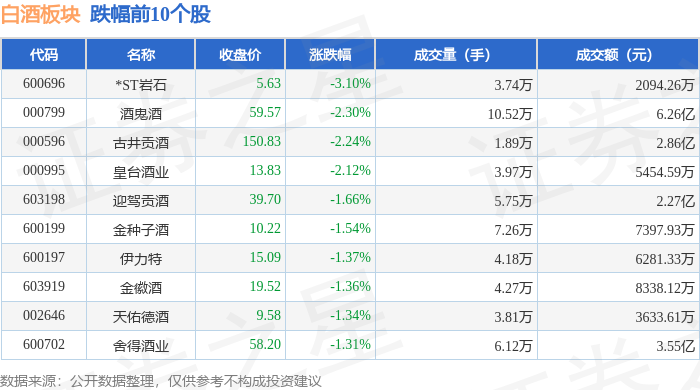
Market Overview - The liquor sector experienced a decline of 0.87% on October 13, with *ST Rock leading the drop [1] - The Shanghai Composite Index closed at 3889.5, down 0.19%, while the Shenzhen Component Index closed at 13231.47, down 0.93% [1] Individual Stock Performance - *ST Rock (600696) closed at 5.63, down 3.10% with a trading volume of 37,400 shares and a turnover of 20.94 million yuan [1] - Other notable declines include: - Si Gu Dian (000799) down 2.30% to 59.57 with a volume of 105,200 shares [1] - Gujing Gongjiu (000596) down 2.24% to 150.83 with a volume of 18,900 shares [1] - Huangtai Liquor (000995) down 2.12% to 13.83 with a volume of 39,700 shares [1] Capital Flow Analysis - The liquor sector saw a net outflow of 1.133 billion yuan from main funds, while retail funds had a net inflow of 579 million yuan [1] - The table of capital flow indicates that major stocks like Kweichow Moutai (6150009) had a net outflow of 4.91 million yuan, while retail investors contributed a net inflow of 29,500 yuan [2] - Luzhou Laojiao (000568) experienced a net outflow of 1.74 million yuan from main funds but saw a retail net inflow of 8.366 million yuan [2]



20只白酒股下跌 贵州茅台1419.20元/股收盘
Bei Jing Shang Bao· 2025-10-13 10:01
Core Viewpoint - The three major indices in the Chinese stock market experienced a collective decline on October 13, with the Shanghai Composite Index closing at 3889.50 points, down 0.19% [1] Group 1: Market Performance - The liquor sector index closed at 2236.49 points, down 0.75%, with 20 liquor stocks declining [1] - Notable individual stock performances include: - Kweichow Moutai (600519) closed at 1419.20 CNY, down 0.76% [1] - Wuliangye (000858) closed at 119.85 CNY, down 0.73% [1] - Shanxi Fenjiu (600809) closed at 186.99 CNY, down 0.91% [1] - Luzhou Laojiao (000568) closed at 127.30 CNY, down 1.22% [1] - Yanghe Brewery (002304) closed at 66.98 CNY, down 0.99% [1] Group 2: Industry Insights - Huatai Securities reported that the demand from government and business sectors still needs recovery, while the demand for public banquets remains stable [1] - The report indicates that the decline in liquor sales has gradually narrowed since August, with recovery observed in consumption scenarios such as graduation banquets, weddings, and the Mid-Autumn Festival gatherings [1] - Products priced below 300 CNY are showing relatively better recovery performance [1]


食品饮料行业周报(2025.10.06-2025.10.11):白酒国庆期间动销普遍环比改善,宴席需求相对稳定,大众价格带动销更优-20251013
China Post Securities· 2025-10-13 09:44
Industry Investment Rating - The investment rating for the food and beverage industry is "Outperform the Market" and is maintained [1] Core Viewpoints - The performance of the liquor sector improved during the National Day holiday, with stable demand for banquets and better sales in the mass price range. The high-end and mid-low price segments performed relatively well, while the sub-high-end segment faced pressure. Overall, the performance aligns with market expectations, indicating a gradual bottoming out in sales and performance for liquor companies [3][13] - The food and beverage sector index (801120.SL) experienced a slight decline of -0.15% this week, ranking 18th among 30 first-level industries, outperforming the CSI 300 index by 0.36 percentage points. The current dynamic PE for the industry is 21.51 [7][16] Summary by Relevant Sections Weekly Observation - The liquor sales during the National Day holiday showed a general improvement compared to previous months, with stable banquet demand. Top brands like Moutai maintained prices above 1800 RMB, while second and third-tier brands faced price adjustments and inventory pressures. The overall performance is consistent with capital market expectations, indicating a gradual recovery phase for liquor companies [3][13] Industry Performance - The food and beverage sector saw a mixed performance, with 10 sub-sectors, excluding other alcoholic beverages and liquor, showing increases. The highest gain was in soft drinks, which rose by 4.86% [7][16] Key Company Announcements - Wuliangye announced a stock buyback plan, acquiring 6,273,266 shares, representing 0.16% of its total shares, for a total amount of approximately 800 million RMB [22] - Jinsiyuan reported a significant revenue decline of nearly 30% in Q2, aligning with market sales trends [22] Important Industry News - The liquor industry is undergoing a transformation characterized by slower sales, channel restructuring, and increased differentiation, laying the groundwork for long-term development [25]
白酒板块午盘下跌 贵州茅台微跌0.98%
Bei Jing Shang Bao· 2025-10-13 06:25
Core Viewpoint - The stock market experienced a decline, with major indices dropping over 1%, particularly affecting the liquor sector, which saw a notable decrease in share prices of key companies [1] Industry Summary - The liquor sector index closed at 2224.57 points, down 1.28%, with 20 liquor stocks declining [1] - High-end liquor demand is showing weak recovery during the peak season, while mass-market liquor sales are performing better than the industry average [1] - The next-highest price segment is under pressure, with significant differentiation in performance among brands [1] - Current industry inventory levels are stabilizing, and some liquor companies are reducing inventory to alleviate operational pressure [1] - The outlook suggests that leading liquor companies are focusing on long-term healthy development, with fundamentals stabilizing and consumption promotion policies supporting gradual recovery in the industry [1] Company Summary - Guizhou Moutai closed at 1415.93 CNY per share, down 0.98% [1] - Wuliangye closed at 119.64 CNY per share, down 0.90% [1] - Shanxi Fenjiu closed at 187.00 CNY per share, down 0.90% [1] - Luzhou Laojiao closed at 126.90 CNY per share, down 1.53% [1] - Yanghe Brewery closed at 66.91 CNY per share, down 1.09% [1]
中秋旺季也没救起来!茅台跌破1800元,白酒为啥割不动年轻人了?
Sou Hu Cai Jing· 2025-10-13 05:31
Core Viewpoint - The white liquor industry, particularly Moutai, is experiencing a significant downturn, with prices dropping and sales declining, primarily due to changing consumer preferences among younger demographics [1][5][39] Group 1: Price and Sales Trends - Moutai's wholesale price has fallen to 1770 yuan, breaking the psychological barrier of 1800 yuan, marking the lowest price in years [1][3] - The overall white liquor industry is facing a decline, with profits of major companies down by 10.93% in the first half of 2025, and 13 out of 19 listed companies reporting revenue decreases [5][18] - In August, the monthly production of white liquor decreased by 18.2% compared to the same period last year, leading to increased inventory levels [5][18] Group 2: Challenges for Smaller Enterprises - Smaller liquor companies are struggling, with Yanghe's revenue and profit dropping over 30% in Q1, and Kuozi's revenue halving in Q2 [7][18] - More than half of liquor companies are reportedly selling at a loss, with many retailers experiencing stagnant sales [7][18] Group 3: Changing Consumer Preferences - Younger consumers, aged 18 to 30, represent a potential market of 490 million but only account for 18% of white liquor consumption among the post-95 generation [9][11] - A significant 83% of young drinkers prefer beverages with an alcohol content below 20 degrees, indicating a shift away from traditional high-alcohol white liquor [9][11] - The traditional drinking culture associated with white liquor, often linked to formal occasions and social pressures, is seen as unappealing by younger consumers [11][13] Group 4: Industry Overproduction and Distribution Issues - The white liquor industry has overproduced, with Moutai's production increasing from 39,300 tons in 2016 to 56,300 tons in 2024, leading to excess inventory [18][20] - The rise of direct sales channels and online platforms has disrupted traditional distribution methods, making it difficult for distributors to maintain profitability [20][23] Group 5: Industry Adaptation and Future Outlook - In response to market challenges, companies are developing low-alcohol products, with the low-alcohol market projected to grow significantly [27][39] - The industry is also shifting towards online sales and instant retail, with 34.9% of companies prioritizing these channels [33] - The upcoming national standards for liquor production aim to stabilize quality and adapt to changing consumer demands, potentially revitalizing the industry [31][39]
白酒巨头竞相“上车”即时零售,千亿风口下的效率革命与渠道博弈
Qi Lu Wan Bao· 2025-10-13 02:46
Group 1 - Instant retail is significantly transforming the consumption landscape of liquor, particularly in the white liquor segment, with a competitive landscape formed by various models including comprehensive e-commerce platforms and niche platforms [1] - Major e-commerce giants dominate the market, with Meituan's flash purchase achieving a phenomenal performance during the "618" shopping festival, where the transaction volume of white liquor surged over 90 times within 20 hours, and daily order peaks exceeded 150 million [1] - JD's liquor platform has achieved "29-minute delivery" across its logistics network, while new player Taobao Flash Purchase has seen rapid growth, with white liquor sales increasing by 172% since its launch in May [1] Group 2 - 2025 is projected to be a pivotal year for white liquor companies as they transition from passive cooperation to actively engaging in instant retail, with industry leader Kweichow Moutai initiating deep collaborations with Taobao Flash Purchase and launching over 1,000 official stores offering "30-minute delivery" [2] - Other brands like Guotai Liquor and Nuodai Shede have also announced strategic partnerships with instant retail platforms, while Meituan Flash Purchase has launched the industry's first "full-chain authenticity system" in collaboration with major brands to address online trust issues [2] - Companies like Luzhou Laojiao are also launching their own instant retail services or deepening partnerships with platforms [2] Group 3 - The rapid channel revolution poses multiple risks, primarily the collapse of the pricing system, as e-commerce platforms use premium liquor as loss leaders, leading to significant price cuts that pressure traditional distribution channels [3] - Mid-range brands face even greater pressure, and traditional distributors are concerned about becoming mere "delivery tools" for platforms, with high platform fees and complex traffic rules squeezing their profits [3] - Trust and experience remain shortcomings in online channels, as the social, tasting, and collectible attributes of high-end liquor cannot be fully satisfied online, and counterfeit risks are a major concern for consumers [3] - Industry analysis suggests that while instant retail is a necessary response to changing consumer behavior, the ultimate goal should not be a zero-sum game between platforms and traditional channels, but rather finding a balance that protects pricing integrity and distributor interests [3]
白酒的黄金时代,结束了
Sou Hu Cai Jing· 2025-10-13 02:29
Core Insights - The price of Feitian Moutai has dropped below 2000 yuan, halving from its peak in 2021, indicating a significant revaluation of the brand previously regarded as "China's gold" [2] - A large number of liquor distributors are exiting the market, with some reporting near-zero sales, highlighting a critical turning point for the industry [2][4] - The current inventory of Feitian Moutai in circulation exceeds the total of the past three years, exacerbated by low-price dumping on e-commerce platforms [2][4] Industry Transformation - The introduction of the revised "Regulations on Strict Economy and Opposition to Waste" in May 2025, which restricts alcohol at official receptions, is seen as a significant blow to the industry [3] - Despite the policy's limited impact on Moutai's overall consumption, the market sentiment has shifted dramatically, leading to a sustained decline in stock prices across major liquor brands [4] - The average inventory turnover days in the industry have reached 900 days, a 10% increase year-on-year, with inventory levels rising by 25% [6] Consumer Behavior Changes - Consumers are becoming more rational, moving away from the blind pursuit of high-end liquor as an investment [5] - The traditional consumer base of business and management professionals, which once accounted for 85.1% of liquor consumption, is being replaced by younger demographics [8] - The share of white liquor in business banquets has dropped below 50% for the first time, with lighter social beverages like coffee and tea gaining popularity [11] Market Dynamics - The market for mid-range liquor priced between 300-800 yuan is growing rapidly, now accounting for 35% of the market [4] - The low-end liquor market is projected to exceed 200 billion yuan by 2025, with high-line low-alcohol products experiencing growth rates over 40% [6] - The competition in the low-alcohol segment is intensifying, with established brands and new entrants vying for market share [16] Strategic Shifts - Liquor companies are actively seeking new directions, focusing on low-alcohol and bottled liquor as key growth areas [15] - A significant portion of companies (64.9%) are concentrating resources on core products, while 33.3% are developing new products [18] - The industry is entering a new phase characterized by policy adjustments, structural transformations, and intensified competition [19]