
易方达基金

Search documents
从“重规模”转向“重回报” 公募基金讲述高质量发展叙事
Zheng Quan Ri Bao· 2025-12-22 16:17
Core Insights - The public fund industry is transitioning towards high-quality development, with a focus on performance over scale, as evidenced by regulatory reforms and market dynamics [1][2][3] Group 1: Industry Transformation - Regulatory bodies have introduced a series of new rules aimed at shifting the focus from "scale" to "returns," including a floating management fee mechanism linked to fund performance [2] - The investment process is being standardized to prevent "style drift," ensuring that performance benchmarks are clear and consistent [2][3] - The fee structure is being adjusted to lower costs for investors, with measures to reduce subscription and service fees, thereby enhancing overall returns [3] Group 2: Fund Size and Growth - The total size of the public fund industry is approaching 37 trillion yuan, reflecting robust growth and resilience [4] - Equity funds continue to play a crucial role, serving as a primary tool for investors to engage with the equity market and benefit from economic transitions [4] - Fixed-income products are maintaining stability, complementing equity funds and enhancing portfolio risk management [4] Group 3: ETF Market Expansion - The ETF market has seen significant growth, with total assets increasing from 3.73 trillion yuan to 5.83 trillion yuan, marking a 56% increase [7] - The diversity of ETF products has expanded, with bond ETFs and cross-border ETFs gaining traction, indicating a shift towards more sophisticated investment options [7][8] Group 4: Performance of Equity Funds - Equity funds have shown strong performance, with many achieving net value growth rates exceeding 200%, driven by themes like technology and consumer recovery [9][10] - The issuance of new equity funds has surged, with over 1.16 trillion yuan raised, reversing previous trends dominated by bond funds [10] Group 5: Technological Investment Trends - The focus on technology investments, particularly in AI, has become a defining theme, with several funds achieving over 100% net value growth [11][12] - The rise of technology-themed funds has led to increased investor interest and significant fundraising success [11] Group 6: Personal Pension Products - The personal pension fund market has expanded significantly, with over 302 products available and a 65% increase in management scale [13] - Investment returns for personal pension funds have improved, with over 90% of products showing positive net value growth since inception [13] Group 7: Fund Distribution and Dividends - The public fund industry has experienced a "dividend harvest" year, with total dividends exceeding 230 billion yuan, reflecting a shift towards enhancing investor returns [15][16] - Fixed-income funds have been the primary contributors to dividends, while equity funds have also seen significant increases in dividend payouts [15] Group 8: REITs Market Development - The public REITs market has seen substantial growth, with 78 products listed and a total market value exceeding 210 billion yuan [17][18] - The diversity of underlying assets in REITs has increased, with new categories being introduced to enhance market depth [17] Group 9: International Expansion - The public fund industry is accelerating its international presence, with over 20 subsidiaries established abroad and significant QDII investment quotas approved [20] - This expansion reflects a strategic move towards global asset allocation and product innovation, enhancing the industry's competitive edge [20]
年内ETF发行数量份额均创历史新高
Zheng Quan Ri Bao· 2025-12-22 16:13
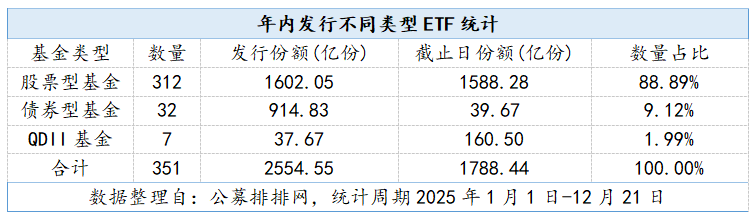
融智投资FOF基金经理李春瑜对《证券日报》记者表示:"这是多种因素共同推动的结果。其一,政策 支持力度持续加大,ETF产品审批流程不断优化;同时,指数化投资的理念日益普及,再加上市场整体 回暖带来的赚钱效应,都促使越来越多的资金流入ETF市场。其二,作为一种投资工具,ETF产品本身 就具备费率低、风险分散、交易便捷、透明度高等特点,因此无论对机构还是个人投资者,都展现出持 续吸引力。其三,ETF产品种类不断丰富,逐步向行业主题、跨境资产、债券等多元化方向拓展,更好 地满足了不同投资者的配置需求。其四,随着长期资金的持续流入,头部ETF产品的规模和流动性进一 步放大,形成'强者恒强'的良性循环,吸引更多资金跟随入场。" 今年以来,ETF市场产品发行火热。 公募排排网最新统计数据显示,按认购起始日统计,截至12月21日,年内新发行的ETF产品数量多达 351只,发行总份额高达2554.55亿份。这组数据刷新了历史纪录,也反映出随着A股市场投资生态的演 进,以及居民资产配置结构的变迁,ETF市场正迎来爆发式增长。 对于科技类ETF产品的"吸金力"较强,李春瑜认为,此类产品紧密契合新质生产力发展方向,重点布局 了人工 ...
年内ETF发行创新高,QDII型超募4倍
Guo Ji Jin Rong Bao· 2025-12-22 14:14
Core Insights - The ETF market is experiencing explosive growth in 2025, with a record issuance of 351 products and a total issuance volume of 2,554.55 billion shares, surpassing the total issuance of the previous two years [1][2]. Group 1: ETF Market Overview - The total number of ETFs issued in 2025 reached 351, with a total issuance volume of 2,554.55 billion shares, marking a historical high [1]. - The issuance of stock ETFs is the primary driver, with 312 products issued, accounting for 88.89% of the total number of ETFs and 62.71% of the total issuance volume [2]. - Bond ETFs also saw significant growth, with 32 new products issued and a total issuance volume of 914.83 billion shares, exceeding historical totals [3]. Group 2: Performance of Different ETF Types - The total shares of bond ETFs reached 39.67 billion, marking a new high, and representing over three times the total from the past four years [3]. - QDII ETFs, although fewer in number with only 7 products issued, experienced substantial growth in issuance volume, reaching 37.67 billion shares, with a final share count of 160.50 billion, indicating strong demand for global asset allocation [3]. Group 3: Issuing Institutions - A total of 47 public fund institutions participated in ETF issuance, with 31 institutions issuing at least 2 products and 15 institutions issuing more than 10 products [3]. - E Fund led the market with 31 products and an issuance volume of 172.41 billion shares, followed by Fuguo Fund with 26 products and 160.12 billion shares [4]. Group 4: Market Dynamics and Trends - The market is characterized by a significant over-subscription phenomenon, with 6 institutions experiencing notable over-subscription, reflecting strong market recognition of quality ETF products [4]. - Factors such as policy support, expedited approval processes, and the popularity of index investing have contributed to the dual breakthroughs in issuance scale and product quantity in 2025 [4]. - The core advantages of ETFs, including low fees, risk diversification, and high transparency, continue to attract both institutional and individual investors [4].

红利板块今日承压,红利低波动ETF(563020)、恒生红利低波ETF(159545)等受资金关注
Sou Hu Cai Jing· 2025-12-22 11:41
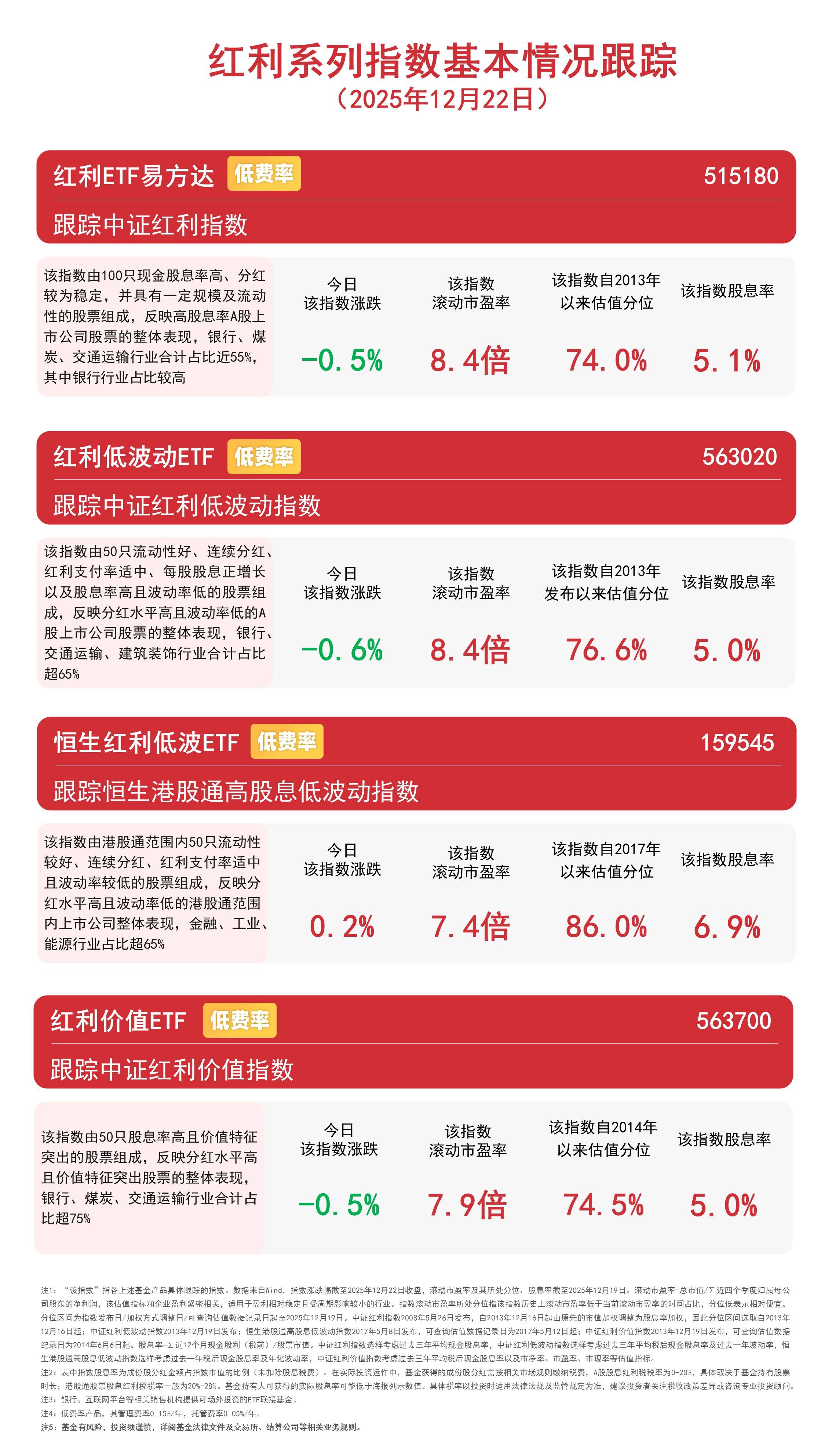
Group 1 - The market experienced fluctuations today, with the technology sector leading gains while the dividend sector faced pressure. The Hang Seng High Dividend Low Volatility Index rose by 0.2%, while the CSI Dividend Index and CSI Dividend Value Index fell by 0.5% and 0.6% respectively [1][4][5] - The dividend low volatility ETFs attracted significant capital, with the Wind data showing that the Dividend Low Volatility ETF (563020) and the Hang Seng Dividend Low Volatility ETF (159545) raised 440 million yuan and 190 million yuan respectively last week [1] - E Fund is currently the only fund company that implements low fee rates for all its dividend ETFs, with management fees set at 0.15% per year for products including the Hang Seng Dividend Low Volatility ETF (159545), Dividend ETF E Fund (515180), Dividend Low Volatility ETF (563020), Dividend Value ETF (563700), and A500 Dividend Low Volatility ETF (563510) [1] Group 2 - The index consists of 50 stocks that have good liquidity, continuous dividends, moderate dividend payout ratios, positive growth in earnings per share, and low volatility, reflecting the overall performance of A-share listed companies with high dividend levels and low volatility. The banking, transportation, and construction industries account for over 65% of the index [3] - The Hang Seng Dividend Low Volatility ETF tracks the Hang Seng High Dividend Low Volatility Index, which is composed of 50 stocks within the Hong Kong Stock Connect that have good liquidity, continuous dividends, moderate dividend payout ratios, and low volatility, reflecting the overall performance of high dividend and low volatility stocks in the Hong Kong Stock Connect. The financial, industrial, and energy sectors account for over 65% of this index [7]
焕然“E”新!近六万亿市场,大变样!
券商中国· 2025-12-22 09:54
Core Viewpoint - The article discusses the rapid evolution of the ETF market in China, highlighting a shift from scale expansion to quality enhancement in index investment, marking 2025 as a pivotal year for high-quality development in the capital market [2]. Group 1: Market Transformation - The release of the "Action Plan for Promoting High-Quality Development of Index Investment in Capital Markets" has initiated a significant transformation in the index investment sector, focusing on optimizing resource allocation and enhancing the quality of listed companies [2][3]. - By 2025, index investment is expected to demonstrate strategic value in five core areas: optimizing resource allocation, improving the quality of listed companies, serving wealth management, guiding long-term capital into the market, and maintaining market stability [2]. Group 2: Institutional Support and Innovation - The implementation of the "Action Plan" provides dual support through institutional guarantees and innovation engines, enhancing the efficiency of ETF registration and issuance processes [3]. - The China Securities Regulatory Commission has streamlined the ETF registration process, allowing fund managers to apply directly for registration, significantly reducing the time required for ETF product approval [3]. Group 3: Product Development and Cost Reduction - A variety of new ETFs have been launched this year, including those focused on hard technology and high-end manufacturing, with efforts to lower investment costs by waiving certain fees associated with ETF operations [4][5]. - The introduction of innovative tools such as ESG indices and Smart Beta strategy indices caters to diverse investor needs, enhancing the vibrancy of the industry [4]. Group 4: Growth of ETF Adoption - The total market size of listed ETFs reached 5.83 trillion yuan, an increase of 2.09 trillion yuan or 56% from the beginning of the year, indicating a growing channel for attracting household wealth [5]. - The proportion of individual investors holding ETFs has been steadily increasing, with ETFs becoming a core component of their investment strategies [5]. Group 5: Enhanced Clarity and Naming Standards - Fund companies have begun to rename their ETFs for clearer identification, aligning with new naming regulations that emphasize the core characteristics of the products [6]. - The revised naming conventions aim to improve product recognition and enhance investment decision-making efficiency [6]. Group 6: Diversification and Thematic Focus - The variety of ETF products has expanded, with a notable increase in narrow-based and thematic ETFs, reflecting a trend towards more specialized investment options [7]. - The focus on specific sectors, such as consumer goods and technology, allows for more precise investment strategies that align with market demands [8]. Group 7: Role of ETFs in Asset Allocation - ETFs are increasingly replacing actively managed equity funds in FOF portfolios, indicating a shift towards quality-focused asset management [9]. - The growth of ETFs is seen as a critical support for the transition of the wealth management industry from product sales to asset allocation [9]. Group 8: Contribution to Market Stability - The development of ETFs has attracted long-term capital, including pension funds and social security funds, which play a vital role in maintaining market stability [9]. - The involvement of state-owned entities in ETF investments has been significant, contributing to the stabilization of the capital market [9]. Group 9: Focus on New Quality Production - ETFs have evolved into essential infrastructure for high-quality development in the capital market, directing capital towards emerging industries such as AI and biotechnology [10]. - The inclusion of high-quality companies in indices is expected to enhance the long-term investment value for investors [11].

易方达基金林伟斌谈如何使用风格因子指数构建投资组合
Zheng Quan Ri Bao Wang· 2025-12-22 09:47
Core Insights - The article discusses the increasing importance of index investment strategies and how to build a robust allocation framework amid style rotation, as highlighted by Lin Weibin, General Manager of the Index Investment Department at E Fund [1] Group 1: Industry Trends - Lin Weibin predicts that the next decade will be a golden period for ETF development in China, estimating that if the total market capitalization of A-shares achieves a 5% annual growth rate, it could reach 200 trillion yuan by 2035 [1] - He references the U.S. market's 10% ETF penetration rate, suggesting that the scale of stock ETFs in China could exceed 20 trillion yuan, and with contributions from bonds, gold, and commodities, the overall ETF market could reach 30 trillion yuan, positioning it among the global leaders [1] Group 2: Style Factors and Investment Logic - Lin Weibin defines style factors as a middle ground between active and purely passive investment, aligning with the Smart Beta concept in overseas markets, which aims to achieve excess returns through clear, rule-based stock selection logic [1] - He emphasizes that the main domestic style factors include dividend, low volatility, growth, value, and quality [2] Group 3: Practical Application of Style Factors - For single-factor usage, Lin suggests optimizing stock selection logic, such as avoiding the value trap by excluding stocks with unstable or negative ROE, and focusing on high dividend and free cash flow indicators [2] - In multi-factor portfolio configuration, he recommends a "constant proportion rebalancing" strategy, such as a 60% value and 40% growth mix, to outperform the CSI 300 index through regular adjustments [2] Group 4: Future of Index Investment - Lin asserts that index investment is not a "fool's investment," as it involves complex stock selection logic and asset allocation strategies [3] - He believes that China's capital market has entered a high-quality development phase for index investment, with participants evolving from simple beta investments to more complex factor investing and multi-asset allocations, further enhanced by AI technology [3]
上证科创板100指数ETF今日合计成交额11.61亿元,环比增加43.62%
Zheng Quan Shi Bao Wang· 2025-12-22 09:43
Core Viewpoint - The trading volume of the Shanghai Stock Exchange Science and Technology Innovation Board 100 Index ETF reached 1.161 billion yuan today, showing a significant increase of 353 million yuan or 43.62% compared to the previous trading day [1] Trading Volume Summary - The Kexin 100 ETF Fund (588220) had a trading volume of 469 million yuan, an increase of 263 million yuan or 128.08% from the previous day [1] - The Bosera Kexin 100 ETF (588030) recorded a trading volume of 182 million yuan, up by 53.48 million yuan or 41.76% [1] - The Huaxia Shanghai Stock Exchange Science and Technology Innovation Board 100 ETF (588800) saw a trading volume of 308 million yuan, increasing by 16.67 million yuan or 5.73% [1] - The Fuguo Shanghai Stock Exchange Science and Technology Innovation Board 100 ETF (589950) and the E Fund Shanghai Stock Exchange Science and Technology Innovation Board 100 ETF (588210) had the highest increases in trading volume, with rises of 230.96% and 171.52% respectively [1] Market Performance Summary - As of market close, the Shanghai Stock Exchange Science and Technology Innovation Board 100 Index (000698) rose by 1.43%, with related ETFs averaging an increase of 1.42% [1] - The top-performing ETFs included the Huatai-PineBridge Shanghai Stock Exchange Science and Technology Innovation Board 100 ETF (589980) and the E Fund Shanghai Stock Exchange Science and Technology Innovation Board 100 Enhanced Strategy ETF (588500), which increased by 1.65% and 1.54% respectively [1]
年内ETF发行超2500亿份创新高 股票ETF为发行主力军
Zheng Quan Shi Bao Wang· 2025-12-22 09:16
Core Insights - The ETF market has experienced significant growth in 2025, with a total of 351 new ETF products issued, reaching an issuance volume of 2,554.55 billion units, surpassing the total issuance of the previous two years [1] - Equity ETFs dominate the market, with 312 equity-type ETFs issued, accounting for 88.89% of the total number and 62.71% of the total issuance volume [1] - Bond ETFs also saw a record year in 2025, with 32 new products issued and a total issuance volume of 914.83 billion units, exceeding historical totals [1] Market Dynamics - The growth in ETF issuance is driven by policy support, expedited approval processes, and the increasing popularity of index investing, alongside a market recovery that has created a profit incentive [2] - ETFs are attracting both institutional and individual investors due to their low fees, risk diversification, ease of trading, and high transparency [2] - The product line is diversifying into niche sectors, cross-border investments, and bonds, catering to various asset allocation needs of different investors [2] Sector Trends - Technology-themed ETFs have become the most sought-after products in 2025, with 47 new ETFs issued that include "technology" in their names, representing 13.39% of total issuance and 26.04% of total issuance volume [2] - The growth of technology ETFs is supported by favorable policies and clear industry trends, particularly in AI, semiconductors, and computing power, enhancing the certainty of industry growth [3] Issuer Landscape - In 2025, 47 public fund institutions participated in ETF issuance, with 31 institutions issuing at least 2 products and 15 institutions issuing over 10 products [3] - E Fund ranked first with 31 products and an issuance volume of 172.41 billion units, followed by China Universal with 26 products and 160.12 billion units, and Penghua Fund with 25 products and 135.27 billion units [3]
【公募基金】情绪持续修复,仍偏震荡思维——泛固收类公募基金指数跟踪周报(2025.12.15-2025.12.19)
华宝财富魔方· 2025-12-22 09:04
Market Review - The bond market showed signs of recovery last week (December 15-19, 2025), with the 1-year government bond yield decreasing by 3.32 basis points to 1.35%, the 10-year yield down by 0.88 basis points to 1.83%, and the 30-year yield down by 2.35 basis points to 2.23%. There is a noticeable improvement in bullish sentiment across various maturities as negative factors are gradually being digested [3][13] - The U.S. Treasury yields also declined across the board during the same period, with the 1-year yield down by 3 basis points to 3.51%, the 2-year yield down by 4 basis points to 3.48%, and the 10-year yield down by 3 basis points to 4.16%. The release of a non-farm employment report indicated higher-than-expected job creation but also a higher unemployment rate, while a core CPI increase of 2.6% year-on-year suggested a notable cooling of inflation, contributing to the decline in U.S. Treasury yields [13] Public Fund Market Dynamics - The yield of money market funds has continued to decline this year, with the median 7-day annualized yield dropping to 1.24% as of December 16, 2025. Many money market funds have announced purchase limits to protect the interests of existing holders, with some limits as low as 10,000 yuan [4][16] Fund Index Performance Tracking - The Money Enhancement Index rose by 0.03% last week, with a cumulative return of 4.43% since inception [5][18] - The Short-term Bond Fund Index increased by 0.04% last week, with a cumulative return of 4.57% since inception [6][18] - The Mid-to-Long-term Bond Fund Index rose by 0.08% last week, with a cumulative return of 6.77% since inception [7][18] - The Low Volatility Fixed Income + Fund Index increased by 0.22% last week, with a cumulative return of 4.49% since inception [8][18] - The Medium Volatility Fixed Income + Fund Index rose by 0.12% last week, with a cumulative return of 6.25% since inception [9][18] - The High Volatility Fixed Income + Fund Index increased by 0.13% last week, with a cumulative return of 8.00% since inception [10][18] - The Convertible Bond Fund Index rose by 0.01% last week, with a cumulative return of 22.42% since inception [11][18] - The QDII Bond Fund Index increased by 0.05% last week, with a cumulative return of 10.05% since inception [11][18] - The REITs Fund Index fell by 2.22% last week, with a cumulative return of 29.35% since inception [11][18] Fund Index Positioning - The Money Enhancement Strategy Index aims for liquidity management and seeks to outperform money market funds while maintaining a smooth upward curve [19][21] - The Short-term Bond Fund Index focuses on liquidity management while ensuring controlled drawdowns and aims for a smooth upward curve [21][23] - The Mid-to-Long-term Bond Fund Index targets stable returns while controlling drawdowns, selecting funds that balance yield and risk management [23][25] - The Low Volatility Fixed Income + Index targets a 10% equity center and selects funds with a historical equity center within 15% [25][27] - The Medium Volatility Fixed Income + Index targets a 20% equity center and selects funds with a historical equity center between 15% and 25% [27][29] - The High Volatility Fixed Income + Index targets a 30% equity center and selects funds with a historical equity center between 25% and 35% [29][31] - The Convertible Bond Fund Index focuses on funds with a significant allocation to convertible bonds and evaluates based on long-term performance and risk-adjusted returns [31][32] - The QDII Bond Fund Index includes overseas bonds and selects funds based on credit ratings and risk control [32][36] - The REITs Fund Index focuses on mature, stable infrastructure projects with predictable cash flows and selects funds based on operational stability and valuation [36]

MSCI中国A50互联互通(人民币)指数(本币)ETF今日合计成交额1.85亿元,环比增加45.08%
Zheng Quan Shi Bao Wang· 2025-12-22 08:38
Group 1 - The MSCI China A50 Connect (RMB) Index ETF recorded a total trading volume of 185 million yuan today, an increase of 57.5 million yuan compared to the previous trading day, representing a growth rate of 45.08% [1] - Specifically, the E Fund MSCI China A50 Connect ETF (563000) had a trading volume of 56.04 million yuan, up by 32.81 million yuan from the previous day, with a growth rate of 141.26% [1] - The Huaxia MSCI China A50 Connect ETF (159601) saw a trading volume of 55.94 million yuan, an increase of 19.59 million yuan, reflecting a growth rate of 53.91% [1] Group 2 - The average increase for ETFs tracking the MSCI China A50 Connect (RMB) Index was 1.19% at market close, with the top performers being the Fuguo MSCI China A50 Enhanced Strategy ETF (563280) and the Southern MSCI China A50 Connect ETF (159602), which rose by 1.40% and 1.19% respectively [2] - The trading volume changes for December 22 for various ETFs include the E Fund MSCI China A50 Connect ETF (563000) with a 1.14% increase, trading at 56.04 million yuan, and the Huaxia MSCI China A50 Connect ETF (159601) with a 1.05% increase, trading at 55.94 million yuan [2] - The Huatai-PineBridge MSCI China A50 Connect ETF (560050) recorded a trading volume of 67.20 million yuan, with a growth rate of 16.82% [2]