
三环集团

Search documents
三环集团递表港交所 A股IPO+定增累计募资超70亿元
Mei Ri Jing Ji Xin Wen· 2025-12-18 13:19
Core Viewpoint - SanHuan Group has submitted its IPO application to the Hong Kong Stock Exchange, aiming to raise funds for overseas projects, automation, technology innovation, and working capital [1] Group 1: Company Overview - SanHuan Group is a leading provider of advanced electronic ceramic materials and components, claiming to be the largest MLCC supplier in mainland China for 2024, with a global market share of approximately 2% [1][3] - The company has over 55 years of experience in the advanced electronic ceramic materials sector and has developed a product matrix covering electronic materials, electronic components, communication devices, and equipment components [2] - SanHuan Group's revenue for the reporting period was 50.89 billion yuan, 56.82 billion yuan, 72.66 billion yuan, and 64.21 billion yuan, with corresponding profits of 15.06 billion yuan, 15.83 billion yuan, 21.9 billion yuan, and 19.58 billion yuan [3] Group 2: Financial Performance - The company has maintained a stable dividend payout ratio of over 30% over the past three years, with cumulative dividends amounting to approximately 48.04 billion yuan since its A-share listing [5][6] - Revenue from the electronic components segment increased from 16.2% in 2022 to 36.1% in the first three quarters of 2025, while the communication devices segment's revenue share decreased from 42.2% to 30% [2][3] - Operating costs rose significantly, with a 22.12% increase in costs from approximately 31.47 billion yuan to 38.43 billion yuan in the first three quarters of 2025 [4] Group 3: Market Position and Strategy - SanHuan Group is recognized as a top supplier of aluminum oxide ceramic substrates, holding over 50% of the global market share by revenue in 2024 [2] - Despite being the largest MLCC supplier in mainland China, the company ranks ninth globally, indicating a significant gap compared to industry giants [3] - The company plans to use the funds raised from the IPO for overseas expansion and automation projects, despite having substantial cash reserves and a history of high dividends [8]

社保基金连续持仓三年以上的科技股曝光
Xin Lang Cai Jing· 2025-12-17 23:05
Core Insights - The meeting led by Liu Kun emphasized the importance of utilizing long-term funds and patient capital to support national development needs, particularly in the integration of technological and industrial innovation [1] Group 1: Asset Allocation - As of the end of Q3 this year, the market value of technology stocks (TMT sector, including electronics, communications, computers, and media) held by the social security fund exceeded 46.9 billion, marking a historical high for the same period [1] - This represents a significant increase of nearly 61% compared to the end of Q3 last year and more than an 18-fold increase compared to the same period in 2011, indicating strong support for technology stocks by the social security fund [1] Group 2: Long-term Holdings - The social security fund has consistently held positions in six technology stocks, including Zhongnan Media, Zhongyuan Media, Phoenix Media, Yilian Network, Sanhuan Group, and Transsion Holdings, for 24 consecutive quarters, with Transsion Holdings and Yilian Network each having a market value exceeding 1 billion at the end of the period [1] - Additionally, there are 11 other technology stocks that have been held for more than three years, with Pengding Holdings having a market value exceeding 3.2 billion at the end of the period [1] - The long-term holdings of the social security fund in technology stocks can be categorized into two types: industry-leading stocks with high dividend ratios and media stocks with high dividend yields [1]
机器人+商业航天双buff,又一个科技赛道悄悄起风了
3 6 Ke· 2025-12-17 09:53
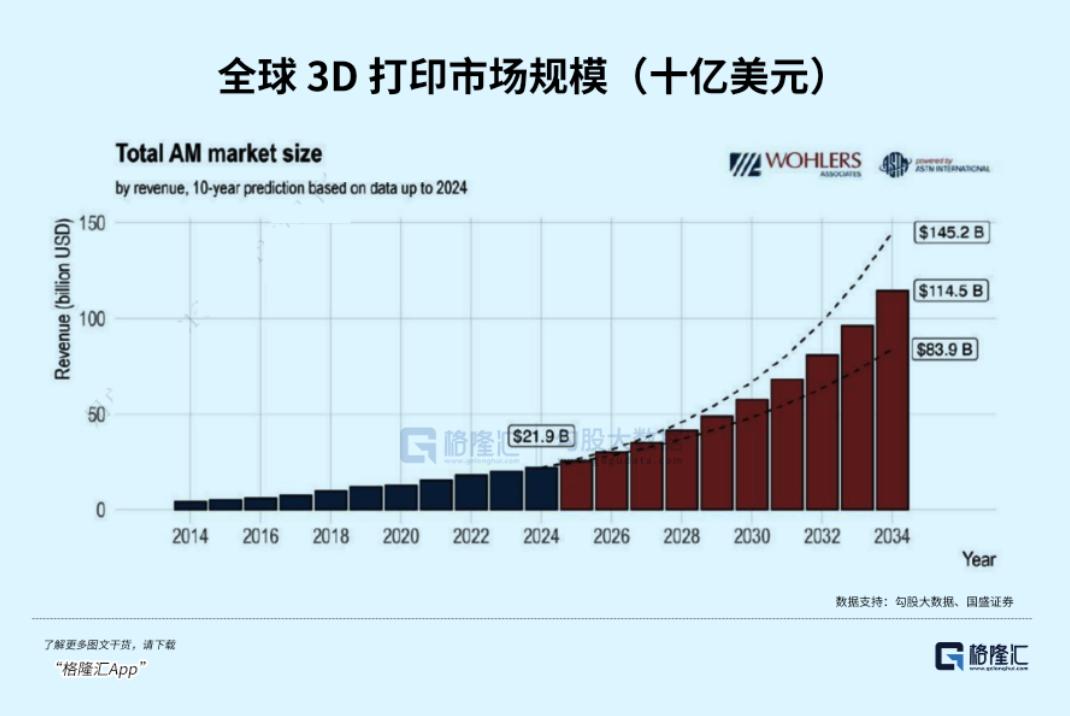
Core Insights - The 3D printing technology has transitioned from experimental stages to becoming a core productivity driver in high-end manufacturing, evidenced by successful applications in aerospace and robotics [1] - The global 3D printing market is projected to reach $21.9 billion in 2024 and is expected to grow to $114.5 billion by 2034, indicating a significant expansion phase [2] - Chinese manufacturers dominate the entry-level equipment market with over 90% market share, supported by rapid technological advancements and cost advantages [4] Market Growth - The 3D printing industry has entered a phase of large-scale expansion, with a notable increase in domestic exports, reaching 3.77 million units valued at 8.9 billion yuan in 2024 [4] - The export volume is expected to exceed 5 million units in 2025, with a potential for export value to surpass 10 billion yuan for the first time [4] Technological Advancements - Significant improvements in SLM metal printing precision and carbon fiber 3D printing have enhanced capabilities for aerospace and automotive applications [5] - AI modeling technology and advancements in consumer-grade 3D printing have made the technology more accessible, reducing operational complexity and costs [5] Application Expansion - The demand for 3D printing in humanoid robotics and commercial aerospace is rapidly increasing, with 3D printing reducing the number of parts in rocket engines by 80% and costs by 90% [6] - The consumer market is also experiencing a surge, with sales of 3D printed toys and custom home goods tripling during major shopping events [8] Investment Opportunities - The industry is poised for growth in 2025, driven by increased orders and capital investment, with three main investment lines identified: core equipment, core materials, and emerging applications [9] - Key players in industrial-grade 3D printing, such as Platinum and Huazhu, are well-positioned to benefit from the growing demand [9] - The domestic production of core materials, such as titanium alloy powders, is becoming increasingly competitive, with significant cost advantages over imports [10] Conclusion - The evolution of 3D printing technology from concept to reality has established it as a core production force, with Chinese companies leading in both consumer and industrial markets [12] - The structural opportunities in the industry, driven by exports and domestic production, warrant close attention from investors [12]


机器人+商业航天双buff,又一个科技赛道悄悄起风了!
Ge Long Hui· 2025-12-17 09:51
Core Insights - The 3D printing technology has transitioned from experimental stages to becoming a core productivity driver in high-end manufacturing, evidenced by successful applications in aerospace and robotics [2] - The global 3D printing market is projected to reach $21.9 billion in 2024 and is expected to grow to $114.5 billion by 2034, indicating a significant expansion phase [2] Market Growth and Domestic Manufacturers - The global 3D printing industry has moved beyond small-scale growth and is now in a phase of large-scale expansion, with Chinese manufacturers capturing over 90% of the entry-level equipment market due to high cost-performance ratios [4] - In 2024, China exported 3.7777 million 3D printing devices worth 8.9 billion yuan, with projections indicating that exports could exceed 5 million units and 10 billion yuan in 2025 [4] Domestic Production and Technological Advancements - The domestic production rate for metal 3D printing equipment has increased from less than 30% five years ago to 60%, while the local supply chain coverage for non-metal materials exceeds 85% [5] - Companies like Plater and Huazhu High-Tech are producing competitive metal 3D printers at prices 30% lower than their Western counterparts, successfully entering supply chains in aerospace and new energy vehicles [6] Technological Improvements and Application Expansion - Significant technological advancements have been made in industrial-grade 3D printing, with SLM metal printing achieving precision of 0.01 mm, suitable for aerospace engine components [7] - The efficiency of 3D printing has improved fivefold over the past three years, with entry-level device prices dropping by 60%, making the technology accessible to consumers and small businesses [7] Application Scenarios and Market Drivers - The demand for 3D printing in humanoid robotics and commercial aerospace is rapidly increasing, with 3D printing reducing the number of parts in rocket engines by 80% and cutting costs by 90% [8] - During the 618 shopping festival, sales of 3D printed toys and customized home goods surged over threefold, indicating a strong awakening of consumer demand [10] Investment Opportunities - The year 2025 is anticipated to be pivotal for 3D printing, with three main investment lines identified: core equipment, core materials, and emerging applications [10] - In the core equipment sector, companies like Plater and Huazhu High-Tech are positioned to benefit from industrial and consumer demand growth [11] - The core materials sector is expected to see further domestic production increases, with companies like Zhonghang Mite and Yuyuan Powder Materials offering competitive products [12] - Emerging applications in humanoid robotics and commercial aerospace are likely to experience significant growth, with companies like LZ Group and Yinbang Co. poised to capitalize on these trends [13]
机器人+商业航天双buff,又一个科技赛道悄悄起风了!
格隆汇APP· 2025-12-17 09:48
Core Insights - The article emphasizes the rapid growth and transformation of the 3D printing industry, highlighting its transition from experimental technology to a core productivity driver in high-end manufacturing [5][6][23]. - The global 3D printing market is projected to reach $21.9 billion in 2024, with expectations to grow to $114.5 billion by 2034 [6]. Market Expansion and Domestic Manufacturers - Chinese manufacturers dominate the entry-level 3D printing equipment market, capturing over 90% of the share due to high cost-performance and rapid technological iteration [10]. - In 2024, China exported 3.7777 million 3D printing devices worth 8.9 billion yuan, with projections for 2025 to exceed 5 million units and 10 billion yuan in export value [10][11]. - The domestic production rate for metal 3D printing equipment has increased from under 30% five years ago to 60%, while non-metal material supply chain coverage exceeds 85% [11]. Technological Advancements and Application Scenarios - Key technological breakthroughs in industrial-grade 3D printing have achieved precision levels of 0.01 mm, meeting aerospace manufacturing requirements [13]. - The cost of titanium alloy powder, a core material for metal printing, has halved from 600 yuan/kg in 2023 to below 300 yuan/kg [14]. - 3D printing is significantly reducing costs and production times in commercial aerospace, with SpaceX's Raptor engine comprising 85% 3D printed components, leading to a 90% cost reduction and a production cycle cut from 6 months to 1 month [14]. Investment Opportunities - The article identifies three main investment lines for 3D printing: 1. **Core Equipment Line**: Benefiting from industrial and consumer demand growth, with companies like Platinum and Huashu High-Tech leading the market [19]. 2. **Core Materials Line**: Focusing on domestic production advantages, with companies like Zhonghang Mite and Youyan Powder Materials providing competitive pricing [20]. 3. **Emerging Applications Line**: Companies in humanoid robotics and commercial aerospace are positioned to benefit directly from increased demand [22]. Conclusion - The 3D printing industry is at a pivotal moment, transitioning from concept to reality, with significant opportunities for investment as domestic companies lead in both consumer and industrial markets [23].

社保基金重仓科技股曝光!近19亿元新进特种芯片龙头,连续6年重仓股仅6只
Zheng Quan Shi Bao Wang· 2025-12-17 05:01
Core Insights - The Social Security Fund's investment in technology stocks has reached a historical high, with a market value exceeding 46.9 billion yuan as of the end of Q3, reflecting a significant increase in preference for technology stocks [1][2]. Group 1: Investment Trends - The Social Security Fund's holdings in the electronics sector reached nearly 27.4 billion yuan, making it the highest among technology sectors, followed by the computer sector with over 7.7 billion yuan [2]. - Year-on-year, the market value of technology stocks held by the Social Security Fund has increased by nearly 61% compared to the end of Q3 last year, and it has grown more than 18 times compared to the same period in 2011 [2]. Group 2: Individual Stock Holdings - Transsion Holdings has the largest holding among the Social Security Fund's investments, with a market value exceeding 4.5 billion yuan [3]. - Other notable stocks with holdings exceeding 1 billion yuan include Pengding Holdings, Focus Media, Unisoc, and Shenzhen South Electronics [4]. Group 3: New Investments - The Social Security Fund's 113 combination and the Basic Pension Insurance Fund's 802 combination have newly invested in Unisoc with 20.93 million shares, amounting to nearly 1.9 billion yuan [5]. - Giant Network was also newly added to the portfolio with 27.84 million shares, valued at over 1.258 billion yuan [6]. Group 4: Long-term Holdings - The Social Security Fund has maintained long-term positions in six technology stocks for over 24 quarters, including Zhongnan Media, Zhongyuan Media, Phoenix Media, Yilian Network, Sanhuan Group, and Transsion Holdings, with each having a market value exceeding 1 billion yuan [7]. - Additionally, 11 technology stocks have been held for over three years, with Pengding Holdings having a market value exceeding 3.2 billion yuan [8]. Group 5: Investment Strategy - The long-term holdings of the Social Security Fund primarily consist of industry-leading stocks with generous dividends and high dividend-yielding media stocks [9].






三环集团港股IPO:前次定增募投项目进度缓慢 广义货币资金近80亿元仍要募资
Xin Lang Cai Jing· 2025-12-17 04:59
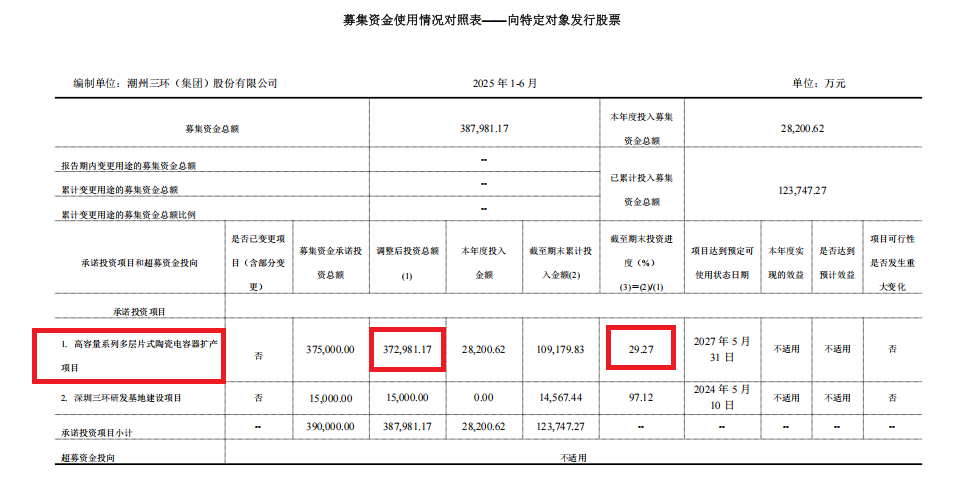
Core Viewpoint - SanHuan Group has submitted its prospectus for an IPO on the Hong Kong Stock Exchange, raising questions about the necessity of this fundraising given its strong financial position and slow progress on previous fundraising projects [1][11]. Financial Position - SanHuan Group has substantial cash reserves, with total monetary funds and trading financial assets amounting to approximately 8 billion yuan, and interest-bearing liabilities of less than 600 million yuan, resulting in an overall debt-to-asset ratio of only 17% [2][3][14]. - As of the end of the third quarter of 2025, the company reported cash and cash equivalents of 5.202 billion yuan and trading financial assets of 2.743 billion yuan, totaling 7.945 billion yuan [3][14]. - The company has raised over 7.4 billion yuan through equity financing since its listing, including 3.88 billion yuan from a recent private placement [2][12]. Previous Fundraising Projects - The previous fundraising project, which raised 3.9 billion yuan in November 2021, has seen slow progress, with only about 30% of the funds utilized over three and a half years, leading to a two-year extension of the project timeline [4][15][18]. - The high-capacity multilayer ceramic capacitor expansion project, which was supposed to be completed by May 2025, has been postponed to May 2027 without clear explanations for the delays [7][18]. Production Capacity and Utilization - SanHuan Group's production capacity is expected to expand by 65% after the completion of the previous fundraising projects, potentially adding 300 billion units per year to its existing capacity of approximately 4.56 trillion units [8][19]. - However, the utilization rates of some core products have remained around 70%, raising concerns about the company's ability to absorb the increased capacity from the new fundraising [10][21]. IPO Fund Utilization - The funds raised from the Hong Kong IPO are intended for overseas expansion projects, automation construction, technological upgrades, and general corporate purposes [13][19]. - The necessity of this IPO is questioned due to the company's current financial health and the slow progress of previous projects, which may indicate that further expansion may not be warranted at this time [1][4][21].
氢能2026年度策略:非电降碳关键载体,蓄势已成、拐点将至
2025-12-17 02:27
Summary of Key Points from Conference Call Industry Overview - The conference call focuses on the hydrogen energy sector, particularly the development of green hydrogen, methanol, and ammonia as key carriers for decarbonization in non-electric fields, driven by China's dual carbon goals [1][3][4]. Core Insights and Arguments - **Policy Support**: There is increasing policy support for green hydrogen and methanol, including subsidies for green methanol projects and direct connections to green electricity to reduce costs [1][4]. - **Demand for Green Methanol**: The demand for green methanol as a shipping fuel is strong, with existing orders for methanol-powered vessels reaching 7 million tons. If the long-term penetration rate reaches 10%, demand could exceed 40 million tons [1][6]. - **Investment Opportunities**: Short-term investment should focus on early market entrants and compliant green methanol producers, while long-term investments should consider scale effects and cost reductions as the industry matures [1][7]. - **Inner Mongolia's Leadership**: Inner Mongolia is a leader in green hydrogen projects, with specific policies encouraging the use of renewable energy and improving efficiency [1][8]. - **European Support**: Europe is supporting green methanol through carbon border adjustment taxes and maritime carbon taxes, ensuring significant short-term demand despite delays in IMO voting [1][8]. Additional Important Content - **Hydrogen Production Equipment**: The market for hydrogen production equipment is expanding, with 9 million tons of green hydrogen projects approved in China, corresponding to a demand for 20-25 GW of electrolyzers [2][13]. - **Investment Logic**: Short-term investments should focus on policy implementation and market entry, while long-term investments should consider industry maturity and broader applications [7][10]. - **Key Companies**: Recommended companies for investment in green methanol include Jin Feng Technology, China Tianying, and others, with specific projects and profit expectations outlined [9][12][22]. - **Future Development Path**: The future of green methanol will focus on electrochemical production, with significant cost reductions expected through direct connections to renewable energy [11][21]. Conclusion - The hydrogen energy sector is poised for significant growth, driven by strong policy support, increasing demand for green methanol, and advancements in hydrogen production technology. Key investment opportunities exist in both production and supporting technologies, with a focus on companies that can effectively navigate the evolving landscape.
英伟达电力大会在即,2026年AI电力出海核心板块逻辑梳理
傅里叶的猫· 2025-12-14 12:37
Core Insights - The article discusses the challenges and opportunities in the U.S. power supply, particularly in the context of AI and energy demands, highlighting the "impossible triangle" of energy policy, economic growth, and AI needs [5][6]. Group 1: Energy Supply Challenges - The U.S. power grid is aging, with an average establishment time of over 40 years, leading to structural issues and a mismatch between supply and demand [5]. - The Biden administration's goal to eliminate 100GW of fossil fuel power generation by 2030 is threatened by the sudden surge in AI energy demands, creating a dilemma for energy policy [5]. - The U.S. power system lacks the capability for large-scale inter-regional energy distribution, unlike China's "West-to-East Power Transmission" [5]. Group 2: AI Power Export Opportunities - The article outlines three main directions for AI power export to North America by 2026: power sources (gas turbines, SOFC), power grid equipment (transformers, large-scale storage), and energy-saving technologies for data centers (SST) [6][19]. - The demand for gas turbines is expected to grow significantly, with an average annual demand of 80-110GW projected from 2026 to 2030, driven by the need for stable and green energy sources [8][9]. Group 3: Gas Turbine Market Dynamics - The supply side of the gas turbine market faces challenges due to complex production processes and a shortage of skilled labor, with an average training period of 1-2 years for workers [8]. - Major gas turbine manufacturers like Siemens Energy, GE, and Mitsubishi Heavy Industries dominate the market, leading to a tight supply situation with orders extending to 2028-2029 [9][10]. Group 4: SOFC and Energy Storage - The demand for SOFC is expected to reach 1.5-2GW by 2026, with a growth rate of over 30-50% annually, driven by major tech companies' procurement needs [14]. - The large-scale storage market in North America is projected to see demand exceed 70-80GWh by 2026, supported by favorable economic returns and declining system costs [17]. Group 5: Data Center Energy Efficiency - SST technology is anticipated to significantly reduce energy consumption and space requirements for data centers, with a projected market space of $25-35 billion by 2027 [19]. - The SST market is expected to see a penetration rate of 15-20% by 2027, with major players including Eaton and emerging domestic manufacturers [19][20].

国金证券:氢能顶层关注度提升 建议把握窗口期布局
智通财经网· 2025-12-12 09:16
Core Insights - The report from Guojin Securities highlights the increasing attention and urgency of hydrogen energy policies at the national level, marking a significant shift from the 14th Five-Year Plan to the 15th Five-Year Plan, with a focus on decarbonization in non-electric sectors and the essential role of hydrogen, ammonia, and methanol as energy carriers [1] Green Methanol - Global demand for green methanol is expected to surge, driven by the EU carbon tax and IMO policies promoting green shipping, with 334 methanol-powered vessels projected to create over 7 million tons of methanol demand [1] - Long-term projections indicate that when global green methanol penetration reaches 10%, demand could exceed 40 million tons, presenting significant investment opportunities for early production and cost-effective green methanol producers [1] Hydrogen Production Equipment - The economic viability of green hydrogen production is becoming clearer, with projects showing an internal rate of return (IRR) exceeding 6.5%, making previously stalled green hydrogen projects feasible [2] - Direct connection to renewable electricity and cost reductions in hydrogen production are expected to enhance demand across various sectors, including transportation and industrial applications [2] Fuel Cell Vehicles - The development path for fuel cell vehicles is now clearer, with infrastructure improvements and cost reductions leading to increased adoption, particularly in heavy-duty applications [3] - The removal of highway fees for fuel cell vehicles is anticipated to enhance their economic viability, contributing to a recovery in the sector's overall performance [3] Solid Oxide Fuel Cells (SOFC) - The demand for SOFCs is expected to grow due to the increasing power needs of AI data centers, with SOFCs offering advantages such as short installation times and high efficiency [4] - The projected cost of SOFC power generation could decrease to $0.09 per kWh due to tax incentives, making it competitive with gas turbines [5] Investment Recommendations - The hydrogen industry is still in its commercialization phase, driven by policy support, with recommendations to focus on companies that can leverage domestic and international demand [6] - Key companies to consider include Jin Feng Technology, Huadian Technology, Guofu Hydrogen Energy, and Sanhuan Group, particularly those with early production capabilities and strong sales channels in green methanol [6]
