步步高

Search documents
铜价飙涨35%,全球进入抢铜狂潮,机构看涨至1.5万美元
2 1 Shi Ji Jing Ji Bao Dao· 2025-12-17 13:19
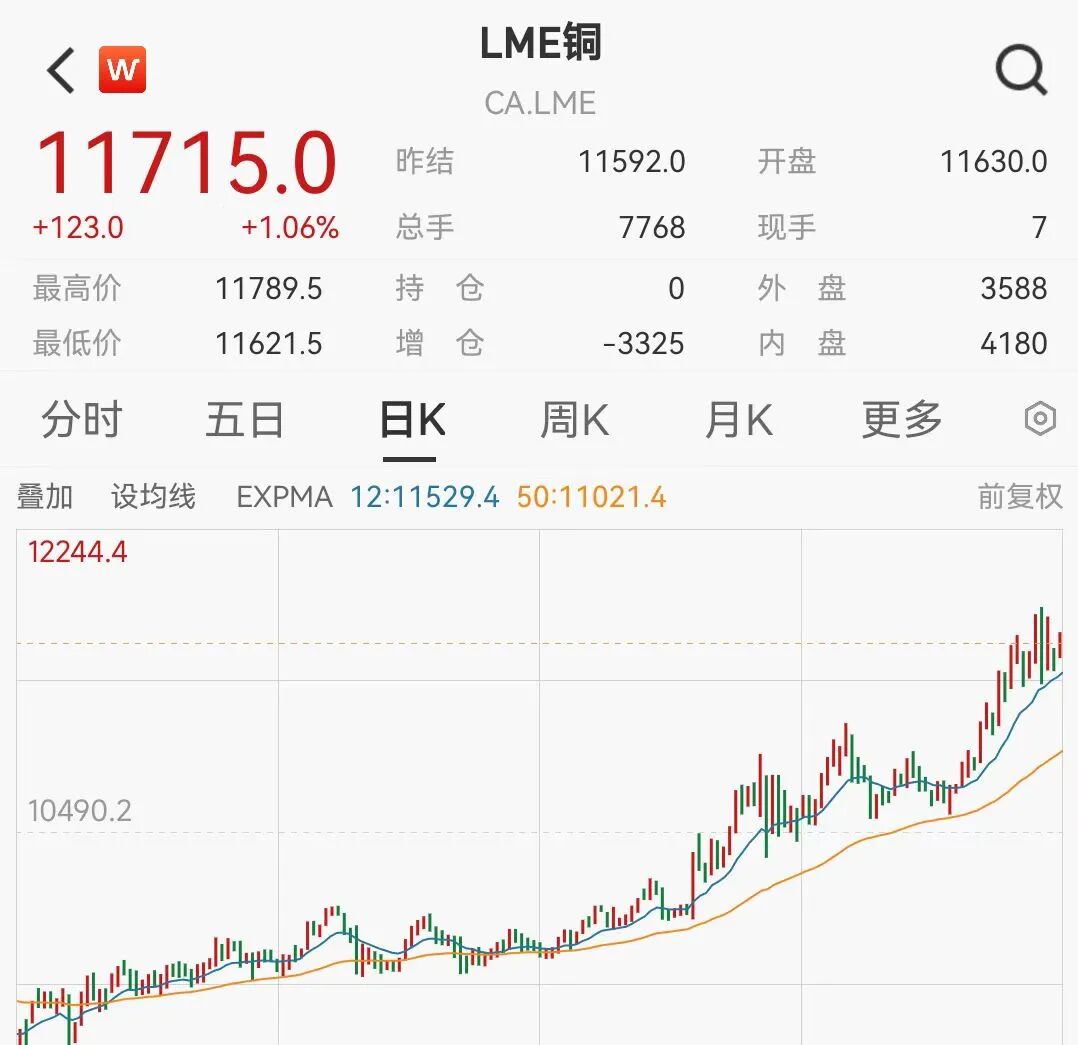
近期,铜市场迎来新一波上涨。 伦敦金属交易所(LME)三个月期铜的走势可谓芝麻开花节节高,12月12日盘中一度触及11952美元/吨的历史新高。此后,铜价高位震荡,截至12月17日20 时LME铜价达到11715美元/吨。与此同时,沪铜主连当日上涨0.4%,收报92820元/吨。 | W | | LME铜 | | | | | | --- | --- | --- | --- | --- | --- | --- | | | | CA.LME | | | | | | 11715.0 | | 昨结 | 11592.0 | 开盘 | | 11630.0 | | +123.0 +1.06% | | 总手 | 7768 | 现手 | | 7 | | 最高价 11789.5 | | 持 仓 | 0 | 2 | | 3588 | | 最低价 11621.5 | | 壇 仓 | -3325 | 内 | | 4180 | | 分时 | 目K 五日 | | 周K | 月K | 更多 | | | 叠加 设均线 | EXPMA 12:11529.4 50:11021.4 | | | | | 前复权 | | 12244.4 | | | | ...

众泰汽车(000980.SZ):与奇瑞及步步高没有合作
Ge Long Hui· 2025-12-17 13:12
Core Viewpoint - Zhongtai Automobile (000980.SZ) has confirmed that it currently has no cooperation with Chery and BBK, and will fulfill information disclosure obligations in accordance with relevant laws and regulations if any cooperation arises [1] Group 1 - Zhongtai Automobile is actively engaging with its stakeholders through an interactive platform to provide updates on its business partnerships [1] - The company emphasizes its commitment to transparency and compliance with legal requirements regarding information disclosure [1]

23.13亿元主力资金今日撤离商贸零售板块
Zheng Quan Shi Bao Wang· 2025-12-17 09:47
Market Overview - The Shanghai Composite Index rose by 1.19% on December 17, with 28 out of the 31 sectors experiencing gains, led by the communication and non-ferrous metals sectors, which increased by 5.07% and 3.03% respectively [1] - The retail sector saw a modest increase of 0.18%, while the agriculture, forestry, animal husbandry, and fishery, defense, and coal sectors faced declines of 0.54%, 0.20%, and 0.11% respectively [1] Capital Flow - The net inflow of capital in the two markets reached 9.51 billion yuan, with 16 sectors experiencing net inflows. The communication sector led with a net inflow of 6.449 billion yuan, coinciding with its 5.07% increase [1] - The electronics sector followed with a daily increase of 2.48% and a net inflow of 6.340 billion yuan [1] - Conversely, 15 sectors experienced net outflows, with the defense sector leading at a net outflow of 4.870 billion yuan, followed by the retail sector with a net outflow of 2.313 billion yuan [1] Retail Sector Analysis - The retail sector's overall performance included 97 stocks, with 56 stocks rising and 38 stocks declining. Four stocks hit the daily limit up [2] - Notably, the stock "Bubugao" saw a net inflow of 488 million yuan, while "Nanjing Shanglv" and "Cuiwei Shares" followed with net inflows of 159 million yuan and 144 million yuan respectively [2] - The stocks with the highest net outflows included "Yonghui Superstores" at 1.951 billion yuan, "Hongqi Chain" at 334 million yuan, and "China Duty Free" at 290 million yuan [2] Key Stocks in Retail Sector - "Yonghui Superstores" decreased by 3.24% with a turnover rate of 18.96% and a net outflow of approximately 1.951 billion yuan [2] - "Hongqi Chain" increased by 2.63% with a turnover rate of 35.14% and a net outflow of approximately 334 million yuan [2] - "China Duty Free" saw a slight decrease of 0.47% with a turnover rate of 1.71% and a net outflow of approximately 290 million yuan [2]



前三季度全球腕戴设备出货增长10%:华为登顶,小米苹果并列
Guan Cha Zhe Wang· 2025-12-17 09:00
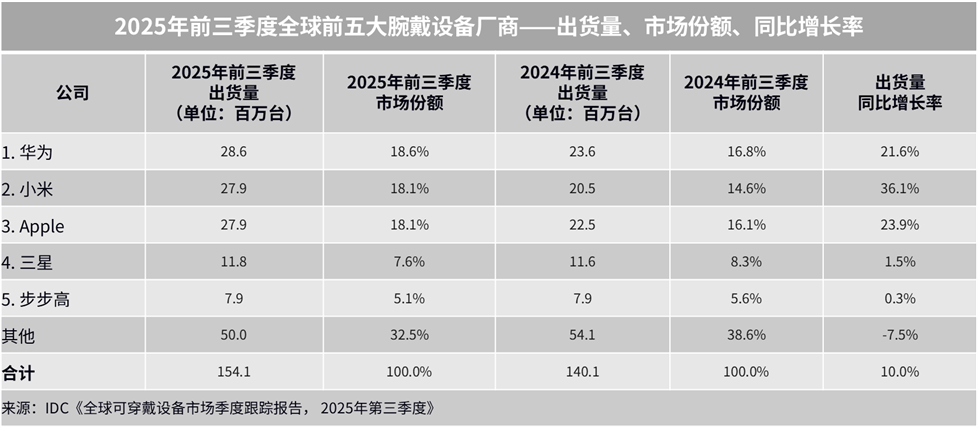
Core Insights - The global wearable device market shipped 150 million units in the first three quarters of 2025, marking a 10.0% year-on-year growth, with China contributing 58.43 million units, a 27.6% increase [1][4] - Major manufacturers have launched new products, driving growth in the smart wearable market, particularly in developed regions like Europe and North America [1][3] Global Market Performance - In the first three quarters of 2025, the global smartwatch market shipped 120 million units, up 7.3% year-on-year, while the global wristband market saw shipments of 32.86 million units, a 21.3% increase [1] - Huawei led the global wearable market with 28.6 million units shipped, capturing 18.6% market share, followed closely by Xiaomi and Apple, each with 27.9 million units and 18.1% market share [2] - Xiaomi exhibited the fastest growth among top brands, with a 36.1% increase in shipments [2] Chinese Market Performance - In China, Huawei dominated the wearable market with 20.8 million units shipped, holding a 35.5% market share, while Xiaomi followed with 15.9 million units and a 27.2% market share [4] - The overall Chinese wearable market grew by 27.6% year-on-year, with significant contributions from both Huawei and Xiaomi [4] Product Innovations and Strategies - Huawei's new Watch GT 6 series features significant upgrades, including enhanced screen brightness and health monitoring capabilities, and is expanding its overseas market presence [3] - Xiaomi's growth is driven by its entry-level products, particularly the Mi Band 10 and Redmi Watch series, leveraging high cost-performance ratios [3] - Apple introduced three new models in Q3 2025, enhancing its position in the mid-to-high-end market through aggressive pricing strategies [5] Future Market Projections - IDC forecasts that China's wearable market will reach 79.58 million units by 2026, with adult smartwatches expected to grow by 8.2% [7] - The children's smartwatch market is anticipated to recover in 2026, driven by continuous product iterations from leading manufacturers [7] - The wristband segment is expected to maintain growth due to its affordability and broad user base [7] Industry Trends - The wearable market is entering a "value competition" phase, with manufacturers focusing on health function upgrades and technological advancements [8] - There is a growing demand across different age groups and a penetration into lower-tier markets, which may unlock long-term growth potential for the industry [8]




镰刀妹AI智能写作 | 12月17日湘股涨跌TOP5
Chang Sha Wan Bao· 2025-12-17 07:58
长沙晚报掌上长沙12月17日讯 截至12月17日收盘:沪指涨1.19%,报3870.2775点;深证成指涨2.4%,报 13224.514点。 湘股12月17日涨幅TOP5 步步高(维权)开盘价5.600,收盘报5.820元,当日涨5.24%,当日最高价为6.080元,最低价为5.400元, 成交量497.5326万手。 湖南白银开盘价6.100,收盘报6.310元,当日涨4.64%,当日最高价为6.350元,最低价为6.100元,成交量 156.8614万手。 华天酒店开盘价3.330,收盘报3.430元,当日涨4.57%,当日最高价为3.590元,最低价为3.290元,成交量 74.8205万手。 恒立退开盘价0.160,收盘报0.150元,当日跌-11.76%,当日最高价为0.170元,最低价为0.150元,成交量 61.1606万手。 长缆科技开盘价17.760,收盘报17.710元,当日跌-2.96%,当日最高价为18.150元,最低价为17.320元,成 交量12.6104万手。 *ST生物(维权)开盘价8.660,收盘报8.430元,当日跌-2.77%,当日最高价为8.700元,最低价为8.24 ...

IDC:2025年前三季度全球腕戴设备市场同比增长10%
智通财经网· 2025-12-17 05:51
Core Insights - The global wearable device market is projected to ship 150 million units in the first three quarters of 2025, reflecting a year-on-year growth of 10.0% [1] - The Chinese market alone is expected to ship 58.43 million units, marking a significant year-on-year increase of 27.6% [1][9] - Major manufacturers are actively launching new products, which is driving growth in both global and developed markets [1] Global Market Performance - The global smartwatch market is expected to ship 120 million units in the first three quarters of 2025, with a year-on-year growth of 7.3% [1] - The global wristband market is projected to ship 32.86 million units, showing a year-on-year increase of 21.3% [1] - The top five manufacturers in the global wrist-worn device market include Huawei, Xiaomi, Apple, Samsung, and BBK, with Huawei leading at 28.6 million units shipped [3] Company-Specific Insights - **Huawei**: Achieved the highest global shipment volume of 28.6 million units, with a year-on-year growth of 21.6%. The new Watch GT 6 series features significant upgrades and is expanding its overseas market presence [3][4] - **Xiaomi**: Recorded a shipment of 27.9 million units, marking a 36.1% year-on-year increase. The growth is driven by its entry-level products like the Mi Band 10 and Redmi Watch series [4] - **Apple**: Launched three new models in Q3 2025, including the Apple Watch S11, which supports 5G. Apple maintains a strong position in the mid-to-high-end market [5] - **Samsung**: Released the Galaxy Watch 8 series, successfully reversing a decline in shipments earlier in the year [6] - **BBK**: Maintained a strong position in the children's smartwatch market in China, leveraging its brand and product diversity [7] Chinese Market Performance - The Chinese wrist-worn device market is expected to ship 58.4 million units in the first three quarters of 2025, with a year-on-year growth of 27.6% [9] - The top five manufacturers in China include Huawei, Xiaomi, BBK, Apple, and Honor, with Huawei leading at 20.8 million units shipped [9] Future Market Predictions - The Chinese wrist-worn device market is projected to ship 79.58 million units in 2026, with a growth rate of 5.1% [11] - The adult smartwatch segment is expected to grow by 8.2%, while the children's smartwatch market is anticipated to recover in 2026 [11] - The wristband market is expected to continue its growth trajectory, driven by high cost-performance ratios and diverse product offerings [11] Industry Trends - The wearable market is entering a "value competition" phase, with manufacturers focusing on health function upgrades, AI applications, and 5G technology [12] - There is a growing demand across different age groups and a penetration into lower-tier markets, which may unlock long-term growth potential for the industry [12]
“提振、细化、聚焦”——从中央经济工作会议及11月经济指标明确消费主线
2025-12-17 02:27
Summary of Conference Call Records Industry and Company Overview - The conference call discusses the overall economic environment in China, focusing on domestic demand and various sectors including retail, education, textiles, jewelry, and home appliances. [1][2][3] Key Points and Arguments Economic Policy and Domestic Demand - The central economic work conference emphasizes the importance of domestic demand, with a focus on detailed policy implementation to enhance consumer sentiment and valuation rather than merely increasing financial input [2][3] - The expectation for service consumption policies to intensify in 2026 and 2027, with specific attention to holiday promotions and paid leave policies that will benefit sectors like tourism and online travel agencies (OTA) [1][5][6] Sector-Specific Insights - **Retail Sector**: - Retail is expected to benefit from domestic demand policies and an extended Spring Festival holiday, with CPI improvements likely boosting supermarket revenues [1][10][11] - Key retail companies to watch include Chongqing Department Store, Bubugao, and Guijia Times [11] - **Education Sector**: - Vocational education institutions are anticipated to benefit from service-oriented consumption policies aimed at improving employment [7] - **Textile and Apparel Industry**: - The industry is experiencing a slowdown, but winter inventory clearance is expected to improve. Key players include home textile leaders like Luolai and sports brands with international multi-brand strategies [8] - **Jewelry Sector**: - The industry faces challenges from high gold prices, but companies with brand differentiation, such as Cao Hongji, are performing well. Potential turnaround stocks include Lao Fengxiang and Zhou Daxing [9] - **Home Appliance Industry**: - The market is stabilizing after a decline due to subsidy reductions, with a focus on product structure upgrades. Key players include Midea and Haier, as well as emerging smart hardware companies [14][16] Economic Data and Trends - Recent economic data shows a mixed performance, with social retail sales growth at 1.3%, indicating various underlying issues such as the weakening of trade-in effects and the impact of promotional events [4] - The focus should shift from short-term data fluctuations to the long-term effects of policy on sentiment and valuation [4][3] Investment Opportunities - **Tourism Stocks**: - OTA companies are highlighted as strong investment opportunities due to their profitability and the increasing interest from state-owned and local industry funds in scenic area companies [6] - **Consumer Goods**: - Companies in the beauty sector, such as Lin Qingxuan, are positioned to benefit from domestic demand growth, with a notable performance in their core products [11][12] - **Agriculture Sector**: - The agricultural sector is currently in a pessimistic state, but there is potential for recovery as supply constraints stimulate hidden demand. Recommended stocks include Muyuan Foods and Wens Foodstuffs [17] Risks and Challenges - The video sector is still facing performance challenges, particularly in the liquor segment, with a focus on companies with low inventory and strong performance potential [18] Additional Important Content - The emphasis on policy detail and implementation reflects a shift towards more actionable economic strategies, which may lead to improved consumer sentiment and market performance in the long run [2][3]
“我不知道”先生段永平
Xin Lang Cai Jing· 2025-12-16 23:20
前阵子段永平在美国加州接受雪球创始人方三文采访,近两个小时的访谈非常有意思,让刚刚读完两本 维特根斯坦传记的笔者立马联想到了罗素在日记中对刚认识的维特根斯坦的评价:"那个讨厌的德国学 生(其实是奥地利)又来了,不管我说什么,他都说不是这样的。" 连罗素一开始都不能理解维特根斯坦,更不要说别人了。维特根斯坦的一个朋友的中学生儿子在日记里 写道:"和爸爸的这个朋友交谈很辛苦,不管我们说什么,他都说:'你们说的不重要。'可是我们说的 对我们是重要的啊!" 维特根斯坦被认为是终结西方哲学史的哲学家、二十世纪最重要的两个人之一(另一个是爱因斯坦)。 后来罗素评价维特根斯坦的贡献:"我是一片雪花,而维特根斯坦是雪崩。" 段永平与主持人的交谈颇有些维特根斯坦的影子,透视出这位十分成功的投资人、企业家十分独特的思 维方式,这正可能是他成功的终极秘诀。本文尝试分析他的思维方式的三个特点。 拒绝仓促连点成线找模式 正如所有意在深度采访成功人士的主持人一样,方三文试图找出段永平的成长环境与其性格、成就的关 系。段永平直接回答:"这个就不知道了。"然后报了一下经历:"我是在南昌出生,六岁左右跟父母下 放到江西安福县。在安福县搬了五六 ...

段永平,他还没有彻底“看懂”汽车
汽车商业评论· 2025-12-16 23:06
Core Viewpoint - The electric vehicle (EV) industry is facing significant challenges, with many companies struggling to achieve profitability, as highlighted by the statement from Duan Yongping, a prominent investor in China [4][10]. Group 1: Industry Challenges - Duan Yongping emphasizes that while the automotive industry has value, it is difficult to turn it into a "good business" due to intense competition and product homogenization [6][14]. - The automotive sector has historically experienced a high level of product similarity, which has led to fierce competition and a lack of unique selling propositions [14][18]. - The transition from traditional fuel vehicles to electric vehicles may exacerbate these challenges, as the EV market is predicted to become increasingly homogeneous [15][18]. Group 2: Business Model Insights - A strong business model requires differentiation, which is currently lacking in the automotive industry, making it hard for companies to establish a competitive moat [12][14]. - Duan Yongping argues that the automotive industry is at risk of falling into a price war, which can undermine long-term profitability and innovation [20][21]. - Companies need to focus on creating unique value propositions rather than competing solely on price, as this can lead to a race to the bottom [20][21]. Group 3: Strategic Recommendations - To transform the automotive business into a sustainable venture, companies should concentrate their efforts and resources rather than diversifying too broadly [22][24]. - The single product model, exemplified by companies like Apple, allows for focused resource allocation and can lead to superior product quality and customer loyalty [26][29]. - Companies should explore the potential of electric vehicles as platforms for additional services, leveraging the time consumers spend in their vehicles to create new revenue streams [32][36]. Group 4: Future Outlook - The future of the automotive industry may hinge on the ability to innovate beyond traditional vehicle sales, potentially integrating software and services that enhance user experience [32][36]. - Duan Yongping's evolving views on electric vehicles and autonomous driving reflect a broader trend of adapting to new market realities and consumer behaviors [37][39].



学18个月胖东来,永辉亏在房本上
Xin Lang Cai Jing· 2025-12-16 08:36
Core Viewpoint - The article discusses the contrasting business models of two supermarket chains, Yonghui and Pang Donglai, highlighting how Pang Donglai's ownership of properties and strong brand presence contribute to its profitability, while Yonghui struggles with a lack of real estate assets and effective brand differentiation [1][4][22]. Group 1: Business Model Comparison - Pang Donglai operates its stores in self-owned properties, allowing it to convert fixed rental income into profit-sharing arrangements with brands like DQ and Miniso [1][6]. - Yonghui, in contrast, primarily rents its properties, limiting its ability to generate rental income and forcing it to rely on external landlords [1][8]. - The financial performance of Pang Donglai is bolstered by its ability to attract customers and generate significant foot traffic, enhancing the commercial value of surrounding properties [5][12]. Group 2: Financial Performance and Challenges - Yonghui's recent financial reports indicate a decline in operating cash flow, with a record low of 3.358 billion yuan in cash reserves, marking a ten-year low [14]. - Despite closing underperforming stores, Yonghui's gross margin has not significantly improved, and its single-store revenue increased by 35% post-reform, but this is attributed to the closure of lower-revenue locations [21][19]. - The total cost of store closures from June 2024 to September 2025 reached 1.645 billion yuan, representing 47.12% of Yonghui's net assets as of September 2025 [17][18]. Group 3: Brand and Market Position - Pang Donglai's success is partly due to its strong private label offerings, which allow it to capture higher profit margins compared to traditional retail [22][26]. - Yonghui has struggled to establish its own successful products, with only one item achieving significant sales, indicating a lack of competitive edge in product offerings [23][25]. - The competition from Pang Donglai has led to challenges for Yonghui, as customers often prefer Pang Donglai's products over Yonghui's, further complicating Yonghui's market position [26][28].