Manus

Search documents
东吴证券:港股进入震荡上行期 把握上半年的科技成长行情
智通财经网· 2026-01-06 00:03
Core Viewpoint - Hong Kong stocks are showing strong performance at the beginning of the year, making them attractive for medium to long-term investment allocation. The expectation is that southbound funds will continue to increase their allocation to Hong Kong stocks, primarily driven by insurance and fixed income investments. The performance of Hong Kong technology stocks will be influenced by the pace of interest rate cuts overseas and the performance of US technology stocks, necessitating dynamic observation [1][2][3]. Group 1: Market Performance - In the week of December 29, 2025, to January 2, 2026, emerging markets rose by 2.3%, while developed markets fell by 0.6%. The Hang Seng Technology Index increased by 4.3%, the Hang Seng Index rose by 2.0%, and the Hang Seng Stock Connect gained 1.5%. The energy sector led the gains, with southbound funds primarily flowing into the financial sector and out of telecommunications [2]. - The report indicates that the current position of Hong Kong stocks is attractive for medium to long-term allocation, largely due to factors such as new year positioning and short covering [2][3]. Group 2: Investment Strategy - Short-term positioning in Hong Kong stocks should be controlled, with expectations for better performance around the Chinese New Year. Concerns exist regarding potential pullbacks in US technology stocks in January, which could indirectly affect Hong Kong stocks. Investors are cautious about upcoming earnings reports from US technology companies, focusing on capital expenditures and return on investment [2][3]. - The report emphasizes the importance of maintaining dividends as a base while capitalizing on the technology growth trend in the first half of the year. Southbound funds are expected to continue increasing their allocation to value dividends [3]. Group 3: Economic Indicators - The US manufacturing and services PMIs showed a slowdown, with the December Markit Composite PMI falling to 53, the lowest in six months, and both manufacturing and services PMIs below market expectations. This indicates a weakening economic growth momentum [3][4]. - The US job market remains resilient, with initial jobless claims dropping to 199,000, the lowest level in a year, and continuing claims also decreasing. The housing market is recovering, with a 3.3% month-on-month increase in the pending home sales index for November [4]. Group 4: Global Investment Trends - Global stock ETFs saw a net inflow of $30.976 billion, with a marginal inflow of $4.844 billion, while bond ETFs experienced a net inflow of $5.337 billion. The US stock ETFs had the highest net inflow at $19.64 billion, while Chinese stock ETFs led among emerging markets with a net inflow of $1.46 billion [7]. - The report highlights that institutional investors are reducing their gold holdings, while retail investors are slightly increasing theirs, indicating a shift in investment preferences [6][7].

2026年第1周计算机行业周报:假期AI利好频出,关注国内AI应用表现-20260106
Changjiang Securities· 2026-01-05 23:30
Investment Rating - The industry investment rating is "Positive" and is maintained [7] Core Insights - The computer sector has shown a continuous upward trend, with an overall increase of 1.23% last week, ranking 4th among primary industries in the Yangtze River region. The sector's trading volume accounted for 6.72% of the total market, with a year-to-date increase of 20.33% [2][4][14] - The report highlights significant developments in the AI industry, indicating that 2026 may be a pivotal year for the transition from technological breakthroughs to large-scale implementation. Key areas of focus include domestic large model manufacturers, major cloud service providers, vertical scenario agent manufacturers, and the domestic computing power supply chain [6][50][61] Summary by Sections Computer Sector Performance - The computer sector's performance last week was characterized by a 1.23% increase, with the Shanghai Composite Index closing at 3968.84 points, reflecting a 0.13% rise for the week and an 18.41% increase for the year [4][14] - The sector's trading volume represented 6.72% of the total market, with a year-to-date increase of 20.33%, ranking 17th among primary industries [2][14] Key Developments - The report emphasizes the positive developments in the AI industry, including Meta's acquisition of Manus and the upcoming IPOs of major AI companies like Zhiyuan and MiniMax, indicating a shift towards large-scale application and value verification in the AI sector [50][51][57] - The digital RMB has transitioned to a "digital deposit currency" era with the launch of the digital RMB App 2.0, which now offers interest on wallet balances, enhancing its role as a financial product [29][30][37] Recommendations - The report suggests focusing on the following areas for investment opportunities: 1) Domestic large model manufacturers 2) Major cloud service providers 3) Vertical scenario agent manufacturers 4) The domestic computing power supply chain [6][61]
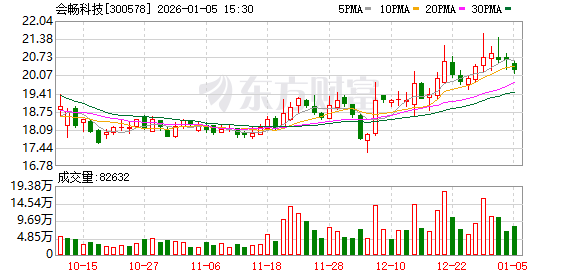
会畅科技:智能体技术与终端结合是未来趋势,公司专注于AI交互与音视频技术的融合创新
Mei Ri Jing Ji Xin Wen· 2026-01-05 13:13
Group 1 - The company is aware of Meta's acquisition of Manus and considers it significant in the AI application field [2] - The integration of intelligent agent technology with terminals is seen as a future trend by the company [2] - The company focuses on innovation in AI interaction and audio-video technology integration, planning to advance related products and business in line with market and technological developments [2]


国泰海通|海外科技:Meta并购、资本密集投入前沿Lab,行业进入价值兑现期
国泰海通证券研究· 2026-01-05 12:55
Core Insights - Meta has made a significant acquisition of Manus for over $2 billion, marking its third-largest acquisition in history, signaling a strong commitment to monetizing AI capabilities through a subscription model for businesses [2] - The acquisition of Manus, which has an annual recurring revenue (ARR) of $125 million, demonstrates a scalable business model for AI agents in the B2B sector, providing a quantifiable revenue anchor for Meta's extensive AI investments [2] - The AI industry is entering a new phase characterized by abundant funding and rapid iteration, with SoftBank committing $40 billion to OpenAI, making it one of the largest private funding rounds in history [3] - OpenAI is venturing into AI hardware, with plans to launch its first AI hardware product, potentially a "smart pen" or wearable audio device, by 2026 or 2027, indicating a shift towards an integrated software-hardware ecosystem [4] Group 1 - Meta's acquisition of Manus reflects a strategic shift towards mature products and cash flow, amidst ongoing skepticism regarding the return on investment from its $600 billion AI infrastructure commitment over the next three years [2] - The successful internationalization and high ARR of Manus serve as a significant example for Chinese AI entrepreneurs, showcasing the potential for global competition and commercialization [2] Group 2 - OpenAI's recent secondary market stock sale has raised its valuation to approximately $500 billion, indicating strong investor confidence and market interest [3] - Major AI labs are alleviating "burn rate anxiety" with substantial capital support, allowing for enhanced technology iteration and product deployment certainty [3]


AI应用端持续走强蓝色光标涨超15%续创10年新高
Xin Lang Cai Jing· 2026-01-05 12:16
Core Viewpoint - The AI application sector is experiencing significant growth, with companies like BlueFocus and others seeing substantial stock price increases, indicating strong market interest and investment potential in AI technologies [1] Group 1: Market Performance - On January 5, the Shanghai Composite Index rose over 1%, reclaiming the 4000-point mark [1] - BlueFocus saw its stock price increase by over 15%, reaching a 10-year high [1] - Other companies such as Zhaoyi Information, Nansheng Co., and Liou Co. also experienced stock price surges, with some hitting the daily limit [1] Group 2: Industry Developments - Meta announced the acquisition of AI company Manus to accelerate its AI innovation efforts [1] - Post-merger, Manus will continue to operate independently while integrating deeply with Meta's core global consumer products [1]


收购“Manus”也治不好大厂的焦虑症
3 6 Ke· 2026-01-05 11:24
Core Insights - Meta announced the acquisition of Manus, an AI Agent startup, for $2 billion, highlighting its urgent need for a capable team and technology in the AI space [1][4][8] - The acquisition reflects a broader trend among tech giants to address anxiety over AI capabilities and market competition, with many companies resorting to buying talent and technology [9][10] Group 1: Acquisition Details - Manus, founded by Chinese entrepreneurs, achieved an annualized revenue of $125 million within eight months of its product launch [1] - The deal was characterized by a quick negotiation process, with Meta's CEO Mark Zuckerberg agreeing to the founder's asking price without hesitation [1] - Following the announcement, Meta's stock price fell for two consecutive trading days, indicating skepticism from the market regarding the potential impact of the acquisition [1] Group 2: Meta's Challenges - Meta's previous AI model, Llama 4, faced significant criticism for underperformance despite initial high rankings, leading to concerns about the company's AI capabilities [2][3] - The company has struggled to produce a competitive foundational model, while rivals like Anthropic and Google continue to excel in the AI space [3][11] - Meta's revenue model is heavily reliant on advertising, which is threatened by the rise of AI Agents that change user engagement dynamics [5][11] Group 3: Market Dynamics - The acquisition of Manus is seen as a strategic move to mitigate Meta's vulnerabilities in AI, as the company faces competition from both established players and emerging startups [6][9] - Manus's reliance on third-party models for its product experience introduces risks related to cost variability and supply chain stability [5][6] - The acquisition reflects a broader pattern of tech companies seeking to secure their positions in the rapidly evolving AI landscape, often driven by fear of falling behind [9][10] Group 4: Future Considerations - The integration of Manus into Meta's ecosystem could provide opportunities for deeper product integration across platforms like Facebook and Instagram [7] - However, concerns remain about whether the acquisition will effectively address Meta's underlying issues, particularly regarding organizational culture and integration challenges [14][15] - Historical examples of successful acquisitions in the tech industry suggest that simply buying technology may not resolve deeper organizational deficiencies [12][16][18]
国泰海通每日报告精选-20260105
国泰海通· 2026-01-05 08:29
| | 国泰海通证券 | | --- | --- | | 2 | GUOTAI HAITONG SECURITIES | 目 录 | | 每日报告精选(2025-12-31 09:00——2026-01-05 15:00) 3 | | | --- | --- | --- | | | 宏观周报:《地缘风险再起,国际油价或迎剧烈波动》2026-01-04 | 3 | | | 宏观周报:《元旦"微度假"热度高》2026-01-04 | 3 | | | 宏观快报点评:《PMI 逆季节性回升,预期改善》2025-12-31 | 4 | | | 策略专题报告:《1 月金股策略:决胜"开门红"》2026-01-05 | 5 | | | 资产配置周报:《地缘政治突变,建议超配黄金》2026-01-05 | 6 | | | 策略专题报告:《AI 应用与机器人主题有望接力》2026-01-04 | 6 | | | 海外策略研究:《长线外资积极增配港股软件服务》2026-01-04 | 7 | | | 策略周报:《一年之计在于春》2026-01-04 | 8 | | | 行业月报:房地产《TOP ...
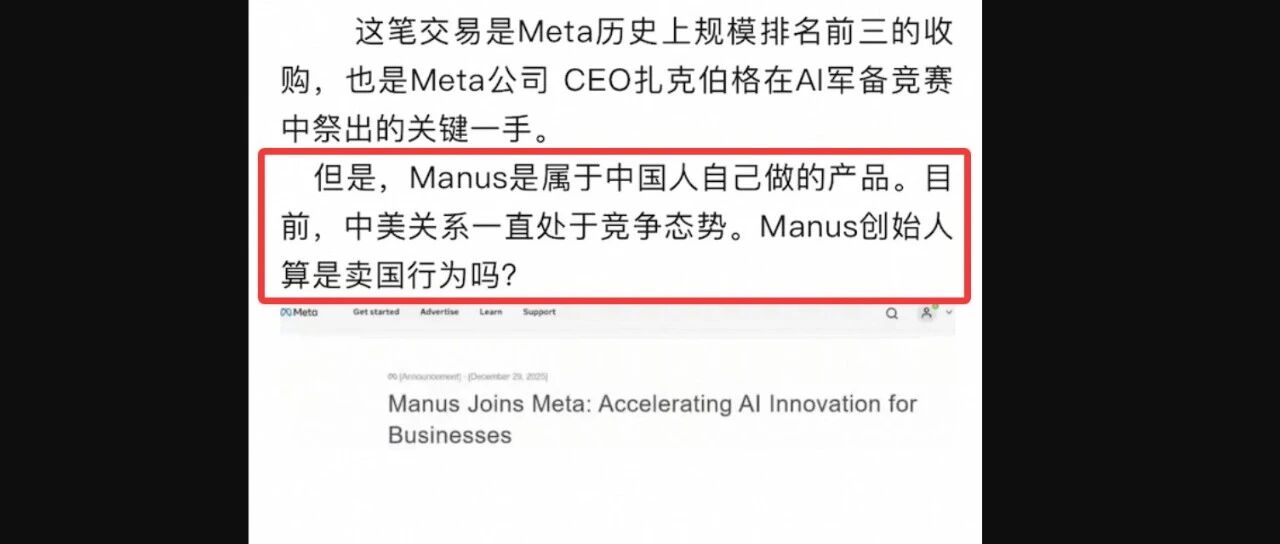
网友:Manus 被美企重金收购,那它创始人算是卖国么?
程序员的那些事· 2026-01-05 07:13
美国互联网巨头 Meta 数十亿美元收购 Manus 这事,真是出圈了。不止是轰动技术圈和资本圈,连汽车博主也开始讨论了。 1 月 4 日傍晚小程程在微信刷到这篇: 我把这个问题扔给了 3 个大模型,得到的结论一致:不是卖国 (↑豆包) (↑ 元宝) ( ↑ DeepSeek) ...
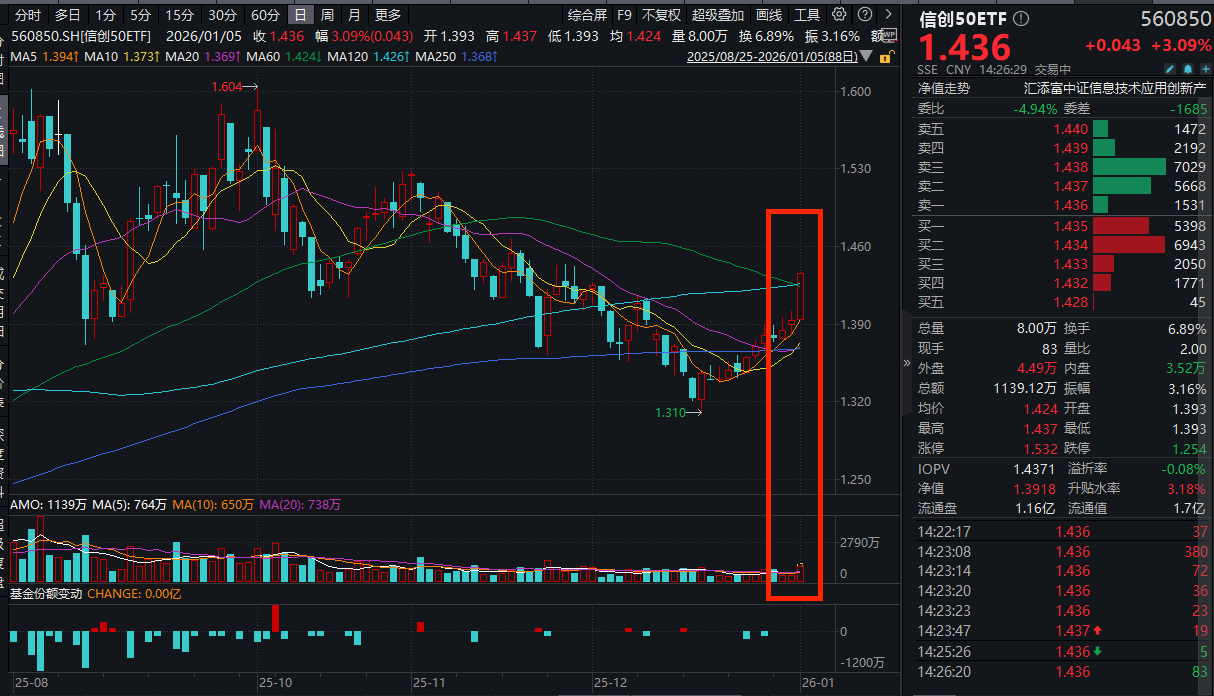
AI应用、自主可控强势大涨!江波龙涨近15%,信创50ETF(560850)涨超3%,软件50ETF(159590)涨近3%!主题风向标:AI应用有望接力!
Sou Hu Cai Jing· 2026-01-05 06:57
Group 1 - The core viewpoint of the articles highlights the strong performance of AI applications, with significant movements in related ETFs, indicating a bullish trend in the market [1][4][5] - The AI application sector is experiencing a surge in demand due to improved product performance and increased user engagement, driven by recent developments such as Meta's acquisition of Manus [4][6] - The listing of Chinese large model companies like Zhipu and MiniMax on the Hong Kong Stock Exchange marks a significant milestone, creating a closed loop of technology, products, and capital, which is expected to enhance the efficiency of domestic AI models [5][6][7] Group 2 - Manus's integration into Meta is anticipated to accelerate the promotion of AI Agent applications, leveraging Meta's vast user base of millions of enterprises and billions of users [6][7] - The competitive landscape in the global AI large model sector remains intense, which is likely to drive the widespread adoption of AI applications and sustain high demand in the AI computing market [7][8] - The 信创50ETF and 软件50ETF are positioned to capitalize on the growth of AI applications, with significant allocations in software and cloud services, reflecting a strong alignment with the "domestic substitution" trend [8]
1070亿、930家公司:2025中国AI应用的野蛮共识
Tai Mei Ti A P P· 2026-01-05 05:30
Core Insights - The year 2025 is identified as the "Year of AI Applications," with significant investments and developments expected in the AI sector [2] - Major tech leaders and investors have reached a consensus that AI applications will see large-scale implementation in 2025, driven by decreasing costs of large model inference and increasing API call volumes [2][3] - A total of 930 AI application companies secured new financing amounting to 107.07 billion RMB in 2025, indicating a high level of investment activity [2][3] Investment Landscape - The top 10 application scenarios account for 73% of the total number of financing companies, indicating a high concentration of capital in these validated or promising areas [3] - Among the 930 companies, 194 focus on embodied intelligence, representing 20.9% of the total, as it aligns with capital's vision of "AI + physical world" [4] - The top three scenarios (embodied intelligence, autonomous driving, and general AI) account for over 51.6% of total financing, highlighting a trend of capital concentration [12][14] Financing Trends - The average financing amount for autonomous driving projects is 45.29 million RMB, significantly higher than other sectors, indicating a strong investment preference [18][19] - 36% of AI application companies are in early-stage financing, while 46% are in growth stages, suggesting that most companies are still proving their business models [20][21] - The majority of financing is directed towards B2B projects, with 62.17% of the top 10 scenarios being purely B2B, reflecting a shift in capital preferences [11] Geographic Distribution - Beijing leads with 226 AI application companies, accounting for 24.3% of the total, followed by Guangdong and Shanghai, indicating a concentration of talent and resources in these regions [23][24] - The geographic distribution of AI application companies reflects a competitive landscape driven by capital, talent, and supply chain dynamics [24] Industry Dynamics - The financing landscape reveals a merging of software and hardware boundaries, with top companies in embodied intelligence and autonomous driving demonstrating this trend [29] - The rapid growth in AI applications is accompanied by potential risks, as many companies may face challenges in achieving sustainable profitability [30] - The acquisition of Manus by Meta for $2 billion signals a global competition for AI talent and resources, reshaping the industry landscape [30]