成都银行

Search documents
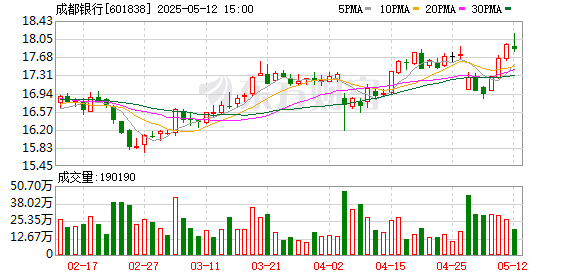
银行股再度走强 浦发银行等多股续创历史新高
news flash· 2025-05-13 02:30
浦发银行、 上海银行、 江苏银行创历史新高, 重庆银行、 中信银行创年内新高, 青农商行、 苏州银 行、 成都银行等跟涨。 ...

成都银行发布2024年年报 经营业绩稳中向好 增长韧性持续跃升
Jing Ji Ri Bao· 2025-05-12 21:53
Core Viewpoint - Chengdu Bank has demonstrated robust growth in business scale, operating income, and net profit in 2024, achieving high-quality development while optimizing asset quality [2][4]. Financial Performance - Total assets reached 1.2501 trillion yuan, an increase of 158.87 billion yuan, or 14.56% year-on-year [3] - Total deposits amounted to 885.86 billion yuan, up by 105.44 billion yuan, or 13.51% [3] - Total loans stood at 742.57 billion yuan, increasing by 116.83 billion yuan, or 18.67% [3] - Operating income was 229.82 billion yuan, a year-on-year increase of 12.79 billion yuan, or 5.89% [3] - Net profit attributable to shareholders reached 128.58 billion yuan, up by 11.87 billion yuan, or 10.17% [3] - The non-performing loan ratio decreased to 0.66%, marking a nine-year decline [3][4]. Strategic Initiatives - Chengdu Bank is focusing on five key financial areas to enhance economic development, including technology finance, green finance, inclusive finance, pension finance, and digital finance [5][6]. - The bank has launched 18 technology finance products and has engaged with over 3,000 technology enterprises [6]. - Green credit balance reached 49.77 billion yuan, growing by 22.87% year-on-year, with significant contributions to low-carbon industries [6]. - Inclusive finance initiatives have reached over 40,000 small and micro enterprises, with loan growth exceeding the bank's average [7]. Regional Economic Integration - Chengdu Bank is deeply integrated into the regional economy, supporting major infrastructure projects with over 38 billion yuan in funding [8]. - The bank has aligned its services with national strategies such as the Belt and Road Initiative and the Chengdu-Chongqing Economic Circle [8]. Customer Base and Digital Transformation - The bank's retail customer base surpassed 10 million, with significant growth in personal loans and savings deposits [12]. - Digital transformation efforts have led to a substantial increase in mobile banking users, enhancing operational efficiency and customer experience [12]. Future Outlook - As of early 2025, total assets reached 1.335 trillion yuan, with continued growth in deposits and loans [13]. - The bank aims to strengthen its foundational financial services while enhancing its business model to adapt to evolving market conditions [13].

中证ECPI ESG 80指数报1903.98点,前十大权重包含国泰海通等
Jin Rong Jie· 2025-05-12 11:21
Core Points - The China Securities Index ECPI ESG 80 Index is currently at 1903.98 points, showing a recent upward trend [1] - Over the past month, the index has increased by 2.74%, while it has seen a slight rise of 0.15% over the last three months, but a decline of 2.90% year-to-date [2] - The index is composed of 80 securities selected from the CSI 300 based on an ESG score of E+ or higher and the lowest volatility over the past six months [2] Index Composition - The top ten holdings of the ECPI ESG 80 Index include: Guotai Junan (2.82%), Changjiang Electric Power (2.09%), Daqin Railway (2.08%), Pudong Development Bank (2.04%), Chengdu Bank (2.04%), Shanghai Bank (1.96%), Agricultural Bank of China (1.80%), Minsheng Bank (1.80%), Everbright Bank (1.73%), and Beijing Bank (1.65%) [2] - The index is primarily composed of stocks from the Shanghai Stock Exchange (73.30%) and the Shenzhen Stock Exchange (26.70%) [2] Sector Allocation - The sector distribution of the ECPI ESG 80 Index is as follows: Financials (34.22%), Industrials (22.32%), Materials (11.50%), Consumer Discretionary (7.83%), Utilities (6.49%), Consumer Staples (5.99%), Health Care (5.73%), Information Technology (3.07%), Energy (1.52%), and Communication Services (1.33%) [3] - The index samples are adjusted semi-annually, with adjustments occurring on the next trading day after the second Friday of June and December [3]

开源证券:稳健红利底色+复苏预期下银行业估值修复
Zhi Tong Cai Jing· 2025-05-12 07:26
Core Viewpoint - The report from Kaiyuan Securities indicates that the banking sector is expected to stabilize in performance by 2025, with revenue and net profit growth gradually recovering, driven by stable dividend strategies and supportive growth policies [1][2]. Group 1: 2025 Q1 Performance Overview - In Q1 2025, listed banks experienced a slight pressure on performance, with revenue showing a year-on-year decline of 1.72%, compared to a growth of 0.08% in 2024 [2]. - The net profit attributable to shareholders also saw a year-on-year decrease of 1.20%, down from a growth of 2.35% in 2024 [2]. - Revenue growth varied by bank type: state-owned banks at -1.51%, joint-stock banks at -3.91%, city commercial banks at +2.96%, and rural commercial banks at +0.21% [2]. - Net profit growth by bank type was: state-owned banks at -2.90%, joint-stock banks at -2.05%, city commercial banks at +5.49%, and rural commercial banks at +4.77% [2]. Group 2: Revenue Structure and Challenges - The income structure reflects a "volume-price balance" as a key theme, with net interest income growth marginally improving for all bank types except state-owned banks [2]. - Non-interest income remains weak overall, although wealth management sales have shown significant growth [2]. - The contribution of financial investment performance is expected to increase in 2024, with Q1 2025 showing reduced impact from the bond market [2]. Group 3: Asset Quality and Credit Trends - The credit quality of banks is showing improvement, with the non-performing loan (NPL) ratio at 1.23% in Q1 2025, a slight decrease from the end of 2024 [3]. - The NPL ratio for corporate loans decreased to 1.32%, improving by 20 basis points from 2023, particularly in the real estate sector [3]. - Retail NPLs increased to 1.13%, marking a 25 basis point rise compared to 2023, continuing a three-year upward trend [3]. - The overall credit cost for listed banks is at a historical low of 0.65%, with state-owned banks at 0.50% [3].
自由现金流和红利低波有哪些差别?
雪球· 2025-05-12 07:19
Core Viewpoint - The article discusses the differences between Free Cash Flow Index and Low Volatility Dividend Index, focusing on stock selection criteria, industry distribution, and performance characteristics. Group 1: Stock Selection Criteria - Free Cash Flow Index considers multiple factors including free cash flow and earnings quality, representing a growth value style [5][21] - The selected stocks in the Free Cash Flow Index include growth-oriented companies such as CATL, Midea Group, and Wuliangye [6] - Low Volatility Dividend Index focuses on liquidity, dividend yield, and volatility, selecting high dividend, low volatility stocks, typical of a value style [10][21] Group 2: Industry Distribution - Free Cash Flow Index covers growth sectors like telecommunications, power equipment, home appliances, and food and beverage, with these sectors accounting for over 34% of the index weight [12][21] - Low Volatility Dividend Index primarily includes undervalued, high dividend sectors such as banking, transportation, construction, textiles, coal, and steel [14][21] Group 3: Concentration and Performance - Free Cash Flow Index has a high concentration with the top ten stocks accounting for nearly 70% of the index weight, leading to higher volatility risk [17][21] - In contrast, Low Volatility Dividend Index has a more dispersed weight distribution, with the highest individual stock weight below 3%, resulting in lower volatility risk [19][21] - Performance-wise, from 2019 to 2021, the Free Cash Flow Index increased by over 90%, while the Low Volatility Dividend Index rose by only about 30% [23][25]

公募改革落地,政策组合拳共振
HTSC· 2025-05-12 04:35
证券研究报告 金融 公募改革落地,政策组合拳共振 华泰研究 2025 年 5 月 11 日│中国内地 行业周报(第十九周) 本周观点 投资机会方面银行>证券>保险。央行降准 50bp+降息 10bp 并引导存款利率 下调,平衡稳息差与降成本。银行系 AIC 布局加速,兴业银行获批筹建国 内第六家 AIC,招商银行、中信银行拟出资设立。国新办新闻发布会召开, 支持资本市场和稳定金融体系的政策组合拳落地;公募基金改革方案发布, 推动行业从"重规模"向"重投资者回报"转型,用 3 年左右形成高质量 发展"拐点"。权益投资偿付能力风险因子下调 10%,有助于推动险资入市, 降低保险公司偿付能力压力。 子行业观点 1)银行:央行降准 50bp+降息 10bp 并引导存款利率下调,平衡稳息差与 降成本。3 月按揭利率边际回升,下一步将出台金融促消费一揽子政策举措, 增加信贷资金供给支持。银行系 AIC 布局加速,为股权投资市场再添活水。 2)证券:公募基金改革方案有望加速行业生态重构,推动头部集中与差异 化竞争。国新办发布会是继去年"924"后的新一轮政策组合拳,从制度、 生态、资金多维度呵护市场平稳运行,权益市场底部有 ...

见证历史!机构:增持!
天天基金网· 2025-05-12 04:26
Core Viewpoint - The banking sector demonstrates strong resilience amid market fluctuations, with increasing interest from investors in high dividend and low valuation bank assets, reflecting a growing demand for defensive investments [2][4][5]. Group 1: Market Performance - On May 9, the banking sector outperformed the market, with several banks like Chengdu Bank, Shanghai Pudong Development Bank, and Jiangsu Bank reaching historical highs. The China Securities Banking Index has risen for three consecutive trading days [2][3]. - The Huabao China Securities Banking ETF saw a daily increase of 1.35%, reaching a historical high, with total trading volume for the top 12 banking ETFs amounting to 9.55 billion yuan, of which Huabao's ETF accounted for 3.93 billion yuan [3][4]. Group 2: Investment Trends - Institutional investors have been increasing their holdings in bank stocks over the past two quarters, with significant increases in the top ten holdings of major banking ETFs [3][4]. - The banking sector's current dividend yield is approximately 6.5%, ranking second among all Shenwan first-level industries, with a PE ratio of 6.5 and a PB ratio of around 0.53, both of which are among the lowest across sectors [4][5]. Group 3: Policy and Economic Support - Recent policies aimed at stabilizing growth, including a 0.5 percentage point reduction in the reserve requirement ratio and a 0.1 percentage point decrease in policy interest rates, are expected to enhance the banking sector's operating environment [5][6]. - The banking sector has shown a long-term performance advantage, outperforming the CSI 300 index since 2011 with a 70% annual win rate, indicating strong relative returns and long-term investment value [6].

瑞银:中国股票策略-如何在当前市场中应对波动
瑞银· 2025-05-12 01:48
Investment Rating - The report maintains a "Buy" rating for selected stocks within the industry, indicating a positive outlook for potential price appreciation over the next 12 months [39]. Core Insights - The report emphasizes that higher volatility in the market is likely to persist, primarily driven by tariff news and external shocks, with MSCI China experiencing an increase in daily share price volatility from 1.8% to 2.4% [2][4]. - Historical data suggests that during periods of rising volatility, the MSCI China index typically sees negative returns, averaging a decline of 6%, but often rebounds with an average return of 5% as volatility decreases [4]. - The report identifies that sectors such as banks and utilities perform well during rising volatility, while growth stocks like internet and tech tend to underperform [5]. - A "Low volatility" investment strategy has consistently yielded positive results during both rising and declining volatility environments [5]. Sector Performance Analysis - During rising volatility, defensive sectors such as utilities and banks have shown resilience, while property stocks have also outperformed as investors seek domestic policy support [5]. - Growth sectors, including internet and technology, generally underperform in high volatility scenarios due to increased discounting of future earnings [5]. - The report highlights that value factors like Price-to-Book (P/B) and Free Cash Flow Yield (FCFY) perform well in rising volatility, whereas Return on Equity (ROE) and Earnings Per Share (EPS) growth are more favorable in declining volatility [5]. Volatility Indicators - The HSI Volatility index has recently decreased from a peak of over 45 to around 25, indicating mixed return profiles for investors entering the market at this level [6]. - The report suggests that a spike in volatility could present a more favorable entry point for investors, while current levels warrant a cautious approach due to fundamental concerns such as potential tariff impacts and EPS forecast revisions [6]. Quantitative Factor Analysis - The report includes a quantitative analysis showing that stocks with low volatility have consistently outperformed during periods of rising volatility [12][14]. - It also identifies large-cap stocks that score highly on various factors, including low volatility and high quality, which are recommended for investment [18][21]. Top Stock Picks - The report lists several "Buy" rated stocks that have historically performed well during periods of rising volatility, including Qinghai Salt Lake Industry Co., Bank of Chengdu, and China Railway Group [15]. - Additionally, it highlights stocks that are expected to perform well after volatility peaks, suggesting a strategic focus on these selections for potential gains [16].
银行板块韧性足 基金经理连续加仓
Zheng Quan Shi Bao· 2025-05-11 18:56
Core Viewpoint - The banking sector in the A-share market demonstrates strong resilience amid market fluctuations, with several bank stocks reaching historical highs and attracting significant investor interest through ETFs [1][2]. Group 1: Market Performance - On May 9, the A-share market experienced a downturn, while bank stocks rose, with the China Securities Bank Index increasing for three consecutive trading days [1]. - Several banks, including Chengdu Bank, Shanghai Pudong Development Bank, and Jiangsu Bank, reached historical highs, while Chongqing Bank and Qingdao Bank hit multi-year highs [1]. - Bank-themed ETFs also saw gains, with the Huabao China Securities Bank ETF rising by 1.35% and achieving a historical high during the trading session [1]. Group 2: Investment Trends - Data from Wind indicates that the total trading volume of the top 12 bank-themed ETFs reached 955 million yuan on May 9, with the Huabao China Securities Bank ETF accounting for 393 million yuan [1]. - Year-to-date, major bank ETFs such as Huabao, Huitianfu, and E Fund have all recorded gains exceeding 6% [1]. - Fund managers have been increasing their positions in bank stocks for two consecutive quarters, with notable increases in the top ten holdings of bank ETFs managed by Huabao and Huaxia funds [1][2]. Group 3: Fundamental Analysis - The banking sector is characterized by a stable fundamental outlook, high dividend yield of approximately 6.5%, and low valuation metrics, with a PE ratio of 6.5 and PB ratio of around 0.53, the lowest among various sectors [2]. - Historical data shows that the banking sector's PE and PB percentiles are at 36% and 25%, respectively, indicating a favorable safety margin and cost-effectiveness [2]. Group 4: Economic Support and Future Outlook - The overall economic policy remains focused on stabilizing growth, with fiscal policies continuing to support market expectations, which is beneficial for the banking sector [3]. - Recent financial policies aimed at stabilizing the market and reducing financing costs are expected to enhance the operating environment for banks and improve their liability costs [3]. - Historical performance indicates that the banking sector has consistently outperformed the CSI 300 index since 2011, with a 70% annual win rate, highlighting its long-term investment value [3].
深耕一城也可成就优质银行——成都银行2024年财报分析
数说者· 2025-05-11 14:15
Core Viewpoint - Chengdu Bank has shown significant growth in total assets and profitability, positioning itself as a leading city commercial bank in China, with a focus on maintaining high asset quality and low non-performing loan ratios [1][2][4][15]. Group 1: Growth and Scale - As of the end of 2024, Chengdu Bank's total assets reached 1.25 trillion yuan, marking a 14.56% increase from the end of 2023, ranking it seventh among city commercial banks listed on A-shares [2]. - The bank's operating income for 2024 was 229.82 billion yuan, reflecting a year-on-year growth of 5.89%, while the net profit attributable to shareholders was 128.58 billion yuan, up 10.17% year-on-year [4][6]. Group 2: Profitability and Income Sources - Chengdu Bank's net interest margin stood at 1.66% in 2024, a decrease of 15 basis points from the previous year, placing it at a medium level among city commercial banks [11]. - Despite the decline in net interest margin, net interest income reached 184.61 billion yuan, a 4.57% increase year-on-year, accounting for over 80% of the bank's operating income [10][14]. - Investment net income was 36.24 billion yuan, growing by 14.18% year-on-year, contributing 15.77% to the total operating income [14]. Group 3: Asset Quality - Chengdu Bank maintained a non-performing loan ratio of only 0.66% at the end of 2024, a decrease of 2 basis points from the previous year, making it one of the banks with the lowest non-performing loan ratios in the A-share market [15][17]. - The bank's non-performing loan coverage ratio was 479.29%, indicating strong asset quality, although it did not retain the top position among A-share listed banks [15]. - The non-performing loan ratio for corporate loans was 0.63%, while personal loans had a slightly higher ratio of 0.78%, both remaining at acceptable levels [18].