
洋河股份

Search documents
文轩指数 | 2025上半年中国上市白酒活力排名
Sou Hu Cai Jing· 2025-09-17 23:46
Core Viewpoint - The Chinese liquor industry is at a crossroads in the first half of 2025, with leading companies showing solid financial performance, but the industry environment is changing, necessitating innovation and new development models for sustained competitiveness [2][3]. Group 1: Financial Performance - In the first half of 2025, leading liquor companies like Kweichow Moutai reported revenue of 91.094 billion yuan, a year-on-year increase of 9.16%, and a net profit of 45.403 billion yuan, up 8.89% [2]. - Among 22 listed liquor companies, 6 maintained growth in both revenue and net profit, including Kweichow Moutai, Wuliangye, Shanxi Fenjiu, and others [3]. - The total revenue of 22 listed liquor companies was approximately 242.4 billion yuan, with a total net profit of about 95.1 billion yuan [5]. Group 2: Industry Challenges - The industry is experiencing a period of "volume reduction, revenue stabilization, and profit decline," with many companies facing declining sales [3][6]. - The number of large-scale liquor enterprises decreased by over 100 year-on-year, with total sales revenue of 330.42 billion yuan and profits down by 10.93% [5]. - The market is seeing a concentration of market share towards leading companies, putting pressure on smaller enterprises [6]. Group 3: Innovation and Development - Companies are focusing on innovation to adapt to changing consumer preferences, with an emphasis on younger demographics and digitalization [4]. - R&D investments are increasing, with Wuliangye's R&D expenses reaching 210 million yuan, a year-on-year increase of 31.2% [3]. - The low-alcohol market is projected to exceed 74 billion yuan by 2025, with a compound annual growth rate of 25% [7]. Group 4: Market Trends - The trend towards low-alcohol products is gaining momentum, with companies like Wuliangye and Luzhou Laojiao launching successful low-alcohol products [7][8]. - Technological advancements are key to the success of low-alcohol products, with various companies developing innovative production techniques [8]. - The industry is shifting from channel competition to technology competition, as companies seek new growth paths [8].







全球烈酒专题四:白酒出海,破局之道
Huachuang Securities· 2025-09-17 23:45
Investment Rating - The report maintains a "Buy" recommendation for the liquor industry, particularly focusing on the international expansion of Chinese Baijiu [1]. Core Insights - The report emphasizes that while Chinese Baijiu has been exported for over 40 years, it has not truly "gone global," with only 6.9 billion yuan in exports in 2024. The report highlights the challenges and opportunities in international markets, particularly in the context of rising global influence and the presence of a significant overseas Chinese population [4][7][8]. - The report identifies the need for Baijiu companies to address consumer decision-making processes and to enhance their marketing strategies to penetrate international markets effectively [7][8]. Summary by Sections 1. Baijiu Going Global: A Potential New Trend? - The report discusses the historical context of Baijiu exports, noting that initial attempts were limited due to cultural and taste differences. Recent years have seen increased internationalization efforts from leading companies like Moutai and Wuliangye [8][9]. - The report outlines the current state of Baijiu exports, indicating a stable export volume of around 15,000 tons, with a focus on premium products driving growth [12][18]. 2. Challenges and Opportunities - The report identifies various challenges faced by Baijiu in international markets, including differing alcohol standards, cultural barriers, and limited consumer awareness. However, it also points out new opportunities arising from China's growing global influence and the potential market among overseas Chinese [7][8][9]. 3. Pathways to Success - The report suggests that Baijiu companies should focus on understanding consumer preferences and building brand narratives to enhance market penetration. It emphasizes the importance of targeted marketing strategies in regions like East Asia, Southeast Asia, and emerging markets [7][8][9]. 4. Investment Recommendations - The report recommends focusing on leading companies like Moutai and Wuliangye, which have shown strong international strategies and brand recognition. It also highlights the potential of other companies like Fenjiu and Laojiao, which are diversifying their product offerings and improving channel management [7][8][9].
18只白酒股下跌 贵州茅台1493.00元/股收盘
Bei Jing Shang Bao· 2025-09-17 11:45
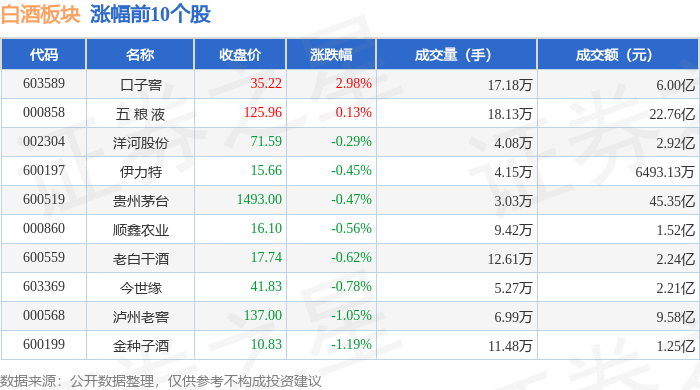
Core Viewpoint - The liquor sector is currently experiencing a dual bottom phase characterized by "fundamental bottoming and low valuation," with a gradual easing of previous policy pressures and a potential weak recovery in demand driven by consumption expansion policies [1] Group 1: Market Performance - On September 17, the Shanghai Composite Index closed at 3876.34 points, up 0.37% [1] - The liquor sector index closed at 2353.15 points, down 1.32%, with 18 liquor stocks declining, led by Jinhui Liquor which fell by 3.23% [1] Group 2: Individual Stock Performance - Kweichow Moutai closed at 1493.00 CNY per share, down 0.47% [1] - Wuliangye closed at 125.96 CNY per share, up 0.13% [1] - Shanxi Fenjiu closed at 204.45 CNY per share, down 1.89% [1] - Luzhou Laojiao closed at 137.00 CNY per share, down 1.05% [1] - Yanghe Brewery closed at 71.59 CNY per share, down 0.29% [1] Group 3: Analyst Insights - Pacific Securities noted that the liquor sector is in a phase of "fundamental bottoming and low valuation," suggesting a potential for recovery as policy pressures ease and consumption expansion policies take effect [1]

白酒板块2025年中报业绩综述:报表释压,加速筑底
Minsheng Securities· 2025-09-17 10:35
Investment Rating - The report suggests a recommendation for strong brands such as Guizhou Moutai, Wuliangye, and Luzhou Laojiao, as well as Shanxi Fenjiu, which has a clear growth path in a counter-cyclical environment [5]. Core Insights - The industry is currently in a phase of accelerated bottoming, transitioning from "passive clearing" to "active adjustment" due to ongoing pressures from excess supply and demand scenarios [3][5]. - The first half of 2025 saw a negative growth in revenue and net profit for major liquor companies, marking the first negative growth in this cycle [15]. - The report highlights a structural opportunity during the volume adjustment period, with market pricing increasingly favoring dividend yield and market share [3][5]. Summary by Sections Industry Overview - The white liquor industry faced challenges in the first half of 2025, including slow macroeconomic recovery and strict alcohol prohibition policies, leading to a decline in consumption scenarios and continued pressure on demand [5]. - The overall revenue and net profit for 17 major liquor companies were 2368.3 billion and 944.6 billion respectively, with a year-on-year decline of 0.4% and 0.9% [15]. Performance Analysis - In Q2 2025, the revenue and net profit for the industry were 867.2 billion and 313.4 billion respectively, reflecting a year-on-year decline of 4.7% and 7.3%, marking the first negative growth in revenue during this cycle [15]. - High-end liquor maintained positive growth, while the mid-range and regional brands experienced declines [20][22]. Market Dynamics - The report indicates that the market is shifting focus from short-term recovery scenarios to verifying the bottom of demand trends through year-on-year comparisons [3]. - The report anticipates a recovery in the third quarter, driven by seasonal consumption events such as Mid-Autumn Festival and National Day, which may accelerate the bottoming process of the fundamentals [5]. Investment Recommendations - The report recommends focusing on brands with strong market positions and growth potential, including Guizhou Moutai, Wuliangye, Luzhou Laojiao, and regional leaders like Guyi Gongjiu and Jinhui Jiu [5].


暴跌2226.38%!老板担心“卖不动”,金种子酒业绩大滑坡
Sou Hu Cai Jing· 2025-09-17 08:52
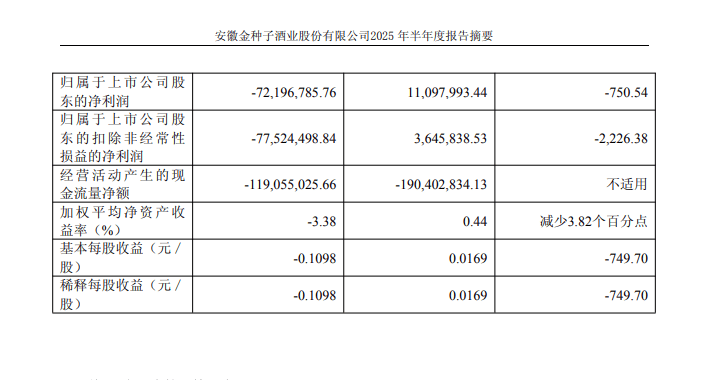
Core Viewpoint - The performance of the liquor industry, particularly for the company Jinzhongzi Liquor, has significantly declined in the first half of the year, with many companies experiencing revenue drops exceeding 20% [1][9]. Financial Performance - Jinzhongzi Liquor reported a revenue decline of 27.47%, from 667 million yuan in the same period last year to 484 million yuan [2][5]. - The net profit turned into a loss of 72.2 million yuan, a decrease of over 750% compared to a profit of 11.1 million yuan in the previous year [2][3]. - The net profit after excluding non-recurring gains and losses was -77.5 million yuan, a decline of 2226.38% [2][3]. Product Performance - The company’s product categories saw a significant revenue drop, with low-end liquor revenue decreasing by 32.77% to 251 million yuan, while mid-range liquor revenue fell by 19.72% to 113 million yuan [5][6]. - High-end liquor showed a slight increase in revenue, reaching 37.3 million yuan, a growth of 0.64% [5][7]. Marketing and Sales Strategy - Jinzhongzi Liquor spent nearly 47 million yuan on advertising in the first half of the year, with sales expenses increasing by 18.44% to 151 million yuan [7][8]. - The company attempted to raise prices on its low-end liquor products by 5% to 8%, but this led to a significant drop in sales volume, with a month-on-month sales decline of 18% [6][7]. Management Changes - The sudden resignation of the general manager, He Xiuxia, occurred last month, with the deputy general manager Liu Fubi taking over [8][9]. - He Xiuxia had been a key figure in implementing reforms after the strategic investment from China Resources Holdings [8][9]. Industry Context - The overall trend in the liquor industry shows a decline in revenue and net profit for most listed companies, with only a few, like Moutai and Jinhuijiu, reporting growth [10][11].

白酒板块9月17日跌0.62%,金徽酒领跌,主力资金净流出15.51亿元
Zheng Xing Xing Ye Ri Bao· 2025-09-17 08:42
证券之星消息,9月17日白酒板块较上一交易日下跌0.62%,金徽酒领跌。当日上证指数报收于3876.34, 上涨0.37%。深证成指报收于13215.46,上涨1.16%。白酒板块个股涨跌见下表: 从资金流向上来看,当日白酒板块主力资金净流出15.51亿元,游资资金净流入5.6亿元,散户资金净流入 9.9亿元。白酒板块个股资金流向见下表: | 代码 | 名称 | 主力净流入 (元) | 主力净占比 游资净流入 (元) | | 游资净占比 散户净流入 (元) | | 散户净占比 | | --- | --- | --- | --- | --- | --- | --- | --- | | 603589 | □子窖 | 9363.61万 | 15.59% | -4275.91万 | -7.12% | -5087.70万 | -8.47% | | 600197 | 伊力特 | -471.03万 | -7.25% | 64.88万 | 1.00% | 406.15万 | 6.26% | | 600696 | *ST岩石 | -719.67万 | -19.62% | -185.78万 | -5.06% | - 905.45 ...
内蒙古乌兰察布市市场监管局联合多部门开展酒类打假行动
Zhong Guo Zhi Liang Xin Wen Wang· 2025-09-17 08:38
Core Viewpoint - The article highlights a crackdown on counterfeit alcoholic beverages in Ulanqab City, Inner Mongolia, aimed at maintaining market order and protecting consumer rights and intellectual property [1] Group 1: Regulatory Actions - The Ulanqab Market Supervision Administration, in collaboration with the Public Security Bureau and major liquor manufacturers, has launched a special anti-counterfeiting operation in the lead-up to the Mid-Autumn Festival and National Day [1] - The operation involved identifying key areas and venues for liquor sales, including tobacco and liquor specialty stores and dining establishments, to ensure targeted and efficient enforcement [1] Group 2: Inspection and Enforcement - A total of 8 liquor retail units were inspected during the operation, leading to the seizure of counterfeit products confirmed by manufacturers [1] - Further investigations are being conducted into the suspected illegal activities of the involved retail units [1] Group 3: Future Actions - The Ulanqab Market Supervision Administration plans to maintain a high-pressure stance against counterfeit liquor, enhance inter-departmental collaboration, and increase daily supervision [1] - There will be a focus on consumer education to improve their ability to identify counterfeit products, contributing to a safer and more orderly consumption environment [1]
百润股份实控人转让6%股份套现14.7亿:预调鸡尾酒销量不断下滑 威士忌业务潜力有待检验
Xin Lang Cai Jing· 2025-09-17 04:06
Core Viewpoint - Liu Xiaodong, the controlling shareholder of Bairun Co., has transferred 6.01% of his shares to Liu Jianguo for 1.47 billion yuan, marking his first significant reduction since 2019 amid declining sales in the pre-mixed cocktail segment and the nascent whiskey business [1][2][4]. Group 1: Share Transfer Details - Liu Xiaodong transferred 63 million shares, representing 6.01% of the total share capital, to Liu Jianguo at a price of 23.337 yuan per share, which is a 7.54% discount to the closing price of 25.24 yuan on September 10 [1][2]. - Following the transfer, Liu Xiaodong retains a 34.58% stake in Bairun Co., while Liu Jianguo becomes a significant shareholder with 6.01% [1][2]. - Liu Jianguo's acquisition is characterized as a long-term financial investment, with no intention to participate in company management or appoint board members [2]. Group 2: Business Performance and Challenges - Bairun Co. has experienced a continuous decline in its main business, with a 6.61% revenue drop in 2024 and an 8.56% decline in the first half of the year [4][5]. - The revenue from pre-mixed cocktails, including sparkling water, was 2.677 billion yuan in 2024, down 7.18% year-on-year, with sales volume decreasing by 8.81% [4][5]. - The company faces significant challenges in sales channels, primarily relying on offline sales, which have been impacted by reduced foot traffic in supermarkets [5]. Group 3: Whiskey Business Potential - Bairun Co. is expanding its whiskey production capacity, having raised funds for whiskey aging projects, with an expected increase of 33,800 kiloliters in whiskey raw material capacity [6][7]. - The company plans to launch two whiskey products in November 2024, with additional products scheduled for release in 2025, indicating a potential shift in focus to whiskey as a second growth curve [7][8]. - The domestic whiskey market is highly competitive, with foreign brands dominating and a growing number of local companies entering the market [7][8].

中国白酒行业 - 第三季度前瞻 - 理性发货下的低谷,需求仍与政策、宏观相关;股价反映市场情绪触底-China Spirits_ 3Q Preview_ trough on rational shipment w_demand still tied to policy_macro; ;stocks reflect sentiment bottoming,
2025-09-17 01:51
Summary of Conference Call on China Spirits Industry Industry Overview - The spirits industry in China is currently facing challenges due to the ongoing impact of the anti-extravagance policy, which has affected consumer demand and retail momentum. [1][2][11] - The third quarter of 2025 (3Q25) is expected to be the trough for the industry, with a projected sales decline of 5% to 27% across various brands, excluding Moutai and Jiugui. [1][2][21] Key Points and Arguments Demand and Sales Trends - Retail momentum is anticipated to remain weak, particularly during the peak season due to fewer holiday days compared to previous years. [1] - A significant decline in retail volume is expected, with estimates of a 30% drop in August and a 15-20% decline during the peak season. [11] - The wholesale pricing remains under pressure, with notable declines in prices for key brands like Feitian Moutai and Common Wuliangye. [19][27] Shipment and Inventory Management - Spirits companies are prioritizing channel health by implementing deeper destocking and tighter shipment controls to ease distributor financing burdens. [1][2] - The trend of controlling shipments is crucial for maintaining channel inventory and supporting wholesale prices, especially for high-end spirits. [18][27] Financial Forecasts and Revisions - Sales and net profit forecasts for super-premium and upper-mid-end spirits have been revised down by up to 6% and 17% respectively for 2025E-27E. [2][42] - Despite the cautious outlook, target multiples have been raised by 9-19% to reflect a more normalized valuation level amid market re-rating. [2] Product Strategy and Market Positioning - Companies are focusing on product strategy to navigate the current market challenges, including reinforcing mid-end and mass portfolios and innovating lower-degree liquor products for younger consumers. [11] - The emphasis on residential banquets and product mix shifts is seen as a potential catalyst for recovery. [11] Dividend and Shareholder Returns - There is potential for enhancement in shareholder returns, with increased dividend payout forecasts for companies like Wuliangye. [11][43] Additional Important Insights - The anti-extravagance policy's impact is expected to gradually normalize, potentially boosting sentiment during the 2026 Chinese New Year holiday season. [11] - The affordability of high-end spirits has improved, which may support residential demand as policy headwinds ease. [31] - The spirits sector has seen a rotation towards laggards, indicating a market sentiment shift towards recovery narratives. [12][42] Conclusion - The China spirits industry is navigating a challenging environment with significant policy impacts affecting demand and pricing. However, strategic adjustments in shipment control, product offerings, and potential improvements in affordability may provide pathways for recovery in the coming years. [1][2][11][12]
白酒降度“低调”如何激活市场活力
Bei Jing Shang Bao· 2025-09-17 00:09
Core Viewpoint - The Chinese liquor industry is shifting from a "business necessity" to a "lifestyle enjoyment" approach, with many companies launching lower-alcohol products to attract younger consumers and enhance market vitality [2][3][4]. Group 1: Industry Trends - Several major liquor companies, including Wuliangye, Luzhou Laojiao, and Shui Jing Fang, are actively introducing lower-alcohol products, indicating a trend towards product diversification and market adaptation [2][3]. - The market for low-alcohol liquor is projected to grow significantly, from approximately 20 billion yuan in 2020 to about 57 billion yuan in 2024, with an expected compound annual growth rate of 30% [4]. Group 2: Consumer Demographics - The primary consumer demographic for liquor is shifting, with older generations gradually exiting the market, while younger consumers, particularly those born after 1985, are becoming the main growth drivers [3][4]. - The younger generation prefers personalized, lower-alcohol, and social drinking experiences, which necessitates a strategic shift for liquor companies to engage this demographic effectively [3][5]. Group 3: Marketing and Sales Strategies - Companies need to adopt innovative marketing strategies, utilizing new media and experiential marketing to resonate with younger consumers and stimulate brand engagement [5][6]. - The current market faces challenges, including a lack of consumption scenarios for low-alcohol products and limited channel profitability, which may hinder sales unless companies implement supportive policies [5][6]. Group 4: Future Directions - Lowering alcohol content is seen as a starting point for companies to connect with younger consumers, but deeper engagement with consumer preferences and behaviors is essential for long-term success [6]. - The industry is entering a new era characterized by rational consumption attitudes, where understanding and responding to the needs of younger consumers will be crucial for driving growth [6].