
陕西煤业

Search documents
周期类价值风格强势回归,不含银行地产的自由现金流ETF备受关注
Xin Lang Cai Jing· 2025-08-12 03:19
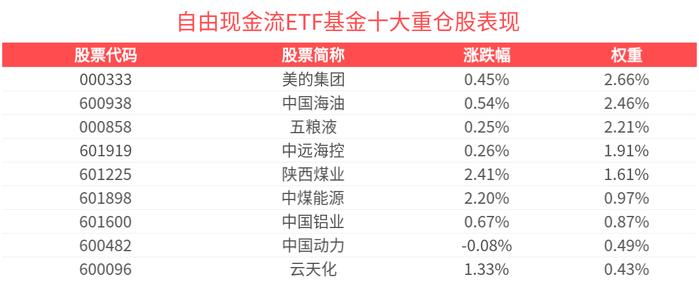
Core Insights - The CSI All Share Free Cash Flow Index (932365) has shown a positive performance, with a 0.42% increase as of August 12, 2025, and notable gains in constituent stocks such as Xinpeng Co., Ltd. (10.02%) and Feiyada (10.01%) [1][2] - The Free Cash Flow ETF (159233) has also performed well, rising 0.56% and achieving an 8-day consecutive increase, with a latest price of 1.08 yuan [1] - The Free Cash Flow ETF has demonstrated strong liquidity, with a turnover rate of 3.68% and a total transaction volume of 566.95 million yuan on August 11, 2025 [1] - The ETF has shown a historical average monthly return of 2.20% since inception, with a maximum monthly return of 4.04% and a winning percentage of 88.89% [1][2] Performance Metrics - The maximum drawdown for the Free Cash Flow ETF since inception is 3.28%, with a relative benchmark drawdown of 0.16% [2] - The management fee for the Free Cash Flow ETF is set at 0.50%, while the custody fee is 0.10% [2] - The CSI All Share Free Cash Flow Index tracks 100 high free cash flow rate listed companies, reflecting the overall performance of companies with strong cash flow generation capabilities [2] Top Holdings - As of July 31, 2025, the top ten weighted stocks in the CSI All Share Free Cash Flow Index account for 57.53% of the index, including China National Offshore Oil Corporation (2.46%), COSCO Shipping Holdings (1.91%), and Wuliangye (2.21%) [2][4] - The detailed performance of selected stocks includes Midea Group (0.45%), Shaanxi Coal and Chemical Industry (2.41%), and China Aluminum (0.67%) [4]

陕煤集团:打出改革“组合拳” 塑造发展新优势
Zhong Guo Hua Gong Bao· 2025-08-12 02:42
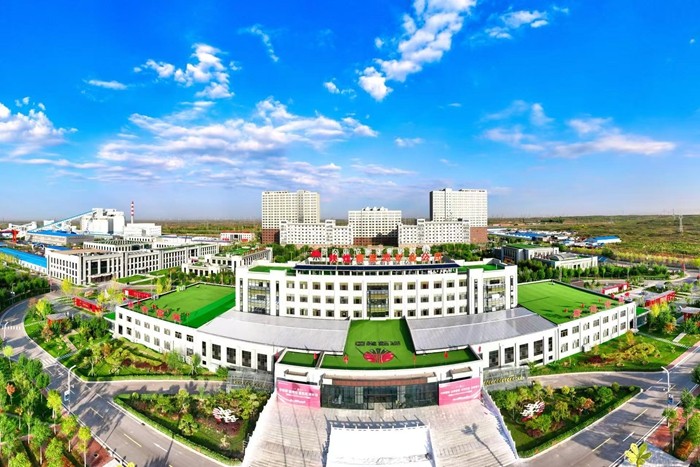
Core Viewpoint - Shaanxi Coal and Chemical Industry Group (Shaanxi Coal Group) is actively implementing reforms and innovative measures to enhance its core functions and competitiveness, focusing on industry transformation, innovation-driven development, corporate governance, and risk prevention [1][4]. Group 1: Investment and Projects - The Yulin Chemical project, with a total investment of 176 billion yuan, aims to convert raw coal into 45 high-value products, achieving a profit of 1.68 billion yuan from its first phase [3]. - The company is advancing major projects in coal chemical integration and supercritical coal-fired power generation, contributing to the formation of new industrial clusters in new energy and materials [4]. - The company plans to invest in 49 strategic emerging industry projects in 2025, accounting for 49.5% of its total annual investment projects [7]. Group 2: Technological Innovation - Shaanxi Coal Group has established 33 intelligent mines, achieving a coal production capacity of 99% through automation and innovation [9]. - The company has made significant breakthroughs in high-end materials and aerospace products, with its carbon fiber holding a domestic market share of 1st and global share of 2nd [9]. - The group has achieved a 165% year-on-year increase in revenue from technology transfer, totaling 890 million yuan in the first half of the year [10]. Group 3: Corporate Governance and Reform - The company has implemented a performance-based salary system, with a maximum salary difference of 1.4 times, enhancing employee motivation [12]. - Shaanxi Coal Group has optimized its organizational structure, reducing the number of departments by 13.4% and personnel by 18% [12]. - The company has established a governance model that integrates party leadership with corporate governance, ensuring effective decision-making [12]. Group 4: Financial Performance - In the first half of 2025, Shaanxi Coal Group produced 129 million tons of coal and achieved a revenue of 227.5 billion yuan, with a profit of 18.04 billion yuan [21]. - The company has reduced its asset-liability ratio to a historical low of 64.5% through effective financial management [16]. - The group has completed the collection of overdue debts amounting to 9.4 billion yuan over the past two years [16]. Group 5: Future Outlook - Shaanxi Coal Group plans to advance 99 projects with a total investment of 410 billion yuan, focusing on coal, chemical, and power industries while also exploring new energy and materials [22].

煤炭行业2025年中期策略:反转,不是反弹
GOLDEN SUN SECURITIES· 2025-08-12 01:16
Market Performance - The coal sector has underperformed, with the CITIC Coal Index declining by 10.77% from the beginning of 2025 to June 30, 2025, lagging behind the CSI 300 Index by 10.80 percentage points, ranking last among 30 industries [1][14][15] - The decline is attributed to weak demand for thermal power, leading to a continuous drop in coal prices and a significant decrease in coal company profits, raising concerns about the sustainability of high dividends in the coal industry [1][15] Fund Holdings - As of the end of Q2 2025, the proportion of active funds holding coal stocks decreased to 0.36%, down 0.08 percentage points from Q1 2025. Index funds' holdings also fell to 0.71%, a decrease of 0.12 percentage points [1][19] - The combined holding of both types of funds in the coal sector is now 0.52%, down 0.09 percentage points from Q1 2025 [1][19] Cost Perspective on Coal Price Valuation - The complete cost curve for 16 listed thermal coal companies indicates that the complete cost per ton of coal is approximately 390 CNY/ton, suggesting a port price of 640 CNY/ton. The port coal price fell to 618 CNY/ton in early June, indicating that over 20% of coal production capacity could face losses at this price level [2] - The current coal price is considered low in terms of valuation, as it is near the cost line, which could lead to production cuts if prices remain below cost [2] Historical Policy Interventions - Historical analysis shows that significant policy interventions were necessary for coal price reversals in 2008, 2015, and 2020. Each price bottom was accompanied by government actions to stimulate demand or control supply [3] - The report emphasizes that policy intervention is a necessary condition for coal price recovery, with expectations for potential government actions to support prices in the current context [3] Thermal Coal Price Outlook - The report suggests that the current thermal coal price of 618 CNY/ton may represent a bottom, with potential for recovery driven by improved demand in the second half of 2025 [4][6] - Two scenarios are outlined: an optimistic scenario where demand improves significantly, and a pessimistic scenario where demand remains weak, potentially leading to further price declines [6] Coking Coal Market Dynamics - The coking coal market has seen significant price drops due to supply-demand imbalances, with low-sulfur coking coal prices falling to around 1100 CNY/ton. The report indicates that this decline has already reflected market expectations [5][7] - The report highlights the importance of inventory rebuilding and the enforcement of production limits to support price recovery in the coking coal market [7] Investment Recommendations - The report recommends focusing on major coal enterprises such as China Shenhua and China Coal Energy, as well as companies with significant earnings elasticity like Lu'an Huanneng and Jinneng Holding [8] - The report also notes the potential for price recovery in coking coal, with expectations for prices to rise to a range of 1500-2000 CNY/ton in the long term [7][8]


煤炭行业周报:煤价涨幅扩大,上冲700有可期-20250811
Datong Securities· 2025-08-11 14:30
Investment Rating - The report rates the coal industry as "Positive" [1] Core Views - The report indicates that coal prices are expected to continue rising due to supply constraints and increased demand from power plants, with a notable week-on-week increase in daily coal consumption by 11% [4][11][39] - The report highlights that the coking coal prices are also anticipated to rise, driven by supply reductions and strong demand from steel mills, particularly in the context of pre-holiday stockpiling [24][39] Summary by Sections Market Performance - The equity market showed a general upward trend, with the coal sector outperforming the index, as the coal industry index rose by 3.65% during the week [5][39] - Major coal companies saw significant stock price increases, with Shaanxi Coal Industry leading at 9.90% [5] Thermal Coal - Thermal coal prices are on the rise, with supply constraints due to extreme weather affecting production in key regions [10][11] - The report notes that the utilization rate of thermal coal mines is at 89.9%, indicating a slight decrease, and that imports are also declining due to price competitiveness [10][12] Coking Coal - Coking coal prices are expected to continue increasing, supported by strong demand from steel production and low inventory levels [23][24] - The report mentions that the average operating rate of coking coal mines is at 85.0%, reflecting a decrease in production capacity [23][28] Shipping Situation - The number of vessels at anchor in the Bohai Sea has significantly decreased, leading to an increase in shipping rates for coal [32] Industry News - The report discusses the resumption of premium coal exports by China Pingmei Shenma Group and the successful trial of a heavy-load railway by the National Energy Group [35][36]
煤炭开采行业周报:超产核查逐步展开叠加需求高位,动力煤价有望持续修复-20250811
CMS· 2025-08-11 14:08
Investment Rating - The report maintains a "Recommended" rating for the coal mining industry, indicating a positive outlook for the sector [5]. Core Views - The report highlights that the thermal coal market prices continue to rise, with significant increases observed in various indices as of August 8, 2025. For instance, the Yulin 5800 kcal index reached 569.0 CNY/ton, up 24.0 CNY/ton week-on-week [11][12]. - The report notes that the coal market is operating steadily with a slight upward trend, driven by supply constraints due to production checks and adverse weather conditions affecting mining operations. Downstream demand remains robust, particularly from power plants, which are increasing their coal procurement [11][12]. - The report anticipates that the supply will continue to tighten due to overproduction policies, and with high temperatures persisting nationwide, the daily coal consumption by power plants is expected to remain elevated, making thermal coal prices more likely to rise than fall [11][12]. Summary by Sections 1. Investment Views - The thermal coal market is experiencing price increases, with key indices showing significant week-on-week gains. The focus is on the supply-side constraints and strong downstream demand [11][12]. 2. Coal Sector Performance and Stock Review - The report indicates that the CSI 300 index rose by 1.23%, while the coal mining and washing index increased by 3.96%. Major coal companies like Shaanxi Coal and China Shenhua have shown notable stock performance [12][15]. 3. Important Announcements and News - Shaanxi Coal reported a 1.1% year-on-year increase in coal production for July, totaling 14.11 million tons. Nationally, coal imports in July decreased by 22.9% year-on-year but increased by 7.8% month-on-month [15][17][18]. 4. Dynamic Data Tracking - The report provides detailed tracking of coal prices, with significant increases noted in various coal types, particularly thermal coal and coking coal, reflecting market trends and supply-demand dynamics [19][21][28]. 5. Key Company Valuations - The report includes valuations for major coal companies, highlighting their market capitalizations and projected earnings, with China Shenhua leading with a market cap of 732.31 billion CNY and a projected net profit of 586.7 million CNY for 2024 [42].
超2000亿元险资加速入市
2 1 Shi Ji Jing Ji Bao Dao· 2025-08-11 13:52
Core Viewpoint - The recent approval for China Taiping's subsidiary to establish a private equity fund management company marks a significant advancement in the long-term investment reform pilot for insurance funds, indicating an acceleration in insurance capital entering the market [2][4]. Group 1: Investment Reform Pilot - The long-term investment reform pilot for insurance funds has seen three batches of approvals, with a total scale of 222 billion yuan (approximately 31.5 billion USD) [4][5]. - The first batch was approved in October 2023, with China Life and Xinhua Life jointly investing 50 billion yuan [4]. - The second batch, initiated in January 2025, allowed several insurance companies to participate with a total scale of 520 billion yuan [5]. - The third batch, approved in March 2025, included additional participants with a total scale of 600 billion yuan [5]. Group 2: Investment Strategies and Trends - Insurance funds are increasingly favoring large-cap blue-chip stocks and high-dividend yielding companies, reflecting a shift towards stable and well-governed investment targets [7][9]. - The types of funds being established are diversifying, with both company-type and contract-type funds being utilized, enhancing the flexibility and standardization of fund management [7][8]. - The investment focus includes sectors such as finance, energy, public infrastructure, and new energy transitions, aligning with national economic development goals [9]. Group 3: Market Participation and Trends - Insurance capital has been actively participating in the stock market, with a notable increase in stock holdings, reaching a market value of 2.65 trillion yuan (approximately 375 billion USD) in the first quarter of 2024 [2][12]. - The number of equity stakes taken by insurance funds has surged, with 22 instances recorded in 2024 alone, surpassing the total for the previous year [11][12]. - The sectors attracting the most investment include public utilities and banking, characterized by stable returns and high dividend yields [11][12].






超2000亿元险资加速入市
21世纪经济报道· 2025-08-11 13:42
Core Viewpoint - The article discusses the recent progress in the pilot reform of long-term investment by insurance funds in China, highlighting the acceleration of insurance capital entering the market and the establishment of private equity funds by insurance companies [1][4]. Group 1: Pilot Reform Progress - The pilot reform of long-term investment by insurance funds has seen three batches approved, with a total scale of 222 billion yuan, involving major insurance companies such as China Life and New China Life [1][4]. - The first batch was approved in October 2023, with a total investment of 50 billion yuan fully deployed by March 2024 [4]. - The second batch, approved in January 2025, involved 520 billion yuan, while the third batch, approved in March 2025, added another 600 billion yuan, bringing the cumulative approved scale to 222 billion yuan [4]. Group 2: Investment Strategies and Trends - Insurance companies are increasingly favoring large-cap blue-chip stocks and high-dividend yielding companies, with a focus on stable governance and operational performance [6][8]. - The types of funds established under the pilot reform are diversifying, with both company-type and contract-type funds being utilized, allowing for easier standardization and management [6][7]. - The article notes a trend of insurance capital actively participating in local infrastructure projects, exemplified by the establishment of the "Ping An Fund" in Shenzhen, which allocates 90% of its capital to local projects [7][8]. Group 3: Market Impact and Investment Behavior - There has been a notable increase in insurance capital's market participation, with 22 instances of shareholding increases recorded in 2024 alone, surpassing the total for the previous year [10][11]. - The sectors attracting insurance capital include public utilities and banking, characterized by high dividend yields and stable return on equity [10][11]. - The article highlights that insurance companies are facing challenges in investment decisions due to new financial regulations, prompting a shift towards long-term stock investments to stabilize returns [11].
中证周期稳健成长50指数下跌0.2%,前十大权重包含中国石油等
Sou Hu Cai Jing· 2025-08-11 13:07
Group 1 - The core index, the China Securities Index 50 for cyclical steady growth, has shown a recent performance with a 0.34% increase in the Shanghai Composite Index and a 0.2% decrease in the cyclical index, closing at 1705.34 points with a trading volume of 20.543 billion yuan [1] - Over the past month, the cyclical index has increased by 6.05%, by 10.01% over the last three months, and by 1.81% year-to-date [1] - The cyclical index comprises 50 companies with low price-to-book ratios, high revenue growth, and high return on equity (ROE), reflecting the overall performance of cyclical industry companies with valuation advantages and growth potential [1] Group 2 - The top ten weighted companies in the cyclical index include China State Construction (9.33%), China Petroleum (9.24%), COSCO Shipping Holdings (9.14%), Shaanxi Coal and Chemical Industry (8.12%), Huayou Cobalt (5.93%), China Aluminum (5.78%), Hualu Hengsheng (3.5%), Satellite Chemical (3.14%), Shenhuo Holdings (2.88%), and Nanshan Aluminum (2.78%) [1] - The market capitalization distribution of the cyclical index shows that the Shanghai Stock Exchange accounts for 75.77% and the Shenzhen Stock Exchange accounts for 24.23% [1] - In terms of industry composition, raw materials represent 40.34%, energy 29.38%, industrials 29.11%, and real estate 1.17% [2] Group 3 - The cyclical index samples are adjusted biannually, with adjustments occurring on the next trading day after the second Friday of June and December each year [2] - Weight factors are generally fixed until the next scheduled adjustment, with special circumstances allowing for temporary adjustments [2] - Companies that are delisted or undergo mergers, acquisitions, or spin-offs are handled according to calculation and maintenance guidelines [2]



8月11日汇添富沪深300安中指数A净值增长0.51%,近3个月累计上涨8.99%
Sou Hu Cai Jing· 2025-08-11 13:07
金融界2025年8月11日消息,汇添富沪深300安中指数A(000368) 最新净值1.9755元,增长0.51%。该基金 近1个月收益率4.47%,同类排名1935|3935;近3个月收益率8.99%,同类排名2177|3717;今年来收益率 5.35%,同类排名2609|3294。 简历显示:吴振翔先生:中国国籍,中国科学技术大学管理学博士,中国科学院数学与系统科学院应用数学 专业博士后。曾任长盛基金管理有限公司金融工程研究员、上投摩根基金管理有限公司产品开发高级经 理。2008年3月加入汇添富基金管理股份有限公司,历任产品开发高级经理、数量投资高级分析师、基金 经理助理,现任指数与量化投资部副总监。2010年2月6日至今任汇添富上证综合指数证券投资基金的基 金经理。2011年9月16日至2013年11月7日任深证300交易型开放式指数证券投资基金的基金经理。2011 年9月28日至2013年11月7日任汇添富深证300交易型开放式指数证券投资基金联接基金的基金经理。 2013年8月23日至2015年11月2日任中证金融地产交易型开放式指数证券投资基金的基金经理。2013年8 月23日至2015年11月2 ...
又一险资系私募获批 超两千亿“长钱”加速入市
2 1 Shi Ji Jing Ji Bao Dao· 2025-08-11 10:56
Core Viewpoint - The recent approval for China Taiping's subsidiary to establish a private equity fund marks a significant advancement in the long-term investment reform pilot for insurance funds, accelerating their entry into the capital market [1][2]. Group 1: Investment Reform Pilot - The long-term investment reform pilot for insurance funds has seen three batches of approvals, with a total scale of 222 billion yuan (approximately 31.5 billion USD) [2][3]. - The first batch, approved in October 2023, involved China Life and Xinhua Life jointly investing 50 billion yuan (approximately 7 billion USD) to establish the Honghu Fund, which was fully invested by early March 2024 [2]. - The second batch, initiated in January 2025, allowed several insurance companies to participate with a total scale of 520 billion yuan (approximately 73.5 billion USD) [3]. Group 2: Fund Management and Strategy - Taiping Asset aims to establish a robust fund management framework and investment strategies tailored to insurance funds, emphasizing long-term capital deployment to support national strategies and the real economy [2][4]. - The types of funds have diversified, with a mix of company-type and contract-type funds, enhancing the flexibility and standardization of fund operations [4][5]. Group 3: Investment Preferences - Insurance funds are increasingly favoring large-cap blue-chip stocks with stable governance and dividends, focusing on sectors such as finance, energy, public infrastructure, and new energy transitions [6][7]. - The investment strategy includes a significant allocation towards companies with high dividend yields, with an average historical dividend yield of 5.3% for companies targeted in recent investments [7][8]. Group 4: Market Activity and Trends - There has been a notable surge in insurance capital's market activity, with 22 instances of shareholding increases recorded in 2024, surpassing the total for the previous year [7]. - The sectors attracting the most investment include public utilities and banking, characterized by stable earnings and high dividend payouts [7][8].