
智谱

Search documents
OpenAI据悉正在开发一款对标苹果AirPods的人工智能设备;智谱联合华为开源首个国产芯片训练的多模态SOTA模型丨AIGC日报
创业邦· 2026-01-15 00:26
Group 1 - OpenAI is reportedly developing an AI device to compete with Apple's AirPods, internally codenamed Sweetpea, with expectations for features like phone calls and audio playback [2] - Zhizhu and Huawei have open-sourced a new generation multimodal SOTA model, GLM-Image, which is the first to complete full training on domestic chips, with a cost of 0.1 yuan per image generation [2] - A new AI model named SleepFM, developed by researchers at Stanford University, can predict the risk of approximately 130 diseases based on sleep data, utilizing data from 65,000 participants [2] Group 2 - MiniMax has open-sourced a new evaluation set for Coding Agents called OctoCodingBench, revealing that while all models can achieve over 80% Check-level accuracy, Instance-level success rates are only between 10% and 30% [2]

四条“战线”齐头并进,港股冲刺AI企业聚集地
证券时报· 2026-01-15 00:17
Core Viewpoint - The Hong Kong stock market is emerging as a key hub for AI companies, with a significant increase in listings from Chinese AI firms, particularly in the GPU and software sectors, amidst the ongoing US-China tech rivalry [1][3][8]. Group 1: AI Companies and Market Dynamics - In 2026, several Chinese AI companies have listed on the Hong Kong Stock Exchange, including GPU leaders like Biren Technology and Tensyn, filling a gap in the GPU sector [1][3]. - The number of Hong Kong-listed companies related to AI has surpassed 40, categorized into four main "battle lines" [3]. - The first "battle line" focuses on the AI computing power industry, with Biren Technology being the first GPU company to list in Hong Kong, and Tensyn being the first to achieve mass production of general-purpose GPUs [3][4]. Group 2: AI Software and Applications - The second "battle line" involves AI software, highlighted by the listing of Zhipu AI, which has become one of the largest independent large model vendors in China, reporting revenue of 190 million yuan in the first half of 2025 [4]. - MiniMax, another AI company, saw its stock price surge by 109% on its first day of trading, with a market capitalization exceeding 100 billion HKD [4]. - Established companies like Meitu are also leveraging their AI technology to enhance their product offerings, indicating a robust presence in the AI software sector [4]. Group 3: AI Hardware and Robotics - The third "battle line" encompasses AI hardware, including smartphones and autonomous vehicles, with predictions that AI smartphone penetration will reach 34% by 2025 [5]. - Companies like BYD and Xiaomi are involved in the automotive sector, while over 30 robotics companies have applied to list in Hong Kong since December 2024, indicating a trend towards robotics firms seeking public funding [5][6]. Group 4: Internet Giants and AI Integration - The fourth "battle line" features major internet companies such as Alibaba and Tencent, which are enhancing their AI capabilities across various domains, including AI computing power and applications [6]. - The collective shift of these internet giants towards AI is establishing a solid foundation for the AI sector in the Hong Kong market [6]. Group 5: Strategic Positioning of Hong Kong - Hong Kong is becoming a crucial offshore hub for Chinese tech companies, providing a platform for international capital access amidst the US-China tech competition [8][9]. - The presence of significant foreign investors, including sovereign wealth funds from the Middle East and Asia, indicates a shift in capital sources towards a "non-US capital alliance" [9]. - The Hong Kong Stock Exchange's regulatory framework has become more accommodating for unprofitable tech companies, facilitating critical financing avenues for AI firms [10]. Group 6: Future Outlook and Challenges - The influx of AI companies is expected to elevate Hong Kong's status as a "hard tech financing hub," with projections indicating that new stock fundraising could exceed 280 billion HKD in 2025 [12]. - However, many AI companies may not achieve commercial viability until 2026 or 2027, posing risks of valuation corrections if revenue growth falls short of expectations [12][13]. - The Hong Kong market must address challenges such as sustaining high-quality asset supply and enhancing liquidity to fully realize its potential as a global tech financing center [13].

金十数据全球财经早餐 | 2026年1月15日
Jin Shi Shu Ju· 2026-01-14 22:56
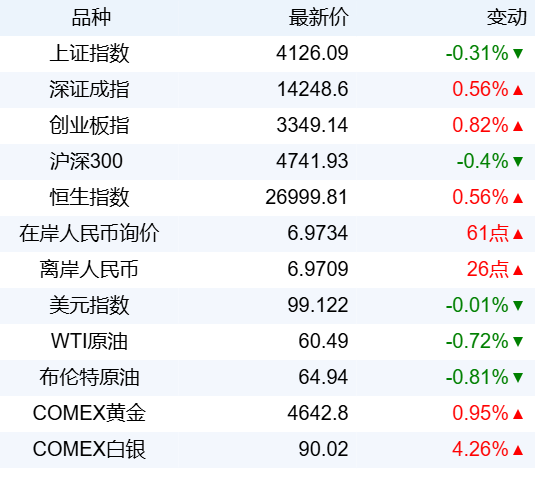
Group 1 - Trump announced a 25% tariff on imported chips not used for AI in the U.S. [10] - The U.S. Supreme Court has not ruled on the legality of Trump's tariffs, with the next decision window expected next week [9] - The gold price reached a historical high of $4628.14 per ounce, increasing by 0.92% [6] Group 2 - The adjustment of financing margin ratios from 80% to 100% by the Shanghai and Shenzhen stock exchanges [12] - The Hang Seng Index closed at 26999.81 points, up 0.56%, with significant activity in the AI healthcare sector [4] - The A-share market saw the Shanghai Composite Index drop by 0.31%, while the Shenzhen Component Index rose by 0.56% [5] Group 3 - The Nasdaq China Golden Dragon Index fell by 0.23%, with notable movements in individual stocks such as Alibaba, which rose by 1.7% [4] - The AI application sector showed strong performance across markets, while sectors like lithium and insurance faced declines [5]

11只新股登陆港交所 港股2026年开局火热
Shang Hai Zheng Quan Bao· 2026-01-14 17:53
Core Insights - The Hong Kong stock market has seen a resurgence in new IPOs, with 11 companies listed in 2026, all experiencing price increases on their debut, marking the best start in recent years for the new stock market [1][2] Group 1: New IPOs and Market Sentiment - The new IPOs include companies from popular sectors such as GPU, AI, and biomedicine, reflecting strong global capital interest in these areas [1][3] - Among the 11 companies listed, 10 had their public offerings oversubscribed by over 100 times, with 6 companies exceeding 1000 times, indicating high investor enthusiasm [1][2] - BBSB INTL, listed on the GEM board, achieved over 10,000 times subscription, with a debut price increase of over 400% [1] Group 2: Performance of Technology Companies - Companies in the tech sector, such as 壁仞科技 and MINIMAX-WP, received exceptionally high subscription rates, with figures of 2347.53 times and 1837.17 times respectively [2] - The performance of new stocks has improved significantly since December 2025, with no major instances of price drops on the first day of trading for the 2026 listings [2] Group 3: Funding and Future Prospects - The new listings have raised substantial capital, with 9 out of 11 companies raising over 1 billion HKD, and 5 companies raising over 4 billion HKD [4] - The pipeline for new listings remains strong, with over 300 companies waiting to go public, primarily in technology, biomedicine, and consumer sectors [4]
AI企业四条“战线”齐头并进 港股硬科技融资高地辨识度飙升
Zheng Quan Shi Bao· 2026-01-14 17:35
Core Viewpoint - The Hong Kong stock market is transforming into a key hub for Chinese AI companies, with a surge in listings from both hardware and software sectors, amidst the ongoing US-China tech rivalry [1][6]. Group 1: AI Hardware Sector - Hong Kong has seen significant activity in the AI hardware sector, with companies like Biren Technology and Tensynse Semiconductor going public, filling the gap in the GPU market [1][2]. - Biren Technology, known as the "first GPU stock in Hong Kong," focuses on high-end general-purpose GPUs and large-scale data center computing platforms [2]. - Tensynse Semiconductor is the first domestic company to achieve mass production of general-purpose GPUs, having delivered over 52,000 units by mid-2025 [2][3]. - Semiconductor manufacturing leader SMIC has become the third-largest foundry globally, with a 5% market share as of Q3 2025 [2]. Group 2: AI Software Sector - The AI software sector is also thriving, with companies like Zhipu AI and MiniMax making headlines. Zhipu AI has become one of the largest independent large model vendors in China, reporting revenue of 190 million yuan in the first half of 2025 [3]. - MiniMax, known as the "first global large model stock," saw its stock price surge by 109% on its debut, with a market capitalization exceeding 100 billion HKD [3]. - Established companies like Meitu are leveraging their AI technology to enhance their product offerings, creating a comprehensive AI application matrix [3]. Group 3: AI Hardware Applications - The AI hardware sector includes applications in smartphones, automobiles, and robotics, which are crucial for the widespread adoption of AI technologies [4]. - The penetration rate of AI smartphones is expected to reach 34% by 2025, with companies like Xiaomi and ZTE leading the market [4]. - In the automotive sector, companies like BYD and Xiaomi are positioned to benefit from the rapid advancement of autonomous driving technologies [4]. - Over 30 robotics companies have applied to list in Hong Kong since December 2024, indicating a trend of robotics firms seeking public funding [4]. Group 4: Internet Giants - Major internet companies such as Alibaba, Tencent, and Baidu are intensifying their AI investments, contributing to the overall growth of the AI sector in Hong Kong [5]. - Kuaishou's self-developed video generation model has achieved significant revenue milestones, showcasing the potential of internet giants in the AI landscape [5]. Group 5: Strategic Positioning of Hong Kong - Hong Kong is emerging as a strategic "buffer zone" for Chinese tech companies, providing a platform for international capital access amidst the US-China tech competition [6][7]. - The presence of Middle Eastern sovereign wealth funds among cornerstone investors in AI companies indicates a shift in capital sources, forming a new "non-US capital alliance" [6]. - The Hong Kong Stock Exchange's listing rules have become more accommodating for unprofitable tech companies, facilitating critical funding avenues for AI firms [7]. Group 6: Future Outlook - The influx of AI companies is expected to elevate Hong Kong's status as a "hard tech financing hub," with projections indicating that new stock fundraising could exceed 280 billion HKD in 2025 [8]. - The AI sector is anticipated to account for over 20% of the Hong Kong stock market within three years, potentially reshaping the traditional valuation framework [8]. - However, many AI companies may not achieve commercialization until 2026 or 2027, which could lead to valuation corrections if revenue growth falls short of expectations [8][9].
港股异动丨智谱高开超7%,联合华为开源首个国产芯片训练的多模态SOTA模型
Ge Long Hui· 2026-01-14 17:31
Core Viewpoint - Zhizhu (2513.HK) opened 7.1% higher at HKD 194.7, following the announcement of a collaboration with Huawei to launch the new generation image generation model GLM-Image, which is the first SOTA multimodal model fully trained on domestic chips [1] Group 1: Product Development - GLM-Image is based on the Ascend Atlas 800T A2 device and the MindSpore AI framework, completing the entire process from data to training [1] - The model employs an innovative "autoregressive + diffusion decoder" hybrid architecture, achieving a combination of image generation and language modeling [1] Group 2: Technological Significance - This development represents an important exploration for Zhizhu towards the new generation of "cognitive generation" technology paradigm, exemplified by the Nano Banana Pro [1]
新华财经晚报:沪深北交易所将融资保证金最低比例提高至100%
Xin Hua Cai Jing· 2026-01-14 16:46
Domestic News - The Shanghai and Shenzhen Stock Exchanges have adjusted the financing margin ratio, increasing the minimum financing margin ratio from 80% to 100% to help reduce leverage levels and protect investors' rights [1] - The China Association of Automobile Manufacturers forecasts that new energy vehicle sales in 2026 are expected to reach 19 million units, representing a year-on-year growth of 15.2% [1] - The domestic price of gold jewelry has surpassed 1435 CNY per gram, with various brands reporting price increases [2] International News - NASA plans to implement the "Artemis 2" manned lunar flight mission no earlier than February 6, marking the first crewed mission for the new generation lunar rocket [4] - The Bank of Japan will hold a market operations meeting on February 26, 2026, to discuss recent market developments and liquidity [4] - The Bank of Indonesia is intervening in the foreign exchange market due to concerns over the country's fiscal situation, which has led to the Indonesian rupiah nearing historical lows [4] Economic Data and Market Overview - In 2025, China's foreign trade is projected to reach 45.47 trillion CNY, growing by 3.8%, with exports at 26.99 trillion CNY (up 6.1%) and imports at 18.48 trillion CNY (up 0.5%) [2] - The inflation rate in Argentina for 2025 is reported at 31.5%, a decrease of 86.3 percentage points compared to 2024, marking the lowest level in eight years [5]
腾讯研究院AI速递 20260115
腾讯研究院· 2026-01-14 16:03
Group 1: US Export Control Regulations - The US Department of Commerce's Bureau of Industry and Security has relaxed export control regulations for high-performance chips, allowing for the export of Nvidia's H200 and AMD's MI325X to China under specific conditions [1] - The new regulations require applicants to demonstrate sufficient supply in the US market and that exports do not exceed 50% of total US sales, with projections indicating that the H200 could generate over $47.6 billion in revenue for Nvidia by 2026, including nearly $16 billion from the Chinese market [1] - Concurrently, the US House of Representatives passed the Remote Access Security Act, which may impact overseas data center projects by restricting access to advanced computing power for AI model training [1] Group 2: Google Veo 3.1 Upgrade - Google Veo 3.1 has been upgraded to support "material-based video" generation, allowing users to create high-quality videos by uploading images and text instructions, achieving unprecedented consistency in character representation [2] - The new version supports native 9:16 vertical output and industry-leading 1080p and 4K ultra-resolution technology, eliminating the need for post-editing and quality loss, making it suitable for platforms like YouTube Shorts [2] - This functionality has been introduced in YouTube Shorts and YouTube Create applications, with enhanced versions being pushed to Flow, Gemini API, Vertex AI, and Google Vids [2] Group 3: Zhiyuan and Huawei Collaboration - Zhiyuan has partnered with Huawei to open-source a new generation image generation model, GLM-Image, which is the first SOTA multimodal model trained on domestic chips [3] - The model employs an innovative "autoregressive + diffusion decoder" hybrid architecture, achieving first place in open-source rankings on CVTG-2K and LongText-Bench, with a Chinese text rendering score of 0.979 [3] - API calls for generating an image cost only 0.1 yuan, excelling in knowledge-intensive scenarios such as posters, PPTs, and Chinese character generation, and is available on GitHub and Hugging Face [3] Group 4: PixVerse R1 Release - Aishi Technology has released PixVerse R1, the world's first real-time world model capable of generating video at a maximum resolution of 1080P, allowing users to intervene in the video generation process in real-time [4] - The model is based on an Omni native multimodal foundational model, an autoregressive streaming generation mechanism, and an instant response engine, transforming video generation from "fixed segments" to "infinite visual streams" [4] - It defines a new form of "Playable Reality," making videos a continuously existing process that can be intervened in real-time, currently in beta testing with a selective invitation mechanism [4] Group 5: Vidu's One-Click MV Generation - Vidu AI has launched a "one-click MV" feature, enabling users to submit music, reference images, and text instructions for automatic output of a coherent, high-quality music video [6] - The system incorporates a deep collaborative multi-agent framework, including director, storyboard, visual generation, and editing agents, producing complete videos within minutes [6] - The "multi-image reference video generation" technology allows users to upload up to seven reference images, accurately replicating character features and aesthetic styles in videos up to five minutes long, achieving frame-level audio-visual integration [6] Group 6: 1X Company's NEO Robot - 1X Company has introduced a new "brain" for its home humanoid robot NEO, which learns the laws of physical world operation by watching vast amounts of online videos and human first-person operation recordings [7] - The model is based on a 14 billion parameter generative video model, employing a multi-stage training strategy that includes 900 hours of human first-person mid-training and 70 hours of embodied fine-tuning, generating successful task completion videos before executing actions [7] - The inverse dynamics model (IDM) is trained on 400 hours of unfiltered robot data, extracting corresponding action trajectories from generated videos, with official tweets surpassing 5 million views [7] Group 7: League of Legends Mysterious Player - A mysterious player in the Korean server achieved a 95% win rate, completing 56 matches in just 51 hours, with a record of 52 wins and 4 losses, rising from below Diamond to the top ranks [8] - This account used 22 different heroes in ranked matches, with a lane win rate of 86%, significantly outperforming the top ten players in the Korean server, sparking discussions about the player's identity possibly being linked to Elon Musk's AI [8] - Following T1's global championship win in 2025, Musk's challenge to top teams has led to speculation, with the true identity of the account remaining a mystery [8] Group 8: Google MedGemma 1.5 Release - Google Research has released MedGemma 1.5, which supports high-dimensional medical image analysis, including CT and MRI three-dimensional data and whole-slide digital pathology images [9] - The accuracy of disease classification in MRI has improved from 51% to 65%, with anatomical structure localization accuracy rising from 3% to 38%, and MedQA accuracy increasing from 64% to 69% [9] - The MedASR speech recognition model has been launched, achieving a word error rate of only 5.2% in chest X-ray report dictation scenarios, outperforming the general model Whisper by 82%, and is now available on Hugging Face and Vertex AI [9] Group 9: Google Cloud AI Director's Insights - The director of Google Cloud AI, Addy Osmani, raised five critical questions regarding the future of software engineering in the AI era, including the necessity of junior engineers and the relevance of computer science degrees [10][11] - A Harvard study indicated that the introduction of generative AI led to a 9%-10% decline in junior developer positions over six quarters, while senior engineer employment remained stable, with major tech companies reducing entry-level hiring by 50% [11] - Recommendations for junior engineers include building AI-integrated portfolios and manually coding key algorithms, while senior engineers should focus on architecture reviews to adapt to an "agent-based" engineering environment [11]
从智谱与MiniMax股东结构看科技金融生态演进
Zheng Quan Ri Bao· 2026-01-14 15:42
Core Viewpoint - The recent listings of Beijing Zhipu Huazhang Technology Co., Ltd. and MiniMax on the Hong Kong Stock Exchange mark a significant milestone as they become among the first AI large model companies to go public, attracting considerable market attention due to their impressive shareholder structures [1] Group 1: Shareholder Structure - The shareholder structure of both AI companies is characterized by three distinct layers: early-stage venture capital firms, industry-backed capital from major tech companies, and long-term "patient capital" from sovereign funds and insurance [1][2] - This multi-layered shareholder arrangement reflects a capital relay model that supports the growth of innovative enterprises, indicating a mature financial ecosystem for technology innovation in China [1][2] Group 2: Role of Different Capital Types - The integration of various types of capital, including risk capital, industry capital, and patient capital, is essential for supporting technology innovation, particularly in high-risk sectors like AI [2] - Early-stage venture capital takes on high risks, while industry capital connects to commercialization paths, and patient capital focuses on long-term returns after technology barriers are established [2] Group 3: Commercialization Challenges - The primary challenge for innovative companies, especially in hard technology, lies in the commercialization phase rather than in technology development [3] - Major industry players like Alibaba and Tencent play a crucial role by integrating cutting-edge technologies into their vast business ecosystems, creating a symbiotic relationship that enhances both investment and technological application [3] Group 4: Importance of Patient Capital - The introduction of patient capital, such as sovereign funds and insurance, prior to a company's IPO serves as a strategic anchor and aids in managing expectations, stabilizing market confidence amid volatility in the tech sector [4] - This type of capital is crucial for fostering a stable investment environment that supports the long-term growth of innovative enterprises [4] Group 5: New Financing Paradigm - The diverse shareholder composition behind Zhipu and MiniMax illustrates the evolving financial ecosystem in China, outlining a new financing paradigm characterized by market discovery, industry empowerment, and long-term support [4] - Continuous optimization of institutional design is necessary to ensure that various types of capital effectively collaborate within the innovation chain, thereby enhancing the financial support for high-level technological self-reliance [4]
智谱、MiniMax港股上市催化GEO行情 AI应用商业化节奏有望提速
Zheng Quan Shi Bao Wang· 2026-01-14 13:56
Core Viewpoint - The AI application sector, particularly in software and media, has seen a significant surge since the beginning of the year, driven by multiple factors including the successful listings of domestic AI companies in Hong Kong, which have catalyzed market interest and investment in AI applications [1][3][4]. Group 1: AI Application Sector Performance - The AI application sector has experienced explosive growth, with numerous concept stocks achieving consecutive price increases, particularly in the AI + e-commerce direction [1]. - Notable stocks include Liou Co., Ltd. (9 days of 6 consecutive price increases), Provincial Advertising Group (4 consecutive price increases), and others like Xinhua Net and People's Daily with 3 consecutive price increases [1]. - The recent AI market rally is primarily driven by the GEO (Generative Engine Optimization) concept, which has gained traction due to the successful market performance of companies like Zhiyu and MiniMax [1][2]. Group 2: Impact of Company Listings - Zhiyu and MiniMax's listings on the Hong Kong stock market have significantly boosted the AI application sector, with both companies experiencing substantial stock price increases shortly after their IPOs [3][4]. - As of January 12, Zhiyu's stock price peaked at over 60% increase, reaching a market capitalization of over 110 billion HKD, while MiniMax's stock also saw significant gains, with a market cap of approximately 123.1 billion HKD [3]. - The successful performance of these companies is seen as a shift from a "financing competition" phase to a "value realization" phase in the AI industry, enhancing the perceived value of AI applications [4]. Group 3: Commercialization of AI - The commercialization of AI is being driven by various sectors, including digital marketing, e-commerce, and content experience, with GEO being a promising area for AI monetization [2][5]. - GEO aims to enhance the visibility of brands and services in AI-generated content, allowing for prioritized mentions and recommendations in AI search results [5]. - The domestic GEO market is expected to start gaining traction in the second half of 2025, with service models still being defined, indicating a potential for growth in AI marketing solutions [6][7].