
易方达基金

Search documents
两市ETF两融余额增加6158.22万元丨ETF融资融券日报
2 1 Shi Ji Jing Ji Bao Dao· 2025-12-16 06:19
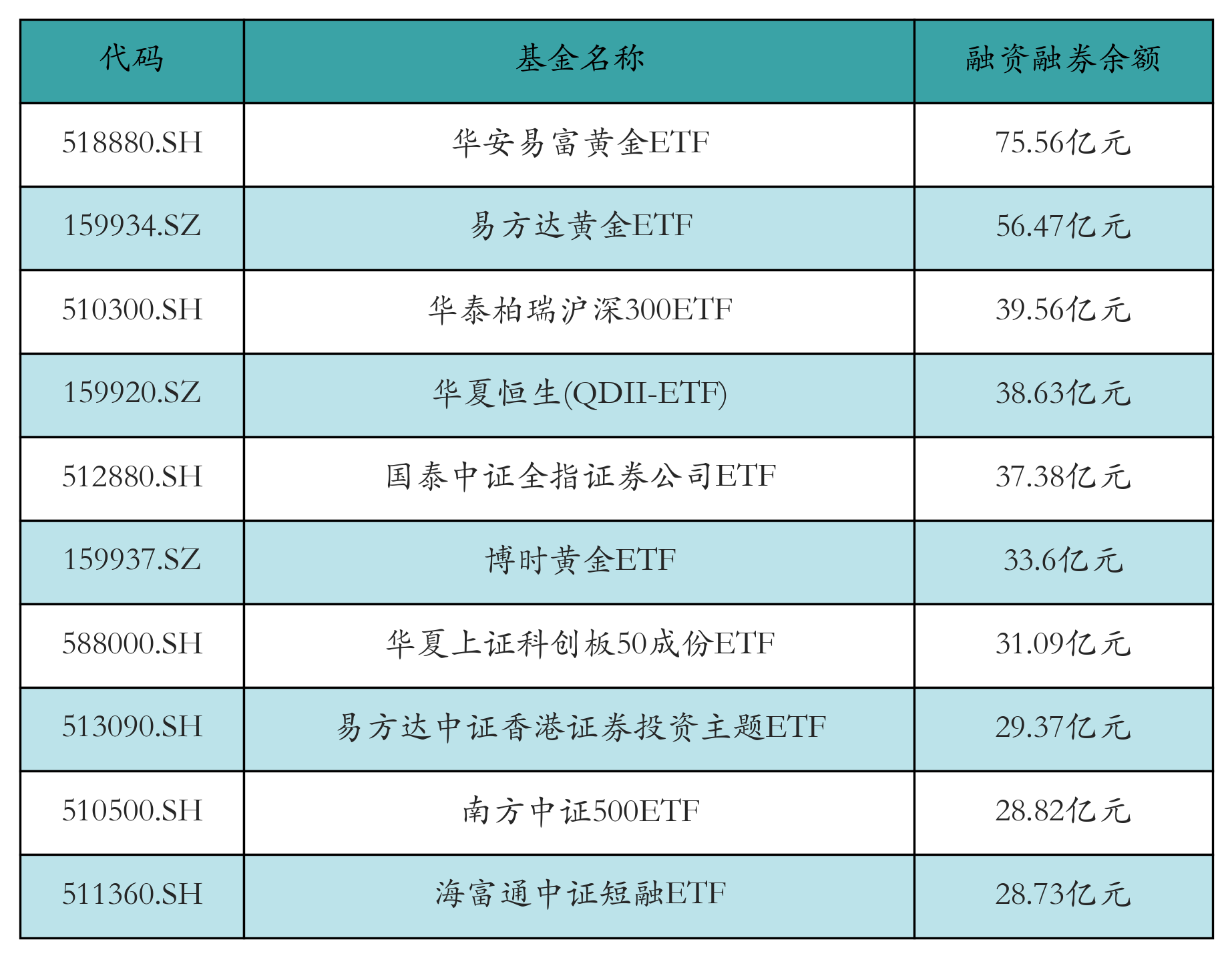
Market Overview - On December 15, the total ETF margin balance in the two markets reached 117.979 billion yuan, an increase of 615.822 million yuan from the previous trading day. The financing balance was 110.52 billion yuan, up by 614 million yuan, while the securities lending balance decreased by 552 million yuan to 7.46 billion yuan [1] - In the Shanghai market, the ETF margin balance was 82.677 billion yuan, a decrease of 10.3 million yuan from the previous trading day. The financing balance increased by 43.7 million yuan to 76.174 billion yuan, while the securities lending balance decreased by 540 million yuan to 6.503 billion yuan [1] - In the Shenzhen market, the ETF margin balance was 35.302 billion yuan, an increase of 16.5 million yuan from the previous trading day. The financing balance rose by 17.7 million yuan to 34.346 billion yuan, while the securities lending balance decreased by 12.552 million yuan to 956 million yuan [1] ETF Margin Financing Balances - The top three ETF margin financing balances on December 15 were: 1. Huaan Yifu Gold ETF (7.556 billion yuan) 2. E Fund Gold ETF (5.647 billion yuan) 3. Huatai-PB CSI 300 ETF (3.956 billion yuan) [2] ETF Financing Buy Amounts - The top three ETF financing buy amounts on December 15 were: 1. Hai Fudong CSI Short-term Bond ETF (1.931 billion yuan) 2. E Fund CSI Hong Kong Securities Investment Theme ETF (1.233 billion yuan) 3. Huatai-PB Southern Dongying Hang Seng Technology Index (0.744 billion yuan) [4] ETF Financing Net Buy Amounts - The top three ETF financing net buy amounts on December 15 were: 1. Fuguo Medium-term Policy Financial Bond ETF (194 million yuan) 2. E Fund ChiNext ETF (126 million yuan) 3. Harvest CSI Sci-Tech Innovation Board Chip ETF (115 million yuan) [5] ETF Securities Lending Sell Amounts - The top three ETF securities lending sell amounts on December 15 were: 1. Southern CSI 1000 ETF (31.8015 million yuan) 2. Huatai-PB CSI 300 ETF (17.6759 million yuan) 3. Huaxia SSE 50 ETF (16.7387 million yuan) [6]

越跌越买!抄底来了
中国基金报· 2025-12-16 06:14
Core Viewpoint - The stock ETF market experienced a net inflow of nearly 7.5 billion yuan on December 15, despite a general market downturn, indicating strong investor interest in ETFs as a preferred investment vehicle during market fluctuations [2][4]. Group 1: Market Performance - On December 15, the A-share market saw a decline, with the Shenzhen Composite Index and the ChiNext Index both dropping over 1%. However, the consumer sector showed resilience, and commercial aerospace stocks remained active [2]. - Over the past three trading days, the net buying in the stock market has exceeded 18.5 billion yuan [3]. Group 2: ETF Inflows - The total net inflow into the stock ETF market on December 15 was approximately 7.457 billion yuan, with significant contributions from broad-based ETFs and Hong Kong market ETFs, which saw inflows of 4.318 billion yuan and 2.685 billion yuan, respectively [6]. - The CSI A500 Index ETF led the inflows with 4.942 billion yuan, with the Southern A500 ETF and Huatai-PB A500 ETF contributing over 3.9 billion yuan and 0.92 billion yuan, respectively [6][9]. Group 3: Fund Company Performance - Leading fund companies like E Fund and Huaxia Fund saw substantial inflows into their ETFs. E Fund's ETFs had a total scale of 818.24 billion yuan, with a net inflow of 1.19 billion yuan on December 15 [9]. - Huaxia Fund's A500 ETF and Sci-Tech 50 ETF also attracted significant inflows of 0.712 billion yuan and 0.462 billion yuan, respectively [9]. Group 4: Outflows from Specific ETFs - The CSI 300 Index ETF experienced the largest outflow, with a net outflow of 1.071 billion yuan, followed by the Securities ETF and Wine ETF, which saw outflows of 0.618 billion yuan and 0.420 billion yuan, respectively [11][12]. - Despite some broad-based and thematic ETFs experiencing outflows, institutional investors remain optimistic about the market outlook [15].

个人养老金全国推广一年:基金类产品年内普涨,三年业绩分化
Sou Hu Cai Jing· 2025-12-16 06:00
Group 1 - The personal pension system has been promoted nationwide for one year, with over 97% of pension fund products achieving positive returns in 2023 [2] - The total scale of personal pension funds reached 15.11 billion yuan, growing by 65.3% since the beginning of the year [2] - Among the 128 FOF products established for over three years, over 96% have achieved positive returns, with the highest return reaching 33.54% [2][6] Group 2 - The first batch of 85 personal pension index funds has all achieved positive returns, with an average return of approximately 24.2% since their establishment [3][4] - The total scale of personal pension index funds reached 2.294 billion yuan, increasing by 6.3 times since the beginning of the year [3] - The top four index funds tracking the ChiNext 50 Index have returns exceeding 58%, with the highest at 60.59% [4] Group 3 - The average return of personal pension FOF products in 2023 is approximately 13.2%, with about 99% of products achieving positive returns [6][7] - The total scale of personal pension FOF products reached 12.817 billion yuan, increasing by 45.3% since the beginning of the year [6] - Among the 128 FOF products established for over three years, the average return is 11.03%, with only 5 products showing negative returns [7][8]
近一个月公告上市股票型ETF平均仓位18.34%
Zheng Quan Shi Bao Wang· 2025-12-16 03:40
Group 1 - Two stock ETFs have released listing announcements, with the Guangfa CSI All Share Food ETF having a stock position of 29.94% and the Huatai-PineBridge AI ETF at 9.69% [1] - In the past month, 20 stock ETFs have announced listings, with an average position of only 18.34%. The highest position is held by the Huitianfu Hang Seng Index ETF at 69.53% [1] - The average number of shares raised for the newly announced ETFs is 519 million, with the largest being the E Fund CSI AI ETF at 1.336 billion shares [1] Group 2 - Institutional investors hold an average of 13.22% of the shares, with the highest proportions in the Jiao Yin CSI Selected Technology ETF at 48.92% and the Huatai-PineBridge AI ETF at 34.43% [2] - The newly established stock ETFs have varying positions during their construction period, with the Guangfa CSI All Share Food ETF set to list on December 19, 2025, and the Huatai-PineBridge AI ETF on the same date [2][3] - The lowest institutional holding ratios are found in the E Fund CSI A500 Dividend Low Volatility ETF and the Penghua Hang Seng Biotechnology ETF, both below 3% [2]
12月15日217只基金净值增长超1%
Zheng Quan Shi Bao Wang· 2025-12-16 02:44
Market Overview - On December 15, the Shanghai Composite Index fell by 0.55% to close at 3867.92 points, while the Shenzhen Component Index decreased by 1.10%, the ChiNext Index dropped by 1.77%, and the STAR Market 50 Index declined by 2.22% [1][2] - Among the Shenwan first-level industries, the top gainers were non-bank financials, commercial retail, and agriculture, forestry, animal husbandry, and fishery, which rose by 1.59%, 1.49%, and 1.24% respectively. The sectors with the largest declines included electronics, communications, and media, which fell by 2.42%, 1.89%, and 1.63% respectively [1][2] Fund Performance - In the stock and mixed fund categories, the average net value growth rate on December 15 was -0.89%, with only 16.43% of funds achieving positive returns. A total of 217 funds reported returns exceeding 1%, while 617 funds experienced net value declines exceeding 3% [1][2] - The top-performing fund was Xinghua Jingcheng Mixed A, with a net value growth rate of 3.94%, followed closely by Xinghua Jingcheng Mixed C (3.92%), Zhongjia Advantage Enterprise Mixed A (2.76%), and Zhongjia Advantage Enterprise Mixed C (2.74%) [1][2] Fund Types - Among the funds with a net value growth rate exceeding 1%, 78 were equity funds, 74 were index equity funds, and 35 were flexible allocation funds [2] - The fund with the largest decline was Zhonghang Youxuan Linghang Mixed Initiation C, which saw a net value drop of 6.70%. Other significant declines included Zhonghang Youxuan Linghang Mixed Initiation A (-6.69%), Tongtai Industry Preferred Stock C (-5.08%), and Tongtai Industry Preferred Stock A (-5.07%) [2][4] Fund Company Performance - In terms of fund companies, Penghua Fund had 25 funds with net value growth rates exceeding 1%, while Huaxia Fund and GF Fund had 12 and 11 funds respectively [1][2]
291只ETF获融资净买入 富国中债7—10年政策性金融债ETF居首
Zheng Quan Shi Bao Wang· 2025-12-16 02:44
Core Viewpoint - As of December 15, the total margin balance for ETFs in the Shanghai and Shenzhen markets reached 117.979 billion yuan, reflecting a slight increase from the previous trading day [1] Group 1: ETF Financing and Margin Data - The ETF financing balance stood at 110.52 billion yuan, which is an increase of 0.614 billion yuan compared to the previous trading day [1] - The ETF margin short balance was recorded at 7.459 billion yuan, showing a decrease of 0.553 billion yuan from the previous trading day [1] Group 2: Net Inflows into ETFs - On December 15, a total of 291 ETFs experienced net financing inflows, with the top inflow being the Fuguo Zhongzhai 7-10 Year Policy Financial Bond ETF, which saw a net inflow of 194 million yuan [1] - Other ETFs with significant net inflows included the E Fund ChiNext ETF, Harvest SSE STAR Chip ETF, Huaxia Hang Seng Internet Technology ETF, Huaxia Hang Seng Technology ETF, Huaxia SSE STAR 50 ETF, and Haitai Baichuan Hang Seng Technology ETF [1]
易方达丰华债券(A/C:000189/006867)公告降费
Mei Ri Jing Ji Xin Wen· 2025-12-16 02:12
Core Viewpoint - E Fund announced a reduction in management and custody fees for its E Fund Fenghua Bond Fund to better meet investor needs and lower investment costs, effective December 17 [1] Group 1: Fee Adjustments - The management fee will decrease from 0.8% per year to 0.6% per year [1] - The custody fee will decrease from 0.2% per year to 0.15% per year [1] - E Fund has already reduced management fees for nearly 10 products and custody fees for around 20 products this year, covering various asset types including multi-asset, fixed income, money market, index, and QDII [1] Group 2: Fund Performance - E Fund Fenghua Bond Fund (A/C: 000189/006867) is a medium-duration secondary bond fund aimed at achieving stable returns with lower drawdowns [1] - As of December 12, the fund's year-to-date return was 5.49% and 5.1%, outperforming its benchmark [1] - The maximum drawdown for the year was 2.19% and 2.25%, indicating a relatively stable overall performance [1]
A股跨年行情蓄势待发
21世纪经济报道· 2025-12-16 02:11
Core Viewpoint - The A-share market is experiencing a recovery in sentiment following a significant meeting, with expectations for a potential year-end rally driven by structural market dynamics and capital market reforms [1][8]. Market Performance - A-share daily average trading volume increased to 19,530.44 billion yuan from the previous week, marking a rise of 2,568.66 billion yuan [4]. - The ChiNext Index and Shenzhen Component Index rose by 2.74% and 0.84%, respectively, while the Shanghai Composite Index fell by 0.34% during the same period [4]. - Key sectors such as aerospace equipment, communication devices, and electronic chemicals saw significant gains, with increases of 7.89%, 7.81%, and 6.99% respectively [4]. Fund Flows - Institutional and retail investors showed synchronized net inflows into the consumer sector, while there were divergent trends in other sectors [5][6]. - The financing balance increased to 2.48 trillion yuan, reflecting a rise of 196.21 billion yuan, indicating a relatively positive stance on leverage [5]. - Notably, the A500 ETFs attracted significant inflows, with top funds like Huatai-PB and Southern Fund seeing net inflows of 40.33 billion yuan and 37.64 billion yuan respectively [6]. Future Outlook - Analysts predict a potential year-end rally for A-shares, supported by improving liquidity and institutional fund flows [8][9]. - Key sectors expected to perform well in 2026 include AI, advantageous manufacturing, "anti-involution," and structural recovery in domestic demand, with projected net profit growth exceeding 30% [10]. - The macroeconomic environment is anticipated to remain supportive, with a combination of fiscal and monetary policies aimed at enhancing market liquidity [9][10].

公募业发声:明年股市表现可期
3 6 Ke· 2025-12-16 01:56
Core Viewpoint - The 2025 Central Economic Work Conference in Beijing has provided a clear path for China's economic development, with policies aimed at stabilizing market expectations and enhancing economic growth momentum [1][3]. Group 1: Economic Outlook - The conference has set a solid policy foundation for high-quality economic development over the next five years, emphasizing continuity and foresight in policies to stabilize market expectations [3]. - Public fund institutions believe that the conference's directives will lead to a deepening of capital market reforms and an improved investment environment, enhancing the resilience of the stock market [5][6]. Group 2: Policy Insights - Fiscal policy is expected to maintain necessary deficits and total debt levels, indicating a commitment to robust fiscal spending, with a slight expansion anticipated next year [4]. - Monetary policy discussions highlighted the need for flexible and efficient tools, with potential opportunities for interest rate cuts in the coming year [4]. Group 3: Capital Market and Investment Focus - The conference's positive signals have boosted market confidence and investment enthusiasm, with a focus on technology innovation, consumer spending, and emerging industries as key investment areas [5][7]. - Public fund institutions are particularly optimistic about new energy, new materials, and strategic emerging industries, as well as consumer sectors, as priorities for investment in 2026 [7]. Group 4: Public Fund Industry Response - The public fund industry, with a total scale nearing 37 trillion yuan, is actively responding to the conference's directives, emphasizing the importance of aligning with national development strategies and enhancing service offerings for diverse wealth management needs [1][8]. - Institutions like E Fund and Huatai-PineBridge are committed to implementing the conference's spirit by optimizing their investment research systems and supporting technological innovation [8][9].
国联民生:顾伟当选董事长,葛小波任总裁;年内138家公募机构积极自购传递信心 | 券商基金早参
Mei Ri Jing Ji Xin Wen· 2025-12-16 01:43
Group 1 - Guolian Minsheng has appointed Gu Wei as Chairman and Ge Xiaobo as President, indicating an optimization of the company's governance structure and potential strengthening of strategic execution [1] - The new management team includes five non-independent directors and three independent directors, with a focus on enhancing business adjustment expectations in the brokerage sector [1] - The changes in the financial sector's senior management are seen as positive signals, increasing market expectations for deeper financial reforms and highlighting structural investment opportunities [1] Group 2 - Dongfang Caifu has completed a management restructuring aimed at creating a flatter organizational structure, enhancing operational efficiency and market responsiveness [2] - Huang Jianhai, the new General Manager, is expected to strengthen the company's risk control and resource allocation capabilities due to his financial background [2] - The restructuring is likely to invigorate the internet brokerage sector and may lead to a reassessment of strategic transformation potential in financial technology firms [2] Group 3 - Over 60% of QDII funds are currently under purchase restrictions or have suspended subscriptions, reflecting a sustained high demand for overseas asset allocation [3] - The total scale of restricted funds amounts to 507.997 billion yuan, indicating a structural imbalance in global asset allocation [3] - This situation may lead to increased price volatility in the secondary market for certain products and could affect cross-border investment sentiment [3] Group 4 - A total of 138 public fund institutions have actively engaged in self-purchase, with a net subscription amount reaching 255.087 billion yuan, marking a significant increase compared to the previous year [4] - The surge in self-purchase activity, exceeding 17 times the previous year's figures, demonstrates institutions' confidence in the long-term value of the market [4] - This behavior is expected to boost market attention on related fund products and support equity assets, potentially leading to a valuation recovery in the broader financial sector [4]
