软银集团

Search documents
日本股市三连跌 旅游板块继续承压
Xin Hua She· 2025-11-18 08:23
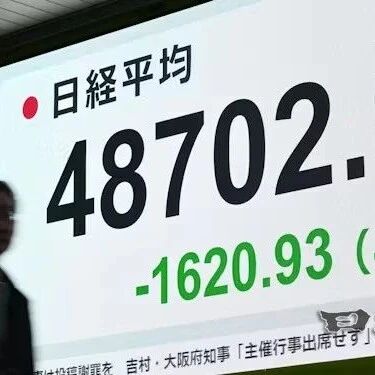
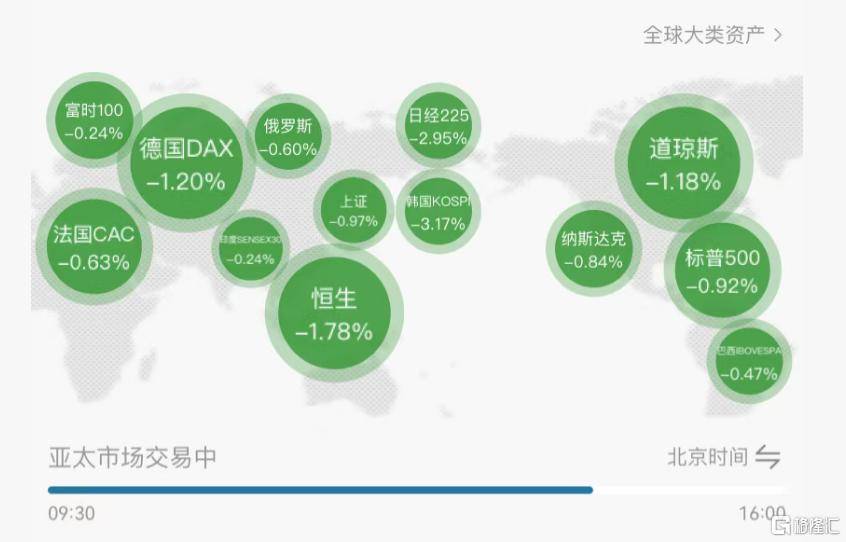
新华社东京11月18日电(记者刘春燕)日本东京股市两大股指18日连续第3个交易日下跌。日经225种股 票平均价格指数收盘下跌3.22%,东京证券交易所股票价格指数下跌2.88%。 受隔夜纽约股市三大股指全面下跌及投资者对中日关系恶化的担忧上升等因素影响,东京股市两大股指 18日早盘跳空低开。日经225种股票平均价格指数盘中一度下跌3.3%。当天,软银集团、爱德万测试、 东京电子等三大科技股明显下跌。 由于投资者担心中日关系恶化长期化,三越伊势丹百货、高岛屋、大丸松坂屋百货母公司、日本航空、 全日空、帝国饭店等与旅游相关股票大多继续下跌。对中国游客消费依赖度较高的资生堂继昨天收盘下 跌9%后今天收盘再跌2.89%。 至收盘时,日经指数下跌1620.93点,收于48702.98点;东证指数下跌96.43点,收于3251.10点。 从板块来看,东京证券交易所33个行业板块全部下跌,有色金属、电气产品、机械等板块领跌。 (文章来源:新华社) ...
日经平均指数三连跌,破4万9000点关口
日经中文网· 2025-11-18 08:00
版权声明:日本经济新闻社版权所有,未经授权不得转载或部分复制,违者必究。 11月18日,日本东京股票市场的日经平均指数连续三个交易日下跌,收盘报4万8702点,较上一交易日 下跌1620日元(跌幅3.22%)。这是自10月23日以来,日经平均指数首次在收盘时跌破4万9000点关 口。由于日本时间20日清晨美国英伟达(NVIDIA)将公布财报,同日还将公布美国9月就业数据,市 场对过热感较强的人工智能(AI)及半导体相关个股保持警惕,卖压显著增加。日经平均也跌破被视 作"下档支撑线"的25日的移动均线,投资者的警觉情绪在加强。 17日的美国股市方面,道琼斯工业平均指数较上周末下跌1.18%,科技股权重较高的纳斯达克综合指数 下跌0.84%。美国联邦储备委员会(FRB)官员持续发表对进一步降息保持谨慎的讲话,加之有消息 称,美国数据分析软件企业 Palantir Technologies 的联合创始人彼得·蒂尔(Peter Thiel)在7~9月期间已 将其所持的英伟达股票全部抛售,这些消息进一步推动了以AI相关股票为主的持仓调整。 上述风险规避情绪也扩散至日本股市。18日,软银集团(SBG)大跌7.47%,TO ...

【环球财经】日经225指数重挫3.22% 东证33个行业板块无一上涨
Xin Hua Cai Jing· 2025-11-18 07:24
Core Points - The Tokyo stock market experienced a decline for three consecutive trading days, with the Nikkei 225 index falling by 3.22% and the Tokyo Stock Exchange index dropping by 2.88% on November 18 [1] - The decline was influenced by a comprehensive drop in the three major U.S. stock indices and rising investor concerns regarding the deterioration of China-Japan relations [1] - Major technology stocks, including SoftBank Group, Advantest, and Tokyo Electron, saw significant declines as investors adjusted their positions ahead of Nvidia's earnings report [1] Industry Summary - The retail sector, particularly companies reliant on inbound tourism, faced continued declines, with stocks such as Mitsukoshi Isetan, Takashimaya, and Daimaru Matsuzakaya Holdings falling [1] - Shiseido, which heavily depends on Chinese tourist spending, dropped by 9% on November 17 and further declined by 2.89% on November 18 [1] - All 33 industry sectors on the Tokyo Stock Exchange experienced declines, with non-ferrous metals, electrical products, and machinery sectors leading the downturn [1]
暴跌1400点!高市之“祸”拖垮日股,AI泡沫“杀跌”全球?
Sou Hu Cai Jing· 2025-11-18 06:39
Core Viewpoint - The global financial markets are experiencing heightened anxiety over the technology and AI bubble, particularly ahead of Nvidia's earnings report, which is seen as pivotal for market sentiment regarding AI investments [1][9]. Group 1: Market Performance - Asian markets, particularly Japan and South Korea, are leading declines, with the Nikkei 225 index dropping over 1400 points, a decline of more than 3%, falling below the 49000 mark [3][5]. - The Hong Kong and A-share markets are also experiencing significant downturns, with the Hang Seng Index down over 1.95% and the ChiNext Index down 1.62% [4][3]. Group 2: Technology Sector Concerns - The recent sell-off in the technology sector is attributed to growing concerns over an AI bubble, with the S&P 500 index having risen 38% from its April low to its October high, driven by strong tech stock performance [5][6]. - Major tech stocks, including Tesla, Meta, and Nvidia, have seen significant declines, with Tesla down over 10% and both Meta and Nvidia down over 7% [6][10]. Group 3: Nvidia's Impact - Nvidia is at the center of the current market anxiety, with its upcoming earnings report being crucial for maintaining investor confidence in AI [9][10]. - Notable hedge funds, including Bridgewater, have significantly reduced their holdings in Nvidia, with a nearly two-thirds reduction reported [10][11]. Group 4: Broader Economic Implications - Analysts express concerns that the current market dynamics may be influenced by expectations of tighter monetary policy from the Federal Reserve, which could further impact market stability [20][21]. - Morgan Stanley predicts a "risk reset year" in 2026, with a shift in focus from macroeconomic factors to microeconomic performance, potentially driving strong corporate earnings growth [22]. Group 5: Outlook for Chinese Assets - Foreign investment banks remain optimistic about Chinese assets, with UBS forecasting a continued upward trend in the Chinese stock market by 2026, driven by earnings growth rather than valuation [24]. - Morgan Stanley also anticipates moderate gains in the Chinese stock market, with specific indices expected to see up to 5% upside by the end of 2026 [25].

Japan's Nikkei falls 3% on tech selloff
The Economic Times· 2025-11-18 05:47
Market Overview - Japan's Nikkei share average fell 3% on Tuesday, marking its largest decline in over seven months, with the index dropping as much as 3.3% to 48,661.52, its lowest level since October 23 [1][7] - The broader Topix index also declined by 2.49% to 3,264.11 [1][7] Investor Sentiment - Investor sentiment worsened significantly after the Nikkei fell below the key 50,000 level, leading to an accelerated sell-off [1][7] - Some investors expressed interest in buying shares on a dip but chose to wait for further declines before making purchases [2][7] U.S. Market Influence - U.S. stocks ended sharply lower, with the S&P 500 and Nasdaq closing below a key technical indicator for the first time since late April, as investors anticipated quarterly results from retailers and Nvidia [2][7] - Nvidia, a major player in the AI sector and the world's largest company by market value, is set to report earnings after the market closes on Wednesday [5][7] Sector Performance - High-profile technology stocks experienced significant sell-offs, a common trend when investors adopt a risk-off approach [6][7] - Fibre optic cable manufacturers, which benefit from the AI trade, saw declines, with Fujikura and Sumitomo Electric Industries losing 9% and 7.45%, respectively [6][7] - Retail stocks, including Ryohin Keikaku, which operates Muji brand stores, fell sharply after a previous session decline of 9.4%, influenced by China's travel warning to its citizens regarding Japan amid diplomatic tensions over Taiwan [6][7]

Peter Thiel’s fund dumps entire Nvidia stake amid AI market jitters
BusinessLine· 2025-11-18 04:53
Peter Thiel’s hedge fund Thiel Macro LLC sold its stake in Nvidia Corp. during the third quarter, marking yet another retreat from investments in the world’s leading provider of artificial intelligence chips.The fund offloaded its entire position of 537,742 shares in the Santa Clara, California-based chipmaker — a holding that would have been worth about $100 million based on the closing price from Sept. 30. The Thiel Macro fund now counts Apple Inc., Microsoft Corp. and a reduced stake in Tesla Inc. as it ...

日本东京股市开盘跳水 日经指数一度跌逾千点
Sou Hu Cai Jing· 2025-11-18 04:42
Group 1 - The Nikkei 225 index in Japan experienced a significant decline, dropping over 1000 points during early trading on November 18 [1] - The decline was influenced by the drop in technology stocks and concerns regarding the economic outlook of the United States, with the index falling more than 2% at one point [3] - Notable individual stock performances included Sumitomo Electric Industries and Fujikura, which both fell over 7%, while SoftBank Group dropped nearly 6%, LASERTEC Semiconductor fell over 5%, and Nippon Steel declined over 4% [3] Group 2 - The previous day, the Nikkei 225 index closed down 0.1% and had also seen a decline of over 1% during trading, with sectors such as department stores, transportation, and tourism-related stocks facing significant sell-offs [3]
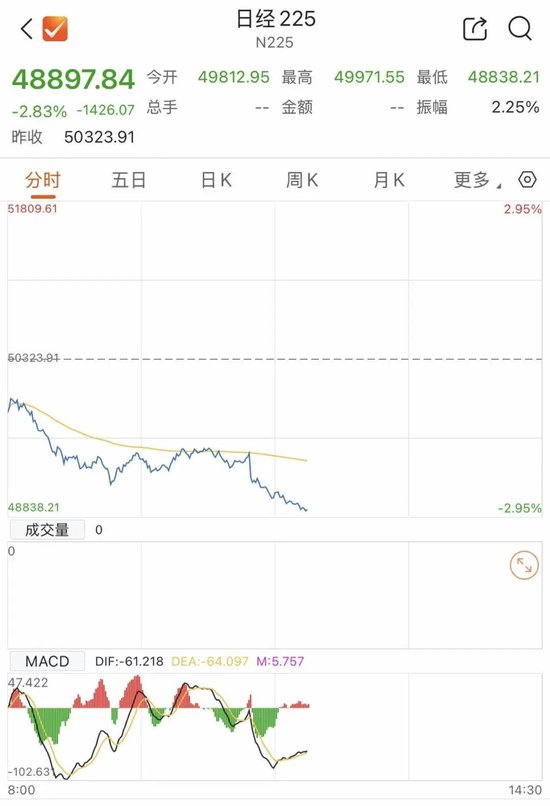
刚刚,日本股汇“双杀”!
Shang Hai Zheng Quan Bao· 2025-11-18 04:26
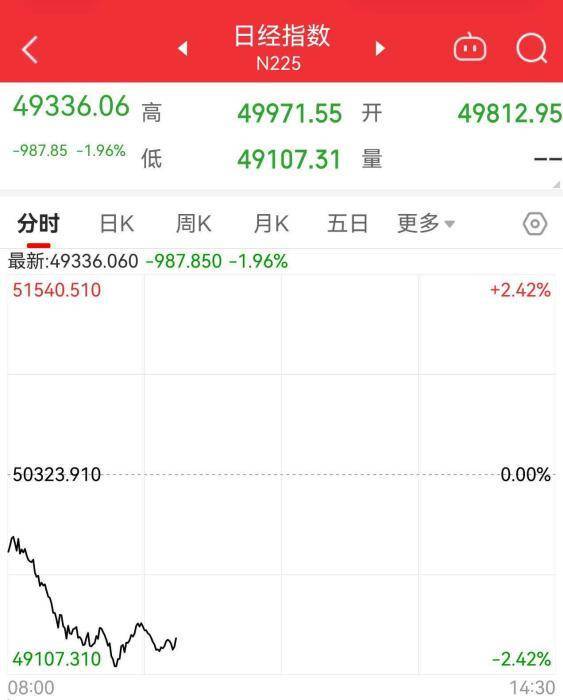
Group 1 - The Japanese stock market experienced a significant decline, with the Nikkei 225 index falling below 49,000 points, down over 1,400 points, representing a drop of 2.83% [1] - The Japanese yen continued its weakening trend, with the euro to yen exchange rate surpassing 180 for the first time since 1999, driven by concerns over Japan's deteriorating fiscal situation [3] - Political tensions arising from provocative statements by Japanese Prime Minister Suga Yoshihide regarding Taiwan have negatively impacted consumer sentiment, leading to declines in major companies such as SoftBank Group, Tokyo Electron, and Nintendo [5] Group 2 - Analysts express concerns that deteriorating Japan-China relations could further impact Japan's economy, which is already facing downward pressure, potentially leading to negative growth in the fourth quarter [7] - The South Korean stock market also saw a significant drop, with the KOSPI index declining over 3% [7]


Are We in an AI Bubble or Witnessing a Structural Transformation?
Medium· 2025-11-18 04:14
Core Insights - The article discusses the dual nature of the current AI landscape, suggesting that while there is a genuine structural transformation occurring, there are also signs of a speculative bubble forming in certain AI-related equities [4][29][61]. Group 1: Market Dynamics - Nvidia briefly reached a market capitalization of $3 trillion, surpassing the GDP of the UK, with data-center revenues from AI chips growing over fivefold year-on-year [1]. - Some prominent investors, including Peter Thiel and Michael Burry, have reduced their exposure to AI stocks, indicating a cautious sentiment among sophisticated investors [2][3]. - A concentration of gains in a few AI-exposed companies, such as Nvidia, Microsoft, and Amazon, raises systemic risk concerns, reminiscent of past financial bubbles [7][8]. Group 2: Capital Expenditure Trends - Major tech companies are engaged in an unprecedented capital expenditure race, with Microsoft planning $80 billion for AI and data center infrastructure in fiscal year 2025 [9]. - This synchronized capital deployment may lead to overbuilding, as seen in previous technological transitions, raising questions about future adjustments [10]. Group 3: Monetization Challenges - Despite significant infrastructure investments, business models for AI are still evolving, with high operational costs and unclear paths to profitability [11][12]. - Enterprise adoption of AI remains largely experimental, with broad deployment still in early stages, suggesting that current infrastructure may be ahead of actual demand [13]. Group 4: Insider Actions and Market Signals - Insider selling by executives, such as Nvidia's CEO, and profit-taking by major investors signal caution regarding inflated valuations [14][16]. - Historical patterns indicate that when early investors begin to exit, it may be prudent for others to reassess their positions [16]. Group 5: Structural Demand for AI - AI systems create ongoing demand for processing capacity, as they generate intelligence dynamically, unlike traditional software [19][21]. - Industry forecasts predict that spending on AI-related infrastructure could reach hundreds of billions annually, with cumulative investments potentially exceeding a trillion dollars by 2030 [23]. Group 6: Global Infrastructure Investments - Sovereign wealth funds and nations are treating AI capacity as critical infrastructure, with significant investments from countries like Saudi Arabia and the UAE [25][26]. - This strategic recognition by governments suggests a structural rather than speculative nature of AI development [26]. Group 7: Long-Term Perspectives - The article draws parallels to the late 1990s dot-com era, where genuine technological advancements coexisted with speculative excess, indicating that long-term winners will emerge post-correction [30][31]. - Companies with strong fundamentals and technological advantages are likely to consolidate their positions after any market corrections [34][56]. Group 8: Strategic Recommendations for Boards - Investment committees should stress-test portfolios for concentration risks and prepare for potential volatility in AI equities [37][39]. - Organizations should focus on ROI-positive AI use cases and prioritize investments in data quality and governance to ensure long-term success [41][45].

日本股市大跳水,盘中暴跌超1000点!高市早苗,同时惹恼中、俄、朝、韩四国
Mei Ri Jing Ji Xin Wen· 2025-11-18 03:33
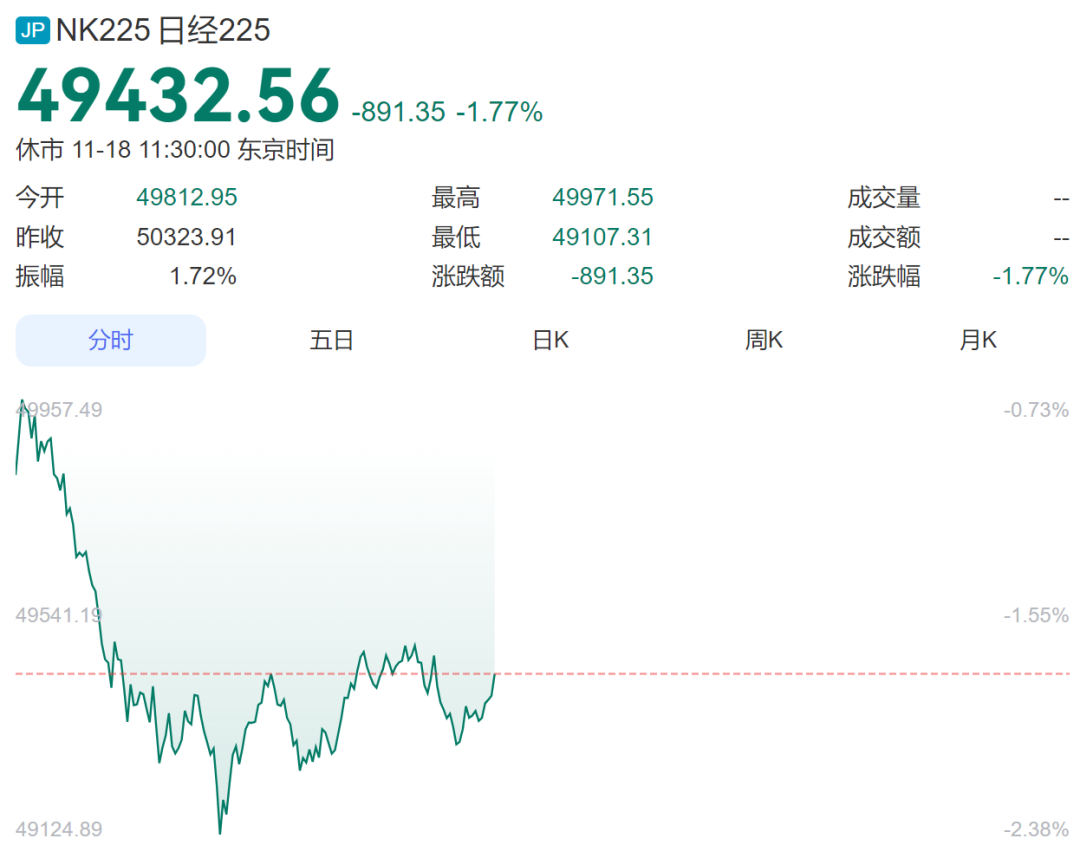
Market Performance - The Japanese stock market continued its downward trend, with the Nikkei 225 index dropping over 1000 points, a decline of more than 2% [1] - As of the report, the Nikkei 225 index was down 1.77% [1] - The Tokyo Stock Exchange index also fell nearly 1.5%, currently reported at 3297.96 points [4] Individual Stocks - Major companies such as SoftBank Group saw a decline of over 5%, influenced by the drop in U.S. tech stocks [5] - Other companies like Tokyo Electron, Advantest, and Nintendo also experienced declines, alongside consumer stocks such as Shiseido and Ajinomoto [5] Economic Indicators - The Japanese yen weakened, with the euro surpassing the 180 yen mark, marking the first time since 1999 that the yen fell into this range [6] - Concerns over Japan's fiscal situation have led to increased selling pressure on the yen, compounded by the government's plans for economic measures exceeding the previously estimated 17 trillion yen [6] Monetary Policy - The Bank of Japan maintained its policy rate at approximately 0.5% for the sixth consecutive time, with discussions of potential rate hikes emerging [7] - Macroeconomic data revealed a 0.4% decrease in Japan's real GDP for Q3 2025, marking the first contraction in six quarters [8] Geopolitical Concerns - Rising tensions due to comments from Prime Minister Fumio Kishida regarding Japan's security policy have led to cancellations of bookings in Osaka, raising concerns about the economic impact [10] - Analysts predict that reduced tourism from China could lead to a decrease in Japan's GDP by approximately 0.36% [10] Nuclear Policy - There is significant domestic opposition to potential changes in Japan's "Three Non-Nuclear Principles," which could impact public sentiment and government policy [11]