
平安人寿

Search documents
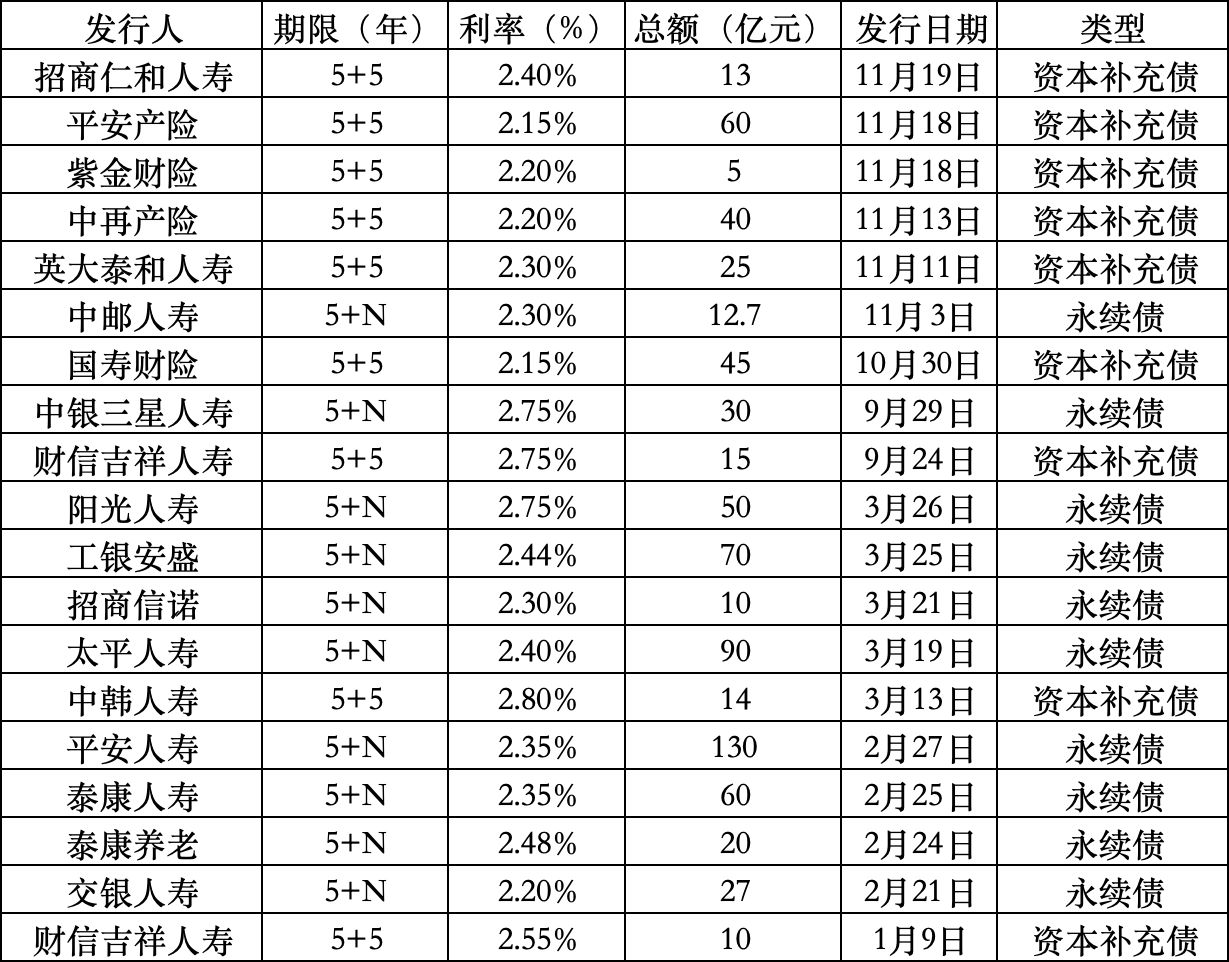
年内险企发债超700亿元,永续债占比接近七成
Huan Qiu Wang· 2025-11-22 01:28
Core Insights - Insurance companies are accelerating capital replenishment as the transition period for the second phase of the solvency regulation approaches its end [1][4] - A total of 19 insurance companies have issued capital replenishment bonds or perpetual bonds this year, with a combined issuance scale of 74.17 billion yuan, maintaining a high level despite a slight decrease compared to the same period last year [1][4] Group 1: Issuance Details - Among the 19 insurance companies that issued bonds, half opted for perpetual bonds, with a total issuance close to 50 billion yuan, accounting for nearly 70% of the total [3] - Ping An Life issued the largest perpetual bond this year at 13 billion yuan, followed by Taiping Life, ICBC-AXA Life, Taikang Life, and Sunshine Life with issuance sizes of 9 billion yuan, 7 billion yuan, 6 billion yuan, and 5 billion yuan respectively [3] Group 2: Financial Implications - Perpetual bonds are favored by insurance companies as they directly supplement core tier 2 capital and enhance core solvency, with lower coupon rates making them an attractive option [3] - The coupon rates for the bonds issued this year are all below 3%, with the highest at 2.8% and the lowest at 2.15% [3] Group 3: Regulatory Context - The surge in bond issuance is primarily driven by the need to enhance solvency to meet stricter regulatory requirements established in the first quarter of 2022 [4] - The transition period for the second phase of solvency regulations has been extended to the end of 2025, prompting insurance companies to expedite their capital replenishment efforts as the deadline approaches [4]


分红险“霸屏”背后: 险企从“卷收益”到“拼服务”
Zhong Guo Jing Ying Bao· 2025-11-21 19:12
Core Viewpoint - The insurance industry is shifting towards dividend insurance products as a consensus in response to the ongoing decline in interest rates [1][2]. Group 1: Market Trends - A significant number of new insurance products launched by various life insurance companies are dividend insurance, with over 40 out of 50 life insurance products currently on sale being dividend-type [2]. - Major life insurance companies like Xinhua Insurance, Ping An Life, and China Life have introduced various dividend insurance products, indicating a trend towards these offerings [3]. - The design of dividend insurance products, such as the "Taiping Guowei No.1" from Taiping Life, combines guaranteed benefits with dividends, allowing for both asset security and market participation [3]. Group 2: Product Structure and Performance - The maximum preset interest rate for dividend insurance from leading insurers is generally set at 1.75%, with some joint venture companies offering rates as low as 1.5% [4]. - The reduction in preset interest rates for traditional and dividend insurance products has been noted, with dividend products experiencing a smaller decline, thus enhancing their yield advantage over traditional products [4]. - Dividend insurance provides a combination of guaranteed benefits and non-guaranteed dividends, which helps mitigate the liability pressure on insurance companies [5]. Group 3: Marketing Challenges - The complexity of dividend insurance products poses challenges for insurance agents, requiring them to possess a solid understanding of product configurations and benefits [6][7]. - The shift from traditional fixed-return products to dividend insurance has created difficulties in marketing, as agents must now explain the intricacies of dividend structures to clients [7][8]. - Some agents continue to use outdated marketing strategies, misrepresenting dividend insurance as quick-return products, which may lead to consumer confusion [8]. Group 4: Service Integration - Dividend insurance is evolving beyond mere insurance products to become gateways for integrated services in healthcare, retirement, and wellness, forming a "product + service" model [9][10]. - Companies are increasingly linking their insurance products with healthcare and retirement ecosystems, offering a range of services from family doctors to retirement communities [10][11]. - This integration allows insurers to meet diverse customer needs and enhances the overall value proposition of dividend insurance products [11].


2025年险企发债观察:发行规模仍处历史高位 永续债占比近七成
Mei Ri Jing Ji Xin Wen· 2025-11-20 14:03
Core Viewpoint - Insurance companies are experiencing a peak in bond issuance as they seek to supplement capital through perpetual bonds and capital replenishment bonds, driven by regulatory requirements and business development needs [1][2][4]. Group 1: Bond Issuance Trends - In November 2025, several insurance companies, including China Post Life and Ping An Property & Casualty, successfully issued perpetual bonds or capital replenishment bonds, contributing to a total issuance of 741.7 billion yuan in 2025 [1][2]. - The issuance of perpetual bonds has become increasingly popular, with 10 out of 20 bonds issued in 2025 being perpetual bonds, amounting to approximately 500 billion yuan, which accounts for nearly 70% of the total [2][4]. - The overall trend shows a decrease in total bond issuance compared to previous years, but the levels remain historically high, indicating a shift towards perpetual bonds [1][8]. Group 2: Regulatory and Market Factors - The issuance of bonds is primarily driven by the need for insurance companies to meet regulatory requirements regarding solvency and capital adequacy [1][4]. - The current low-interest-rate environment has created favorable conditions for insurance companies to issue bonds at lower costs, with rates ranging from 2.15% to 2.8% in 2025, compared to higher rates in previous years [9][10]. - The introduction of the "Solvency II" rules has led to a surge in bond issuance from 2023 to 2024, with companies seeking to enhance their capital positions [8]. Group 3: Company-Specific Issuances - Notable issuances include China Post Life's 12.7 billion yuan perpetual bond and Ping An Property & Casualty's 60 billion yuan capital replenishment bond, reflecting the diverse strategies employed by different companies [2][3]. - Major life insurance companies, such as Ping An Life and Taikang Life, have issued perpetual bonds ranging from 10 billion to 130 billion yuan, showcasing their capacity to meet the higher issuance thresholds [2][4]. - The trend indicates that larger insurance firms are more likely to issue perpetual bonds due to their stronger capital positions, while smaller firms tend to rely on capital replenishment bonds [4].
首破3万亿!A股“市值王”再刷新记录
Ge Long Hui· 2025-11-12 06:53
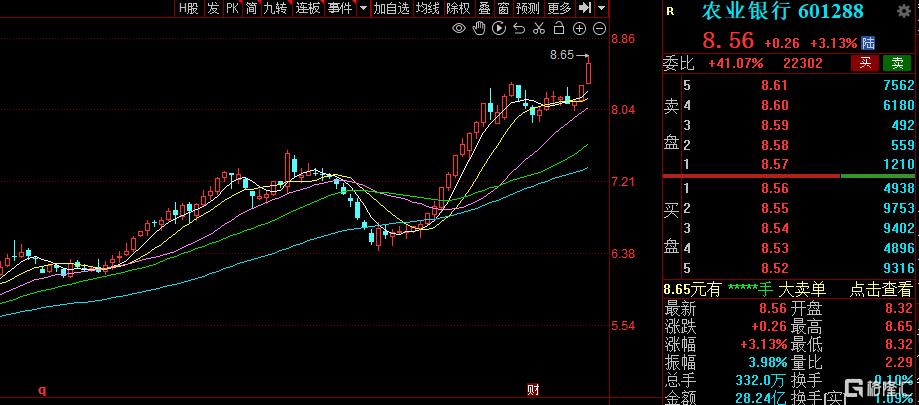
Core Insights - The banking sector showed resilience with Agricultural Bank and Industrial and Commercial Bank reaching historical highs in stock prices, with Agricultural Bank's A-shares up 3.13% to 8.65 yuan and H-shares up nearly 3% to 6.4 HKD, marking year-to-date increases of over 68% and 51% respectively [1][2] - The total market capitalization of Agricultural Bank surpassed 3 trillion yuan [1] Financial Performance - The six major state-owned banks reported a combined operating revenue of 27,205.35 billion yuan for the first three quarters of 2025, reflecting a year-on-year growth of 1.87%, and a net profit of 10,723.43 billion yuan, also up 1.22% year-on-year [5][6] - Agricultural Bank led the net profit growth among the six banks with a year-on-year increase of 3.03%, while other banks showed varying growth rates [5][6] Investment Trends - Insurance capital has increased its holdings in several major banks, with Postal Savings Bank seeing the largest increase in shares, while Industrial and Commercial Bank and Agricultural Bank also saw insurance capital enter their top ten shareholders [8][9] - Analysts suggest that with policy support for long-term capital entering the market, insurance capital is expected to increase its allocation to bank stocks, enhancing their investment value [9]






金融壹账通连续第四年荣获央行“金发奖”
Zheng Quan Ri Bao Wang· 2025-11-12 06:11
Core Insights - The People's Bank of China has announced the winners of the "2024 Financial Technology Development Award," with Financial One Account winning for the fourth consecutive year [1][2] Group 1: Award Recognition - Financial One Account, in collaboration with Ping An Life and Ping An Technology, received the second prize for the project "Data-Driven and Human-Machine Collaborative Comprehensive Digital Transformation in Life Insurance" [1] - The project aims to create an intelligent operational system covering customers, agents, and internal staff, driven by AI technology [1] Group 2: Innovation in Insurance - The project "New Energy 'Technology + Insurance' New Model Construction," developed by Ping An Property & Casualty and Financial One Account, focuses on the risk characteristics of the new energy industry [2] - It establishes a collaborative insurance ecosystem among car manufacturers, insurance companies, and car owners, promoting green financial innovation [2] - The project features a dynamic pricing model that integrates insurance companies, car manufacturers, and industry stakeholders, enabling automated accident responsibility determination and claims processing [2] - The integrated claims model reduces customer claim waiting time by 60% and decreases secondary accident occurrence by 26% [2] - An AI-based accident simulation platform supports product iteration for car manufacturers, enhancing risk reduction and industry collaboration [2] - The project also includes the development of a global risk map and quantitative model to provide safety and risk management support for new energy enterprises expanding internationally [2] Group 3: Future Outlook - Financial One Account plans to continue its role as a technology output window, collaborating with Ping An's ecosystem and industry partners to explore new intelligent financial models [2] - The company aims to contribute to the service of the real economy, foster new productive forces, and enhance financial risk prevention capabilities [2]
金融壹账通连续第四年荣获央行金发奖,以科技之力赋能金融高质量发展
Huan Qiu Wang· 2025-11-12 03:17
Core Insights - The People's Bank of China has announced the winners of the "2024 Financial Technology Development Award," with Financial One Account winning two second prizes for its innovative projects in digital transformation and green finance [1][5]. Group 1: Financial Technology Development Award - Financial One Account has won the "2024 Financial Technology Development Award" for the fourth consecutive year, highlighting its ongoing commitment to innovation in the financial sector [1][5]. - A total of 681 projects participated in the evaluation, with 290 projects recognized, emphasizing the competitive nature of the award [1]. Group 2: Digital Transformation in Life Insurance - The project "Data-Driven, Human-Machine Collaborative Comprehensive Digital Transformation in Life Insurance" utilizes AI to create an intelligent operational system covering customers, agents, and internal staff, achieving a 30% reduction in business processes and over 90% online operation rate [2][3]. - The project features nine intelligent scenarios, including AI-assisted underwriting and claims processing, with the AI underwriting model providing conclusions in seconds and claims processed in as little as one minute [2][3]. Group 3: Green Finance Innovation - The "New Energy 'Technology + Insurance' Model Construction" project aims to create a collaborative ecosystem among car manufacturers, insurance companies, and vehicle owners, focusing on risk characteristics in the new energy sector [4]. - The project has achieved a 61% growth in insured clients and a claims payout rate that exceeds the industry average by 4.5 percentage points, facilitating the transition of new energy insurance from a risk bearer to an ecosystem enabler [4]. Group 4: Commitment to Technological Innovation - Financial One Account has consistently leveraged technological innovations such as AI, privacy computing, and data governance to drive digital and intelligent transformation in the financial industry [5][6]. - The company aims to enhance its digital and intelligent service capabilities while contributing to the development of a safe and efficient financial infrastructure [5][6].
告别“简单培训即上岗”!险企招募“拼手速”
Bei Jing Shang Bao· 2025-11-11 12:56
Core Viewpoint - The insurance industry is undergoing a significant transformation in its recruitment strategies, moving from a quantity-focused approach to a quality-driven model that emphasizes the need for specialized and multi-skilled agents [1][4][8]. Recruitment Strategies - Insurance companies like Taikang Life and China Merchants Life are actively recruiting agents with a focus on professional training rather than just sales skills, aiming to develop agents into multi-faceted professionals [1][3]. - New recruitment plans emphasize roles such as "health wealth planners" and "insurance health consultants," indicating a shift towards agents who can provide comprehensive financial and health management services [3][5]. Changes in Agent Demographics - The number of insurance agents in China has dramatically decreased from approximately 9 million to under 3 million, necessitating a rise in the quality and professionalism of agents to meet evolving market demands [4][8]. - The current market requires agents to possess a diverse skill set, including knowledge in healthcare, wealth management, and elder care services, transforming them into "six-sided warriors" [3][4]. Empowerment and Training - Companies are building comprehensive empowerment systems to support agents, including specialized training programs and the integration of AI tools to enhance their capabilities [5][6]. - For instance, Taikang Life has developed a growth path for its "big health business partners," while China Merchants Life has introduced a structured career development plan for its sales personnel [5][6]. Regulatory Influence - The recent regulatory framework issued by the Financial Regulatory Bureau emphasizes the need for improved professional standards among insurance sales personnel, pushing companies to enhance their recruitment and training processes [7][8]. - This regulatory push is driving a transformation in the insurance agent workforce from a focus on quantity to a focus on quality, requiring agents to be well-versed in multiple disciplines [8][9]. Future Talent Requirements - The insurance industry is seeking multi-disciplinary talent who can effectively utilize AI tools for marketing and client management, reflecting the industry's shift towards a more technology-driven approach [9][10]. - The recruitment of agents is increasingly targeting experienced professionals from other sectors and recent graduates, indicating a trend towards a more professional and career-oriented workforce [9][10].

险资三季度加码银行股 国有大行成布局重点
Zhong Guo Zheng Quan Bao· 2025-11-05 20:08
Core Viewpoint - Insurance capital is increasingly investing in the banking sector, particularly in state-owned banks, due to the high dividend yields that align with their investment needs [1][2][3] Group 1: Insurance Capital Increases in State-Owned Banks - Insurance capital has significantly increased its holdings in major state-owned banks, with Postal Savings Bank and China Construction Bank being the primary targets for investment [1] - Ping An Life has increased its stake in Postal Savings Bank by 2.189 billion shares, making it the second-largest shareholder [1] - New China Life Insurance has also increased its holdings in China Construction Bank by 8.8 million shares, becoming its fifth-largest shareholder [1] Group 2: Entry of Insurance Capital in Other Major Banks - For the first time, insurance capital appears in the top ten shareholders of Industrial and Commercial Bank of China and Agricultural Bank of China, with China Life Insurance and Ping An Life becoming significant shareholders [2] - Insurance capital has also been active in the Hong Kong market, frequently increasing stakes in H-shares of state-owned banks [2] Group 3: Attractive Features of Banking Stocks - The six major banks have shown stable profit growth, with a total net profit of 1.07 trillion yuan in the first three quarters, alongside improved asset quality [2] - The low valuation and high dividend yield of banking stocks align well with the asset allocation needs of insurance capital, making them a core investment area [3] Group 4: Future Outlook for Insurance Capital Investment - Industry experts predict that insurance capital will increase its market presence and allocation in banking stocks due to favorable policy environments [3] - The implementation of new accounting standards in early 2026 will likely enhance the demand for stable, low-volatility stocks, further solidifying the preference for banking stocks among insurance capital [4]
险资三季度继续扫货银行股!银行AH优选ETF(517900)涨近2%,机构:银行股投资进入季节性“顺风期”
2 1 Shi Ji Jing Ji Bao Dao· 2025-11-04 03:31
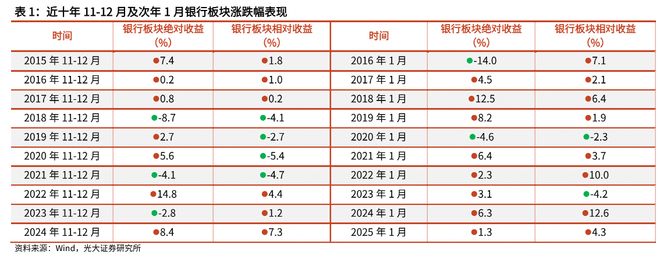
Core Viewpoint - The banking sector is experiencing a strong performance, with several banks seeing significant stock price increases, indicating a seasonal "tailwind" for bank stocks as they enter a favorable investment period from November to January [1][4]. Group 1: Market Performance - On November 4, various banks such as Xiamen Bank and CITIC Bank saw stock price increases of over 4% and 2% respectively, with the Bank AH Preferred ETF also rising nearly 2% [1]. - Historical data shows that from November to December, the banking sector has a 70% probability of generating absolute returns, which increases to 80% in January [4]. Group 2: Investment Trends - Insurance funds have been increasing their holdings in bank stocks since the third quarter, with a notable shift in strategy towards A-share state-owned banks like Agricultural Bank and Postal Savings Bank [4][5]. - Major insurance companies, such as Ping An Life and China Life, are adjusting their investment focus, with Ping An Life increasing its stake in Agricultural Bank and Postal Savings Bank [5][6]. Group 3: Market Conditions - The banking sector's strong performance is attributed to limited market information at the beginning of the year and the traditional "credit opening red" practice in January, which provides more certainty for bank operations [4]. - The current low-interest-rate environment has made high-dividend assets more attractive, enhancing the appeal of bank stocks for long-term investors [9].



银行股强势冲高,招商银行涨超2%,银行ETF龙头(512820)大涨超2%!险资加大银行股配置,机构看好银行板块稳健性、持续性
Xin Lang Cai Jing· 2025-11-04 02:54
Group 1 - The core viewpoint of the news highlights the strong performance of the banking sector, with significant increases in stock prices and positive market sentiment towards bank ETFs [1][3][4] - As of November 4, 2025, the China Securities Bank Index rose by 2.09%, with notable increases in individual bank stocks such as Xiamen Bank (up 4.79%) and Industrial Bank (up 3.26%) [1] - The banking ETF leader (512820) also saw a rise of 2.08%, with a recent price of 1.47 yuan, and a one-month cumulative increase of 5.72%, ranking second among comparable funds [1] Group 2 - The total assets of the banking and insurance sectors in mainland China have exceeded 500 trillion yuan, with an average annual growth of 9% over the past five years, solidifying China's position as the largest credit market and the second-largest insurance market [3] - Insurance capital is increasingly allocating to bank stocks, reflecting a long-term preference for high dividend and low valuation targets, with bank stocks being recognized for their stable dividends and anti-cyclical properties [3] - According to Morgan Stanley, the third-quarter revenue and net profit growth for domestic banks is expected to be faster than the first half of the year, with Agricultural Bank of China leading the profit growth among state-owned banks [4] Group 3 - The report indicates that the banking sector is viewed positively due to expected inflows of long-term capital, public fund reforms, and passive index expansions, which could accelerate the revaluation of bank stocks [4] - The insurance funds' heavy investment in bank stocks, particularly in state-owned banks, demonstrates confidence in their stability and consistent performance in a low-interest-rate environment [3][4]

