
燕京啤酒

Search documents
燕京啤酒(000729.SZ):预计2025年归母净利润15.84亿元-17.42亿元,同比增长50.00%-65.00%
Ge Long Hui A P P· 2026-01-20 11:21
Group 1 - The core viewpoint of the article highlights the launch of a new platform by Sina Finance that provides real-time market prices for well-known liquor brands, indicating a focus on transparency in the liquor market [1] Group 2 - Yanjing Beer (000729.SZ) announced an expected net profit attributable to shareholders for the year 2025 ranging from 1.58352 billion to 1.74187 billion yuan, representing a year-on-year growth of 50.00% to 65.00% [1] - The company's net profit after deducting non-recurring gains and losses is projected to be between 1.45689 billion and 1.56096 billion yuan, reflecting a year-on-year increase of 40.00% to 50.00% [1]

燕京啤酒:2025年净利同比预增50%—65%
Zheng Quan Shi Bao Wang· 2026-01-20 10:47
Core Viewpoint - Yanjing Beer (000729) expects a net profit attributable to shareholders of 1.584 billion to 1.742 billion yuan for 2025, representing a year-on-year growth of 50% to 65% [1] Group 1: Company Strategy - The company is firmly advancing its big product strategy, focusing on product strength, brand power, and channel strength while actively exploring innovative paths [1] - Yanjing Beer is deepening the construction of its excellent management system and promoting brand youthfulness, fashion, and premiumization [1] - The company is implementing a gradient market development strategy, with Yanjing U8 continuing to maintain a steady growth trend [1]
燕京啤酒:预计2025年归母净利润15.84亿元-17.42亿元,同比增长50.00%-65.00%
Ge Long Hui· 2026-01-20 10:44
Core Viewpoint - Yanjing Beer (000729.SZ) expects a significant increase in net profit for the year 2025, indicating strong financial performance and growth potential in the beverage industry [1] Financial Performance - The company forecasts a net profit attributable to shareholders ranging from 1.58352 billion to 1.74187 billion yuan for the year 2025, representing a year-on-year growth of 50.00% to 65.00% [1] - The net profit after deducting non-recurring gains and losses is expected to be between 1.45689 billion and 1.56096 billion yuan, with a year-on-year growth of 40.00% to 50.00% [1]
燕京啤酒(000729) - 2025 Q4 - 年度业绩预告
2026-01-20 10:30
(二)业绩预告情况 预计净利润为正值且属于下列情形之一: 证券代码:000729 证券简称:燕京啤酒 公告编号:2026-01 北京燕京啤酒股份有限公司 2025 年度业绩预告 本公司及董事会全体成员保证信息披露的内容真实、准确、完整,没有虚假记载、误导 性陈述或重大遗漏。 一、本期业绩预计情况 (一)业绩预告期间 2025 年 1 月 1 日至 2025 年 12 月 31 日 (二)非经常性损益的影响 □扭亏为盈 ☑ 同向上升 □同向下降 | 项目 | 本报告期 | 上年同期 | | --- | --- | --- | | 归属于上市公司 | 盈利:158,352万元-174,187万元 | 盈利:105,567.85万元 | | 股东的净利润 | 比上年同期增长:50.00%-65.00% | | | 扣除非经常性损 | 盈利:145,689万元-156,096万元 | 盈利:104,063.74万元 | | 益后的净利润 | 比上年同期增长:40.00%-50.00% | | | 基本每股收益 | 盈利:0.5618元/股-0.6180元/股 | 盈利:0.3745元/股 | 二、与会计师事务所沟通情 ...
食品饮料行业2026年投资策略:白酒有望调整结束,大众品优选个股
Southwest Securities· 2026-01-20 09:16
Core Insights - The report indicates that the adjustment period for high-end liquor is expected to end, highlighting the long-term investment value in this sector. The price of mainstream liquor has decreased from approximately 2200 yuan around the Spring Festival in 2025 to about 1560 yuan currently, with a notable decline since June [4][30][32] - The beer industry is anticipated to benefit from a low base effect in 2026, with emerging retail channels and government consumption stimulus policies expected to drive recovery [5][42] - The dairy industry is currently in a transitional phase, with low milk prices expected to rebound as demand improves and supply stabilizes. The long-term growth potential remains strong due to ongoing consumption upgrades [5][60][63] - The condiment sector is projected to benefit from a gradual recovery in restaurant consumption, with both B2B and B2C channels expected to see improved sales as consumer spending recovers [5][79] Liquor Industry - High-end liquor is expected to stabilize after a period of adjustment, with long-term investment value becoming more apparent. The market share of premium liquor brands continues to rise, and the consumption upgrade trend remains intact despite short-term impacts [4][30][34] - The competition in the mid-range liquor segment has intensified, with brands experiencing varying levels of performance due to market pressures. The demand for mid-range products has been notably affected by weak business consumption [36][39] - Inventory management is crucial, with manufacturers actively controlling supply to maintain price stability. The introduction of information systems has improved inventory management capabilities [40][39] Beer Industry - The beer market is expected to recover due to a low base effect from 2025, with national leaders likely to benefit significantly. The rise of instant retail channels is also anticipated to drive growth in non-on-premise beer sales [42][43] - The industry is entering a mature phase, with a focus on premiumization and product structure upgrades. The market share of high-end products is increasing, reflecting a shift in consumer preferences [47][50] - Cost stability is expected in 2026, with barley prices remaining low and contributing to profit margins. The overall cost structure is anticipated to support profitability in the beer sector [51][53] Dairy Industry - The dairy sector is currently experiencing a down cycle in milk prices, but a rebound is expected as demand improves and supply stabilizes. The long-term growth potential remains strong due to increasing consumer preferences for high-quality dairy products [60][63] - The population base in China supports the demand for dairy products, with significant growth potential in rural areas where consumption is currently lower compared to urban areas [66][70] - The industry is witnessing a shift towards high-quality growth, with leading companies focusing on improving profitability through better cost management and efficiency [60][77] Condiment Industry - The condiment sector is expected to benefit from a gradual recovery in restaurant consumption, with B2B channels likely to see significant improvements as consumer spending increases [79][84] - The industry has shown resilience, with a stable growth rate over the past five years. The market size for condiments has surpassed 650 billion yuan, driven by rising consumer demand and changing eating habits [83][84] - Cost advantages are anticipated in 2026, with raw material prices remaining low, which will help maintain stable growth in the condiment sector [79][80]




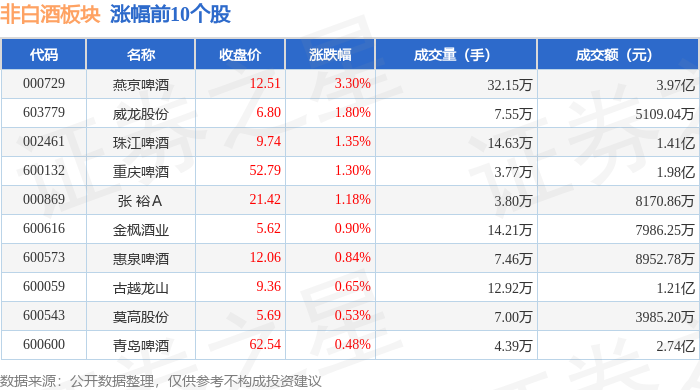
非白酒板块1月20日涨0.96%,燕京啤酒领涨,主力资金净流入3894.01万元
Zheng Xing Xing Ye Ri Bao· 2026-01-20 08:51
证券之星消息,1月20日非白酒板块较上一交易日上涨0.96%,燕京啤酒领涨。当日上证指数报收于 4113.65,下跌0.01%。深证成指报收于14155.63,下跌0.97%。非白酒板块个股涨跌见下表: | 代码 | 名称 | 收盘价 | 涨跌幅 | 成交量(手) | 成交额(元) | | --- | --- | --- | --- | --- | --- | | 000729 | 咸東県河 | 12.51 | 3.30% | 32.15万 | 3.97亿 | | 603779 | 威龙股份 | 6.80 | 1.80% | 7.55万 | 5109.04万 | | 002461 | 珠江啤酒 | 9.74 | 1.35% | 14.63万 | 1.41亿 | | 600132 | 重庆啤酒 | 52.79 | 1.30% | - 3.77万 | 1.986 T | | 000869 | 张裕A | 21.42 | 1.18% | 3.80万 | 8170.86万 | | 600616 | 金枫酒业 | 5.62 | 0.90% | 14.21万 | 7986.25万 | | 600573 | 惠泉啤酒 | ...

啤酒概念涨1.52%,主力资金净流入14股
Zheng Quan Shi Bao Wang· 2026-01-20 08:49
Group 1 - The beer concept index rose by 1.52%, ranking 8th among concept sectors, with 18 stocks increasing in value, including Hongmian Co., HeBai Group, and Jiamei Packaging reaching the daily limit [1] - Leading gainers in the beer sector included Haoxiangni, Kaimeteqi, and Aoruijin, with respective increases of 5.77%, 5.31%, and 3.76% [1] - The stocks with the largest declines were Zhuhai Zhongfu, *ST Lanhua, and Pinwo Food, which fell by 3.18%, 2.94%, and 1.94% respectively [1] Group 2 - The beer concept sector saw a net inflow of 828 million yuan, with 14 stocks receiving net inflows, and 5 stocks exceeding 50 million yuan in net inflow [2] - Kaimeteqi led the net inflow with 254 million yuan, followed by Hongmian Co., Luzhou Laojiao, and HeBai Group with net inflows of 167 million yuan, 164 million yuan, and 130 million yuan respectively [2] Group 3 - In terms of net inflow ratios, Hongmian Co., HeBai Group, and Chongqing Beer had the highest ratios at 32.90%, 15.07%, and 13.17% respectively [3] - The top stocks in the beer concept by net inflow included Kaimeteqi with a 5.31% increase and a turnover rate of 16.50%, and Hongmian Co. with a 10.13% increase and a turnover rate of 9.38% [3][4]



啤酒行业2025年12月跟踪:淡季蓄力,复苏将至
Xiangcai Securities· 2026-01-20 07:05
Investment Rating - The industry investment rating is maintained as "Buy" [2] Core Insights - The macroeconomic and consumption environment shows signs of marginal improvement despite ongoing pressure in the consumer market. The restaurant sector continues to outperform overall retail sales, indicating structural growth opportunities for the beer industry [4][14] - The beer industry is experiencing a seasonal production decline due to the off-peak season, but overall production levels remain stable compared to previous years. The industry is expected to recover, with a focus on high-end and super high-end beer segments [5][36] - Cost pressures in the beer industry are manageable, with stable raw material costs and a neutral overall cost environment. Price stability in the terminal market supports profitability [6][50] Summary by Sections 1. Macroeconomic and Consumption Environment - In December 2025, the retail sales growth rate fell to 0.9% year-on-year, while the restaurant sector showed a 2.2% increase, indicating resilience in selected consumption categories. CPI rose to 0.8%, and PPI showed a narrowing decline at -1.9% [4][14] - Consumer confidence and income indicators are gradually improving, which is expected to enhance consumption potential in 2026 [15][16] 2. Overall Operation of the Beer Industry - December 2025 saw a seasonal decline in beer production, with a total production of 331.81 million hectoliters by the end of November. The industry is expected to maintain production levels close to historical highs despite short-term fluctuations [5][33] - The import and export dynamics show a weak import performance but stable export growth, with expectations for marginal improvement in imports in early 2026 [34][35] 3. Prices and Costs - Raw material costs remain stable, with domestic barley prices at 2205 CNY/ton and imported barley prices at 255 USD/ton. Packaging material costs are in a neutral state due to price fluctuations [6][49] - The terminal prices for canned and bottled beer have shown minimal fluctuations, maintaining a stable pricing structure [50][51] 4. Tracking of Listed Companies - The stock prices of key beer companies in the A-share and Hong Kong markets have shown slight declines, with most companies experiencing negative growth. Market sentiment appears cautious [58][61] 5. Investment Recommendations - Despite ongoing declines in retail sales data, the beer sector is positioned for potential valuation recovery due to low historical valuation levels. The expected improvement in consumer confidence and manageable cost pressures supports a positive outlook for the beer industry in 2026 [9][67]
食品饮料行业:月聚焦:如何布局零食“春季躁动”?
GF SECURITIES· 2026-01-20 06:14
Group 1 - The report highlights the "Spring Excitement" in the snack sector, indicating a historical high relative win rate of 70% for the food and beverage sector in the 40 days leading up to the Spring Festival [7][16] - The report emphasizes that the "Spring Excitement" is not solely dependent on the annual beta of the food and beverage sector, as structural opportunities still exist despite a long-term adjustment period since 2021 [7][16] - Key catalysts for the upcoming Spring Festival include concentrated demand for gifts and gatherings, which leads to more planned channel stocking, creating a positive feedback loop of expectations and validations [7][16][28] Group 2 - In December, the food and beverage sector underperformed the market by 7.5 percentage points, with a decline of 5.2%, ranking last among 31 primary industries [7][61] - The report notes a divergence in performance among sub-sectors, with snacks and soft drinks showing gains while liquor and beer experienced declines [7][61][64] - The absolute and relative valuations of the food and beverage sector are at their lowest since 2010, indicating potential investment opportunities [7][61][64] Group 3 - The report tracks the recovery of consumer confidence, with a 0.9% year-on-year increase in retail sales in December, showing improvement from the previous month [7][63] - It highlights that the liquor sector is facing weak demand and declining prices, with the price adjustments for premium liquor nearing levels seen between 2011 and 2015 [7][63][64] - The report identifies structural differentiation in costs, with some packaging materials and agricultural products experiencing price increases [7][63][64] Group 4 - Investment recommendations include a focus on liquor stocks that have undergone a four-year adjustment period, with potential for a "valuation + performance" double bottom [7][64] - For consumer goods, the report anticipates a moderate increase in industry prices in 2026, with specific recommendations for companies like Anjuke Foods, Qianhe Flavor, and Eastroc Beverage [7][64] - The report suggests that the upcoming Spring Festival will provide a favorable environment for growth narratives, particularly in the restaurant supply chain and certain chain formats [7][64]




扩大内需政策“暖”风频吹!大消费尝试修复
Mei Ri Jing Ji Xin Wen· 2026-01-20 06:13
Group 1 - The National Development and Reform Commission (NDRC) is formulating a strategy for expanding domestic demand from 2026 to 2030, focusing on improving supply structure and enhancing consumer capacity [1] - The consumer sector is experiencing negative performance, exemplified by Shui Jing Fang's (600779) forecast of a 42% year-on-year decline in revenue for 2025, indicating that the industry's pessimism is already reflected in prior adjustments [1] - Leading companies like Kweichow Moutai (600519) are adapting by launching market-oriented initiatives, such as online direct sales, to increase accessibility for consumers [1] Group 2 - The consumer ETF from Huaxia (510630.SH) has seen net inflows for three consecutive days, covering various consumer sub-sectors including liquor and dairy [2] - The food ETF from Huaxia (159151.SZ) focuses on daily consumer goods without including liquor or beer, emphasizing strong demand resilience [2] - The optional consumption ETF (562580.SH) covers sectors like automotive and retail, excluding food and beverage categories [2]