光大证券

Search documents
三季度金融机构被罚没超10亿,四家机构收超6000万大罚单
2 1 Shi Ji Jing Ji Bao Dao· 2025-10-11 15:02
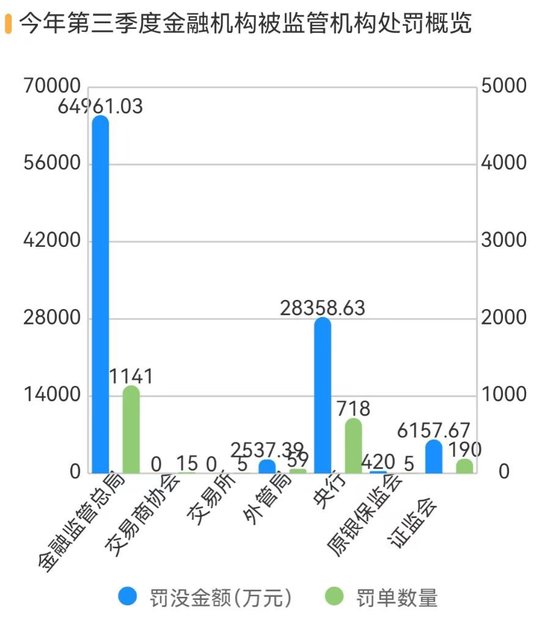
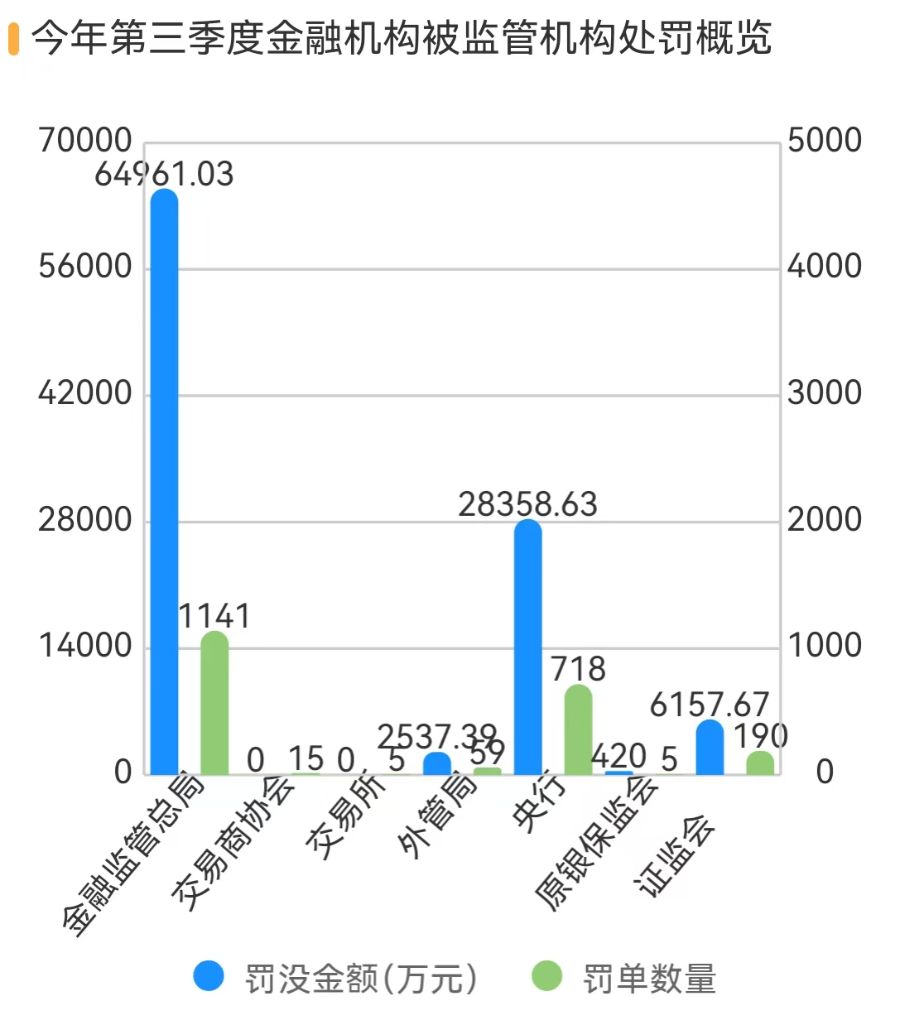
Core Points - In the third quarter of this year, financial institutions received a total of 2,133 fines, amounting to 1.024 billion yuan, representing significant increases of 36.12% and 190.91% respectively compared to the previous quarter, and a notable rise compared to the same period last year [1] Summary by Sections 1. Penalty Situation of Different Types of Institutions in Q3 - The National Financial Regulatory Administration issued 1,141 fines to financial institutions in Q3, totaling 650 million yuan, with a slight decrease of 20.82% in the number of fines year-on-year, but an increase of 46.4% in the total amount [3] - The central bank's penalties increased significantly, with 718 fines issued, a year-on-year increase of 357.32%, and a total penalty amount of 284 million yuan, up 353.34% year-on-year [3] 2. Overall Penalty Situation in the First Three Quarters - The penalty intensity was high in Q1, decreased in Q2, and increased again in Q3 [4] 3. Penalty Breakdown by Institution Type in Q3 - Banks received 1,448 fines, an increase of 18.3% year-on-year, with a total penalty amount of 829 million yuan, up 84.63% year-on-year [8] - Insurance companies received 471 fines, a slight increase of 7.29%, with a total penalty amount of 93.86 million yuan, up 41.57% year-on-year [8] - Securities firms received 45 fines, a decrease of 30.77% year-on-year, but an increase of 40.63% compared to the previous quarter [8] 4. Major Penalties in Q3 - Four fines exceeding 60 million yuan were issued, with Huaxia Bank receiving the largest fine of 87.25 million yuan for imprudent management of loans and related business [13][14] - Other significant fines included 66.70 million yuan for Guangfa Bank and 61.50 million yuan for Hengfeng Bank, both for similar violations [14] 5. Compliance Characteristics in Q3 - There was a notable increase in penalties for internet business violations, with 15 fines issued, a 275% increase from Q2, involving institutions like Postal Savings Bank and Zhejiang Merchants Bank [19] - Loan misappropriation issues were prominent, with 60 related fines issued, a 130.77% increase, primarily involving funds misused for repaying bad loans or investment [21] 6. Penalty Rankings of Financial Institutions in Q3 - Huaxia Bank ranked first in total penalties with 91.62 million yuan, followed by Guangfa Bank with 72.84 million yuan and Hengfeng Bank with 65.55 million yuan [23] - Among non-bank institutions, Donghai Securities topped the list with 60 million yuan in penalties, followed by two wealth management companies, Huaxia Wealth Management and Guangyin Wealth Management [25]




三季度金融机构被罚没超10亿 四家机构收超6000万大额罚单
2 1 Shi Ji Jing Ji Bao Dao· 2025-10-11 07:54
Core Insights - In the third quarter of this year, financial institutions received a total of 2,133 fines, amounting to 1.024 billion yuan, representing significant increases of 36.12% and 190.91% respectively compared to the previous quarter, and a notable rise compared to the same period last year [1] Summary by Sections 1. Penalty Situation in Q3 - The National Financial Regulatory Administration issued 1,141 fines to financial institutions in Q3, totaling 650 million yuan, with a slight decrease of 20.82% in the number of fines year-on-year, but a 46.4% increase in the total amount [2] - The central bank significantly increased its penalties, issuing 718 fines, which is a year-on-year increase of 357.32%, with a total penalty amount of 284 million yuan, also up 353.34% year-on-year [2] 2. Overall Penalty Trends - The overall penalty situation for financial institutions in the first three quarters shows a strong enforcement in Q1, a slight decline in Q2, and a resurgence in Q3 [4] 3. Breakdown by Institution Type - Banks received 1,448 fines in Q3, an increase of 18.3% year-on-year, with penalties totaling 829 million yuan, a year-on-year increase of 84.63% [7] - Insurance companies received 471 fines, with a slight increase of 7.29% year-on-year, and penalties amounting to 93.86 million yuan, up 41.57% [7] - Securities firms received 45 fines, a decrease of 30.77% year-on-year, but an increase of 40.63% compared to the previous quarter [7] 4. Major Penalties - In Q3, there were four penalties exceeding 60 million yuan, with Huaxia Bank receiving the largest fine of 87.25 million yuan for improper management of loans and regulatory data reporting [11] - Guangfa Bank received the second-largest fine of 66.70 million yuan for similar violations [12] - Hengfeng Bank was fined 61.50 million yuan for issues related to loan management and investment [13] 5. Compliance Cases - Huaxia Securities faced penalties for promoting false financial products, resulting in significant client losses [15] - Donghua Futures was penalized for improper procurement processes involving funds [14] 6. Compliance Characteristics - There has been an increase in penalties related to internet business violations, with 15 fines issued in Q3, a 275% increase from Q2 [15] - Loan misappropriation issues were prominent, with 60 related fines issued, a 130.77% increase from the previous quarter [17] 7. Penalty Rankings - In Q3, Huaxia Bank had the highest total penalty amount of 91.62 million yuan, followed by Guangfa Bank at 72.84 million yuan, and Hengfeng Bank at 65.55 million yuan [19] - Among non-bank institutions, Donghai Securities led with a penalty of 60 million yuan, followed by Huaxia Wealth Management and Guangyin Wealth Management [21]


三季度金融机构被罚没超10亿,四家机构收超6000万大额罚单
2 1 Shi Ji Jing Ji Bao Dao· 2025-10-11 07:47
Summary of Key Points Core Viewpoint - In the third quarter of this year, financial institutions received a total of 2,133 fines amounting to 1.024 billion yuan, representing significant increases of 36.12% and 190.91% respectively compared to the previous quarter, and a notable rise from the same period last year [1]. Group 1: Penalty Overview - The National Financial Supervision Administration issued 1,141 fines totaling 650 million yuan in the third quarter, with a year-on-year increase of 46.4% in penalty amounts despite a slight decrease of 20.82% in the number of fines [1]. - The central bank's penalties surged, with 718 fines issued, marking a year-on-year increase of 357.32%, and total penalties amounting to 284 million yuan, up 353.34% [1]. Group 2: Sector-Specific Penalties - Banks received 1,448 fines in the third quarter, an increase of 18.3% year-on-year, with penalties totaling 829 million yuan, reflecting an 84.63% increase [6]. - Insurance companies faced 471 fines, a slight increase of 7.29%, with penalties amounting to 93.86 million yuan, up 41.57% [6]. - Securities firms received 45 fines, a decrease of 30.77% year-on-year, but an increase of 40.63% compared to the previous quarter [6]. Group 3: Major Penalties - Four fines exceeding 60 million yuan were issued in the third quarter, with Huaxia Bank receiving the largest fine of 87.25 million yuan for improper management of loans and regulatory data reporting [11]. - Guangfa Bank was fined 66.70 million yuan for similar violations, while Hengfeng Bank received a fine of 61.50 million yuan for issues related to loan and wealth management [11]. Group 4: Compliance Cases - Hua'an Securities faced penalties for promoting false financial products, resulting in significant client losses [12]. - Donghua Futures was penalized for improper procurement practices involving funds from its parent company [13]. Group 5: Compliance Trends - There has been a notable increase in penalties related to internet business violations, with 15 fines issued in the third quarter, a 275% increase from the previous quarter [14]. - Major banks such as Postal Savings Bank and Zhejiang Merchants Bank were penalized for improper management of internet loan operations [15]. Group 6: Loan Misuse Issues - A total of 60 fines related to loan misuse were recorded, a 130.77% increase from the previous quarter, with funds often misallocated to repay bad loans or for investment purposes [17]. Group 7: Penalty Rankings - In terms of total penalties, Huaxia Bank led with 91.62 million yuan, followed by Guangfa Bank with 72.84 million yuan, and Hengfeng Bank with 65.55 million yuan [17].
接近300万!A股新开户数大增
Zhong Guo Zheng Quan Bao· 2025-10-11 05:04
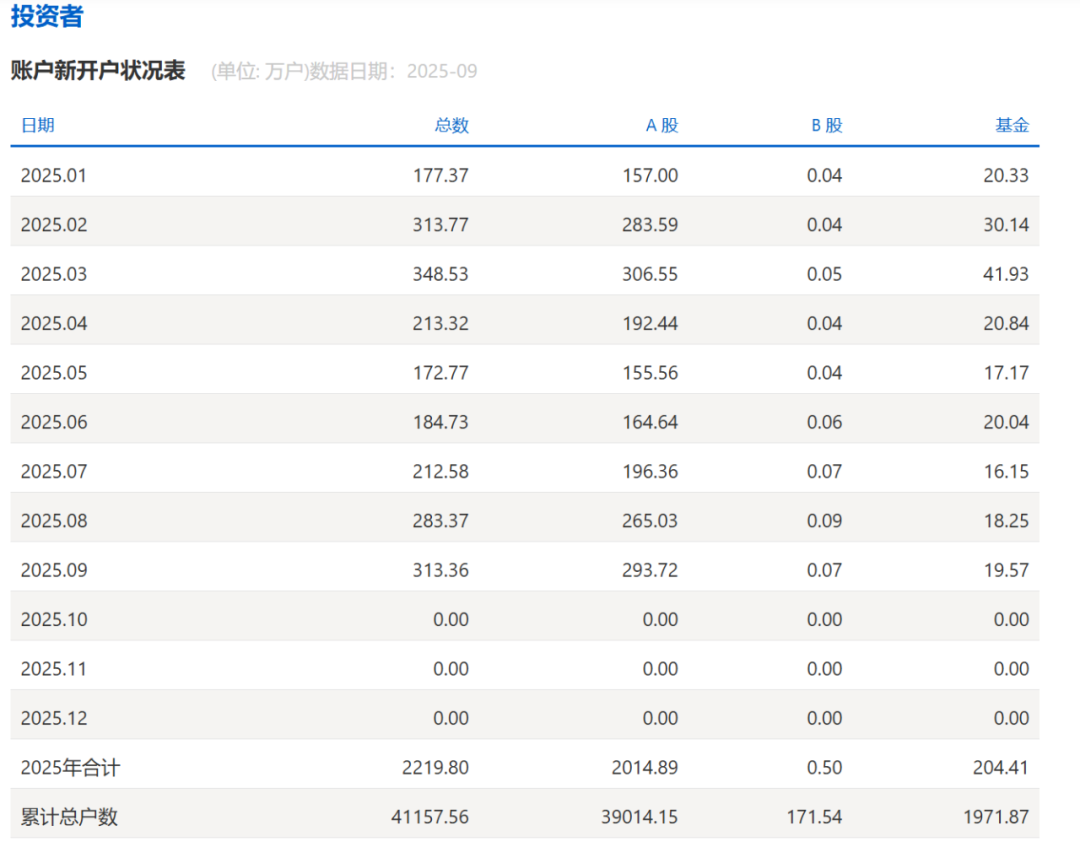
Core Insights - The number of new A-share accounts opened in September 2025 reached 2.9372 million, marking a year-on-year increase of 60.73% and a month-on-month increase of 10.83% [1] - As of the end of September 2025, a total of 20.1489 million new A-share accounts have been opened this year, reflecting a year-on-year growth of 49.64% [1] Monthly New Account Data - Monthly new A-share account openings from January to September 2025 were as follows: 1.5700 million, 2.8359 million, 3.0655 million, 1.9244 million, 1.5556 million, 1.6464 million, 1.9636 million, 2.6503 million, and 2.9372 million respectively [2][3] - The September 2025 figure of 2.9372 million is the second highest for the year, only behind March 2025's 3.0655 million [3] Year-on-Year Comparison - The September 2025 new account openings of 2.9372 million surpassed all months in 2024 except for October, which had 6.8468 million [3][4] - The total new accounts opened in 2024 amounted to 24.9989 million, with a cumulative total of 38.9377 million accounts by the end of the year [4] Market Performance and Investor Sentiment - Since June 2025, the A-share market has shown a strong upward trend, with the Shanghai Composite Index, Shenzhen Component Index, and ChiNext Index rising by 15.99%, 34.72%, and 62.46% respectively from June 1 to September 30 [5][6] - Analysts suggest that the current market still holds certain value, driven by a continuous "profit-making effect" that supports ongoing capital inflow [7] Future Market Outlook - The market is expected to maintain a trend of steady upward movement with low slope in October, following the patterns observed in September [7] - Investors are advised to focus on potential style shifts in the fourth quarter, as historical data indicates a tendency for previously leading sectors to lag while lagging sectors may catch up [7]
本周先涨后跌:可转债周报(2025年10月9日至2025年10月10日)-20251011
EBSCN· 2025-10-11 04:10
1. Report Industry Investment Rating No relevant information provided. 2. Core View of the Report - From the beginning of 2025 to October 10, the convertible bond market underperformed the equity market, with the CSI Convertible Bond Index rising by 17.1% and the CSI All-Share Index rising by 23.3%. In the long term, convertible bonds remain relatively high-quality assets due to the persistent pattern of strong demand exceeding supply. However, the current valuation level is relatively high, so attention should be paid to structural opportunities [1][4]. 3. Summary by Relevant Catalogs Market Conditions - From October 9 to 10, 2025 (2 trading days), convertible bonds first rose and then fell. The CSI Convertible Bond Index had a change of 0% (previous trading cycle: +1.6%), and the CSI All-Share Index changed by -0.3% (previous trading cycle: +2.0%). Since the beginning of 2025, the convertible bond market has underperformed the equity market [1]. - By rating, high-rated bonds (AA+ and above), medium-rated bonds (AA), and low-rated bonds (AA- and below) had changes of +0.45%, +0.50%, and -0.31% respectively this week. Low-rated bonds performed poorly [1]. - By convertible bond size, large-scale convertible bonds (bond balance > 5 billion yuan), medium-scale convertible bonds (balance between 500 million and 5 billion yuan), and small-scale convertible bonds (balance < 500 million yuan) had changes of +0.32%, +0.12%, and -0.16% respectively this week. Large-scale convertible bonds performed the best [1]. - By conversion parity, ultra-high parity bonds (conversion value > 130 yuan), high parity bonds (conversion value between 110 and 130 yuan), medium parity bonds (conversion value between 90 and 110 yuan), low parity bonds (conversion value between 70 and 90 yuan), and ultra-low parity bonds (conversion value < 70 yuan) had changes of +0.03%, -0.17%, +0.03%, +0.14%, and +0.15% respectively this week. High parity bonds closed down [2]. Convertible Bond Price, Parity, and Conversion Premium Rate - As of October 10, 2025, there were 420 outstanding convertible bonds (423 at the close on September 30), with a balance of 587.832 billion yuan (589.024 billion yuan at the close on September 30). The average convertible bond price was 132.67 yuan (131.41 yuan at the close on September 30), the average parity was 105.35 yuan (100.18 yuan at the close on September 30), and the average conversion premium rate was 27.6% (27.1% at the close on September 30) [3]. - The conversion premium rate of medium parity convertible bonds (conversion value between 90 and 110 yuan) was 30.1%, higher than the median conversion premium rate of medium parity convertible bonds since 2018 (20.3%) [3]. Convertible Bond Performance and Allocation Directions - This week, convertible bonds first rose and then fell, and the CSI Convertible Bond Index had a change of 0%. Since the beginning of 2025, the convertible bond market has underperformed the equity market. Given the persistent pattern of strong demand exceeding supply in the convertible bond market, convertible bonds remain relatively high-quality assets in the long term. Currently, the overall valuation level is high, so attention should be paid to structural opportunities [4]. Convertible Bond Increase Situation - The top 15 convertible bonds in terms of increase this week include Zhonghuanzhuan 2, Guanzhong Convertible Bond, Haomei Convertible Bond, etc. The increase rates of these convertible bonds range from 6.01% to 20.00% [22].
巨头激战文生视频领域 三大投资主线浮现
Zhong Guo Zheng Quan Bao· 2025-10-10 22:03
Core Insights - The competition in the AI video generation sector has intensified with major players like OpenAI and xAI launching significant products, indicating a full-scale upgrade in this field [1][2][3] Group 1: Market Reactions - On October 10, shares of companies such as Chuling Information surged by 12.94%, and other firms like Kaipu Cloud and Vision China also saw gains, reflecting positive market sentiment towards AI video applications [1] - The development of the AI video application industry has established a complete chain from "model capability - user scenarios - commercial monetization," enhancing growth potential and solidifying leadership in AI-generated content [1] Group 2: Product Developments - OpenAI launched the Sora App and Sora2 model, which quickly rose to the third position in the free app rankings on the iOS platform in the U.S., marking a significant milestone in AI video generation [2] - Sora2 has made substantial advancements in accurately replicating physical movements, maintaining scene continuity across multiple shots, and generating synchronized audio, enhancing the overall user experience [2] - xAI introduced Grok Imagine v0.9, which allows users to convert static images into dynamic videos seamlessly, representing a strategic product overhaul aimed at competing directly with OpenAI's offerings [3] Group 3: Industry Trends and Investment Opportunities - Analysts suggest that AI video generation technology is transitioning from auxiliary creation to autonomous generation, with ongoing breakthroughs in various technical aspects [4] - The rapid development of AI video is expected to boost demand for computing power and storage, positively impacting investment sentiment in related sectors [4] - Investment strategies should focus on three main areas: AI chip and component demand, the evolution of AIoT devices, and the monetization potential of AI video applications, which are seen as key drivers for future growth [5]
最新!中芯国际、佰维存储两融折算率分别调回70%、50%
Zhong Guo Ji Jin Bao· 2025-10-10 14:21
Core Viewpoint - The adjustment of margin trading collateral rates for SMIC and BAWI Storage is seen as a positive development after significant declines in their stock prices, with rates increased to 70% and 50% respectively [2][4]. Group 1: Margin Trading Adjustments - SMIC's margin trading collateral rate has been raised from 0% to 70% [4][6]. - BAWI Storage's margin trading collateral rate has been increased from 0% to 50% [4][6]. - Other stocks such as XianDao Intelligent, Nanji Light, and Manens-T have also seen their collateral rates adjusted upwards to between 30% and 65% [4][6]. Group 2: Market Reactions - The previous announcement of a 0% collateral rate led to significant declines in stock prices, with SMIC and BAWI Storage experiencing maximum drawdowns of over 18% and 17% respectively [4][6]. - Some securities firms, including CITIC Securities and Everbright Securities, still maintain a 0% collateral rate for SMIC and BAWI Storage as of the report date [8][9]. Group 3: Reasons for Collateral Rate Adjustments - Collateral rates can be adjusted to 0% if a stock's static price-to-earnings ratio exceeds 300 or is negative, indicating a significant deviation from fundamentals [10]. - Stocks under risk warnings or in delisting processes also have their collateral rates set to 0% to protect investors [10]. - Brokerages may dynamically adjust collateral rates based on their risk management requirements, particularly during periods of unusual volatility [10].



港股回调五个交易日 分析:仍处于上升趋势
Zhong Guo Xin Wen Wang· 2025-10-10 12:02
渣打北亚区投资总监郑子丰表示,恒生指数进入整固阶段。今年以来"北水"支持力度大,内地投资者对 境外市场情绪越趋积极,加之港股新股市场强劲,相信南向资金会持续流入,现时港股估值仍有上升空 间。国家"十五五"规划方向或为港股带来启示,政策支持和"内卷式"竞争缓和,令企业盈利增长预测有 望上调。此外,他预计美联储会在年底前再度降息,带来利好。(完) 来源:中国新闻网 港股回调五个交易日 分析:仍处于上升趋势 中新社香港10月10日电 (记者 魏华都)港股10月3日起连续回调五个交易日,分析认为,港股回调幅度较 健康,仍处于上升趋势。 10日,恒生指数低开后跌幅进一步扩大,午后一度跌逾500点,收报26290.32点,全日跌462.27点,跌幅 1.73%,全周累计跌逾3%。 恒生科技指数、国企指数当天也分别跌3.27%和1.8%,黄金、医药和科技等多个板块回落,大市成交额 3333.37亿港元。 光大证券国际证券策略师伍礼贤接受中新社记者采访时表示,港股走弱受多重因素影响,包括"上升通 道"顶部遇到阻力、重磅蓝筹股股价下挫拖累大市表现,以及此前升幅较大的大型科技股和芯片股短线 回调力度大。 但他认为,港股处于"大涨 ...
光大证券:BEST杜瓦顺利落位安装 聚变行业有望迎密集招标期
Zhi Tong Cai Jing· 2025-10-10 08:09
Core Viewpoint - The successful installation of the Dewar base for the BEST project marks a new phase in the construction of controlled nuclear fusion, indicating potential acceleration in component development and engineering installation [1][2]. Group 1: Project Progress - The BEST project has advanced its overall assembly by two months ahead of schedule, with the Dewar base installation signaling a new stage in the project [2]. - Multiple projects in the domestic fusion industry are progressing steadily, with new routes and projects being announced, indicating an upcoming period of intensive bidding [3]. Group 2: Technological Advancements - Significant breakthroughs in key technologies and components have been reported, including the introduction of a kilometer-level REBCO superconducting tape suitable for controlled nuclear fusion scenarios and the successful generation of a steady-state strong magnetic field [3]. Group 3: Strategic Value of Fusion Energy - The strategic value of fusion energy is highlighted by its potential to reshape electricity consumption structures, particularly with the increasing demand from AI and data centers, which are projected to account for 5%-9% of global electricity consumption by 2050 [4]. - Major tech companies are actively engaging in fusion energy, with agreements for purchasing fusion power, indicating a strong market interest and potential for long-term growth in the controlled nuclear fusion industry [4]. Group 4: Investment Opportunities - Companies to watch in the vacuum chamber and internal components include Hezhong Intelligent (603011), Guoguang Electric (688776), Antai Technology (000969), and Parker New Materials (605123) [5]. - For magnet systems, notable companies include Lianchuang Optoelectronics (600363) and Yongding Co., Ltd. (600105) [5]. - In the power systems sector, key players are Sichuan Chuang Electronics (600990), Wangzi New Materials (002735), and Xuguang Electronics (600353) [5].
【光大研究每日速递】20251010
光大证券研究· 2025-10-09 23:08
Group 1: Macro Insights - The recent surge in gold prices during the National Day holiday is driven by three new variables: concerns over U.S. fiscal credibility due to government shutdown, changes in Japanese and European political landscapes affecting currency credibility, and significant inflows into gold ETFs indicating rising risk aversion among private investors [5][6][9] - Current corporate earnings are still stabilizing, with signs of improvement in certain sectors, such as a rebound in industrial profits and a narrowing decline in PPI. Domestic exports are expected to remain resilient, and the support from policies may lead to a slight recovery in A-share earnings in Q4 [5][6] Group 2: Market Trends - In September 2025, 11 new stocks were listed, raising a total of 11.69 billion yuan, with a month-on-month increase in new stock issuance. The average first-day gains for new stocks remain high, with main board stocks averaging a 131.33% increase and growth enterprise board stocks averaging a 251.9% increase [6][8] - The issuance scale of credit bonds continues to grow, with a total of 1.24 trillion yuan issued in September 2025, marking a month-on-month increase of 10.27%. The total outstanding credit bond balance reached 30.49 trillion yuan by the end of September [8] Group 3: Industry Developments - The BEST project for controlled nuclear fusion has made significant progress, with the installation of the dewar base completed ahead of schedule. This marks the beginning of a new phase in the project, with upcoming tenders for key components expected to accelerate development [8][9] - OpenAI's launch of Sora2 and its Apps SDK is reshaping the AI ecosystem, emphasizing that AI enhances traditional SaaS rather than replacing it, which may alleviate market pessimism regarding AI applications [9]