
浙商证券

Search documents
突破6000人!券商分析师,创历史新高!
券商中国· 2025-09-21 23:36
Core Insights - The number of securities analysts in China has surpassed 6,000, reaching a historical high of 6,162 as of September 19, 2023, indicating rapid expansion in the analyst workforce [2][4][10] - The growth in analyst numbers is driven by the increasing demand from institutional investors and the need for talent in the face of regulatory changes affecting commission income [4][10] - Despite the increase in analyst numbers, the industry is facing significant revenue challenges due to a more than 30% decline in commission income from the public fund sector [2][10] Analyst Growth - The analyst workforce has seen a rapid increase, with the number surpassing 3,000 in 2018 and crossing 4,000 in 2022, now exceeding 6,000 in less than two years [4] - Major firms like CITIC Securities and CICC lead in analyst numbers, with CICC having 344 analysts and CITIC Securities surpassing 300 [4][5] - The growth is characterized by a mix of internal promotions and external hiring, particularly among smaller firms seeking to enhance their research capabilities [6][8] Structural Changes in Hiring - Large firms primarily rely on internal growth for expanding their analyst teams, while smaller firms are increasingly hiring externally to fill gaps [6][8] - For instance, CITIC Securities registered 62 new analysts this year, with 59 being internal promotions, while smaller firms like Guojin Securities have seen significant external hiring [6][8] Industry Challenges and Transformation - The research environment is changing, with a notable decline in income from commission-based models, prompting firms to seek new revenue streams [10] - Firms are focusing on diversifying their income sources, including expanding into non-public fund clients and exploring international business opportunities [10] - Some leading firms have slowed their hiring pace, with CICC reporting a decrease in analyst numbers this year, indicating a potential shift in strategy [11]

A股行业轮动速度放缓,意味什么?机构:把握基本面 享受资金面
Feng Huang Wang· 2025-09-21 22:39
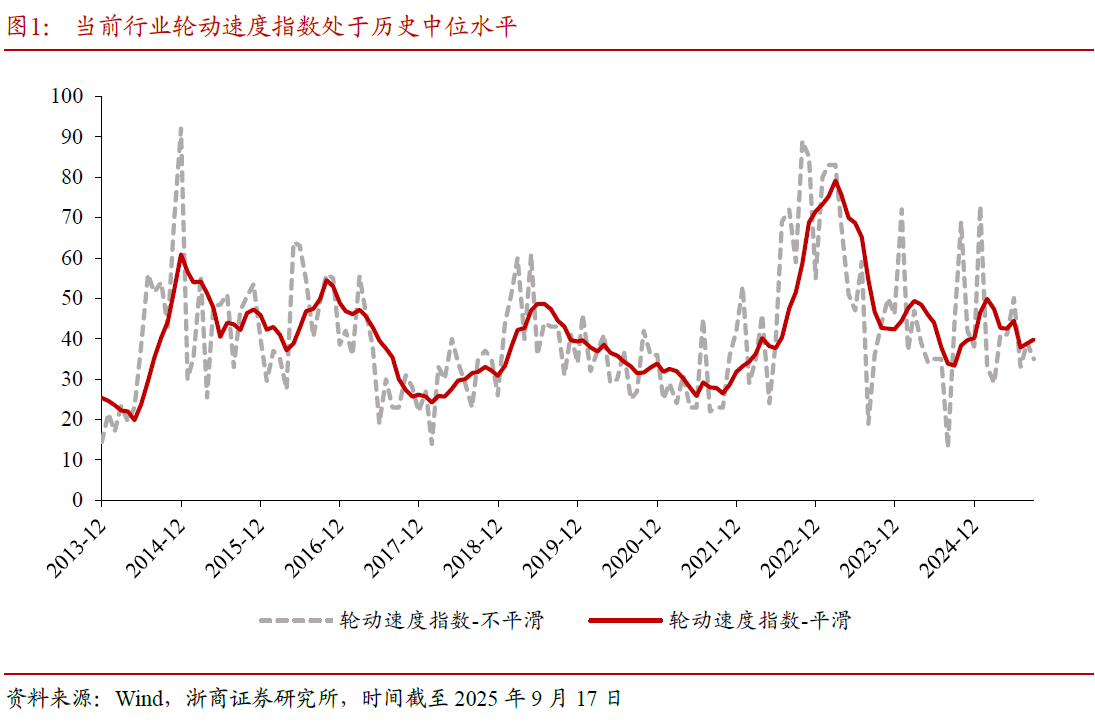
Core Viewpoint - The A-share market has entered a new phase of industry rotation, characterized by a slowdown in rotation speed but an increase in market differentiation [1][2][5] Group 1: Market Rotation Characteristics - The industry rotation speed has decreased since July, following a technology-led market rally, and is currently at the historical median over the past decade [2][5] - Despite the slowdown in rotation speed, the intensity of market differentiation has reached a new high for the year, indicating a significant structural divergence [5][6] Group 2: Driving Forces Behind Market Rotation - The core logic driving the current rotation is the interplay between liquidity and fundamentals, with liquidity being a major factor in the short term [6][7] - Different market phases are identified: liquidity-driven phases favor sectors like advanced manufacturing and TMT, while fundamental-driven phases benefit consumption, cyclical, and financial sectors [6][8] Group 3: Investment Strategies - Investment strategies should focus on balanced allocation to cope with moderate rotation speeds, while also identifying key opportunities in leading sectors [8][9] - Specific recommendations include focusing on the TMT sector due to strong catalysts and considering a shift to financial sectors as the market evolves [8][9] - The "dumbbell strategy" is suggested for long-term investors, emphasizing a tilt towards technology growth sectors while maintaining some exposure to dividend-paying stocks [9]
券商年内科创债发行规模已超570亿元
Zheng Quan Ri Bao Zhi Sheng· 2025-09-21 15:39
Core Insights - The issuance of bonds by securities firms has been active this year, with a total issuance scale reaching 1.23 trillion yuan as of September 21 [1] - Technology innovation bonds (referred to as "Sci-Tech Bonds") have played a crucial role in supporting the development of technology innovation enterprises due to their precise funding allocation and flexible financing models [1] - The issuance of Sci-Tech Bonds by securities firms has exceeded 57 billion yuan this year, driven by both policy guidance and market demand [1] Group 1: Issuance and Market Dynamics - As of September 21, 40 securities firms have issued Sci-Tech Bonds totaling 57.17 billion yuan since May 7, with both leading and mid-sized firms participating [1][2] - Leading securities firms dominate the issuance scale, with China Merchants Securities at the forefront, having issued 10 billion yuan, followed by CITIC Securities and Guotai Junan with 9.7 billion yuan and 5.9 billion yuan respectively [2] - The bonds exhibit flexible terms and lower interest rates, with rates ranging from 1.64% to 2.29%, significantly lower than ordinary corporate bonds [2] Group 2: Underwriting and Strategic Focus - In the first half of the year, 68 securities firms acted as lead underwriters for Sci-Tech Bonds, underwriting a total of 380 bonds, which represents a year-on-year increase of 82.69% [3] - The total underwriting amount reached 381.39 billion yuan, marking a 56.48% increase year-on-year [3] - Securities firms are focusing on providing comprehensive financial services throughout the lifecycle of technology enterprises, with firms like CITIC Securities and Zhongyin Securities emphasizing the integration of technology innovation and industrial innovation [3] Group 3: Future Outlook - The market for Sci-Tech Bonds is expected to see increased supply in the second half of the year, presenting further opportunities for investors [4]





市场对央行重启国债买卖操作预期升温
Zheng Quan Ri Bao· 2025-09-21 15:25
Group 1 - The bond market has experienced significant volatility, with the 10-year government bond yield rising above 1.8% again, and expectations for the People's Bank of China (PBOC) to resume government bond trading operations are increasing [1][2] - From August to December 2024, the PBOC conducted net purchases of government bonds totaling 1 trillion yuan, providing crucial support for liquidity adjustment and stable operation of the bond market [1] - The PBOC's decision to temporarily pause government bond purchases was made in response to a supply-demand imbalance in the bond market, with the 10-year yield previously dropping below 1.6% [1] Group 2 - The PBOC's operations in government bond trading are significant for financial market stability and macroeconomic regulation, serving both as a quantitative monetary policy tool and a price-based tool to guide bond yields [2] - A recent meeting between the Ministry of Finance and the PBOC emphasized the importance of coordinating fiscal and monetary policies, discussing topics such as government bond issuance management and the PBOC's bond trading operations [2] - The expectation for the PBOC to resume government bond trading is increasing, with analysts suggesting that clearer triggers are needed for interest rates to reopen a downward channel [3] Group 3 - The current market environment is considered favorable for the PBOC to resume government bond trading operations, as the bond market has shifted from rapid declines in rates to a more stable range [3] - Analysts indicate that the PBOC may take measures to protect against the rapid rise in long-term bond yields, which could include increasing liquidity, resuming bond trading, or guiding market interest rates downward [3]
十大机构看后市:牛市中高位震荡后A 股多继续上涨,坚持科技,高低切的时机尚未到来
Sou Hu Cai Jing· 2025-09-21 09:12
Group 1 - The overall market performance shows mixed results with the Shanghai Composite Index down by 1.3%, while the Shenzhen Component and ChiNext Index increased by 1.14% and 2.34% respectively [1] - Citic Securities emphasizes the importance of the globalization of leading Chinese manufacturing companies, suggesting that this will enhance pricing power and profit margins, leading to market capitalization growth beyond domestic economic fundamentals [1] - The financing trends around the National Day holiday indicate a pattern of "pre-holiday contraction and post-holiday explosion," with historical data suggesting a high probability of A/H shares rising after preventive rate cuts by the Federal Reserve [1][2] Group 2 - Huajin Securities notes that historically, after high-level fluctuations in a bull market, A-shares tend to continue rising, with current policies and external events remaining positive [2] - Dongwu Securities identifies potential market directions for the fourth quarter, suggesting a structural shift may occur, with cyclical sectors and low-position technology branches being key areas to watch [3] - China Galaxy Securities recommends focusing on sectors benefiting from policy and industry support, such as AI, lithium batteries, and consumer services, especially with the upcoming holidays boosting travel-related stocks [4] Group 3 - Western Securities reports a contraction in A-share valuations, with the coal industry leading gains due to rising coal prices driven by winter supply concerns [5] - The market is expected to experience a period of consolidation, with support levels identified at previous lows, and recommendations to maintain current positions until adjustments are complete [7] - Kaisheng Securities highlights the ongoing dominance of technology sectors, driven by relative profitability and global semiconductor cycles, with AI emerging as a significant demand driver [8] Group 4 - Debon Securities indicates that the current market is at the beginning of a new dollar interest rate cut cycle, with a slow bull market expected to continue, particularly in sectors like AI and solid-state batteries [9] - Xiangcai Securities suggests that the A-share market is likely to operate in a "slow bull" manner, influenced by ongoing policies and the "14th Five-Year Plan," with a focus on technology, green initiatives, and consumer services [10]

揽客违规现形!券商合规红灯频亮
Shang Hai Zheng Quan Bao· 2025-09-21 02:16
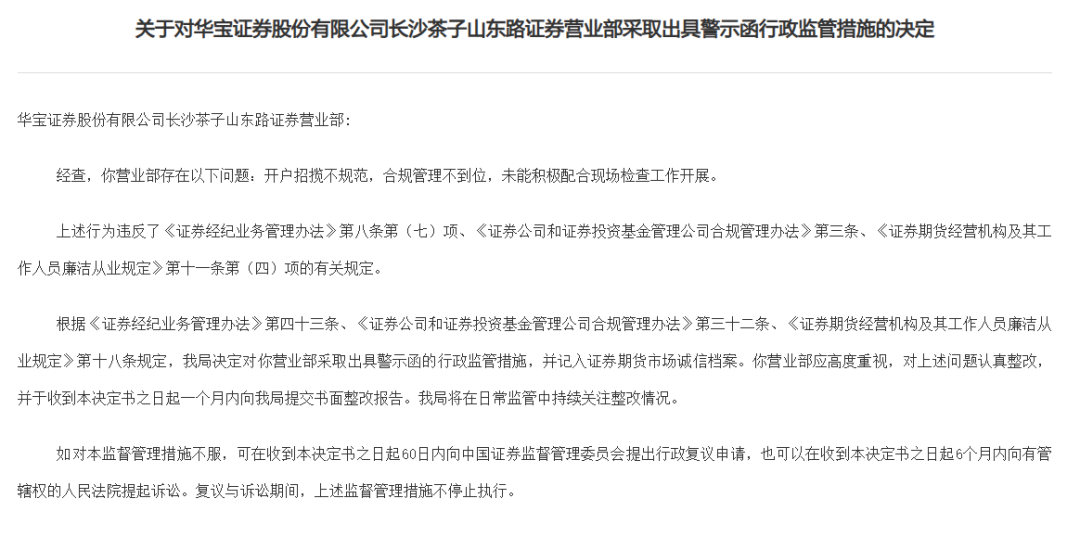
Core Viewpoint - The recent administrative regulatory measures disclosed by the Hunan Securities Regulatory Bureau highlight ongoing compliance issues within the brokerage industry, signaling a need for improved regulatory adherence and risk management practices [1][6]. Group 1: Regulatory Actions - Hunan Securities Regulatory Bureau issued three administrative measures involving two brokerages, emphasizing the importance of compliance in the brokerage sector [1]. - Huabao Securities' Changsha branch received a warning letter for irregularities in client account solicitation and failure to cooperate with inspections, leading to accountability for the responsible person [2]. - Dong Zhimei, an investment advisor at Northeast Securities' Hunan branch, was warned for investing in external companies and facilitating individual investors in off-market stock options trading [5]. Group 2: Prevalence of Violations - Numerous violations have been reported in the brokerage industry this year, covering various aspects such as account opening, product sales, margin financing, and off-market options [6]. - Specific cases include Shen Gang Securities' failure to diligently verify investor materials during new three-board account openings and Southwest Securities' improper client solicitation practices [6]. - Violations in product sales are also notable, with instances of misleading statements and promotion of fraudulent financial products leading to significant investor losses [6]. Group 3: Underlying Issues - The low entry barriers for the securities industry contribute to a lack of professional competence and compliance awareness among some practitioners, exacerbated by high performance pressures [7]. - The number of new accounts opened reached approximately 17.21 million in the first eight months of the year, a year-on-year increase of about 48%, indicating a surge in brokerage activities and highlighting gaps in investor suitability management [7]. Group 4: Need for Enhanced Suitability Management - The legal obligation of "suitability" requires brokerage firms to ensure that the risk levels of financial products match the risk tolerance of investors [8]. - Previous cases have shown failures in conducting adequate financial status reviews and verifying professional investor qualifications, leading to potential legal repercussions for brokerages [8]. - Strengthening compliance management through staff training and process control is essential for mitigating risks and protecting both investor rights and the brokerage's reputation [8][9].


浙商证券:美联储重启降息 国内降息渐行渐近
智通财经网· 2025-09-20 11:54
Group 1 - The core viewpoint is that the probability of the domestic central bank following the Federal Reserve in cutting interest rates has increased, with a higher likelihood of implementation after the end of October [1][4] - External constraints are weakening, creating a "maneuvering space" for monetary policy, as the narrowing of the China-US interest rate differential reduces the risk of capital outflow, thus opening a window for monetary easing [2] - The current low net interest margin of commercial banks and rising real interest rates pose internal constraints on further interest rate cuts, making the central bank cautious about comprehensive rate reductions [3] Group 2 - The bond market is showing signs of stabilization after three months of adjustments, and there is an expectation for a new round of smooth declines in bond market rates entering the fourth quarter [1][4] - Investors are advised to prepare for defensive strategies and consider entering the market around the 10-year government bond yield of 1.8% [1][4]

南京证券上半年营收逆势下降 依赖行情却没跑赢行情 连续三年无IPO保荐项目过会储备为0|券商半年报
Xin Lang Zheng Quan· 2025-09-19 10:18
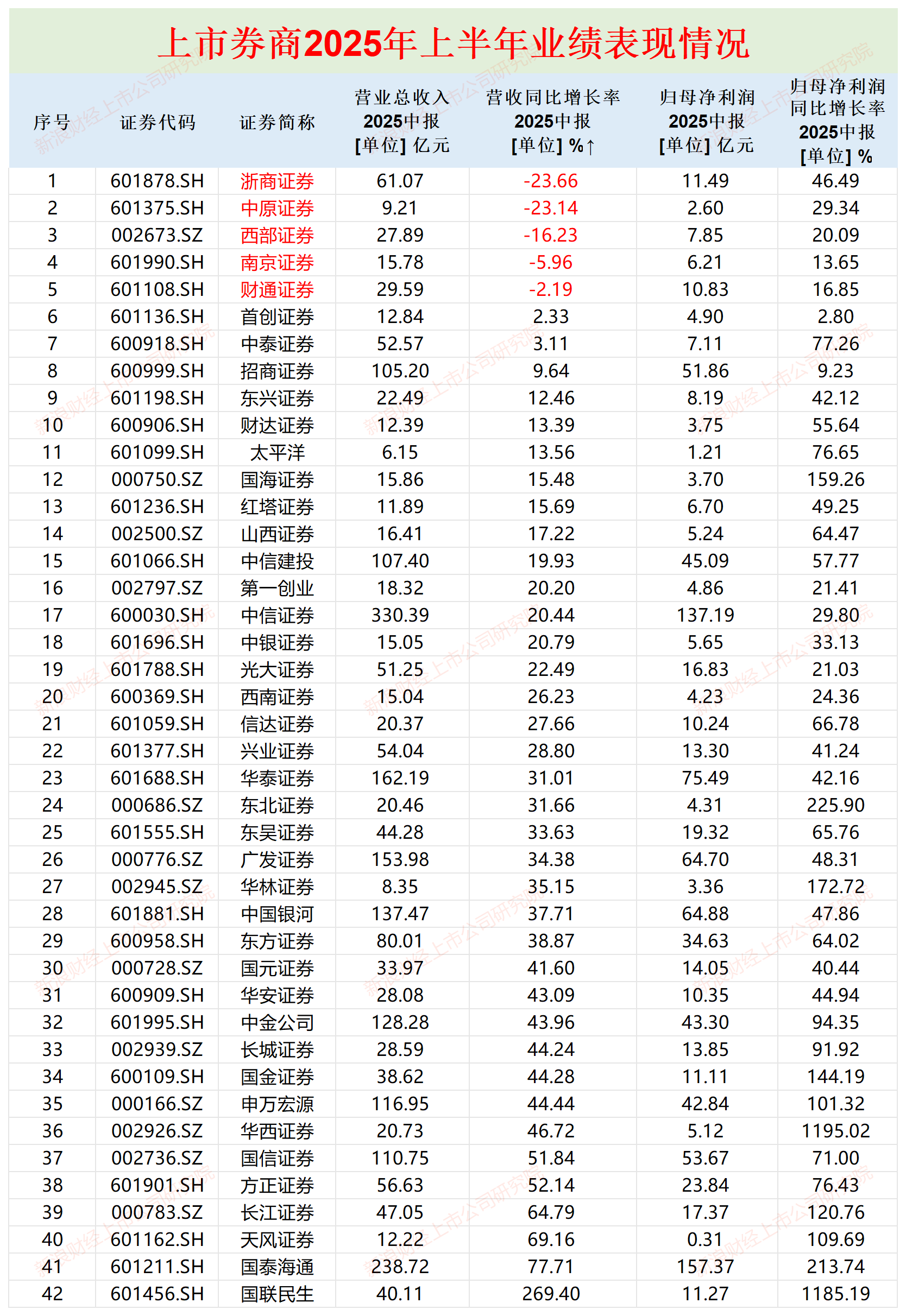
Core Viewpoint - The performance of 42 listed securities firms in the first half of 2025 showed significant growth, with total operating revenue reaching 251.9 billion yuan, a year-on-year increase of 31%, and net profit attributable to shareholders reaching 104 billion yuan, up 65% [1] Revenue Growth - Among the 42 listed securities firms, 37 reported positive revenue growth in the first half of 2025, while only 5 firms experienced negative growth [1] - The firms with negative revenue growth included: - Zheshang Securities: -23.66% - Zhongyuan Securities: -23.14% - Western Securities: -16.23% - Nanjing Securities: -5.96% - Caitong Securities: -2.19% [2][3] Nanjing Securities Performance - Nanjing Securities reported operating revenue of 1.578 billion yuan, a decrease of 5.96% year-on-year, while net profit attributable to shareholders increased by 13.65% to 621 million yuan [4] - The decline in revenue was attributed to decreases in securities and futures brokerage, securities investment, and investment banking revenues, which fell by 6.93%, 1.84%, and 15.43% respectively [4][5] Business Structure - Nanjing Securities heavily relies on brokerage and proprietary investment businesses, which together accounted for more than total revenue, with brokerage income at 726 million yuan and investment income at 983 million yuan [6][7] - The firm’s investment income growth lagged behind the market, with the overall market indices showing positive trends while Nanjing Securities' investment income slightly declined [8] Investment Banking and Asset Management - Nanjing Securities' investment banking revenue was 81 million yuan, down 15.43%, and the firm has not had any IPO projects approved for three consecutive years, resulting in zero IPO project reserves [9] - Although the asset management and investment management business revenue increased by 61.49% to 32 million yuan, the asset management business fee income dropped by 45.07% [9]

浙商证券:8月快递价格回升显著 下半年行业盈利有望超预期修复
智通财经网· 2025-09-19 08:48
Core Viewpoint - The express delivery industry in August showed signs of recovery with revenue reaching 1189.6 billion yuan, a year-on-year increase of 4.2%, and a business volume of 16.15 billion pieces, up 12.3% year-on-year [1][2]. Industry Summary - August express delivery revenue was 1189.6 billion yuan, with a year-on-year growth of 4.2%, and business volume reached 16.15 billion pieces, growing 12.3% year-on-year [1][2]. - The average price per delivery in August was 7.37 yuan, reflecting a slight month-on-month increase of 0.01 yuan but a year-on-year decline of 7.2% [2]. - Major provinces like Guangdong and Zhejiang have stabilized their express delivery prices [2]. Company Performance - YTO Express reported revenue of 53.9 billion yuan in August, a year-on-year increase of 9.8%, with a business volume of 25.1 billion pieces, up 11.1%. The average revenue per piece was 2.15 yuan, down 1.13% year-on-year but up 0.07 yuan month-on-month [3]. - Yunda Express achieved revenue of 41.2 billion yuan, a year-on-year increase of 5.2%, with a business volume of 21.45 billion pieces, up 8.7%. The average revenue per piece was 1.92 yuan, down 3.52% year-on-year but up 0.01 yuan month-on-month [3]. - Shentong Express reported revenue of 44.34 billion yuan, a year-on-year increase of 14.5%, with a business volume of 21.47 billion pieces, up 10.9%. The average revenue per piece was 2.06 yuan, up 3% year-on-year and up 0.09 yuan month-on-month [3]. Price Increase Trends - Provinces like Liaoning and Heilongjiang announced price increases effective from September 20, with over 80% of the national market share in provinces that have announced price hikes [4]. - The industry has seen a slight price recovery since the "anti-involution" policy was implemented, and the trend of rising prices is expected to continue [4]. - The upcoming autumn and winter seasons are anticipated to boost demand, potentially leading to further increases in delivery fees [4]. Profitability Elasticity - A price increase of 0.1 yuan is estimated to increase the average revenue per delivery for listed companies by 0.05 yuan, contributing to a net profit increase of 0.0375 yuan per piece [5]. - For 2024, the estimated profit per piece for major companies is as follows: YTO (0.15 yuan), Shentong (0.05 yuan), Zhongtong (0.3 yuan), and Yunda (0.08 yuan). A nationwide price increase of 0.3 yuan would result in profit elasticity of 75%, 245%, 38%, and 141% respectively [5]. Investment Recommendations - Despite challenges in the first half of 2025, the express delivery sector is expected to recover due to price stabilization and improved competitive dynamics [6]. - Recommended stocks include YTO Express (600233.SH), Shentong Express (002468.SZ), Jitu Express-W (01519), Zhongtong Express-W (02057), and Yunda Express (002120.SZ) [6].
浙商证券:AI产业浪潮下港股互联网成长逻辑重塑 关注大模型以及垂类线索
智通财经网· 2025-09-19 08:45
Core Viewpoint - The report from Zheshang Securities highlights three key factors driving the Hong Kong internet sector: the positive impact of the Federal Reserve's interest rate cuts, signs of recovery in traditional business, and rapid development in AI applications. The sector's valuation remains at historical lows, presenting strategic investment opportunities in leading internet companies focused on AI advancements [1]. Group 1: Driving Factors - **Factor One: Favorable Liquidity** The Federal Reserve's recent interest rate cuts are seen as preventive measures, providing marginal benefits to the Hang Seng Technology Index. Additionally, there has been a notable increase in holdings of the Hang Seng Technology stocks by international intermediaries since April, and a significant rebound in holdings through the Stock Connect program since June [2]. - **Factor Two: Traditional Business Recovery** Internet platform companies are showing signs of improvement in their traditional business segments. The recent easing of competition in the food delivery sector and positive signals from the PMI data in August indicate a potential bottoming out of traditional business [3]. - **Factor Three: AI Reshaping Growth Logic** Hong Kong internet companies can be categorized into two groups based on their AI advancements: those focusing on general large models and cloud computing, such as Alibaba, Baidu, and Tencent, and those targeting niche applications, like Meitu and Kuaishou. The rapid progress in AI since 2023 is expected to reshape the growth logic of these companies and expand their growth potential [4]. Group 2: Investment Recommendations - **Focus on Large Models and Niche Applications** As of September 16, the PE-TTM for the Hang Seng Technology Index is approximately 23 times, which is at the 32nd percentile since July 2020. The valuation space for internet leaders with rapid AI advancements is not merely a recovery logic but a redefined growth logic under the AI industry wave. Key companies to watch include Alibaba (09988), Baidu (09888), and Tencent (00700) for large models, and Kuaishou (01024), Meitu (01357), and Kingdee International (00268) for niche applications [5].