微软

Search documents
你的盗版Windows,可能一夜之间“失效”了,微软正式封杀KMS38,“白嫖时代”或将走向终点
3 6 Ke· 2025-11-18 00:23
Core Points - Microsoft has officially blocked the KMS38 activation method, leading to a significant number of users losing access to their activated Windows and Office products overnight [1][3] - KMS38 was widely regarded as a safe and easy way to activate Windows and Office without cost, allowing users to receive official updates [2][3] - The blocking of KMS38 is part of Microsoft's broader strategy to tighten control over its software ecosystem and push users towards Windows 11 [5][6] Group 1 - KMS38 was an open-source activation tool developed by the Massgrave team, known for its simplicity and safety, allowing users to activate Windows and Office without modifying system files [2][3] - Following the latest Patch Tuesday update, all devices relying on KMS38 have lost activation, prompting users to purchase legitimate licenses, with Windows 11 keys starting at approximately $10 and Office 2021 Pro at around $39 [3][4] - Microsoft has removed the main activation option from KMS38 and suggested users consider alternative activation methods like HWID or TSforge, which are still operational [4] Group 2 - The timing of Microsoft's decision to block KMS38 is speculated to be influenced by the retirement of Windows 10, pushing users to upgrade to Windows 11, which has stringent hardware requirements [5][6] - Microsoft has been tightening its policies, having previously blocked offline installation methods for Windows 11, indicating a shift towards a more controlled and cloud-centric ecosystem [6] - The rise of counterfeit versions of KMS38 and associated security risks has prompted Microsoft to take action, as popular tools can easily be mimicked and infected with malware [6][7] Group 3 - As Windows 11 becomes more restrictive, there is a growing interest in alternative operating systems like Linux, with users considering migration due to hardware limitations and the desire to avoid licensing fees [7][8] - The development of Linux desktop systems has accelerated, with improved gaming capabilities and user experiences, leading to a potential shift in user preferences away from Windows [7][8] - While Linux and ChromeOS may not replace Windows overnight, they present viable options for users unwilling to pay for licenses or comply with stringent account management [8]

昨夜,科技股大跌!道指下挫超500点!
Sou Hu Cai Jing· 2025-11-18 00:12
Market Overview - On November 17, US stock indices collectively declined, with the Dow Jones falling over 500 points, a drop of 1.18% [1][4] - The S&P 500 index decreased by 0.92%, and the Nasdaq Composite index fell by 0.84% [1][4] - Major tech stocks mostly declined, with Dell Technologies down over 8%, AMD down over 6%, and Nvidia, Intel, and others down over 1% [1][6] Federal Reserve Insights - Federal Reserve Vice Chairman Jefferson indicated rising downside risks to employment, suggesting caution in further rate cuts as rates approach neutral levels [4] - The Fed implemented two 25 basis point rate cuts in September and October, lowering the target range to 3.75% to 4.00% [4] - Market expectations for a December rate cut have decreased from nearly 100% to about 40% following hawkish comments from Fed officials [4] Investment Sentiment - Jeffrey Gundlach, a veteran investor, warned that many asset prices are extremely overvalued and recommended allocating about 20% of investment portfolios to cash to mitigate major market correction risks [4] - Gundlach described the current US stock market as exhibiting dangerous speculative characteristics, labeling it one of the most unhealthy markets he has seen in his career [4] Technology Sector Performance - Nvidia is set to report earnings after the market close on Wednesday, with its stock down 1.88% prior to the announcement [6] - Notably, Peter Thiel's Thiel Macro Fund sold approximately 537,000 shares of Nvidia in Q3, representing nearly 40% of its portfolio, cashing out around $100 million [6] - Berkshire Hathaway acquired 17.85 million shares of Alphabet in Q3, valued at approximately $4.93 billion, marking a rare bet on a tech stock by Warren Buffett's firm [7][8] Chinese Stocks Performance - The Nasdaq Golden Dragon China Index fell by 1.21%, with significant declines in several Chinese stocks, including Yatsen and XPeng [2][8] - Alibaba saw a slight increase of over 2%, contrasting with the overall downward trend in Chinese stocks [8]

美股全线下跌,谷歌大涨
Zhong Guo Zheng Quan Bao· 2025-11-17 23:58
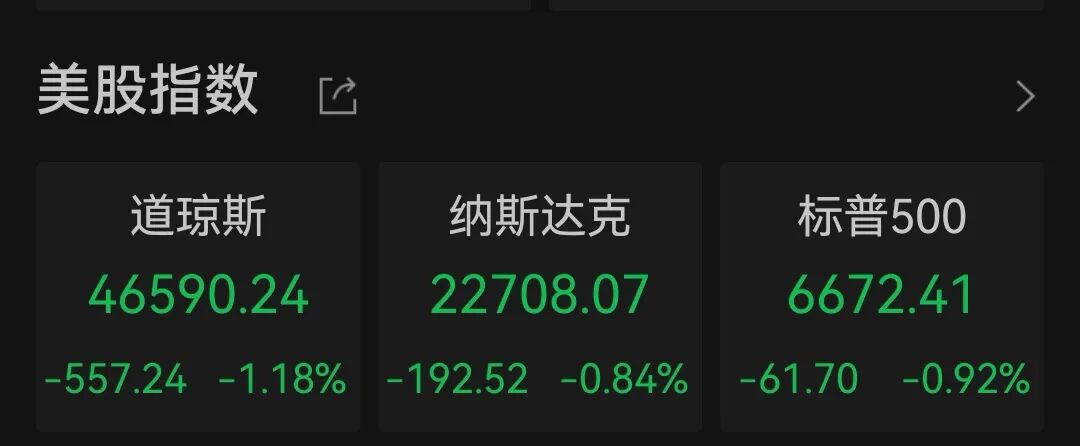
数据显示,当地时间11月17日,美股三大股指全线收跌,道指跌1.18%,标普500指数跌0.92%,纳指跌0.84%。美国科技七巨头指数跌0.47%,英伟达、苹 果跌近2%,谷歌涨超3%。中概股多数下跌。 美股三大股指全线收跌 当地时间11月17日,美股三大股指全线收跌。数据显示,截至收盘,道指跌1.18%报46590.24点,标普500指数跌0.92%报6672.41点,纳指跌0.84%报 22708.07点。 美股大型科技股多数下跌,美国科技七巨头指数下跌0.47%。个股方面,谷歌涨超3%,特斯拉涨逾1%,苹果、英伟达跌近2%,亚马逊、微软小幅下跌。 消息层面,此前巴菲特旗下伯克希尔·哈撒韦公司披露2025年第三季度持股报告(13F)显示,伯克希尔三季度新建仓1784万股谷歌母公司Alphabet的股 票,使之一跃成为其第十大持仓股票。 中概股多数下跌,纳斯达克中国金龙指数跌1.21%。个股方面,阿特斯太阳能跌超15%,小鹏汽车跌超10%,禾赛科技跌逾6%,晶科能源涨超13%,金山 云涨近9%,大全新能源涨超3%,阿里巴巴、华住集团涨超2%。 | S | 纳斯达克中国金龙指数(HXC) 11-17 16: ...

热门中概股走强 阿里巴巴涨超3% 谷歌市值创新高 加密货币超16万人爆仓
2 1 Shi Ji Jing Ji Bao Dao· 2025-11-17 16:06
Market Performance - US stock market opened lower but turned positive, with the Dow Jones up 0.01%, S&P 500 up 0.01%, and Nasdaq up 0.07% as of 23:16 [1] - Major US indices showed mixed performance, with the Nasdaq China Golden Dragon Index down 0.04% [4] Technology Sector - Technology stocks exhibited a mixed performance; Micron Technology surged over 5%, reaching a new historical high, while Western Digital rose nearly 4% and SanDisk increased by almost 8% [2] - Google saw a significant increase of over 4%, with its market capitalization surpassing $3.5 trillion, following Berkshire Hathaway's investment in Alphabet, making it their tenth largest US stock holding [2] Cryptocurrency Market - The cryptocurrency market continued to decline, with Bitcoin down 1.32% and Ethereum and Solana dropping nearly 2% [6] - Over the past 24 hours, more than 164,835 individuals experienced liquidation in the crypto market, totaling approximately $786 million [7] Gold and Precious Metals - Gold prices continued to adjust, with spot gold down 0.43% at $4,062.56 per ounce, and COMEX gold futures down 0.49% at $4,074.20 [4][5] Economic Insights - Analysts noted that Bitcoin's significant price correction is primarily due to tightening US dollar liquidity and changing Federal Reserve policy expectations, leading to increased selling pressure on high-volatility assets [8] - A concerning trend observed is the simultaneous decline of risk assets like Bitcoin and traditional safe-haven assets like gold, indicating potential systemic liquidity issues in the market [8]


TMT行业周报(11月第2周):国内外大模型迎来更新迭代-20251117
Century Securities· 2025-11-17 11:08
Investment Rating - The report does not explicitly state an investment rating for the industry [1]. Core Insights - The TMT sector experienced a decline in the week of November 10-14, with the overall TMT sector underperforming the CSI 300 index. The media sector fell by 1.36%, computer by 3.03%, electronics by 4.77%, and communications by 4.77%. The top-performing sub-industries included portal websites (2.39%), communication engineering and services (1.57%), and panels (0.69%). Conversely, passive components (-9.72%), printed circuit boards (-9.15%), and communication network devices (-6.98%) saw significant declines [3][5]. - Recent updates in large models include OpenAI's release of the GPT-5.1 series, which focuses on enhancing interaction experience and reasoning efficiency. The domestic model Kimi K2 Thinking, released by Moonlight Dark Side, supports continuous multi-round tool calls and autonomous reasoning, achieving state-of-the-art performance in various benchmarks [3][5]. - The report highlights a significant acceleration in the iteration of domestic open-source models compared to overseas closed-source competitors, suggesting a narrowing performance gap and an optimistic outlook for domestic models to capture market share due to their cost-effectiveness [3][5]. Weekly Market Review - The TMT sector's performance for the week was as follows: Media (-1.36%), Computer (-3.03%), Electronics (-4.77%), and Communication (-4.77%), with the overall TMT sector underperforming the CSI 300 index, which fell by 1.08% [3][5]. - The top three gainers in the electronics sector were ShenGong Co. (38.03%), BaiBang Technology (20.89%), and Victory Precision (19.24%). In the computer sector, the top gainers were Haixia Innovation (33.10%), Yingfang Software (19.30%), and Hengyin Technology (17.94%). The media sector saw gains from ZhiDeMai (16.31%), MingChen Health (14.91%), and TianXiaXiu (10.47%). The communication sector's top gainers included Online and Offline (46.55%), ZhongFuTong (30.69%), and MeiLiXin (11.87%) [3][5][12][13][6]. Industry News and Key Company Announcements - Significant events in the industry include the release of Baidu's Wenxin large model 5.0, which utilizes a multimodal ultra-sparse mixed expert architecture with over 2.4 trillion parameters. Additionally, the global AI model ranking system LMArena has ranked models from Anthropic, GPT-5, and China's ZhiPu GLM-4.6 as the top three in programming and code generation [15][18]. - Baidu's new Kunlun chips M100 and M300 were announced, targeting large-scale AI inference and multimodal model training, expected to launch in early 2026 and 2027, respectively [21][22]. - The report notes that Tencent's president stated the company does not perceive itself as lagging in the AI race, emphasizing the competitive landscape among domestic models [15][18].
Epic CEO怒批微软取消本地账户登录功能等做法 马斯克声援
Huan Qiu Wang Zi Xun· 2025-11-17 09:20
Core Viewpoint - Epic Games CEO Tim Sweeney publicly criticized Microsoft for its recent changes to Windows, particularly the removal of the taskbar relocation feature and the mandatory use of Microsoft accounts for login [1][2] Group 1: Criticism of Microsoft - Sweeney expressed strong discontent regarding Microsoft's decision to eliminate the taskbar relocation feature and the requirement for users to create Microsoft accounts instead of allowing local account logins [2] - Elon Musk supported Sweeney's comments, particularly regarding the mandatory Windows account requirement, indicating a shared frustration among users [2] Group 2: User Reactions and Implications - The public outcry from users, including Sweeney and Musk, for Microsoft to restore the taskbar relocation feature may be noted by the company, but there is skepticism about whether any changes will be made [2] - Microsoft appears to be focused on transforming Windows into an intelligent operating system, positioning the taskbar as a dynamic center for artificial intelligence [2]

Epic CEO要求微软恢复任务栏重新定位功能 马斯克声援
Huan Qiu Wang· 2025-11-17 09:08
Core Points - Epic Games CEO Tim Sweeney publicly criticized Microsoft for its changes to the Windows operating system, particularly the removal of the taskbar repositioning feature and the mandatory use of Microsoft accounts for login [1][2] - Elon Musk expressed support for Sweeney's views, particularly regarding the Microsoft account requirement [2] Summary by Sections - **Criticism of Microsoft**: Sweeney has been vocal about his discontent with Microsoft's decision to eliminate the ability to reposition the taskbar and the enforcement of Microsoft account logins, which he finds unacceptable [2] - **Public Support**: Musk's endorsement of Sweeney's comments highlights a growing sentiment among users who are calling for Microsoft to restore the taskbar customization options [2] - **Microsoft's Focus**: Despite the user backlash, Microsoft appears to be prioritizing the development of Windows as an intelligent operating system, positioning the taskbar as a dynamic center for artificial intelligence [2]

大摩Q3大举减持明星AI股,科技巨头仅加仓微软(MSFT.US)与亚马逊(AMZN.US)
智通财经网· 2025-11-17 08:58
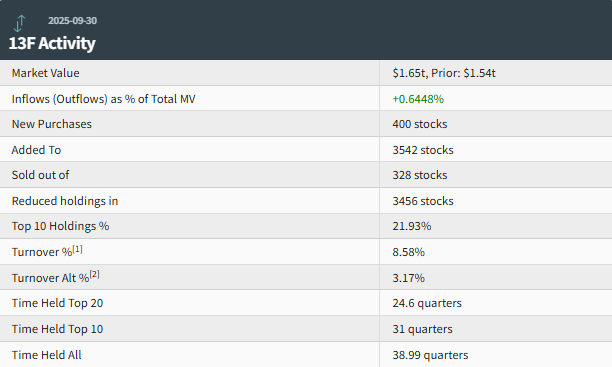
Core Insights - Morgan Stanley's total market value of holdings reached $1.65 trillion for Q3 2025, up 7.1% from $1.54 trillion in the previous quarter [1][2] - The firm added 400 new stocks, increased holdings in 3,542 stocks, reduced holdings in 3,456 stocks, and completely sold out of 328 stocks during the quarter [1][2] - The top ten holdings accounted for 21.93% of the total market value [1][2] Holdings Overview - The top five holdings included Microsoft (MSFT) with 120.24 million shares valued at approximately $62.28 billion (3.77% of the portfolio), Nvidia (NVDA) with 323 million shares valued at $60.26 billion (3.65%), Apple (AAPL) with 229 million shares valued at $58.34 billion (3.53%), Amazon (AMZN) with 163 million shares valued at $35.76 billion (2.16%), and Google (GOOGL) with 122 million shares valued at $29.64 billion (1.79%) [3][4] Trading Activity - The top five purchases by percentage change in the portfolio were Invesco QQQ Trust (QQQ), SPDR S&P 500 ETF (SPY), Invesco MSCI USA ETF (PBUS), Vanguard S&P 500 ETF (VOO), and Johnson & Johnson (JNJ) [5][6] - The top five sales included Visa (V), Meta Platforms (META), Accenture (ACN), Costco (COST), and Salesforce (CRM) [5][6] Sector Movements - Morgan Stanley increased its positions in major energy companies ExxonMobil (XOM) and Chevron (CVX) during Q3, despite concerns over supply surplus [7]


美银Q3持仓:微软(MSFT.US)、英伟达(NVDA.US)仍为前两大重仓股 大举买入标普500指数ETF看跌期权
智通财经网· 2025-11-17 08:31
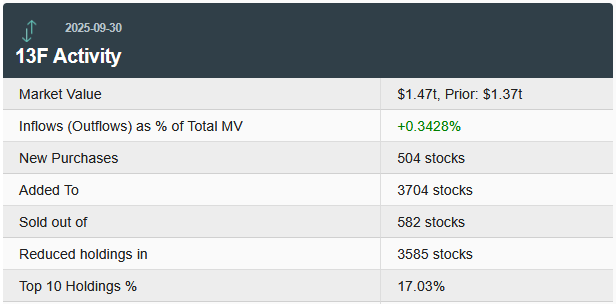
Core Insights - Bank of America reported a total market value of $1.47 trillion for its holdings as of September 30, 2025, an increase from $1.37 trillion in the previous quarter [1][2] - The bank added 504 new stocks to its portfolio, increased holdings in 3,704 stocks, reduced holdings in 3,585 stocks, and completely sold out of 582 stocks [1][2] - The top ten holdings accounted for 17.03% of the total market value [1][2] Holdings Overview - The largest holding is Microsoft (MSFT.US) with approximately 71.69 million shares valued at about $37.1 billion, representing 2.52% of the portfolio, a 2.14% increase from the previous quarter [3][5] - Nvidia (NVDA.US) is the second largest holding with around 191 million shares valued at approximately $35.6 billion, accounting for 2.41% of the portfolio, a decrease of 5.54% from the last quarter [3][5] - Apple (AAPL.US) ranks third with about 123 million shares valued at approximately $31.3 billion, making up 2.12% of the portfolio, an increase of 5.28% [3][5] - The fourth largest holding is Vanguard Value ETF (VTV.US) with around 134 million shares valued at about $25 billion, representing 1.69% of the portfolio, a 4.42% increase [3][5] - Vanguard Growth ETF (VUG.US) is the fifth largest holding with approximately 47 million shares valued at about $22.6 billion, accounting for 1.53% of the portfolio, a decrease of 4.66% [3][5] Sector Activity - The sixth to tenth largest holdings include SPDR S&P 500 ETF (SPY.US), Broadcom (AVGO.US), SPDR S&P 500 ETF Put Options (SPY.US, PUT), iShares MSCI EAFE ETF (IEFA.US), and Amazon (AMZN.US) [4] - Notably, the holdings in SPDR S&P 500 ETF Put Options increased significantly by approximately 142% compared to the previous quarter [4] Buying and Selling Trends - The top five purchases included SPDR S&P 500 ETF Put Options, Apple, iShares 20+ Year Treasury Bond ETF (TLT.US), iShares iBoxx High Yield Corporate Bond ETF Put Options (HYG.US, PUT), and iShares Russell 2000 ETF Put Options (IWM.US, PUT) [5] - The top five sales were iShares S&P 500 ETF (IVV.US), Nasdaq 100 ETF Put Options (QQQ.US, PUT), Nasdaq 100 ETF (QQQ.US), ServiceNow (NOW.US), and Amazon (AMZN.US) [6]

微软研究院路保同:用向量检索重塑模型注意力——Attention
3 6 Ke· 2025-11-17 08:02
Core Insights - The article discusses the limitations of long-context reasoning in large language models (LLMs) due to the quadratic complexity of self-attention and the significant memory requirements for key-value (KV) caching [1][5] - It introduces a new mechanism called Retrieval Attention, which accelerates long-context LLM inference through a dynamic sparse attention approach that does not require retraining [1][8] Group 1: Retrieval Attention Mechanism - Retrieval Attention posits that each query only needs to interact with a small subset of keys, making most attention redundant [3][7] - The approach involves offloading most KV vectors from the GPU to the CPU, using approximate nearest neighbor (ANN) search to identify the most relevant keys for each query [3][7] - This mechanism allows for significant reductions in memory usage, with an 8B model requiring only about 1/10 of the original memory for KV caching while maintaining accuracy [22] Group 2: Performance Metrics - Empirical tests on an RTX 4090 (24GB) show that the 8B model can stably generate with 128K context at approximately 0.188 seconds per token, achieving nearly the same precision as full attention [5][6] - The subsequent work, RetroInfer, demonstrated a 4.5 times increase in decoding throughput on A100 GPUs compared to full attention and a 10.5 times increase in throughput for 1M token contexts compared to other sparse attention systems [5][22] Group 3: System Architecture - The architecture of Retrieval Attention features a dual-path attention mechanism where the GPU retains a small amount of "predictable" local KV cache, while the CPU dynamically retrieves a large-scale KV store [7][8] - This design leads to a reduction in both memory usage and inference latency, allowing for efficient long-context reasoning without retraining the model [8][22] Group 4: Theoretical and Practical Contributions - The work presents a new theoretical perspective by framing the attention mechanism as a retrieval system, allowing for more precise identification of important contextual information [23][25] - It also emphasizes system-level optimizations, transforming traditional linear caching into a dynamic allocation structure that enhances efficiency in large-scale inference scenarios [23][25] Group 5: Future Directions - Future research may focus on establishing a more rigorous theoretical framework for the error bounds of Retrieval Attention and exploring the integration of dynamic learning mechanisms with system-level optimizations [26][30] - The long-term implications of this research could lead to models with true long-term memory capabilities, enabling them to maintain semantic consistency over extensive contexts [30][31]