九识智能

Search documents
浙江嘉兴桐乡——向智能汽车高地进发
Jing Ji Ri Bao· 2025-10-31 22:01
Core Insights - The project in Tongxiang, Zhejiang, focuses on establishing a core manufacturing base for new energy vehicle chassis, with an expected annual production capacity of one million units [1] - Tongxiang has cultivated a robust ecosystem for intelligent connected vehicles, attracting over 60 industry enterprises and more than 200 supporting companies, forming a nearly complete industrial chain [1] - The city is positioned as a digital innovation hub, with advanced testing roads and a dual computing power engine centered around the "Wuzhen Light" supercomputing center [2][3] Group 1 - The T300 unmanned transport vehicle, recently launched by Shangyuan Zhixing, showcases the advancement of Tongxiang manufacturing, featuring a payload capacity of 500 kg and a range of 200 km [2] - The collaboration between Shangyuan Zhixing and leading industry player Jiushi Intelligent has resulted in a new unmanned vehicle series, covering the entire supply chain from core components to vehicle manufacturing [2] - The city’s strategic location allows for quick access to major cities like Shanghai and Hangzhou, enhancing its attractiveness for businesses [2] Group 2 - The intelligent driving sector in Tongxiang is thriving, with companies like Furuitai Intelligent Systems achieving a revenue of 680 million yuan in the first half of the year, reflecting a year-on-year growth of 112% [3] - The local government emphasizes the importance of intelligent connected vehicles as a key driver for high-quality economic development in the region [3] - Tongxiang is recognized for its ability to foster innovation and create a conducive environment for business growth, aiming to become a new highland in the intelligent connected vehicle industry [3]
拼融资、谋上市、打价格战,无人物流车赛道“卷疯了”
3 6 Ke· 2025-10-30 23:12
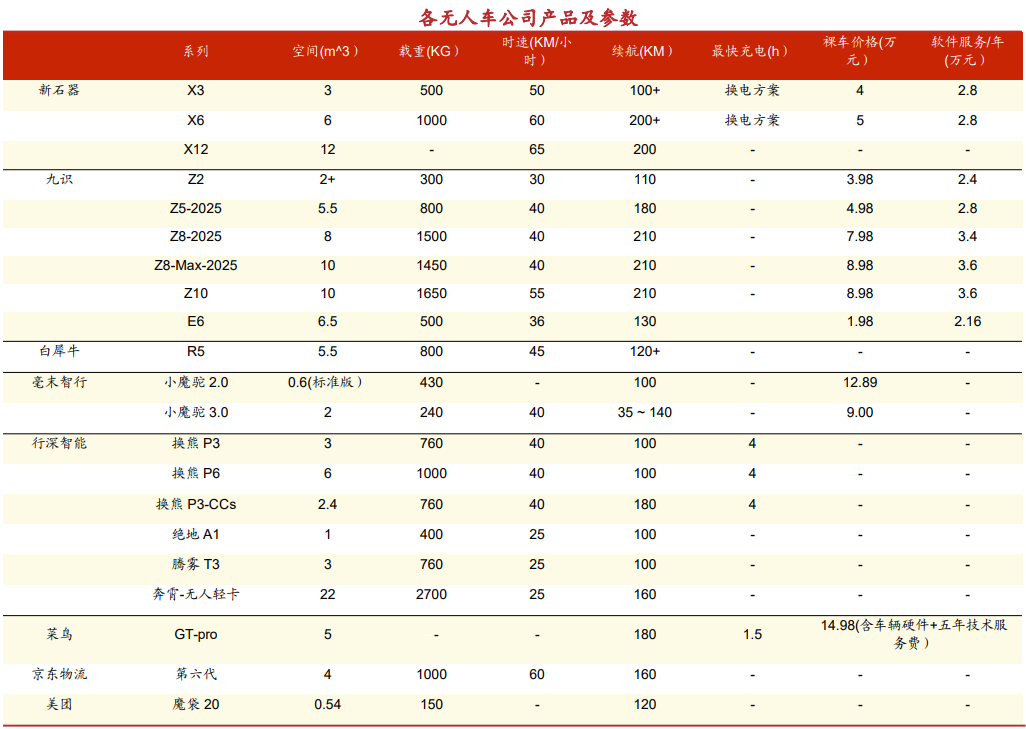
Core Viewpoint - The emergence of unmanned delivery logistics vehicles is rapidly transforming the logistics industry, with significant investments and competition intensifying among key players like New Stone and NineSight [1][4][5] Industry Overview - The industry is characterized by a few dominant players, with New Stone and NineSight leading the market, both having delivered over 10,000 units cumulatively [2][12] - The market is witnessing a surge in capital investment, with major financing rounds reported for leading companies, indicating a growing interest from top-tier investors [4][12] Market Dynamics - Increased competition is leading to a price reduction trend in the unmanned delivery logistics vehicle market, making cost control a critical factor for survival [5][25] - The market is projected to experience explosive growth, with sales expected to exceed 30,000 units by 2025, compared to only 5,100 units in 2024 [13][15] Technological Development - The industry has evolved from initial skepticism to a more favorable environment due to advancements in technology and supportive policies, allowing for legal operation of unmanned delivery vehicles [9][17] - Continuous technological iterations have improved the safety and efficiency of unmanned delivery vehicles, making them more viable for logistics applications [17][19] Competitive Landscape - Major internet companies like Meituan, JD, and Cainiao are entering the unmanned delivery vehicle space, intensifying competition and leading to potential price wars [21][24] - The cost of unmanned delivery vehicles has significantly decreased, with some models now priced below 20,000 yuan, prompting aggressive pricing strategies among competitors [25][26] Future Outlook - The demand for unmanned delivery logistics vehicles is expected to grow as logistics companies seek to reduce costs and improve efficiency, with projections indicating a potential market size of 600,000 units by 2030 [15][16] - The industry is at a critical juncture, with companies needing to capitalize on current demand while navigating the challenges of increased competition and pricing pressures [26]


9个月吸金86亿,资本重仓“无人区”
凤凰网财经· 2025-10-30 13:14
Core Viewpoint - The article highlights the rapid commercialization and growth potential of the unmanned delivery vehicle industry, predicting significant advancements and profitability for leading companies by 2025 [3][6]. Financing and Market Growth - Leading unmanned delivery companies have secured approximately 8.6 billion yuan in financing since the beginning of the year, with notable rounds including 1 billion yuan for New Stone and over 600 million dollars for NineSight [2]. - The industry is expected to reach a market size of around 500 billion yuan, with an anticipated increase of nearly 100,000 units in the coming year [6]. Commercialization Milestones - The critical threshold for the unmanned vehicle business is identified as 10,000 units, which enables a positive cycle of cost reduction, scenario validation, and scale expansion [4]. - New Stone and NineSight have both achieved the delivery of 10,000 vehicles, with New Stone projecting 1 billion yuan in revenue this year and full profitability by 2026 [4][11]. Operational Efficiency - Unmanned delivery vehicles are addressing significant pain points in the logistics sector, such as low vehicle utilization and high personnel costs, leading to cost reductions and efficiency improvements [9]. - For instance, Shunfeng's unmanned vehicles have reduced per-package costs by 1.32 yuan and improved efficiency by 30% [9]. Technological Advancements - The cost of unmanned delivery vehicles has decreased significantly, with New Stone's vehicle costs dropping from 200,000 yuan to 70,000 yuan between 2018 and 2023, and projected prices as low as 19,800 yuan for future models [14]. - The industry is transitioning from a research and testing phase to large-scale commercial operations, with a tenfold increase in development speed compared to the previous year [11]. Challenges and Regulatory Issues - Despite the rapid growth, the industry faces challenges related to technology, standards, and ecosystem development, particularly in maintaining stability during large-scale operations [17]. - Road rights and regulatory frameworks are significant barriers to scaling operations, with a lack of unified standards across regions increasing operational costs [18][19]. Future Outlook - The next decade is expected to see explosive growth in smart mobility, particularly in last-mile logistics and delivery services [16]. - Companies are exploring collaborative models to optimize resource utilization and reduce operational costs, such as partnerships with public transport entities [19].

自动驾驶三大黄金赛道谁主沉浮?
Xin Lang Cai Jing· 2025-10-30 09:47
Core Insights - The autonomous driving sector is experiencing significant growth, particularly in the areas of RoboBus, RoboTruck, and RoboVan, with a focus on practical applications in real-world scenarios [1][2]. Funding and Investment - Neolix, a provider of L4-level autonomous delivery solutions, has completed over $600 million in Series D financing, setting a record in China's autonomous driving sector [2]. - Other leading companies in the autonomous driving field have also secured substantial funding, with notable investments including nearly $3 million for Karl Power in May 2025 and $100 million for Jiushi Intelligent in October 2025 [2]. Market Dynamics - The autonomous delivery vehicle market is entering a phase of intense competition, with leading companies like Neolix and Jiushi Intelligent rapidly scaling operations. By the end of 2025, several companies are expected to surpass the delivery threshold of 10,000 vehicles [4][5]. - The market is projected to see over 30,000 autonomous delivery vehicles sold by 2025, with a potential annual sales volume exceeding 800,000 units by 2030 [5]. Cost Reduction and Efficiency - The cost of autonomous delivery vehicles has significantly decreased, with prices dropping from hundreds of thousands to around 10,000 yuan, a reduction of nearly 90% [5]. - The introduction of autonomous delivery vehicles has led to a 70% reduction in per-package delivery costs and improved delivery efficiency by 20-30% [8]. Operational Impact - Autonomous delivery vehicles are primarily used for transporting goods between sorting centers and residential areas, enhancing operational efficiency and reducing labor costs [7]. - Major logistics companies, including SF Express and Zhongtong Express, have begun integrating autonomous delivery vehicles into their operations, with Zhongtong deploying approximately 1,000 units [8]. Technological Advancements - The industry is moving towards a more mature technological landscape, with a focus on balancing complexity and cost control in autonomous driving applications [9][24]. - The core technologies driving the sector include advanced sensors, AI algorithms, and modular designs that enhance adaptability across various logistics scenarios [17][18]. Future Outlook - The autonomous bus segment is expected to grow significantly, with projections indicating a market size reaching hundreds of billions by 2030 [22][23]. - The integration of autonomous buses into urban transportation networks is anticipated to create a seamless travel experience, contributing to the overall efficiency of public transport systems [24][25].
超44家!2025年融资过亿企业大盘点
Sou Hu Cai Jing· 2025-10-30 09:21
Core Insights - The low-speed autonomous driving sector has seen significant investment activity, with over 49 financing events exceeding 100 million RMB since 2025, totaling nearly 21.8 billion RMB [1][4]. Financing Overview - A total of 49 financing events involved 44 companies, with 27 companies receiving A and B+ round financing in the first ten months of the year, indicating a strong interest in early-stage development [4][6]. - The financing events are categorized as follows: 27 events in the 100 million to 200 million RMB range, 14 events in the 200 million to 1 billion RMB range, 4 events in the 1 billion to 2 billion RMB range, and 4 events exceeding 2 billion RMB [6][7]. Sector Focus - The most popular financing areas include unmanned delivery, unmanned sanitation, and mining autonomous driving, with notable investments in companies like NineSight, New Stone, and White Rhino in the unmanned delivery sector [7][8]. - The mining autonomous driving sector has also seen significant activity, with 9 financing events, 5 of which were publicly disclosed as being of 100 million RMB or more, totaling 1.357 billion RMB [7]. Market Trends - Since 2025, the low-speed autonomous driving sector has exhibited a trend of "head concentration and scenario dominance," with unmanned delivery and mining scenarios becoming the primary focus for capital investment [7][8]. - The overall financing heat in the industry has increased compared to the previous year, indicating a growing interest from investors [4][6].
一家企业融到C13轮了
投中网· 2025-10-30 07:22
Core Insights - The investment enthusiasm in the autonomous driving sector is reportedly returning, with significant financing activities observed recently [3][4][10] - Momenta has completed two rounds of financing this year, with the latest round (C13) valued at $6 billion, indicating a strong interest from large funds in leading autonomous driving companies [2][10] - In the past month alone, over 10 financing events in the domestic autonomous driving sector have occurred, totaling more than 10 billion yuan [6][10] Financing Activities - Didi's autonomous driving subsidiary completed a 2 billion yuan D round financing on October 11, with multiple prominent investors involved [7] - On October 14, Ninebot announced a $100 million B4 round financing led by Ant Group [8] - New Stone Technology secured over $600 million in D round financing on October 23, breaking the record for the largest single financing amount in China's autonomous driving sector [8][10] Market Trends - The number of financing events in the autonomous driving industry in 2023 is approximately 140, with a total amount of around 20 billion yuan, which is less than a quarter of the peak in 2021 [10] - The total financing amount in the sector has exceeded 40 billion yuan this year, indicating a clear "warming" signal in the market [10] Investment Sentiment - Investors are increasingly optimistic about the autonomous driving sector, with many large private equity firms actively investing in multiple projects this year [10][11] - The shift in investment focus is towards L4 level applications with clear use cases, such as RoboVan and Robotaxi, as well as L2 level advanced driving assistance systems [14] Competitive Landscape - Leading companies in the sector, such as New Stone Technology and Didi, are attracting significant investment due to their demonstrated progress in commercialization and operational capabilities [14][15] - The entry of major players like Huawei into the autonomous driving space is seen as a potential game-changer, with expectations that it could significantly impact the competitive landscape [16]

九识智能宣布完成1亿美元B4轮融资
Huan Qiu Wang· 2025-10-28 08:59
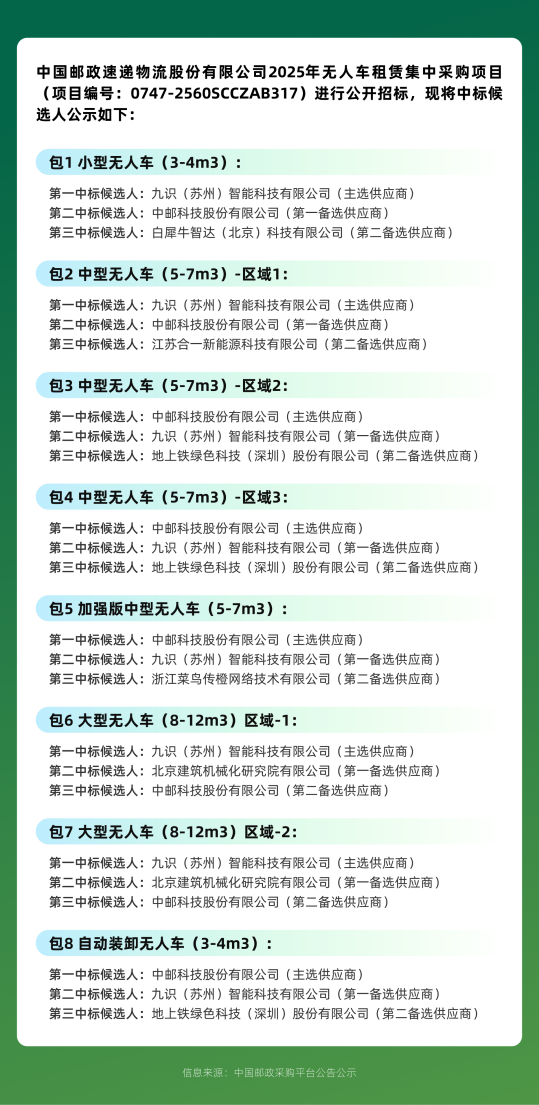
Core Insights - The article highlights the successful completion of a $100 million Series B4 financing round by Jiushi Intelligent, led by Ant Group, marking it as the largest single-round financing in the Robovan sector in China and one of the largest tech financing rounds in the country this year [1][2] Group 1: Financing and Market Position - Jiushi Intelligent has raised nearly $400 million in total during its Series B financing rounds, establishing a strong financial position in the market [1] - The company has secured a significant contract with China Post for a large-scale procurement project involving the leasing of unmanned vehicles, becoming a core partner for China Post's logistics operations [2][5] Group 2: Industry Trends and Government Support - Recent government policies have been introduced to support the application of autonomous driving technology in the logistics sector, including guidelines for the operation and qualification of unmanned logistics vehicles [3][4] - The rapid growth of the express delivery industry in China, with daily deliveries expected to rise from 100 million in 2019 to 729 million by 2024, has created a demand for innovative solutions like unmanned vehicles to address labor shortages [4] Group 3: Operational Achievements and Market Coverage - Jiushi Intelligent has successfully implemented regional collaborations in various provinces, enhancing rural logistics services and establishing a replicable model for rural revitalization [5] - The company has achieved a market share of nearly 70% in the RoboVan sector, with approximately 4,000 units delivered, making it a leading choice for mainstream express delivery companies seeking to upgrade their operations [7] - Jiushi's RoboVan has expanded its operational footprint to cover over 300 cities across 32 provinces and regions in China, and has established partnerships with top postal groups globally, creating the largest RoboVan operational network [8]
特斯拉三季报电话会:预计OptimusGen3明年Q1发布
CMS· 2025-10-27 15:32
Investment Rating - The report maintains a positive outlook on the humanoid robot industry, particularly focusing on Tesla's Optimus project and related companies [6][8]. Core Insights - Tesla's Optimus V3 is expected to launch in Q1 2026, with a production line aiming for one million units by the end of 2026, despite initial delays [8][9]. - The market anticipates the delay in the release of Tesla's humanoid robot, which is expected to have limited impact due to prior expectations [6][8]. - The industrial robot production in China reached 594,800 units from January to September 2025, marking a year-on-year growth of 29.8% [12]. - Significant investments in the autonomous logistics vehicle sector have been noted, with New Stone completing over $600 million in Series D financing, setting a record in China's autonomous driving field [13]. - The report highlights the increasing optimism regarding the commercialization of embodied intelligence and the potential for humanoid robots [6][8]. Summary by Sections Humanoid Robots - Tesla's Optimus V3 prototype is set to be unveiled in Q1 2026, with plans for mass production of one million units by the end of 2026 [8]. - UBTECH secured a 126 million yuan order for humanoid robots as part of a project in Guangxi [9]. - The production of industrial robots in China has shown significant growth, with a 29.8% increase year-on-year [12]. Autonomous Logistics Vehicles - New Stone announced the completion of over $600 million in D-round financing, marking the largest private equity financing in China's autonomous driving sector [13]. - JD Logistics plans to purchase 3 million robots, 1 million unmanned vehicles, and 100,000 drones over the next five years to enhance its logistics capabilities [11]. Investment and Financing - Various companies in the humanoid robot sector have secured significant funding, including 5 billion yuan by 58 Intelligent and 1 billion USD by NineSight [15][14]. - The report emphasizes the importance of strategic partnerships and collaborations in advancing technology and market reach within the humanoid robot industry [16].

红杉连续领投两家AI丨投融周报
投中网· 2025-10-27 06:47
Focus Review - The hard technology sector is witnessing significant financing activities, with Jiusi Intelligent completing a $100 million B4 round led by Ant Group, raising a total of $400 million in B rounds to date [4][10]. - New Stone Technology, a provider of L4 level unmanned city distribution solutions, announced over $600 million in D round financing, led by Stone Venture from the UAE [4][21]. Health Sector - Saina Biotechnology completed a new round of financing exceeding 100 million RMB, led by Shunxi Fund and Yizhuang Guotou [5][28]. - Zhongzhi Keyi, a company specializing in ultra-fast time-resolved imaging technology, also announced over 100 million RMB in A round financing, with strong backing from various funds [5][29][30]. Internet Sector - In the AI field, Xunyu Technology secured over 100 million RMB in Pre-A round financing, co-led by GL Ventures and Sequoia China [5][39]. - LiblibAI, an AI application company, completed a $130 million B round financing, with participation from Sequoia China and CMC Capital [5][40]. Additional Financing Activities - Jitian Starship completed over 100 million RMB in A and A+ rounds, led by Shunrong Capital and Zhi Yi Investment [7]. - Renxin Technology, a high-speed vehicle SerDes chip company, announced over 100 million RMB in A+ round financing, bringing its total financing for the year to nearly 300 million RMB [8]. - Juzi Technology completed several hundred million RMB in B round financing, with investors including Shanghai Guotou and Songjiang Guotou [9]. - Eagle Semiconductor announced a B+ round financing exceeding 700 million RMB, setting a record for VCSEL startups in China [14].

一笔融了43亿,北京跑出最火独角兽
投中网· 2025-10-26 07:04
Core Viewpoint - New Stone Technology has completed over $600 million in Series D financing, marking it as the largest private equity financing in China's autonomous driving sector to date, with plans to expand into the UAE as a strategic market entry point [4][6]. Financing and Investment - The Series D round was led by UAE's Stone Venture, with participation from several prominent investors including Gaocheng Investment, Xincheng Capital, and others, indicating strong confidence in the company's growth potential [4][6]. - This financing round is significant as it positions New Stone Technology as a unicorn in the industry, following a previous $10 million C+ round earlier this year [6]. Technological Advancements - New Stone Technology has made key advancements in autonomous driving technology, particularly with its L4-level driverless technology, which has begun commercial delivery [6][10]. - The company has achieved a milestone of delivering over 10,000 L4 autonomous vehicles, becoming the first in the world to reach this number [9][10]. Market Position and Strategy - The company has deployed over 1,200 vehicles in Qingdao, making it the city with the highest number of autonomous vehicles globally [10]. - New Stone Technology aims to establish the UAE as a launchpad for further expansion into the Belt and Road Initiative and other regions [6][10]. Industry Context - The autonomous delivery vehicle market in China is projected to grow significantly, with an estimated industry value increase of 594.8 billion yuan [14]. - Major players in the industry include both startups like New Stone Technology and established companies such as Baidu and JD Logistics, which are actively investing in autonomous driving technology [14].