极米科技

Search documents
黑色家电板块1月13日跌2.33%,四川九洲领跌,主力资金净流出10.21亿元
Zheng Xing Xing Ye Ri Bao· 2026-01-13 08:56
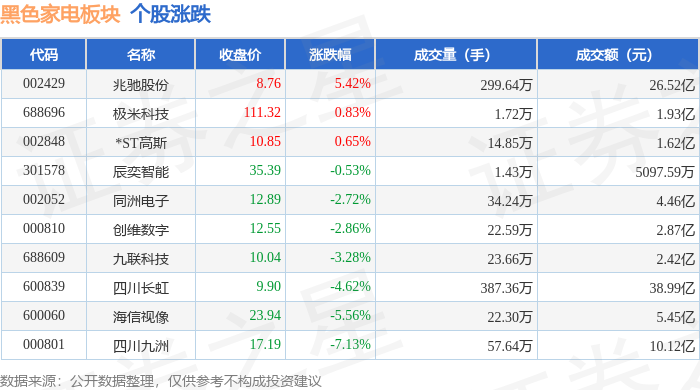
证券之星消息,1月13日黑色家电板块较上一交易日下跌2.33%,四川九洲领跌。当日上证指数报收于 4138.76,下跌0.64%。深证成指报收于14169.4,下跌1.37%。黑色家电板块个股涨跌见下表: | 代码 | 名称 | 收盘价 | 涨跌幅 | 成交量(手) | 成交额(元) | | --- | --- | --- | --- | --- | --- | | 002429 | 非驰股份 | 8.76 | 5.42% | 299.64万 | 26.52亿 | | 688696 | 极米科技 | 111.32 | 0.83% | 1.72万 | 1.93亿 | | 002848 | *ST高斯 | 10.85 | 0.65% | 14.85万 | 1.62亿 | | 301578 | 辰奕智能 | 35.39 | -0.53% | 1.43万 | 5097.59万 | | 002052 | 同洲电子 | 12.89 | -2.72% | 34.24万 | 4.46 Z | | 000810 | 创维数字 | 12.55 | -2.86% | 22.59万 | 2.87亿 | | 688609 | 九联科技 ...


上市申请获受理 成都“超级细菌”概念股冲刺港股IPO
Xin Lang Cai Jing· 2026-01-12 18:00
Group 1 - The core viewpoint of the article is that Olin Bio, a Chengdu-based biotechnology company, has received acceptance for its IPO application on the Hong Kong Stock Exchange, marking a significant step towards its public listing [1] - Olin Bio, established in 2009, focuses on the research, production, and sales of human vaccines, with three products already commercialized: Tetanus vaccine, Hib conjugate vaccine, and AC conjugate vaccine [1] - The company is also developing a vaccine for "super bacteria," specifically a recombinant Staphylococcus aureus vaccine, which is the only one in the world with the most target components and currently in Phase III clinical trials [1] Group 2 - Since its listing on the Shanghai Stock Exchange in June 2021, Olin Bio achieved profitability in its first year, with projected revenues of 547 million yuan, 494 million yuan, and 586 million yuan for 2022-2024, respectively [1] - The gross profit for the same period is expected to be 500 million yuan, 460 million yuan, and 551 million yuan, with net profits of 26.58 million yuan, 11.44 million yuan, and 15.72 million yuan [1] - In the first three quarters of the previous year, the company reported revenues of 507 million yuan, reflecting a year-on-year growth of 31.11%, with a net profit of 47.48 million yuan [1] Group 3 - The backdrop for Olin Bio's Hong Kong listing is the booming IPO market in Hong Kong, with Deloitte's report indicating that the total financing amount on the Hong Kong Stock Exchange is currently the highest globally [2] - The report forecasts that the Hong Kong IPO market could reach a record financing amount of 300 billion HKD by 2026, driven by the "A+H" listing trend [2] - Chengdu is enhancing its capital market connectivity with Hong Kong, leading to an increase in local companies pursuing listings in Hong Kong, with 29 Chengdu-based companies already listed [2]
AI眼镜迈入独立智能终端时代,开始接管手机核心功能
Hua Er Jie Jian Wen· 2026-01-12 09:19
Core Insights - Smart glasses are transitioning from smartphone accessories to independent smart terminals, integrating eSIM communication modules and multimodal AI technology to take over core functions like calls, connectivity, and complex computations [1][2] Group 1: Industry Trends - The introduction of AI glasses as a focal point at CES 2026, with 23 exhibitors, 16 of which are from China, indicates a significant shift towards independent communication capabilities, breaking the reliance on smartphones [1][2] - The concept of "Physical AI" proposed by NVIDIA's CEO signifies a shift in AI development focus from the digital realm to hardware integration that can interact with the physical world [1][2] Group 2: Product Developments - Rayneo's X3 Pro Project eSIM, the first smart glasses supporting eSIM, allows users to make calls and access AI services independently from smartphones or WiFi [2] - Rokid's new AI smart glasses, Rokid Style, emphasize an open ecosystem, featuring a dual-chip design for enhanced functionality and a 12-hour battery life [2][3] Group 3: Market Dynamics - Counterpoint's data shows a 110% year-on-year increase in global smart glasses shipments in the first half of 2025, with AI glasses accounting for 78% of the total [1][8] - Meta leads the market with a 73% share, while the proportion of AI-enabled glasses has surged from 46% in the first half of 2024 to 78% in the same period of 2025 [8] Group 4: Policy Support - China's new policy includes smart glasses in the "trade-in" subsidy program, offering a 15% subsidy for purchases under 6000 RMB, which is expected to boost consumer demand and accelerate market penetration [11]

黑色家电板块1月12日涨5.52%,四川长虹领涨,主力资金净流入8.82亿元
Zheng Xing Xing Ye Ri Bao· 2026-01-12 09:04
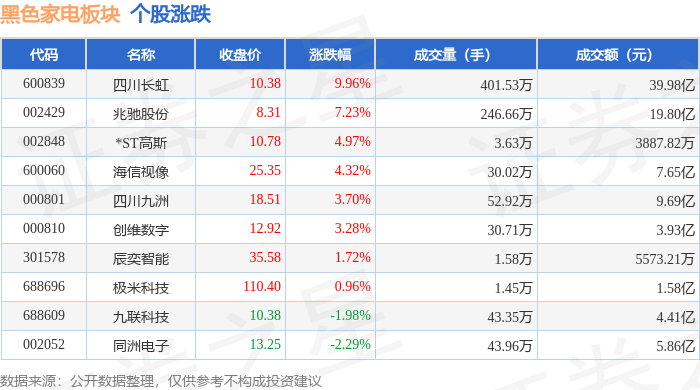
Core Viewpoint - The black home appliance sector experienced a significant increase of 5.52% on January 12, with Sichuan Changhong leading the gains, reflecting positive market sentiment in this industry [1]. Group 1: Market Performance - The Shanghai Composite Index closed at 4165.29, up by 1.09%, while the Shenzhen Component Index closed at 14366.91, up by 1.75% [1]. - Key stocks in the black home appliance sector showed notable price increases, with Sichuan Changhong rising by 9.96% to a closing price of 10.38 [1]. Group 2: Stock Performance Details - Sichuan Changhong (600839) led the sector with a trading volume of 4.0153 million shares and a transaction value of 399.8 million yuan [1]. - Other notable performers included Zhaochi Co. (002429) with a 7.23% increase, closing at 8.31, and Hisense Visual (600060) with a 4.32% increase, closing at 25.35 [1]. Group 3: Capital Flow Analysis - The black home appliance sector saw a net inflow of 882 million yuan from institutional investors, while retail investors experienced a net outflow of 298 million yuan [1]. - The capital flow data indicates that Sichuan Changhong had a net inflow of 1.06 billion yuan from institutional investors, representing 26.51% of its total trading volume [2].




终于上桌吃饭,AI眼镜分野于CES:独立重要,智能体更重要
3 6 Ke· 2026-01-12 03:05
Core Insights - CES 2026 showcased a significant shift in the AI landscape, with AI not just as a feature but as a means to redefine user interaction with information [1][6] - AI glasses emerged as a prominent category, indicating a growing consumer interest and potential market viability [5][18] Group 1: AI Glasses Development - AI glasses are evolving from mere concepts to practical devices, with a focus on usability and experience rather than just technological gimmicks [5][18] - The differentiation among AI glasses continues, with AI audio glasses showing disadvantages compared to AI display and multifunctional glasses like Rokid's offerings [5][18] - The introduction of independent operation capabilities in AI glasses, such as the Thunder X3 Pro with eSIM, marks a significant trend towards detaching from smartphones [10][12] Group 2: Market Trends and Consumer Engagement - Consumer interest in AI glasses is high, with significant foot traffic at Rokid's booth during CES, indicating a positive reception for products like the Rokid AI Glasses Style [3][5] - Companies are focusing on making AI glasses practical for daily use, with various manufacturers exploring different approaches to enhance user experience and encourage purchases [18][22] - The emergence of smart agent stores is crucial for the AI glasses industry, allowing developers to define functionalities, similar to how the App Store transformed the smartphone market [28][31] Group 3: Technical Innovations and Challenges - Innovations in connectivity, such as Qualcomm's efforts to achieve low-power WiFi connections, are essential for the independent operation of AI glasses [12][33] - Battery life and ease of recharging are critical factors for the independence of AI glasses, with various designs being tested to improve these aspects [13][33] - The balance between lightweight design and essential functionalities, such as first-person photography and video recording, remains a challenge for manufacturers [32][33]

CES2026-直击智能眼镜盛会
2026-01-12 01:41
Summary of Key Points from the Conference Call Industry Overview - The conference highlighted the significant presence of Chinese brands at CES 2026, with 31 out of 44 participating brands being Chinese, showcasing the rise of Chinese companies in the smart glasses sector [1][2]. Core Insights and Arguments - **Product Innovations**: - XGIMI launched lightweight smart glasses weighing only 28.9 grams, marking a significant advancement in design [1][3]. - Thunderbird introduced AR glasses with eSIM technology, allowing independent connectivity without relying on smartphones, enhancing user convenience [1][4]. - The eSIM technology improves data transmission efficiency and simplifies operations, providing telecom operators with new revenue opportunities through cloud and AI services [1][6]. - **Market Dynamics**: - The global shipment of AI-enabled smart glasses is projected to exceed 8 million units by 2025, with Meta holding a significant market share [1][22]. - Rokid Glasses have seen substantial shipments since September, totaling over 100,000 units, with supply chain bottlenecks expected to ease in the second half of 2026 [1][22]. - **Commercial Strategies**: - Thunderbird's innovative business model includes offering glasses with prepaid phone plans, lowering consumer entry barriers and stimulating spending, which could enhance telecom operators' average revenue per user (ARPU) [1][10][11]. - Other companies are likely to adopt similar models, especially if telecom operators see positive results from Thunderbird's approach [1][12]. Additional Important Insights - **Technological Advancements**: - The introduction of eSIM technology is expected to revolutionize the smart glasses industry by allowing direct cloud connectivity and reducing reliance on smartphones [1][6]. - eSIM functionality is anticipated to have minimal impact on battery life, potentially improving it due to lower power consumption compared to WiFi [1][9]. - **Competitive Landscape**: - Chinese brands are positioned favorably against international competitors due to cost-effectiveness, supply chain advantages, and rapid deployment capabilities [1][17]. - The integration of AI capabilities in smart glasses is evolving, with new features such as multi-question dialogue being introduced [1][18]. - **Future Projections**: - The smart glasses market is expected to see significant growth, with Meta projected to ship around 800,000 units in 2025, primarily in the fourth quarter [1][22]. - Supply chain issues, particularly in Micro LED and optical modules, are anticipated to improve by the second half of 2026, enabling better product availability [1][26]. - **Upcoming Releases**: - Key product launches to watch for in 2026 include new AI glasses from ByteDance and Huawei, as well as updates from Xiaomi and Rokid [1][28]. - **Market Evolution**: - The smart glasses industry is on the verge of a breakthrough akin to the iPhone 4 moment, contingent on achieving a weight under 30 grams and diverse styling options to cater to various consumer preferences [1][29][30].
西部证券晨会纪要-20260112
Western Securities· 2026-01-12 00:56
Group 1: Home Appliances Industry - The report emphasizes the importance of capturing opportunities at the bottom of the consumer sector, focusing on the "dividend +" allocation direction as high-end consumption and certain mass-market products show signs of recovery [1][5] - The report highlights that the market is gradually returning its attention to the consumer sector due to the implementation of national subsidy policies and the demand for high-quality investments, although high valuations and non-mainstream sectors remain less attractive [1][5] - Key recommendations include focusing on companies with strong business models, high dividends, stable performance, and favorable valuations, such as Haier Smart Home, Midea Group, and Gree Electric [3][5] Group 2: Commercial Aerospace and Power Equipment Industry - The commercial aerospace sector in China is characterized by grand planning and significant potential, with expectations for a transition from "hundreds" to "thousands" of low-orbit satellites between 2026 and 2027, marking a shift to mass production and high-density launches [6] - The report suggests that the aerospace cable industry, which requires high environmental performance and reliability, is expected to see significant growth due to the increasing frequency of rocket launches, with recommendations to focus on companies like Hualing Cable [6][7] - The report also discusses the importance of rocket fuel tanks, which represent a significant cost in rocket structures, and suggests monitoring companies like Taisheng Wind Energy for investment opportunities [7] Group 3: Inflation and Economic Indicators - The report notes that the Consumer Price Index (CPI) increased by 0.8% year-on-year in December, the highest since March 2023, indicating a recovery in prices [10][11] - The Producer Price Index (PPI) showed a month-on-month increase of 0.2% in December, with a narrowing year-on-year decline, suggesting a potential acceleration in nominal GDP growth [11][12] - The report anticipates that the trends of rising inflation and nominal GDP growth will continue into 2026, supported by improving economic indicators [11][12]
国补落地,关注CES新品催化
Xiangcai Securities· 2026-01-11 15:15
Investment Rating - The report maintains an "Overweight" rating for the home appliance industry [4][56] Core Views - The home appliance industry has shown a weekly increase of +2.34%, ranking 25th among its peers, while the CSI 300 index decreased by -0.08% [5][11] - The industry is experiencing a shift from incremental competition to stock integration, with a focus on efficiency optimization, product innovation, and technological upgrades [9][56] - The current price-to-earnings (P/E) ratio for the home appliance industry is 15.65, ranking 25th among 31 industries, indicating a relatively low valuation compared to the CSI 300 index [7][28] Summary by Sections Industry Performance - The home appliance sector's performance over the past month shows a +2.34% increase, with notable sub-sectors such as home appliance components III (+4.11%), other black appliances (+3.99%), and kitchen appliances (+3.84%) leading the gains [5][19] Policy and Market Trends - The national subsidy program has been streamlined to focus on six categories of appliances, with a subsidy of 15% of the product price and clear caps on subsidies for energy-efficient products [7][9] - The 2026 CES highlighted trends in AI integration, display technology innovations, and scenario-based applications in new appliance products [8] Investment Recommendations - The report suggests focusing on three main lines for investment: 1. Companies with solid market positions and high dividend yields in the white goods sector [9][56] 2. Companies that can leverage new products and technologies to explore new demands or expand into new markets [9][56] 3. Opportunities arising from the "trade-in" policy and upgrades in AI and smart home technologies [9][56]
券商首席带你看“科技界春晚”
中国基金报· 2026-01-11 13:07
Core Insights - The article highlights "Physical AI" as a significant trend at the 2026 CES, with a focus on robotics applications, indicating a consensus on the global development of robotics despite early-stage product challenges [2][3] - NVIDIA's CEO emphasized "Physical AI" during his keynote, shifting the company's focus towards building global AI infrastructure to integrate intelligent agents into the real world [2] - The article suggests that 2026 may mark the year for the realization of Agentic AI, supported by acquisitions and technological advancements in both software and hardware [4] Summary by Sections Physical AI Concept - "Physical AI" is defined as models that use motion skills to understand and interact with the real world, typically encapsulated in robots and autonomous vehicles [3] - A fundamental challenge in training such AI is enabling it to comprehend physical world commonalities, such as object permanence and causal relationships [3] - NVIDIA's solution includes a new computing architecture and open-source models to accelerate the development of autonomous driving and Physical AI [3] Future Trends and Opportunities - The article predicts that 2026 will be a pivotal year for consumer technology, driven by AI-enabled product innovations and potential valuation re-evaluations in the tech consumption sector [4] - AI applications in consumer scenarios, from indoor cleaning to smart wearables, are highlighted as key trends observed at CES [4] - Companies with comprehensive product portfolios and ecosystem integration capabilities are expected to gain market share rapidly, while some tech consumption firms may experience systematic valuation re-evaluations due to AI catalysts and performance confirmations [6]

券商首席带你看“科技界春晚”
Zhong Guo Ji Jin Bao· 2026-01-11 12:57
Core Insights - The main highlight of CES 2026 is "Physical AI," particularly applications involving robotics, which is seen as a potential turning point similar to the early days of autonomous driving [1][3] - NVIDIA's CEO emphasized "Physical AI" during his keynote, indicating a shift towards building global AI infrastructure that integrates intelligent agents into the physical world [1][3] Group 1: Definition and Challenges of Physical AI - "Physical AI" refers to models that use motion skills to understand and interact with the real world, typically encapsulated in autonomous machines like robots and self-driving cars [3][4] - A fundamental challenge in training such AI is enabling it to comprehend common physical world concepts, such as object permanence and causality, which are intuitive for humans but not for AI [4] Group 2: Technological Developments and Future Trends - NVIDIA's new computing architecture, Rubin, and the release of the open-source model Alpamayo aim to accelerate advancements in autonomous driving and Physical AI [4] - The year 2026 is anticipated to mark the emergence of Agentic AI, supported by acquisitions and deployments from companies like Meta and NVIDIA, which are enhancing AI training and large-scale reasoning capabilities [4] Group 3: Consumer Applications and Market Opportunities - The application of AI in consumer scenarios is a key focus of CES, with innovations in products ranging from indoor cleaning to smart wearables, indicating a significant acceleration in product development [4] - AI glasses are expected to enter a phase of widespread adoption, with notable products from Chinese companies like Alibaba and Rokid showcasing advanced features and ecosystem integration [5] - The technology consumer sector is projected to experience a new growth cycle driven by technological innovation and valuation reassessment, particularly for companies with strong ecosystem capabilities [5]