
易方达基金

Search documents
暴赚6200倍!谁是摩尔线程的最大赢家?
华尔街见闻· 2025-12-05 04:01
Core Viewpoint - The article highlights the remarkable debut of Moore Threads on the STAR Market, showcasing the market's strong optimism for domestic high-end computing chips amid the AI wave, with a significant price surge post-IPO [1][4]. Group 1: IPO Performance - Moore Threads officially listed on the STAR Market on December 5, opening at 650 yuan, a staggering 468.78% increase from the issuance price of 114.28 yuan, peaking at 688 yuan, marking a 502% rise, with a market capitalization exceeding 270 billion yuan [1]. - Investors who acquired one lot (500 shares) at the opening price saw a floating profit of over 280,000 yuan, making it one of the most profitable new stocks of the year [1]. - The IPO attracted 267 institutions, with an offline subscription multiple of 1572 times, raising approximately 8 billion yuan, making it the largest IPO on the STAR Market this year [4][6]. Group 2: Investment and Valuation - Early investors, such as Peixian Qianyao, achieved over 6262 times return on their initial investment, creating a capital myth [3][8]. - Despite being in a loss-making state, the company has a high price-to-sales ratio of 122 times, significantly exceeding that of overseas giants like NVIDIA, indicating a market premium for its future growth potential and unique technology [4][9]. Group 3: Technology and Market Position - Moore Threads is the only domestic company capable of functionally competing with NVIDIA, utilizing its self-developed MUSA architecture to achieve breakthroughs in AI computing, graphics rendering, physical simulation, and video encoding on a single chip [5][11]. - The company aims to maintain an annual iteration speed for its full-function GPU chips and is committed to creating a comprehensive computing platform covering both cloud and edge computing [5][12]. Group 4: Future Projections and Market Growth - The company anticipates achieving profitability by 2027, with significant R&D investments reflecting its commitment to technological advancement [10]. - The global GPU market is projected to reach 3.62 trillion yuan by 2029, with China's market expected to grow rapidly, indicating a substantial opportunity for Moore Threads in the evolving computing landscape [13].


加仓!连续加仓
中国基金报· 2025-12-05 03:54
Core Viewpoint - The stock ETF market in China experienced a significant net inflow of over 4.3 billion yuan on December 4, with a cumulative increase of 10.8 billion yuan over the past three days, indicating a strong interest in broad-based ETFs despite market volatility [2][5]. Group 1: Market Overview - On December 4, the A-share market showed mixed performance, with the Shanghai Composite Index down 0.06% and the ChiNext Index up over 1% [2]. - The stock ETF market saw a total increase of 1.789 billion shares, with a net inflow of 43.15 billion yuan, primarily driven by broad-based ETFs and Hong Kong market ETFs [5]. - The total scale of all stock ETFs in the market reached 4.56 trillion yuan as of December 4 [4]. Group 2: Fund Inflows - The net inflow for broad-based ETFs was 33.54 billion yuan, while Hong Kong market ETFs saw a net inflow of 12.2 billion yuan [5]. - The CSI A500 Index ETF led the inflows with 9.21 billion yuan, while the Shanghai market corporate bond index saw the largest outflow of 5.01 billion yuan [6]. - Recent inflows into the Hang Seng Technology Index exceeded 1.8 billion yuan, and the SGE Gold 9999 Index saw inflows of over 1.1 billion yuan [7]. Group 3: Top Performing ETFs - The top ETFs by net inflow included the Chinese Internet ETF with 5.33 billion yuan, the CSI A500 ETF with 4.56 billion yuan, and the SSE 50 ETF with 4.37 billion yuan [8]. - Notable inflows were also observed in the STAR Market ETF and the CSI 1000 ETF, with net inflows of 3.89 billion yuan and 2.99 billion yuan, respectively [8]. Group 4: Fund Outflows - The industry-themed ETFs experienced significant outflows, totaling 12.02 billion yuan, with the Bank ETF and Gold Stock ETF each seeing outflows exceeding 3 billion yuan [12][13]. - Other ETFs with notable outflows included the Chemical ETF and the Military Industry Leader ETF, both exceeding 2 billion yuan in outflows [13]. Group 5: Market Sentiment - Despite some industry-themed ETFs experiencing outflows, institutions remain optimistic about structural opportunities in the A-share market, anticipating clearer policy and fundamental expectations in December [15]. - Analysts suggest focusing on growth sectors such as AI, electric new energy, and industrial metals, while also considering potential policy-driven opportunities in sectors like hotels, logistics, and aviation as the year-end approaches [15].

“国产GPU第一股”!摩尔线程大涨502%,中一签赚28万,早期投资者暴赚6200倍
Hua Er Jie Jian Wen· 2025-12-05 03:17
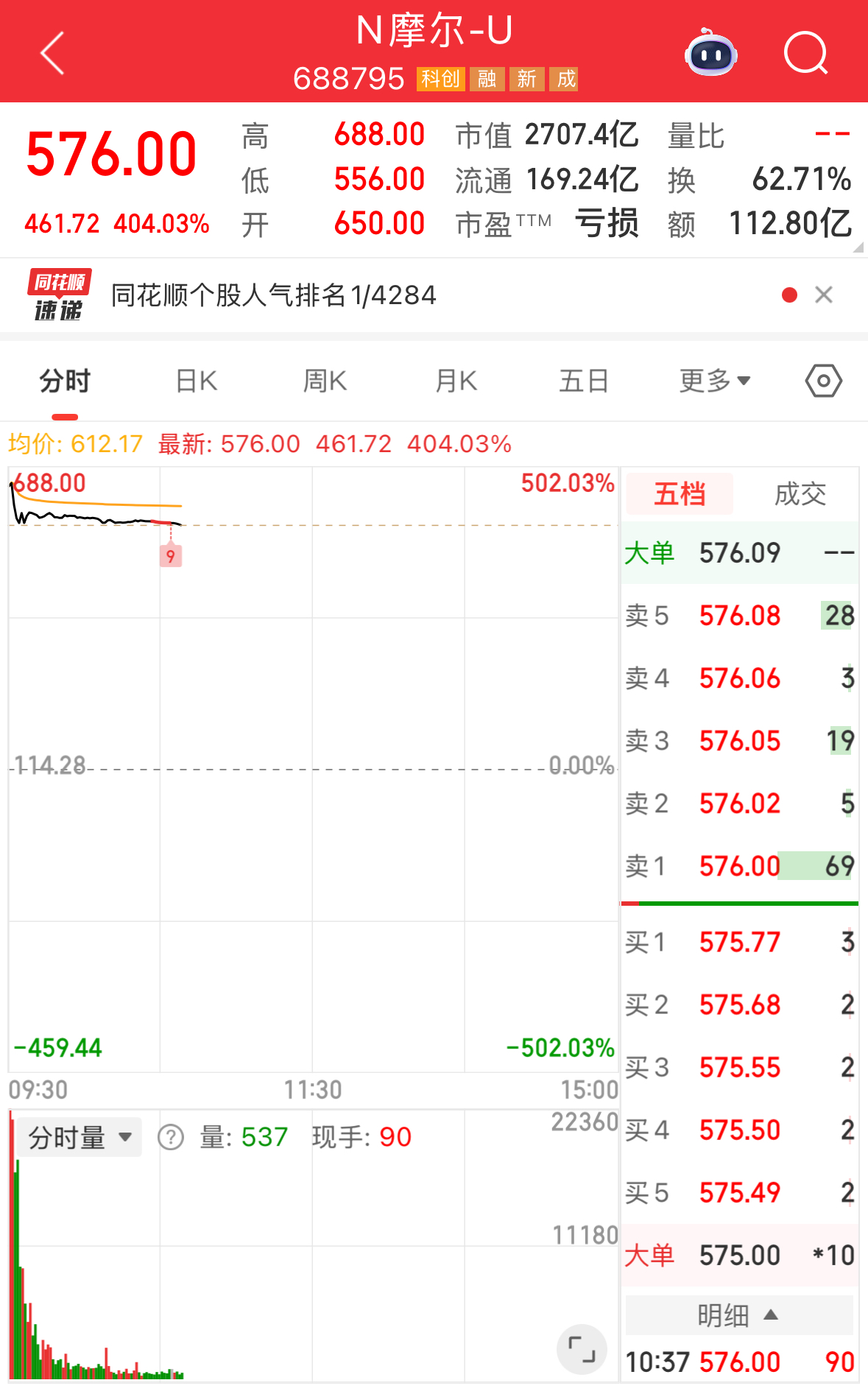
Core Viewpoint - The debut of Moore Threads on the STAR Market has sparked significant market enthusiasm, reflecting strong confidence in the future of domestic high-end computing chips amid the AI wave [1] Group 1: Market Performance - Moore Threads officially listed on the STAR Market on December 5, opening at 650 yuan, a staggering increase of 468.78% from the issuance price of 114.28 yuan [1] - The stock reached a peak of 688 yuan during trading, with a maximum increase of 502%, and its market capitalization briefly exceeded 270 billion yuan [1] - As of the latest update, the stock price is 576 yuan, representing a 404% increase [1] Group 2: Investment and IPO Details - The IPO attracted 267 institutional investors, with an offline subscription multiple of 1572 times, making it the largest IPO on the STAR Market this year, raising approximately 8 billion yuan [4][5] - Early investors, such as Peixian Qianyao, saw returns exceeding 6262 times their initial investment, highlighting the company's remarkable capital appeal [6] - The company completed its IPO process in just 158 days, showcasing a rapid pace in the capital market [5] Group 3: Financial Performance and Valuation - Despite high market enthusiasm, Moore Threads is currently operating at a loss, with projected revenues of 438 million yuan and a net loss of 1.618 billion yuan for 2024 [7] - The company has experienced rapid revenue growth, increasing from 46.1 million yuan in 2022 to 438 million yuan in 2024, but continues to face significant losses due to high R&D expenditures [7] - The company's price-to-sales ratio stands at 122 times, significantly higher than that of international GPU giants like NVIDIA, indicating a premium valuation based on future growth potential [4][7] Group 4: Technological Positioning - Moore Threads is positioned as the only domestic company capable of functionally competing with NVIDIA, utilizing its self-developed MUSA architecture to achieve breakthroughs in AI computing, graphics rendering, physical simulation, and video processing on a single chip [8][9] - The company aims to create a universal computing acceleration platform to support various AI applications and scientific research needs [9] Group 5: Future Outlook and Market Potential - The company plans to invest in three major projects through its IPO proceeds, focusing on AI integrated chips, next-generation graphics chips, and AI SoC chips to meet diverse computing needs [10] - The global GPU market is projected to reach 3.62 trillion yuan by 2029, with China's market expected to grow significantly, indicating a robust future for domestic GPU manufacturers [10]
两市ETF两融余额较增加4.23亿元丨ETF融资融券日报
2 1 Shi Ji Jing Ji Bao Dao· 2025-12-05 02:57
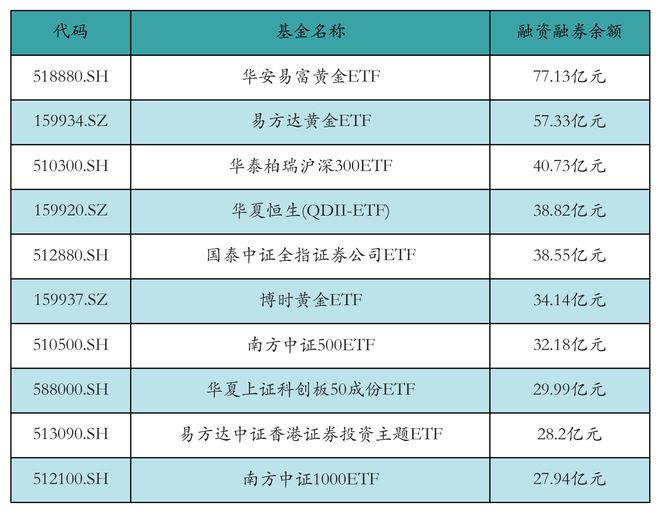
Market Overview - As of December 4, the total ETF margin balance in the two markets reached 118.93 billion yuan, an increase of 423 million yuan from the previous trading day [1] - The financing balance was 110.98 billion yuan, up by 436 million yuan, while the securities lending balance decreased by 13.31 million yuan to 7.96 billion yuan [1] - In the Shanghai market, the ETF margin balance was 83.38 billion yuan, increasing by 454 million yuan, with a financing balance of 76.39 billion yuan, up by 445 million yuan [1] - In the Shenzhen market, the ETF margin balance was 35.55 billion yuan, decreasing by 30.89 million yuan, with a financing balance of 34.59 billion yuan, down by 8.89 million yuan [1] ETF Margin Balances - The top three ETFs by margin balance on December 4 were: - Huaan Yifu Gold ETF (7.71 billion yuan) - E Fund Gold ETF (5.73 billion yuan) - Huatai-PB CSI 300 ETF (4.07 billion yuan) [2] - The total margin balances of the top ten ETFs are detailed in the provided table [2] ETF Financing Amounts - The top three ETFs by financing buy-in amounts on December 4 were: - Hai Futong CSI Short Bond ETF (1.43 billion yuan) - Huatai-PB Southern Dongying Hang Seng Technology Index (QDII-ETF) (853 million yuan) - E Fund CSI Hong Kong Securities Investment Theme ETF (828 million yuan) [3][4] ETF Net Financing Amounts - The top three ETFs by net financing buy-in amounts on December 4 were: - E Fund CSI Hong Kong Securities Investment Theme ETF (141 million yuan) - Huaxia Hang Seng Technology (QDII-ETF) (76.63 million yuan) - Jiashi Shanghai Stock Exchange Sci-Tech Innovation Board Chip ETF (74.78 million yuan) [5][6] ETF Securities Lending Sell Amounts - The top three ETFs by securities lending sell amounts on December 4 were: - Huatai-PB CSI 300 ETF (17.24 million yuan) - Huaxia CSI 1000 ETF (7.88 million yuan) - Southern CSI 500 ETF (7.41 million yuan) [7][8]
公募密集上报双创半导体、机器人ETF
Zhong Guo Zheng Quan Bao· 2025-12-05 01:40
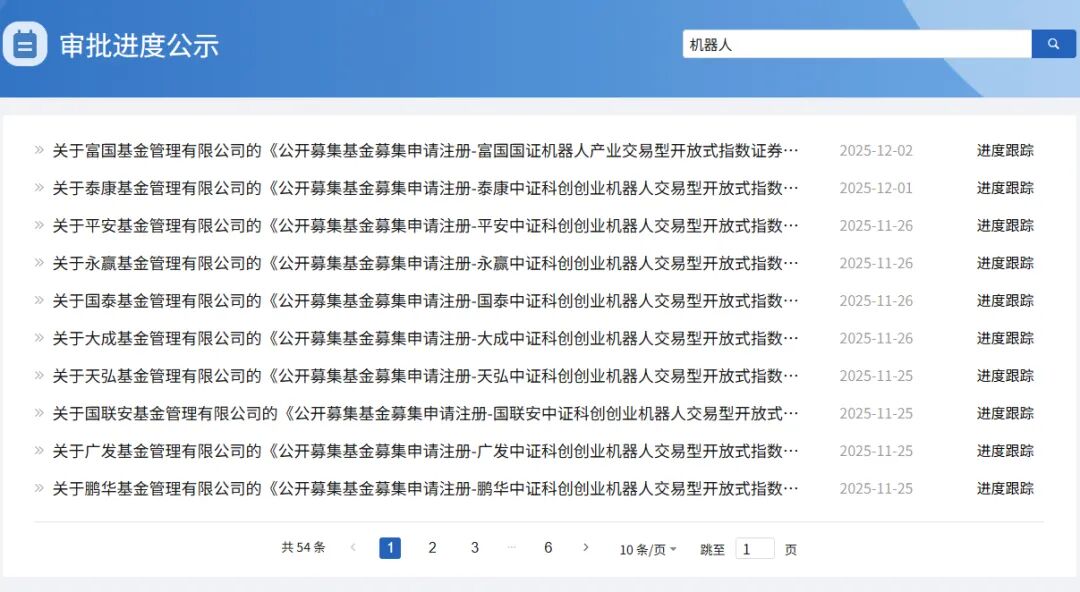
Group 1 - Recently, Guotai Fund has submitted an application for the Shanghai Stock Exchange Sci-Tech Innovation Board Semiconductor Materials and Equipment ETF, while Taikang Fund has submitted an application for the Dual Innovation Robot ETF. Since November 24, over twenty Dual Innovation semiconductor and robot ETFs have been reported, all targeting the current hottest AI sector [1] - Recently, core assets represented by the CSI A500-related ETFs have seen an influx of incremental funds. On December 3, among the ETFs with the highest net inflow of funds, several products such as A500 ETF (512050), A500 ETF Huatai-PB, and CSI A500 ETF (159338) were noted. The CSI 1000 ETF (512100) and CSI 300 ETF (510300) also received significant net inflows [1] - According to an announcement from Moore Threads, it will be listed on the Sci-Tech Innovation Board of the Shanghai Stock Exchange on December 5, with an issuance price of 114.28 yuan per share, corresponding to a post-issuance market value of approximately 53.715 billion yuan. Previously, public fund companies competed fiercely in the allocation, with E Fund, Southern Fund, ICBC Credit Suisse Fund, Fortune Fund, Guotai Fund, Huaxia Fund, China Merchants Fund, and Harvest Fund each receiving allocations exceeding 100 million yuan [1]

盘前资讯|公募密集上报双创半导体、机器人ETF
Zhong Guo Zheng Quan Bao· 2025-12-05 01:40
Group 1 - Recently, Guotai Fund has submitted an application for the Shanghai Stock Exchange's Sci-Tech Innovation Board Semiconductor Materials and Equipment ETF, while Taikang Fund has submitted an application for the Innovation and Entrepreneurship Robot ETF. Since November 24, over twenty Innovation and Entrepreneurship semiconductor and robot ETFs have been reported, all targeting the current hottest AI sector [1] - Recently, core assets represented by the CSI A500-related ETFs have seen an influx of new capital. On December 3, among the ETFs with the highest net inflows, several products were noted, including A500 ETF (512050), A500 ETF Huatai-PB, and CSI A500 ETF (159338). The CSI 1000 ETF (512100) and CSI 300 ETF (510300) also received significant net inflows [1] - According to an announcement from Moore Threads, it will be listed on the Sci-Tech Innovation Board of the Shanghai Stock Exchange on December 5, with an issuance price of 114.28 yuan per share, corresponding to a post-issuance market value of approximately 53.715 billion yuan. Previously, public fund companies competed fiercely in the allocation process, with E Fund, Southern Fund, ICBC Credit Suisse Fund, Fortune Fund, Guotai Fund, Huaxia Fund, China Merchants Fund, and Harvest Fund each receiving allocations exceeding 100 million yuan [1]
量产前夕,机构提示产业链布局窗口已打开丨每日研选
Shang Hai Zheng Quan Bao· 2025-12-05 00:37
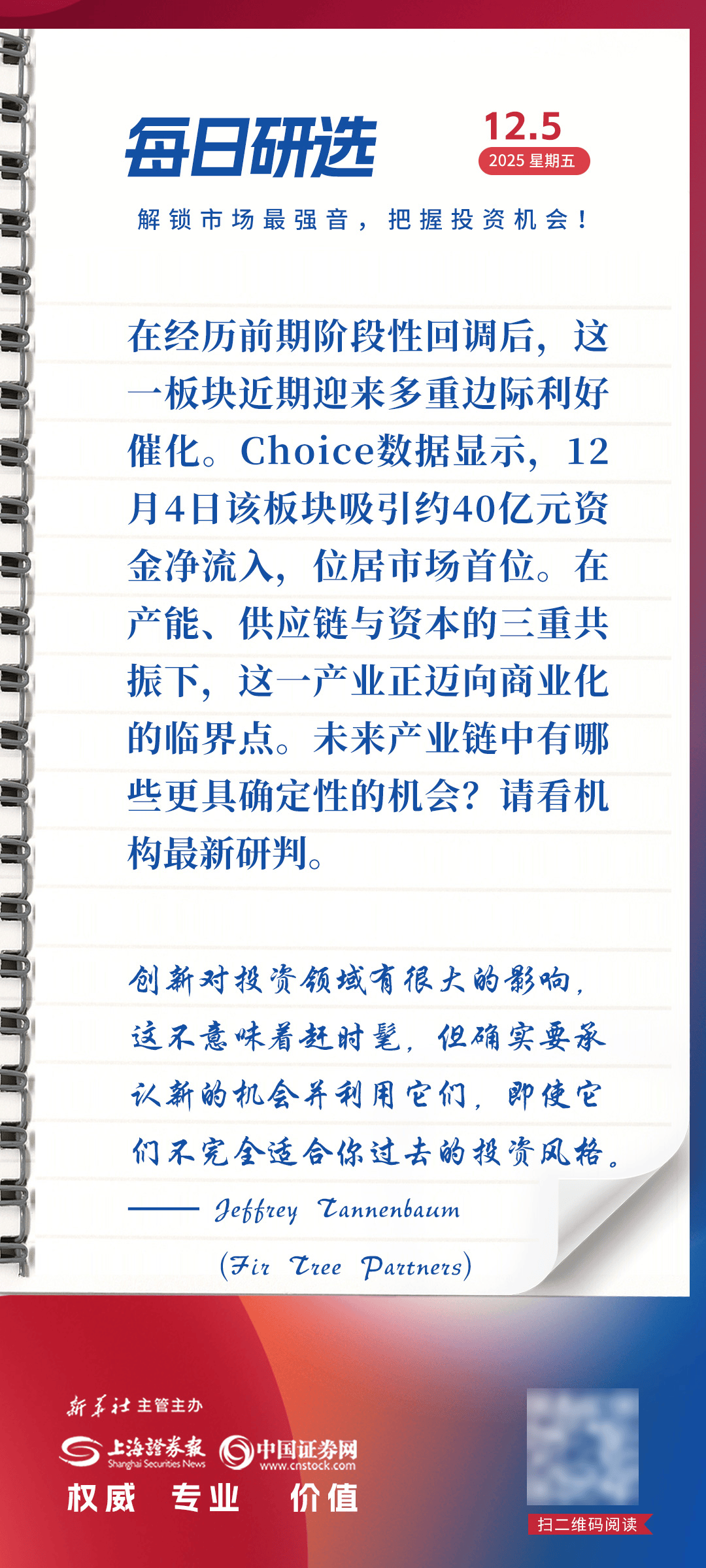
Core Insights - The robotics sector is experiencing a rebound after a significant pullback, driven by multiple marginal benefits and increased confidence from major tech companies like Google and Tesla accelerating their investments in the industry [1][2] - A complete industrial ecosystem is forming, encompassing manufacturing, core component supply, and application scenarios as the supply chain matures [1] Industry Developments - Tesla plans to establish a dedicated facility in Texas with an annual production capacity of 10 million units by 2027 [1] - Yushun Intelligent's emergency robot industrial park project has completed registration, aiming for a monthly production capacity of 500 units [1] - UBTECH has begun mass deliveries of the Walker S2 robot, targeting an annual production capacity of 5,000 units by 2026 and 10,000 units by 2027 [1] - Domestic companies like Zhiyuan Robotics, Galaxy General, and Xiaopeng Robotics are also expanding their production capabilities [1] Supply Chain Progress - Tesla's supply chain (T-chain) is entering a critical verification phase, with expected orders to suppliers in December and guidance for next year's supply [1] - Domestic supply chain companies are rapidly emerging, achieving technological breakthroughs in products like frameless torque motors and precision gears, and have begun small batch deliveries to leading clients [1] Application Scenarios - Application scenarios such as logistics, home services, and data collection are gradually being implemented, with UBTECH winning multiple projects for humanoid robot data collection and training centers [2] - Changan Automobile plans to launch its first vehicle-mounted robot component in Q1 next year, promoting diversified applications [2] Investment Trends - Global capital interest in humanoid robotics is at an all-time high, with increasing financing scales and participant numbers [2] - Domestic companies like Leju Robotics have completed nearly 1.5 billion yuan in Pre-IPO financing, while international firms like Apptronik secured $331 million in strategic financing [2] - Recent ETF initiatives by institutions like Huaxia Fund and E Fund aim to introduce long-term capital support to the sector [2] Focus Areas for Investment - Emphasis on sectors with confirmed industrial certainty, particularly high-probability suppliers in Tesla's supply chain, such as Sanhua Intelligent Controls and Top Group [2][4] - Attention to incremental segments related to technological upgrades, particularly in dexterous hands, with high growth potential for companies like Mingzhi Electric and Dechang Electric [3] - Identifying undervalued companies with substantial progress in robotics, such as Obit Optical and Dongmu Co., which may have a discrepancy in market perception [4]

12月5日每日研选 | 量产前夕,机构提示产业链布局窗口已打开
Sou Hu Cai Jing· 2025-12-05 00:29
Core Viewpoint - The robotics sector is experiencing a rebound after a significant pullback, driven by multiple marginal benefits and accelerated investments from tech giants like Google and Tesla, which boosts industry confidence [2] Industry Developments - Major companies are ramping up production capabilities, with Tesla planning to build a dedicated facility in Texas with an annual capacity of 10 million units by 2027 [2] - Yushun Intelligent's emergency robot industrial park project aims for a monthly production capacity of 500 units [2] - UBTECH has begun mass deliveries of the Walker S2 robot, targeting an annual production capacity of 5,000 units by 2026 and 10,000 units by 2027 [2] - Domestic companies like Zhiyuan Robotics, Galaxy General, and Xiaopeng Robotics are also expanding their production capacities [2] Supply Chain Insights - Tesla's supply chain (T-chain) is entering a critical validation phase, with expected orders to suppliers in December and guidance for next year's supply [2] - Domestic supply chain companies are rapidly emerging, achieving technological breakthroughs in products like frameless torque motors and precision gears, and have begun small batch deliveries to major clients [2] Application Scenarios - Applications in logistics, home services, and data collection are becoming more prevalent, with UBTECH winning multiple projects for humanoid robot data collection and training centers [3] - Changan Automobile plans to launch its first vehicle-mounted robot component in Q1 next year, promoting diversified applications [3] Investment Trends - Global capital interest in humanoid robotics is at an all-time high, with increasing financing scales and participant numbers [3] - Domestic companies like Leju Robotics have completed nearly 1.5 billion yuan in Pre-IPO financing, while international firms like Apptronik secured $331 million in strategic financing [3] - Recent ETF filings by institutions like Huaxia Fund and E Fund aim to introduce long-term capital support to the sector [3] Focus Areas for Investment - Emphasis on companies with verified capabilities and batch supply potential, particularly those in Tesla's supply chain, such as Sanhua Intelligent Controls and Top Group [4] - Attention to incremental segments related to technological upgrades, particularly in dexterous hands, with high growth potential for companies like Mingzhi Electric and Dechang Electric [4] - Consideration of undervalued companies with substantial progress in robotics, such as Obit Light and Dongmu Co., which may have a perception gap in the market [4]

单日大涨超3%!这类ETF年内合计净流入近475亿元
Guo Ji Jin Rong Bao· 2025-12-05 00:13
Core Viewpoint - The robot-themed ETFs have experienced a significant surge, driven by increased market attention and investment inflows, indicating a growing interest in the robotics sector as commercialization accelerates [1][4]. Group 1: ETF Performance - As of December 4, two robot-themed ETFs rose over 3%, leading the stock ETF rankings, while nine others increased by more than 2% [2][3]. - Year-to-date, the 13 robot-themed ETFs have seen a total net inflow of nearly 47.5 billion yuan, with the top two ETFs, 华夏机器人 ETF and 易方达机器人 ETF, attracting 19.09 billion yuan and 12.35 billion yuan respectively [3]. Group 2: Market Dynamics - The performance disparity among robot-themed ETFs is attributed to differences in the underlying indices they track, with 国证机器人产业指数 showing higher gains compared to 中证机器人指数 [3]. - The market currently has 13 robot-themed ETFs, with the largest being 华夏机器人 ETF at 22.8 billion yuan and the second being 易方达机器人 ETF at 13.3 billion yuan [3]. Group 3: Institutional Interest - There has been a notable increase in the number of robot-themed ETFs submitted for regulatory approval, with 17 new products reported in the fourth quarter alone, reflecting strong institutional interest in the sector [4][5]. - The growing focus on robotics is seen as a response to policy support for hard technology innovation and the integration of AI and robotics, highlighting the sector's significant growth potential [5]. Group 4: Investment Strategy - Investors are advised to consider the tracking indices when selecting ETFs, with a preference for those tracking the 国证机器人产业指数 for humanoid robots and 中证机器人指数 for industrial automation [6]. - Key factors for ETF selection include the management capability of the fund company, product scale, liquidity, and cost efficiency, which are crucial for long-term investment success [6].
股票股指期权:隐波与标的呈现负相关,可考虑熊市看跌价差保护
Guo Tai Jun An Qi Huo· 2025-12-04 14:15
Report Date - The report is dated December 4, 2025 [1] Core Viewpoint - Stock index options: Implied volatility is negatively correlated with the underlying, and bear put spread protection can be considered [2] Key Data Summaries Underlying Market Statistics - **Indices and ETFs**: The closing prices of various indices and ETFs showed different changes. For example, the Shanghai Composite 50 Index closed at 2974.34, up 11.26; the CSI 300 Index closed at 4546.57, up 15.52; and the CSI 1000 Index closed at 7248.66, up 0.38. Trading volumes also varied, with some experiencing decreases such as the Shanghai Composite 50 Index with a trading volume of 36.28 billion hands, down 2.24 billion hands, and others like the Huaxia Science and Technology Innovation 50 ETF having an increase in trading volume to 22.21 billion hands, up 3.96 billion hands [3] Option Market Statistics - **Trading Volume and Open Interest**: The trading volumes and open interests of different option types changed. For instance, the trading volume of Shanghai Composite 50 Index options was 19,955, down 5,187, and the open interest was 68,657, up 1,483. The trading volume of CSI 1000 Index options was 189,851, up 201, and the open interest was 328,006, up 5,770 [3] - **PCR Ratios**: The VL - PCR and OI - PCR ratios also had different values. For example, the VL - PCR of Shanghai Composite 50 Index options was 63.02%, and the OI - PCR was 70.50%. The VL - PCR of CSI 1000 Index options was 82.52%, and the OI - PCR was 89.92% [3] Option Volatility Statistics - **ATM - IV, HV, and Other Indicators**: The at - the - money implied volatility (ATM - IV), historical volatility (HV), skew, and VIX of different option types showed different changes. For example, the near - month ATM - IV of Shanghai Composite 50 Index options was 11.06%, up 0.40%, and the 20 - day HV was 10.79%, down 0.27%. The near - month ATM - IV of CSI 1000 Index options was 17.29%, down 0.39%, and the 20 - day HV was 22.68%, down 0.18% [6]