
一汽

Search documents
车圈60天账期革命,压力最大的是新势力
吴晓波频道· 2025-06-11 18:12
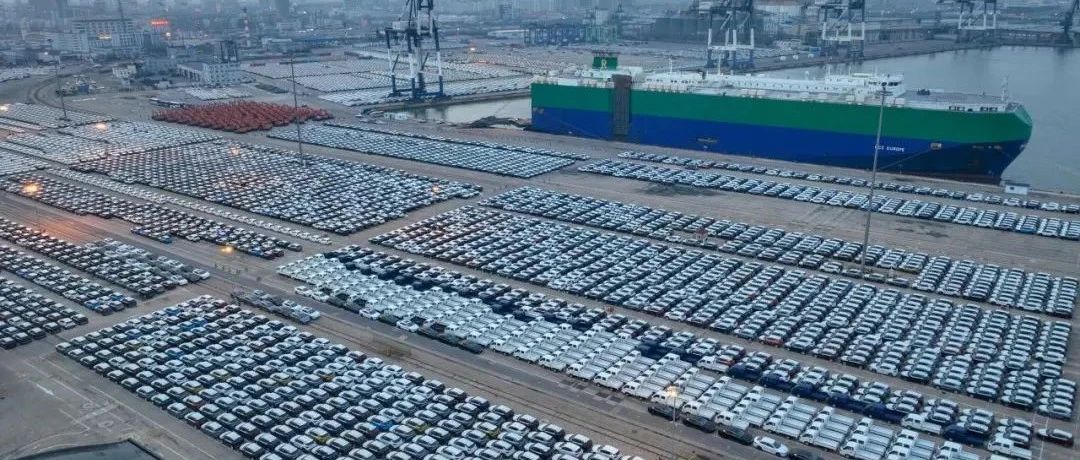
点击上图▲立即收听 " 如果对所有车企都是 ' 一刀切 ' ,那么对那些持续亏损、现金流不足、融资能力又一般的新势力们,恐怕将是一场灾难。 " 文 / 巴九灵(微信公众号:吴晓波频道) 气温在升高,车圈的火药味也没降温。六月,一场由账期引发的"反内卷热浪"正在席卷汽车江湖。 周二 晚上,广汽、一汽、东风三家国企及赛力斯率先发声,承诺供应商账期不超过60 天。紧随其后,吉利、长安接力响应。 昨日凌晨一点,中国第一大车企比亚迪发文称,将供应商支付账期统一至60天内。 图源:比亚迪官微 随后,北汽、上汽、长城、奇瑞等传统车企以及小米、小鹏、零跑等造车新势力纷纷跟进。 就这样,一场由头部车企发起的"账期革命"迅速蔓延,在产业链上空缓缓荡起涟漪,一点点渗入旧有的游戏规则。 口水战 本质而言,此番密集表态,时机微妙,似乎是对近期车企内卷加剧的回应。 五月底,比亚迪宣布了年内第三次大规模价格调整,王朝网、海洋网共计22款智驾版车型最高降幅达5.3万元,创下其智驾车型价格新低。 随后,奇瑞、上汽通用等约10个车企跟进,混战拉开帷幕,引发新一轮车企价格战恐慌。 对此,工信部、汽车工业协会等纷纷发文批评此番降价,车企之间也不再保 ...



60天账期新政背后:汽车已经快卷崩了
阿尔法工场研究院· 2025-06-11 13:15
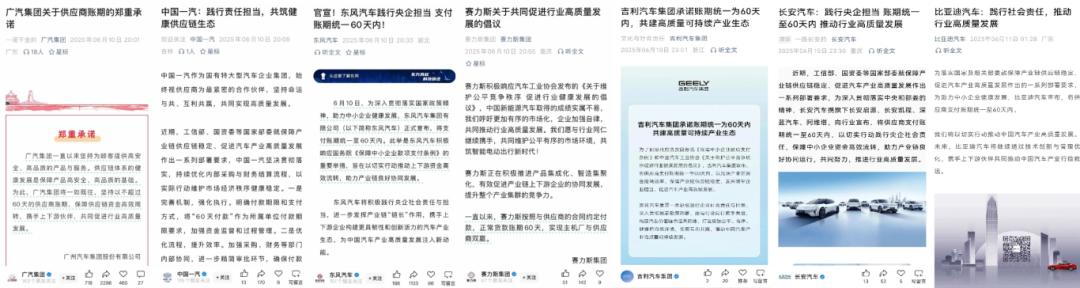
Core Viewpoint - The automotive industry is responding to national calls to unify payment terms to suppliers within 60 days, addressing long-standing issues of delayed payments and cash flow challenges faced by suppliers [1][7][9]. Group 1: Industry Response - GAC Group was the first to announce the commitment to a 60-day payment term for suppliers on June 10 [2]. - Following GAC, major state-owned enterprises like FAW and Dongfeng also made similar announcements, emphasizing their responsibility and leadership in the industry [3]. - Other leading companies such as Seres, Geely, Changan, and BYD quickly followed suit, indicating a collective industry shift towards shorter payment terms [4][5]. Group 2: Payment Terms Context - Historically, the average payment cycle for domestic automotive companies has exceeded 170 days, with some companies reaching over 240 days, contrasting sharply with international counterparts like Toyota and Ford, which average around 54 to 64 days [10][11]. - The long payment terms have been attributed to intense market competition, where manufacturers have used suppliers as a "zero-interest funding pool" to alleviate their financial pressures [10][19]. Group 3: Regulatory Framework - The revised "Regulations on Guaranteeing Payment to Small and Medium Enterprises" came into effect on June 1, aiming to address issues of prolonged payment cycles and unclear responsibilities [21][22]. - The new regulations include a rigid 60-day payment requirement and prohibit non-cash payment methods that could extend payment periods, aiming to create a more equitable environment for suppliers [31]. Group 4: Market Implications - The shift to a 60-day payment term is expected to enhance the resilience of the supply chain, reducing the risk of cash flow crises for suppliers and improving overall liquidity in the industry [25][28]. - However, this change may impose greater financial pressure on automotive manufacturers in the short term, as they adapt to the new payment structure [24][26]. Group 5: Industry Sentiment - There is a mix of optimism and skepticism among industry stakeholders regarding the implementation of the 60-day payment term, with many questioning the actual enforcement and potential loopholes [29][30]. - The sentiment reflects a broader concern about trust and confidence in the industry's ability to adhere to the new regulations and genuinely improve supplier relationships [29][32].




上证指数站上3400点,创业板指涨逾1%
Guang Zhou Ri Bao· 2025-06-11 11:17
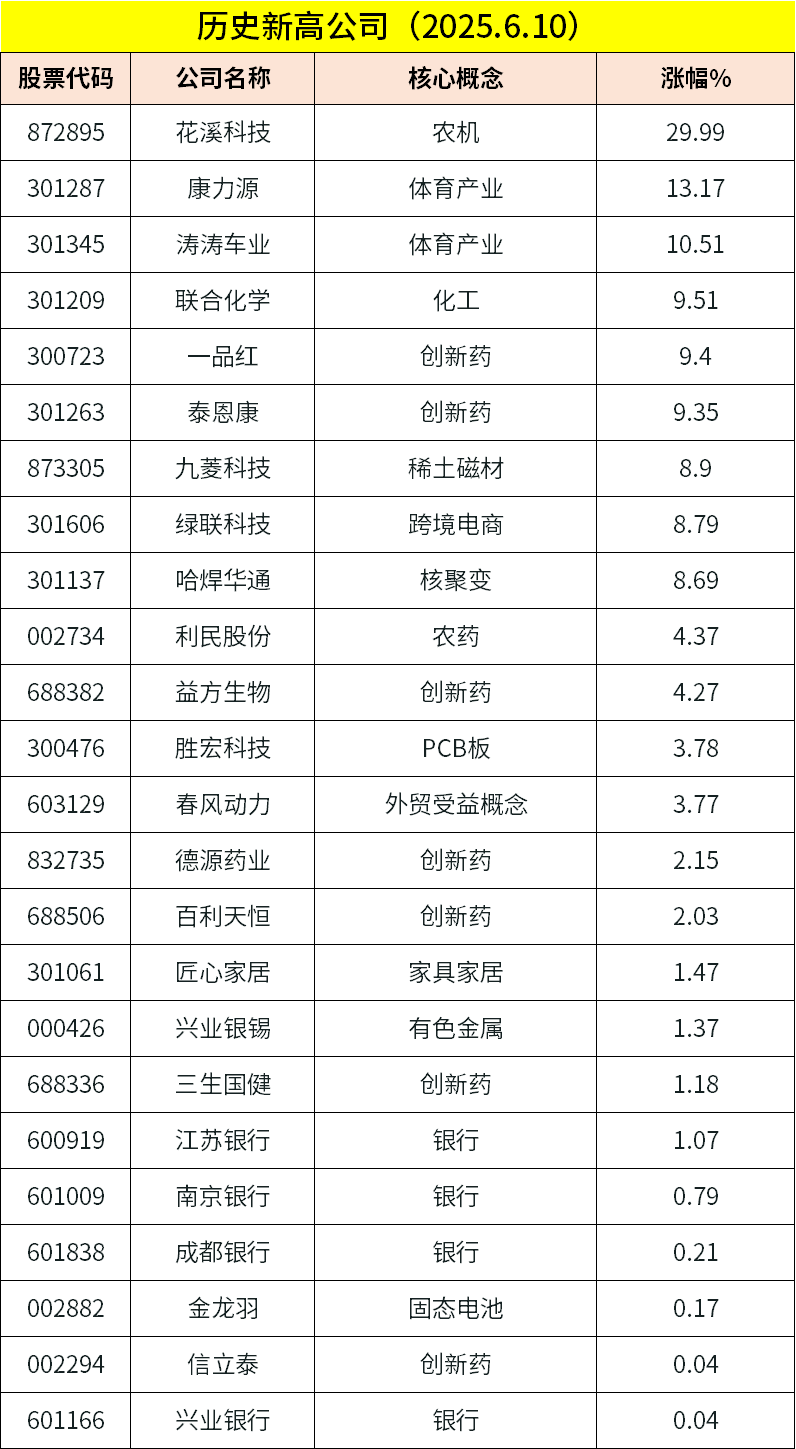
Group 1 - The A-share market experienced a rise, with the Shanghai Composite Index surpassing 3400 points, closing up 0.52% at 3402.32 points, while the Shenzhen Component Index rose 0.83% and the ChiNext Index increased by 1.21% [1] - Ying Shi Innovation officially listed on the Shanghai Stock Exchange's Sci-Tech Innovation Board, opening at 182 CNY per share, a 285% increase from the issue price, with a total market capitalization exceeding 70 billion CNY, closing with a rise of 274.44% and a market cap of 70.977 billion CNY [1] - The rare earth permanent magnet sector saw significant gains, with companies like Beikong Technology achieving three consecutive trading limits, and Zhongke Magnetic Industry hitting a new high. The market adjusted rare earth raw material prices upward due to expectations of gradual easing of export restrictions [1] Group 2 - The automotive parts sector showed strong performance, with multiple stocks such as Tongxin Transmission, Meichen Technology, and Xinyi Technology hitting trading limits. Car manufacturers are increasingly committing to a payment term of no more than 60 days, which benefits parts suppliers by accelerating cash flow and enabling more investment in raw materials and production capacity [1] - The financial sector collectively surged, with companies like Industrial Securities and Xinda Securities reaching trading limits. Analysts suggest that the current potential bull market may evolve into a "slow bull" market, with the A-share market likely remaining in a volatile range until 2025 [2]

8家车厂宣布缩短账期至60天,评论区却吵疯了
3 6 Ke· 2025-06-11 02:02
Core Viewpoint - The automotive industry is responding to a national call to standardize payment terms to suppliers within 60 days, aiming to alleviate cash flow issues and promote high-quality development in the sector [1][2][4]. Group 1: Industry Response - GAC Group was the first to announce the commitment to a 60-day payment term for suppliers, followed by major state-owned enterprises like FAW and Dongfeng, and other leading companies such as Geely and Changan [1][2]. - As of the latest updates, a total of eight automotive companies, including BYD and Chery, have pledged to adhere to the 60-day payment term, indicating a potential trend for more companies to follow suit under public pressure [4][11]. Group 2: Historical Context and Current Issues - Historically, the average payment cycle for domestic automotive companies has increased from approximately 45 days a decade ago to over 170 days currently, with some companies exceeding 240 days [5][6]. - In contrast, international automotive giants like Toyota and Ford maintain much shorter payment cycles, averaging around 54 to 64 days [5][6]. Group 3: Implications of the New Policy - The introduction of a standardized 60-day payment term is seen as a revolutionary change for the automotive supply chain, potentially improving cash flow and reducing financial strain on suppliers [5][11]. - The policy aims to shift the automotive industry from a "dominance of manufacturers" model to a more equitable collaboration between manufacturers and suppliers, fostering a healthier business environment [15]. Group 4: Regulatory Framework - The revised "Regulations on Payment to Small and Medium Enterprises" effective from June 1, 2023, addresses long payment cycles and aims to enhance regulatory oversight, ensuring timely payments [10][15]. - The regulations include provisions to prohibit coercing small businesses into accepting non-cash payment methods, thereby preventing the circumvention of the 60-day payment rule [15]. Group 5: Market Reactions and Concerns - While the announcement has been met with optimism from industry stakeholders, there are concerns regarding the actual implementation and potential loopholes that could allow companies to extend payment periods through various means [13][15]. - The effectiveness of the new policy will depend on the commitment of automotive companies to adhere to the regulations and the enforcement of penalties for non-compliance [15].

汽车业“反内卷”进行中:四大车企同日官宣“60天账期”,比亚迪、吉利、长安、奇瑞凌晨跟进
Hua Er Jie Jian Wen· 2025-06-11 00:47
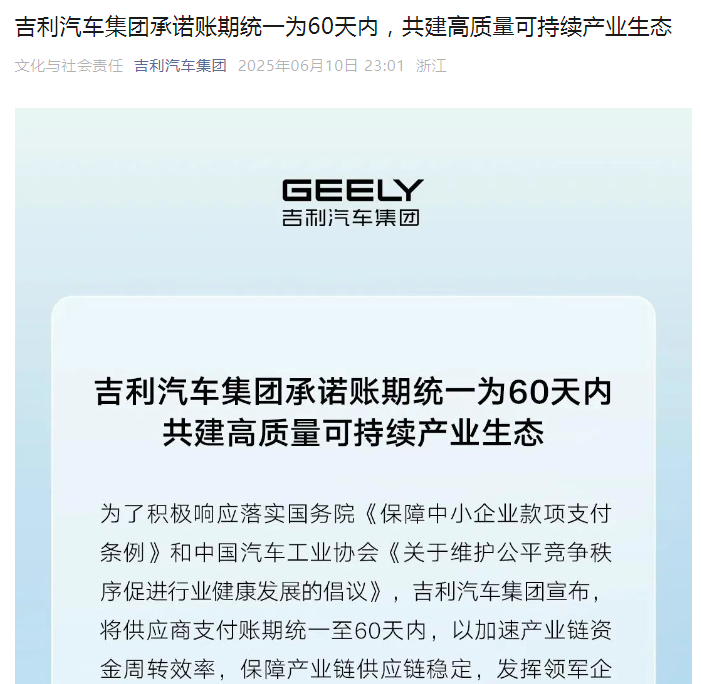
Core Viewpoint - Multiple automotive companies in China have committed to limiting supplier payment terms to no more than 60 days, responding to government efforts to address "involution" in the industry [1][12][13]. Group 1: Company Commitments - On the evening of October 10, companies including FAW, Dongfeng, GAC, and Seres announced their commitment to a 60-day payment term for suppliers to enhance cash flow efficiency and stabilize the supply chain [1]. - Shortly after, Geely announced a similar commitment to unify supplier payment terms to 60 days, emphasizing its role as a leading enterprise in promoting high-quality development in the automotive industry [1]. - Changan Automobile followed suit, stating that its subsidiaries would also adhere to the 60-day payment term, highlighting the importance of corporate social responsibility [3]. - BYD announced its commitment to the same payment term, aiming to drive high-quality development in the Chinese automotive industry through innovation and management optimization [6][7]. - Chery Group also joined the initiative, reinforcing the collective movement among automotive manufacturers [8]. Group 2: Regulatory Context - The commitments from these automotive companies align with the upcoming "Regulations on Payment of Funds to Small and Medium Enterprises," which will take effect on June 1, 2025, mandating a 60-day payment term and prohibiting non-cash payment methods [13]. - The Ministry of Industry and Information Technology has emphasized the need for comprehensive measures to address "involution" in the automotive sector, indicating a strong regulatory push to improve the business environment [15][16]. - The recent statements from various government departments reflect a concerted effort to combat unfair competition and promote healthy industry development, particularly in the context of the ongoing economic transition in China [16].
6月11日早餐 | 深圳新一轮综合改革试点启动;多家车企宣布对供应商的账期不超60天
Xuan Gu Bao· 2025-06-11 00:03
Group 1 - US Commerce Secretary states negotiations are progressing smoothly, boosting US stock market with Dow Jones up 0.25%, Nasdaq up 0.63%, and S&P 500 up 0.55% [1] - Meta Platforms to acquire 49% stake in Scale AI Inc. for nearly $15 billion [3] - OpenAI signs new cloud computing agreement with Google for increased computing power [4] Group 2 - AI data storage platform Vast Data seeks new funding round with a valuation of $25 billion [6] - Qualcomm showcases a new processor for AI glasses [9] - Snap plans to launch its sixth-generation AR glasses product Specs in 2026 [10] Group 3 - Tencent Music plans to acquire Himalaya for $1.26 billion, enhancing its audio content ecosystem [20][30] - TSMC reports May revenue of NT$320.52 billion, a year-on-year increase of 39.6% [22] - First stem cell prescription drug in China, Aimi Maito injection, has been commercially applied [32] Group 4 - Companies like OnePlus and Xiaomi are actively developing flexible fabric pressure sensors for applications in automotive and consumer technology [29] - NVIDIA and HPE plan to build a supercomputer in Leipzig, Germany [8] - National Development and Reform Commission holds a meeting to gather opinions from private tech enterprises for the 14th Five-Year Plan [14]





固态电池专家系列 - 电池专家
2025-06-09 15:30
Summary of Solid-State Battery Industry Conference Call Industry Overview - The solid-state battery industry is currently experiencing stagnation in overall performance, but capital expenditures on equipment are accelerating, leading to increased recommendations and conference calls [2][3] - The industry is gradually leaning towards sulfide routes for solid-state batteries, with major domestic manufacturers like BCC actively exploring these solutions [1][6][9] Key Developments - A pilot production line for solid-state batteries is being established, expected to be completed by the end of this year, focusing on large cell production (590 mm standard length, 80-100 Ah) [2][3] - Current production capacity is limited to a few hundred batteries per day, indicating that the pilot line is not yet at gigawatt-hour scale [1][4] - Major manufacturers are planning small-scale production of high-nickel cathode batteries by 2027 and a combination of high-nickel ternary and lithium-rich manganese cathode batteries by the end of 2025 [1][9] Technical Insights - The energy density of single cells is above 400 Wh/kg, but grouping them results in a decrease in energy density. Cycle life is approaching 1,000 cycles, meeting solid-state battery goals, but requires significant pressure to ensure conductivity [10] - Fast charging technology faces bottlenecks, with current pilot lines supporting 1C fast charging, but higher rates require further optimization of material systems and interface processing [11][13] - The solid-state battery preparation routes include liquid phase, solid phase, and carbothermal reduction methods, with no clear best route established yet [3][16] Material and Design Considerations - The main cathode materials remain high-nickel ternary and lithium-rich manganese, with sulfide lithium primarily used to optimize interfaces rather than as a cathode material [14][15] - The industry is recognizing the need to integrate halides to solve cathode issues and polymers for anode problems, leading to a more practical design approach [6][9] - The current market for silicon-carbon anode materials is limited, with a small percentage of adoption in the liquid electrolyte base [31] Future Projections - Solid-state technology is expected to see small-scale production by 2027 and commercialization by 2029, with large-scale production line construction potentially accelerating in 2028 [32] - The capital expenditure for solid-state technology is anticipated to remain stable, focusing on dry coating for cathodes and other specialized equipment [33] Challenges and Risks - Lithium metal batteries face significant challenges, including dendrite formation and membrane puncture leading to short circuits, despite their high energy density potential [8][19] - The commercial viability of lithium metal anodes remains uncertain, with most companies still focusing on silicon-carbon solutions [19][20] Conclusion - The solid-state battery industry is at a critical juncture, with ongoing developments in technology and production capabilities. However, challenges in fast charging, material optimization, and commercial scalability remain significant hurdles to overcome.
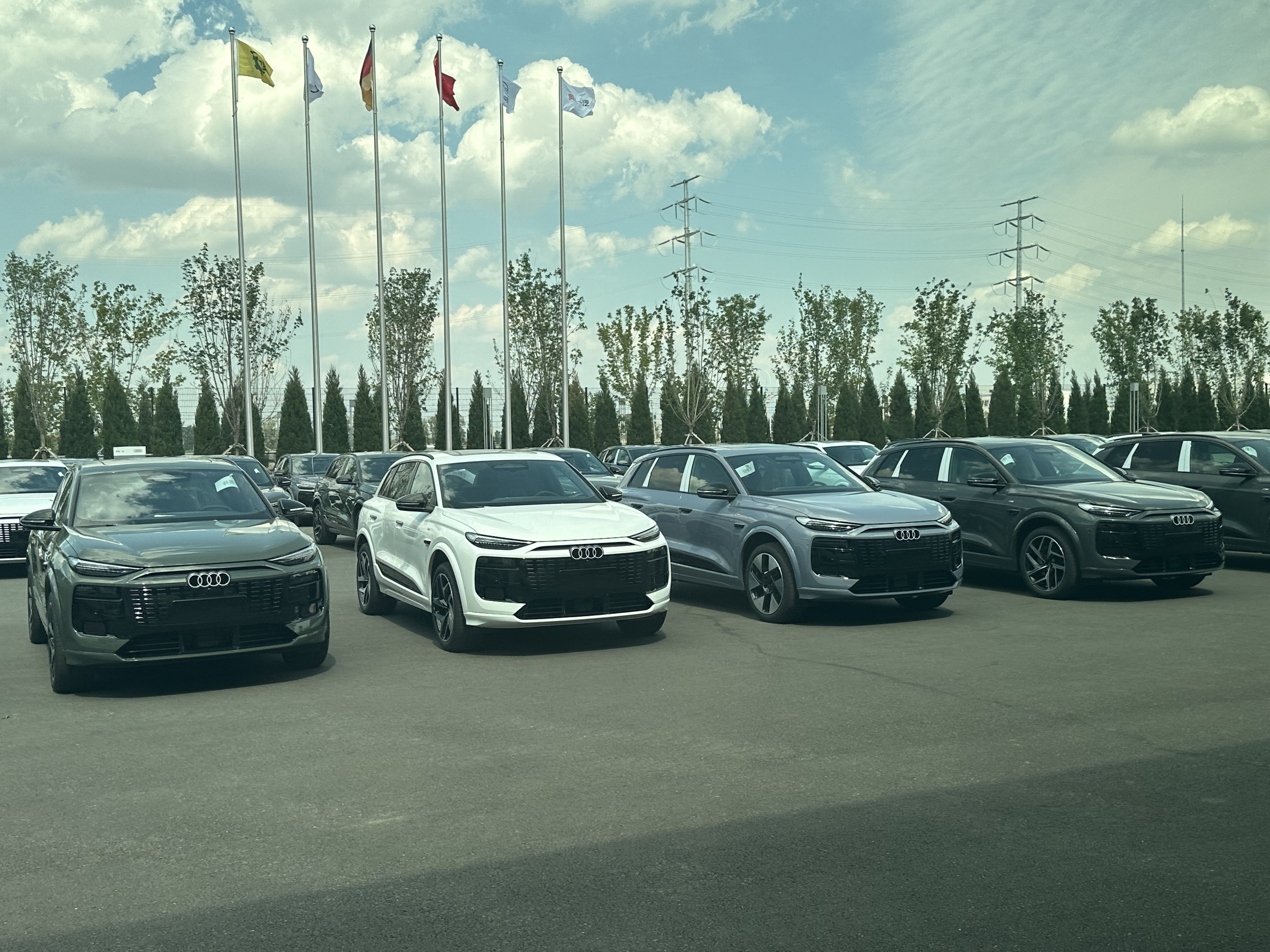
奥迪一汽新能源工厂首揭面纱,核心工艺车间配备近千台机器人
Guo Ji Jin Rong Bao· 2025-06-08 12:50
Group 1 - The Audi Q6L e-tron, as the first model based on the PPE luxury electric platform, marks a significant step in Audi's electrification strategy [1][4] - The vehicle features advanced technology, including Huawei's Qian Kun intelligent driving system, which utilizes dual lidar and visual fusion for L2-level driving assistance [4] - The Q6L e-tron has an extended wheelbase of 2995mm, catering to Chinese consumer preferences, and includes an 88-inch AR HUD and a five-screen interactive cockpit [4] Group 2 - The Audi Q6L e-tron is equipped with an 800V high-voltage battery system that supports a peak charging power of 270kW, allowing for a range of 765km [5] - The Audi FAW New Energy Company factory, where the Q6L e-tron is produced, integrates advanced automation with nearly 1000 robots, achieving 100% automated welding and a 90% efficiency increase in parts handling [5] - The factory's annual production capacity is planned to reach 150,000 vehicles, with a vehicle rolling off the line approximately every 120 seconds [5] Group 3 - The factory operates under a "zero emissions plan," utilizing 100% green energy and achieving a 95% carbon reduction through closed-loop recycling of aluminum materials [6] - Water resource management is emphasized, with 100% recycling of production and domestic wastewater, saving over 105,000 cubic meters of water annually [6] - The local supply chain is robust, with 50% of suppliers located within 30 kilometers of the factory, achieving a localization rate of 90% [6]

亚太股份(002284) - 2025年06月04日投资者关系活动记录表
2025-06-05 07:28
Group 1: Company Overview - The company has been focused on the automotive brake system industry since its establishment in 1979, accumulating a broad customer base including major automotive manufacturers such as Geely, Changan, and SAIC [2][4] - The sales network covers both domestic and international markets, exporting to regions including North America, Europe, and the Middle East, and has entered procurement platforms of companies like Volkswagen and Honda [2][4] Group 2: Product Supply and Production Bases - The company supplies brake and electronic products to Leap Motor and is actively promoting new products and technologies to secure more projects [4][5] - Production bases are located in Xiangshan, Anhui, and Huzhou, with additional bases in Liuzhou, Guangzhou, and Changchun to support local automotive assembly [4][5] Group 3: Financial Performance and Strategy - The gross profit margin has improved due to increased domestic automotive sales and new international projects, alongside ongoing product structure optimization and cost reduction efforts [5][6] - The company faces annual price reduction pressures from automotive manufacturers and plans to optimize product structure and enhance internal management to address these challenges [6][8] Group 4: Capacity and Market Trends - Current production capacity utilization is high, with production levels dependent on vehicle sales; the company will expand production lines based on market demand [8][9] - The proportion of products supplied to new energy vehicles is increasing annually, aligning with the growth trends of downstream electric vehicle manufacturers [9][10] Group 5: Future Growth and Development - Future growth points include expanding market coverage, promoting new automotive electronic systems, and striving for more projects in both joint ventures and mainstream independent brands [10] - The Moroccan production base project is progressing steadily [10]

探访超级智能生态基地:在世界工厂造豪华“旗舰”
Zhong Guo Qi Che Bao Wang· 2025-06-05 01:18
Core Insights - Audi's first dedicated electric vehicle production base in China, located in Changchun, represents a significant milestone in the company's strategy to support its operations in the Chinese market [1][19] - The Q6L e-tron, a luxury electric SUV, has officially begun pre-sales, showcasing Audi's technological strength and innovation in the electric vehicle sector [3][19] Production and Technology - The Audi FAW New Energy PPE factory is recognized as the most advanced production facility globally, emphasizing a fully digital and automated production system [4] - The factory employs digital twin technology to ensure real-time updates and synchronization between digital models and actual construction progress [4] - Automation is a key feature, with 824 KUKA robots achieving a welding precision of 0.1 mm, significantly enhancing production efficiency and quality [6] - The integration of a comprehensive IT architecture allows for the interconnection of all maintenance, logistics, and manufacturing processes, improving operational efficiency [4][8] Environmental Sustainability - The factory operates under a "zero emissions" plan, achieving 100% photovoltaic coverage and green energy supply, along with a closed-loop water treatment system [10][12] - The facility has implemented various ecological initiatives, including the creation of a micro-ecosystem with local flora and fauna, enhancing biodiversity [12] Supply Chain and Localization - A supply chain ecosystem is forming around the PPE factory, with 50% of suppliers located within a 30-kilometer radius, which increases localization and reduces logistics carbon footprint [14] Future Outlook - By 2025, Audi plans to launch its largest product offensive in China, with the Q6L e-tron positioned as a flagship model, combining German engineering with Chinese manufacturing speed [19]
