
太阳纸业

Search documents
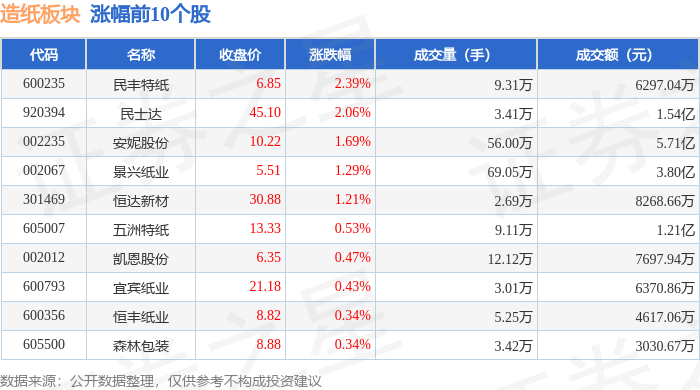
造纸板块1月8日跌0.09%,博汇纸业领跌,主力资金净流出8240.14万元
Zheng Xing Xing Ye Ri Bao· 2026-01-08 08:51
Market Overview - The paper sector experienced a slight decline of 0.09% on January 8, with Bohui Paper leading the drop [1] - The Shanghai Composite Index closed at 4082.98, down 0.07%, while the Shenzhen Component Index closed at 13959.48, down 0.51% [1] Individual Stock Performance - Minfeng Special Paper (600235) saw an increase of 2.39%, closing at 6.85 with a trading volume of 93,100 shares and a turnover of 62.97 million yuan [1] - Minshida (920394) rose by 2.06%, closing at 45.10 with a trading volume of 34,100 shares and a turnover of 154 million yuan [1] - Anni Co., Ltd. (002235) increased by 1.69%, closing at 10.22 with a trading volume of 560,000 shares and a turnover of 571 million yuan [1] - Bohui Paper (600966) declined by 1.78%, closing at 6.64 with a trading volume of 174,600 shares and a turnover of 116 million yuan [2] Capital Flow Analysis - The paper sector saw a net outflow of 82.40 million yuan from institutional investors, while retail investors had a net inflow of 117 million yuan [2] - Among individual stocks, Sun Paper (002078) experienced a significant net outflow of 40.44 million yuan from institutional investors [3] - Xianhe Co., Ltd. (603733) had a net inflow of 13.49 million yuan from institutional investors, indicating some positive interest [3]


【行业深度】一文洞察2026年中国秸秆行业发展前景及投资趋势研究报告
Sou Hu Cai Jing· 2026-01-07 02:34
Core Viewpoint - The straw industry in China is deeply integrated with agriculture, energy, chemicals, and building materials, forming various industrial chains that enhance rural employment and farmers' income while creating indirect economic value through the substitution of petrochemical and wood resources [2][10]. Market Policy - The Chinese government has implemented a series of policies to promote comprehensive utilization of straw, including subsidies, market construction, and incentive measures, providing a favorable policy environment for the development of the straw recycling and processing industry [2][10][12]. - Key policies include the "Air Quality Continuous Improvement Action Plan," which emphasizes the comprehensive utilization of straw and the prohibition of burning, aiming to stabilize the comprehensive utilization rate of straw above 86% [12][10]. Utilization Volume and Rate - The comprehensive utilization of straw in China is projected to increase from 555 million tons in 2024 to 647 million tons, with feed usage accounting for approximately 18.4%, raw material and substrate fields about 1.8%, edible fungus substrate around 2.3%, and fuel fields about 8.2% [2][10]. - The comprehensive utilization rate of straw is expected to rise from 77.7% in 2024 to 88.3%, with the market size growing from 147.63 billion yuan to 205.10 billion yuan [2][10]. Industry Chain - The straw industry chain in China consists of three levels: upstream resource supply and equipment manufacturing, midstream processing and technology conversion, and downstream diversified applications, moving towards scale, high value, and intelligence [13][14]. - The upstream includes straw resource sources, collection, storage, and machinery, while the midstream focuses on processing and technology conversion, leading to applications in agriculture, energy, building materials, and environmental protection [13][14]. Related Companies - Listed companies involved in the straw industry include Sierte (002538), Yili Group (600887), Huarui Agriculture (833462.NQ), Xuerong Biological (300511), Shouxiangu (603896), Disen Co. (300335), Changqing Group (002616), Sun Paper (002078), and Shengquan Group (605589) [2].




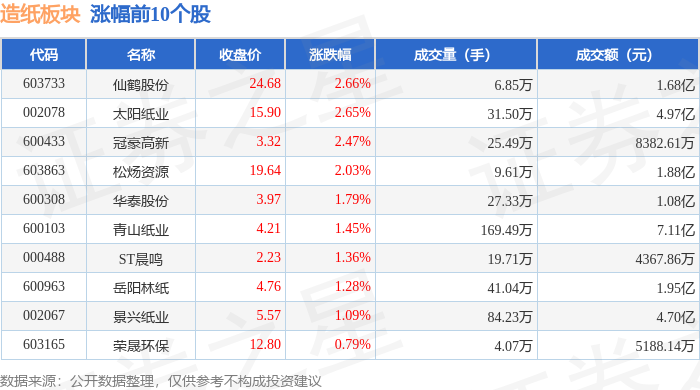
造纸板块1月6日涨1.4%,仙鹤股份领涨,主力资金净流出1.77亿元
Zheng Xing Xing Ye Ri Bao· 2026-01-06 08:56
Group 1 - The paper sector experienced a 1.4% increase on January 6, with Xianhe Co., Ltd. leading the gains [1] - The Shanghai Composite Index closed at 4083.67, up 1.5%, while the Shenzhen Component Index closed at 14022.55, up 1.4% [1] - Key stocks in the paper sector showed various performance metrics, with Xianhe Co., Ltd. closing at 24.68, up 2.66%, and Sun Paper Industry at 15.90, up 2.65% [1] Group 2 - The paper sector saw a net outflow of 177 million yuan from institutional investors, while retail investors contributed a net inflow of 156 million yuan [2] - The trading volume for Sun Paper Industry was 315,000 hands, with a transaction value of 497 million yuan [2] - The net inflow from retail investors for Qing Shan Paper Industry was 5.23 million yuan, despite a net outflow from institutional and speculative investors [3]


中金:中国纸企战略核心已转向利用自有纤维对冲金融属性强的浆价波动
智通财经网· 2026-01-06 08:40
Core Viewpoint - The paper industry chain is currently characterized by "high concentration at the resource end and decentralized competition at the processing end," with pulp being a scarce resource that holds strong pricing power [2][3] Industry Characteristics - After the paper bull market in 2021, profit distribution has tilted towards the pulp end, while the paper production capacity clearance shows a "long tail effect" [2] - The industry is experiencing a slow clearance speed due to high single-ton investment costs and significant depreciation pressure, leading to a reliance on effective cost transmission for profitability stability [2] Strategic Shift - The strategic paradigm has shifted from capacity expansion to industry chain integration, with companies now focusing on using their own fiber to hedge against the volatility of pulp prices [3] - This integration essentially transforms unstable processing profits into stable resource premiums, allowing leading companies to transition from "global resource movers" to "value integrators" [3] Market Outlook - A short-term supply gap for wood chips is expected to emerge by 2026, as the construction cycle for quality wood chip resources lags behind equipment production [4] - As demand marginally improves, the price center for pulp is anticipated to recover in 2026, with leading companies possessing full industry chain self-sufficiency continuing to capitalize on the premium opportunities from "manufacturing" to "resource revaluation" [4] Recommended Companies - Companies to watch include Sun Paper (002078.SZ), Nine Dragons Paper (02689), and Suzano (SUZ.US) [5]

纸浆:宽幅震荡 20260105
Guo Tai Jun An Qi Huo· 2026-01-05 03:20
商 品 研 究 2026 年 01 月 05 日 纸浆:宽幅震荡 20260105 | | | 表 1:基本面数据 | 项目 | | 项目名称 | 昨日数据 | 前日数据 | 变动幅度 | | --- | --- | --- | --- | --- | --- | | 期货市场 | 纸浆主力 | 日盘收盘价(元/吨) | 5.532 | 5. 568 | -36 | | | | 夜盘收盘价(元/吨) | - | 5, 554 | | | | | 成交量(手) | 258. 678 | 301. 862 | -43. 184 | | | (05合约) | 持仓量 (手) | 206. 636 | 218, 046 | -11. 410 | | | | 仓单数量(吨) | 104. 487 | 103.990 | +497 | | | | 前20名会员净持仓(手) | -23, 481 | -23, 560 | +79 | | 价差数据 | 基差 | 银星-期货主力 | ୧୫ | 32 | +36 | | | | 金鱼-期货主力(非标) | -832 | -898 | +66 | | | 月差 | SP03-SP ...
2025年1-11月全国造纸和纸制品业出口货值为732.4亿元,累计增长1.8%
Chan Ye Xin Xi Wang· 2026-01-02 06:19
上市公司:晨鸣纸业(000488),凯恩股份(002012),景兴纸业(002067),太阳纸业(002078), 安妮股份(002235),齐峰新材(002521),青山纸业(600103),民丰特纸(600235),华泰股份 (600308),岳阳林纸(600963),博汇纸业(600966),荣晟环保(603165),仙鹤股份 (603733),松炀资源(603863),五洲特纸(605007),华旺科技(605377),森林包装(605500) 数据来源:国家统计局,智研咨询整理 知前沿,问智研。智研咨询是中国一流产业咨询机构,十数年持续深耕产业研究领域,提供深度产业研 究报告、商业计划书、可行性研究报告及定制服务等一站式产业咨询服务。专业的角度、品质化的服 务、敏锐的市场洞察力,专注于提供完善的产业解决方案,为您的投资决策赋能。 相关报告:智研咨询发布的《2026-2032年中国造纸工业行业发展模式分析及市场运行潜力报告》 根据国家统计局数据可知:2025年11月全国造纸和纸制品业出口货值为68.7亿元,同比增长0.3%;2025 年1-11月全国造纸和纸制品业累计出口货值为732.4亿元,累计同比 ...

造纸板块2026年年报
Yin He Qi Huo· 2025-12-31 10:05
Report Industry Investment Rating No information provided in the content. Core Viewpoints - In 2025, the paper pulp market showed a pattern of "increasing foreign supply, decreasing domestic supply, strong broadleaf, and weak softwood." The supply increment will significantly narrow in 2026, with global commodity pulp slightly increasing and China's imports expected to remain flat. The demand for cultural paper will decline further, while that for tissue paper and white cardboard will perform well. The cost of domestic broadleaf pulp will rise, and the price will range from 4,000 to 4,600 yuan, showing a "high in the front, low in the back, strong broadleaf, and stable softwood" trend [5][75][76]. - The supply - demand situation of offset paper in 2025 was "increasing quantity but not profit." In 2026, new production capacity will be put into operation, but the output is expected to continue to decline, the utilization rate will drop below 50%, and the market competition will intensify. The apparent consumption may decline further, and the cost will be pushed up by high - price pulp. The old production lines will be forced to exit [5][78][80]. Summary by Directory 1. 2025 Paper Pulp Futures and Spot Price Trends Review - From January to early February, the prices of paper pulp futures and spot rose synchronously, driven by factors such as continuous price support from the external market, "hoarding and price support" by traders after the festival, and the boost from the futures market sentiment [10]. - From mid - February to April, the price of paper pulp entered a downward channel, mainly due to the less - than - expected recovery of downstream demand, high port inventory, and the price inversion between the external market and domestic spot [11]. - From May to the end of July, the paper pulp market fluctuated widely, with the core contradiction being the game between short - term benefits and long - term weak reality [11][13][14]. - From August to mid - October, the paper pulp market showed a significant differentiation pattern of "weak softwood and stable broadleaf," which was caused by the difference in supply - demand structure [15]. - From late October to the end of December, the market differentiation further intensified, showing a pattern of "weak softwood and strong broadleaf," and the price gradually stabilized in shock at the end of the year [16]. 2. Paper Pulp Supply: High Imports, Increased Domestic Production, and Overall High Inventory - **Global Import Situation Analysis**: In 2025, the total import of wood pulp increased, with a significant increase in broadleaf pulp and a moderate increase in softwood pulp. The import price fluctuated downward. In 2026, the import volume will decline slightly year - on - year, and the proportion of broadleaf pulp is expected to continue to increase [30][33][35]. - **Domestic Capacity Change Analysis**: In 2025, the actual domestic pulp production capacity reached 425 tons, with a profit ranking of "chemi - thermomechanical pulp > broadleaf pulp > softwood pulp." In 2026, the planned production capacity is 345 tons, mainly concentrated in the fourth quarter, with broadleaf pulp as the core incremental source. The cash cost will become the bottom line of the spot price [37][38][40]. - **Domestic Inventory Change Analysis**: As of December 2025, the domestic paper pulp inventory showed a differentiated situation of "de - stocking in ports and passive inventory accumulation upstream." In the first quarter of 2026, the port inventory is expected to stop falling and rise, but the overall inventory center is expected to be lower than that in the same period of 2024 [43]. - **Summary of Core Features of the Supply Pattern**: The overall supply will remain loose, the structural differentiation will intensify, and the inventory pressure will still exist [44][45][46]. 3. Paper Pulp Demand: Weak Cultural Paper, Improved Packaging and Tissue Paper - **White Cardboard**: In 2025, the production and sales of white cardboard increased, and the export was outstanding. In 2026, the demand for paper pulp is expected to increase steadily [50][51]. - **Cultural Paper**: In 2025, the demand for cultural paper was weak, dragging down the consumption of paper pulp. In 2026, it will still be in a weak recovery state, and it is difficult to significantly improve [51][52]. - **Tissue Paper**: In 2025, the demand for paper pulp in the tissue paper industry increased rapidly. In 2026, it will continue to grow steadily, becoming a key force to offset the decline in cultural paper demand [52][53]. 4. Cultural Paper Market Review - **Spot Price Market**: The price of offset paper fluctuated downward throughout 2025, and stabilized at a low level at the end of the year. There was no obvious regional differentiation, and the market trading was light [54]. - **Futures Price Market**: The newly - listed cultural paper futures showed a weak trend of range - bound fluctuations, with low trading volume and volatility, and were affected by both capital sentiment and spot prices [55][58]. 5. Cultural Paper Supply Analysis - In 2025, the offset paper industry had a large increase in production capacity but a decline in demand, with low capacity utilization, high inventory, and poor profitability. In 2026, new production capacity will be put into operation, but the output is expected to decline further, and the industry will still be in the "capacity - reduction" stage [60][62][63]. 6. Cultural Paper Demand Analysis - **Import and Export**: In 2025, the import of cultural paper continued to be sluggish, and the export showed a structural differentiation. The overall role of export in making up for domestic demand was limited [70]. - **Downstream Demand**: In 2025, the demand for cultural paper was mainly supported by the publishing industry, but the support was weak, and the commercial printing demand was weak [71]. 7. Paper Pulp Fundamental Comprehensive Analysis - In 2025, the paper pulp supply - demand pattern was "increasing foreign supply, decreasing domestic supply, strong broadleaf, and weak softwood." In 2026, the supply increment will narrow, the demand structure will change, and the cost will rise [75][76]. 8. Paper Pulp Futures Strategy Analysis - Unilateral trading: Pay attention to the pressure of South American shipments in the second quarter and domestic production capacity release in the fourth quarter, and appropriately arrange short positions at high prices [77]. - Arbitrage: Pay attention to the positive arbitrage opportunities under the impact of the near - month market [77]. - Options: Wait and see [77]. 9. Offset Paper Fundamental Comprehensive Analysis - In 2025, the offset paper industry had "increasing quantity but not profit." In 2026, the production capacity will increase, but the output is expected to decline, and the market competition will intensify [78][80]. 10. Offset Paper Strategy Analysis - Unilateral trading: The market is likely to fluctuate widely around the cost line of large - scale enterprises. Generally, the idea of shorting at high prices should be adopted [81]. - Arbitrage: Wait and see. Appropriate attention can be paid to the pulp - offset paper arbitrage of shorting papermaking profits [81]. - Options: Pay attention to the opportunity of selling call options [81].
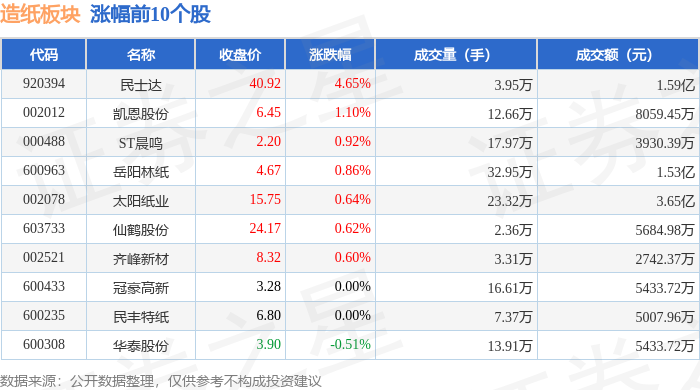
造纸板块12月31日跌0.68%,恒达新材领跌,主力资金净流出3.71亿元
Zheng Xing Xing Ye Ri Bao· 2025-12-31 08:59
Group 1 - The paper sector experienced a decline of 0.68% on December 31, with Hengda New Materials leading the drop [1] - The Shanghai Composite Index closed at 3968.84, up 0.09%, while the Shenzhen Component Index closed at 13525.02, down 0.58% [1] - Notable gainers in the paper sector included Minshida, which rose by 4.65% to a closing price of 40.92, and Kain Co., which increased by 1.10% to 6.45 [1] Group 2 - Hengda New Materials saw a significant drop of 4.89%, closing at 30.37, while other companies like Senlin Packaging and Annie Co. also faced declines of 4.79% and 4.26% respectively [2] - The paper sector experienced a net outflow of 371 million yuan from major funds, while retail investors contributed a net inflow of 369 million yuan [2] - The individual stock fund flow data indicated that Sun Paper had a net inflow of 47.15 million yuan from major funds, despite a net outflow from retail investors [3]
轻工制造行业2026年投资策略:适应新变局
GF SECURITIES· 2025-12-30 23:30
Group 1: Core Insights - The light industry manufacturing sector is expected to experience a recovery in 2026, driven by external macroeconomic stabilization and internal demand adjustments, although the recovery will show differentiation among companies [5][6] - Investment strategies should focus on growth-oriented companies that are expanding overseas, as well as on the supply-side changes in the paper packaging sector and new consumer brands showing marginal improvements [5][6] Group 2: Home Furnishing Sector - The home furnishing industry is currently facing a downturn, with ongoing pressures from consumption and housing handovers, and limited benefits from national subsidies [13][19] - The market environment is expected to remain stable in 2026, with a focus on individual company performance, as the sector is significantly influenced by consumer sentiment and real estate policies [34][40] - The expected decline in new housing completions in 2026 is projected at 21%, which will continue to impact demand for home furnishings [34][40] Group 3: Essential Consumer Goods - The essential consumer goods market is adapting to new dynamics, with established brands facing challenges from evolving channels and increased competition [52] - The growth potential in mature markets remains stable, but the overall consumption environment has weakened, leading to increased competition among leading brands [52][53] - New consumption trends are emerging from changes in consumer sentiment and technological innovations, which are reshaping market dynamics [52][53] Group 4: Light Industry Exports - The light industry export sector has shown strong growth among leading companies, despite fluctuations due to economic cycles and inventory levels [5][6] - The outlook for 2026 suggests continued growth for top companies, supported by stable macroeconomic conditions and ongoing trends such as capacity relocation and cost reduction [5][6] - The overall recovery in the light industry export sector is anticipated to stabilize, with a focus on expanding product categories and niche markets [5][6] Group 5: Paper Packaging Sector - The paper packaging sector is expected to see a gradual recovery, with stable pricing anticipated for cultural paper and improved profitability driven by demand from the consumer electronics and AI sectors [5][6] - The profitability of the paper industry is projected to stabilize, with key factors including supply-demand dynamics and cost efficiencies playing a crucial role [5][6] - Leading companies in the metal packaging sector are expected to benefit from increased market concentration and enhanced pricing power [5][6]


太阳纸业:境外采购原材料主要为木浆、木片及化工原料等
Zheng Quan Ri Bao Zhi Sheng· 2025-12-30 13:48
Core Viewpoint - The company, Sun Paper, has clarified its overseas procurement strategy, focusing on raw materials such as wood pulp, wood chips, and chemical raw materials, with transactions primarily settled in US dollars [1] Group 1: Procurement Strategy - The company's overseas procurement mainly consists of wood pulp, wood chips, and chemical raw materials [1] - The primary currency for settlement in these transactions is the US dollar [1] Group 2: Foreign Exchange Management - The company's foreign exchange operations are determined based on actual import amounts [1] - The company also engages in forward foreign exchange contracts and other financial derivatives to manage exchange rate risks [1]