木片

Search documents
纸浆周报:纸浆期货仍受“弱现实”逻辑主导-20260323
Guo Mao Qi Huo· 2026-03-23 08:00
1. Report Industry Investment Rating - No information provided in the report 2. Core Viewpoints of the Report - This week, pulp futures fluctuated sharply, with significant position - building and price drops from Monday to Wednesday, breaking through 5000 yuan/ton, and then rebounding to around 5200 yuan/ton after position - reduction. The main reason is that the Shanghai Pulp Conference led the market to reach a consensus on the "weak reality" logic [3]. - During the pulp conference, pulp mills and pulp traders negotiated prices. The price of softwood pulp is expected to decline, while hardwood pulp remains relatively strong. The pattern of "weak softwood, strong hardwood" that has persisted since the beginning of the year continues [3]. - The impact of the US - Iran war on pulp's external quotations is currently limited, only supporting the price - holding requirements of Nordic pulp mills [3]. - In terms of inventory, both softwood and hardwood pulp saw a slight reduction this week, mainly in southern ports, while Qingdao Port still accumulated inventory [3]. - There was some improvement in demand this week. After the sharp decline in pulp futures, both traders and cash - futures traders were active in selling, reflecting the paper mills' bottom - fishing psychology. Hardwood pulp was particularly easy to sell below 4500 yuan/ton. However, the prices of the four major wood - pulp papers remained relatively stable (white cardboard prices declined), and this bottom - fishing behavior is considered short - term procurement rather than a long - term bottom signal [3]. - In terms of basis and calendar spreads, the pulp basis strengthened in the second half of this week. Silver Star's basis was restored to a premium, and the price difference between the second - type pulp widened by 10 - 20 yuan/ton. The basis of Russian softwood pulp was stable, which may indicate that the market is gradually pricing based on Russian softwood pulp. In terms of calendar spreads, the 5 - 7/5 - 9 spreads weakened significantly, reaching the risk - free positive arbitrage level, indicating that this decline is dominated by "weak demand" [3]. - For single - side trading, consider shorting at high prices. The "weak reality" logic of pulp futures has been gradually confirmed, and the overall upside space is limited. When domestic prices lead external prices and the futures market is still priced based on the second - type pulp, shorting at around the import cost of the second - type pulp can be considered [4]. - For calendar spread arbitrage, conduct 5 - 7/5 - 9 reverse arbitrage. Reverse arbitrage is considered a relatively safe strategy. Currently, a considerable number of participants are willing to bet on the expectation of "capacity clearance of softwood pulp". The confirmation of "weak reality" and the pressure of "high warehouse receipts" can drive long - position holders to shift their positions to the far - month contracts, creating reverse arbitrage opportunities [5]. - For cash - futures arbitrage, conduct long arbitrage on hardwood pulp. The performance of hardwood pulp in the first quarter has proven that its supply - demand relationship is significantly better than that of softwood pulp, and this trend is expected to continue [6]. 3. Summary According to the Table of Contents 3.1 Part One: Main Views and Strategy Overview - **Market Review**: Pulp futures fluctuated sharply this week, with significant position - building and price drops from Monday to Wednesday, breaking through 5000 yuan/ton, and then rebounding to around 5200 yuan/ton after position - reduction. The main reason is the Shanghai Pulp Conference [3]. - **Pulp Fundamentals**: Price negotiations between pulp mills and traders during the conference led to an expected price decline in softwood pulp and relatively stable hardwood pulp. The "weak softwood, strong hardwood" pattern continued. The impact of the US - Iran war on external quotations was limited. Inventory decreased slightly in southern ports but increased in Qingdao Port. Demand improved slightly, with short - term bottom - fishing behavior [3]. - **Basis and Calendar Spreads**: The basis strengthened in the second half of the week, and the 5 - 7/5 - 9 spreads weakened significantly, indicating "weak demand" [3]. - **Trading Strategies** - **Single - side**: Short at high prices around the import cost of the second - type pulp [4]. - **Calendar Spread Arbitrage**: 5 - 7/5 - 9 reverse arbitrage [5]. - **Cash - Futures Arbitrage**: Long arbitrage on hardwood pulp [6] 3.2 Part Two: Pulp and Paper Industry Chain Price Data - **Futures Prices**: Futures prices first fell and then rose, with overall increases in positions and trading volumes [10]. - **Spot Market**: Spot prices of softwood and hardwood pulp declined, and the basis of softwood pulp strengthened [19]. - **External Quotations**: There is an expected decline in the external quotations of softwood pulp, while hardwood pulp remains relatively strong [32]. - **Chip Prices**: The prices of wood chips in Shandong, Guangxi, and other regions showed certain trends, and the monthly average import price of Chinese wood chips also had corresponding changes [42][44][47]. - **Finished Paper**: The price of white cardboard declined [50]. 3.3 Part Three: Pulp Supply and Demand Fundamental Data - **Import Volume** - **Softwood Pulp**: In February 2025, the import volume of softwood pulp decreased year - on - year [61]. - **Hardwood Pulp**: In February 2026, the import volume of hardwood pulp decreased both year - on - year and month - on - month [71]. - **South American Three - Country Pulp Exports**: In February 2026, the export volume to China decreased slightly month - on - month [80]. - **W20 Chemical Pulp Shipment**: In January 2026, the shipment of W20 chemical pulp to China decreased [89]. - **Domestic Production** - **Pulp Production**: In February 2026, the domestic production of pulp decreased [101]. - **Chip Import and Domestic Procurement**: In February 2026, the import volume of hardwood chips decreased both year - on - year and month - on - month, and the domestic procurement volume of wood chips also decreased [109][122]. - **Inventory** - **Overseas Pulp Mills**: In January 2026, softwood pulp mills had serious inventory accumulation [130]. - **Chinese Pulp Ports**: Softwood pulp had a slight inventory reduction, and hardwood pulp had a significant inventory reduction [137]. - **Pulp Futures Warehouse Receipts**: The newly added warehouse receipts of pulp decreased slightly this week [151]. - **European Pulp Ports**: Pulp inventory decreased month - on - month [161]. - **Chinese Wood - Pulp Paper Production and Inventory** - **Production**: In February 2026, the production of Chinese wood - pulp paper decreased [175]. - **Industry Inventory**: In December 2025, the inventory of finished paper in the Chinese paper - making industry increased [186]. - **Factory Inventory**: Except for tissue paper, other wood - pulp paper products had inventory accumulation [199]. - **Social Inventory**: Tissue paper had inventory reduction, and white cardboard had inventory accumulation [207]. - **Chinese Finished Paper Import and Export** - **Import**: The import volume of Chinese finished paper showed certain trends [214]. - **Export**: The export volume of Chinese finished paper also had corresponding changes [223]. - **Chinese Chemical Pulp Supply - Demand Balance Sheet**: It shows the supply, demand, inventory, and supply - demand differences of chemical pulp from 2020 to February 2026 [232]. 3.4 Part Four: Pulp Price Difference Data - **Spot Price Difference**: The price differences between Silver Star, Russian softwood pulp, and hardwood pulp showed certain trends [237]. - **Calendar Spread**: The 5 - 9 spread weakened [247]. - **Basis**: The basis of softwood pulp weakened [258]. - **Profit Situation** - **Global Major Pulp Mills**: The profit of softwood pulp mills declined significantly [268]. - **Chinese Pulp Import**: The import profit of softwood pulp decreased [280]. - **Chinese Finished Paper Production**: The production profit of finished paper showed corresponding changes [288]
化工情绪带动期价,纸浆基差走弱
Guo Mao Qi Huo· 2026-03-16 09:41
1. Report Industry Investment Rating There is no information about the report industry investment rating in the provided content. 2. Core Viewpoints of the Report - This week, the pulp futures price generally fluctuated slightly stronger, with both positions and trading volume increasing, but the spot price remained weak, and the basis of needle and broadleaf pulp weakened [4]. - Affected by the increase in oil prices and shipping freight due to the US - Iran war, the cost of pulp exported from Northern Europe to China increased by about $20 per ton, but it has not affected the long - term contract FOB price in March 2026. Two large - scale broadleaf pulp mills in Brazil and Uruguay issued regular maintenance notices this week, and foreign broadleaf pulp suppliers still have the intention to support prices [4]. - This week, the port inventory of needle pulp continued to accumulate, while the broadleaf pulp slightly decreased. There is no obvious positive news for needle pulp. Notably, a large number of new warehouse receipts were added this week, mainly Ural needle pulp, and the overall pulp warehouse receipts changed from tight to loose [4]. - This week, the prices of cultural paper and household paper were basically stable, while the price of white cardboard slightly decreased. The new round of price increase letters issued by paper mills may be difficult to implement. In February 2026, cultural paper slightly accumulated inventory, and white cardboard significantly accumulated inventory [4]. - This week, the US - Iran war continued to drive up the prices of chemical products, and the war tends to be long - term. Although the current impact on pulp prices is mainly the driving of commodity sentiment, it is still necessary to pay attention to whether it will be transmitted to the pulp FOB price through shipping freight and other means in the future [4]. - Pulp shows a situation of "weak reality and strong expectation". An inverse arbitrage strategy can be considered. There is no clear driving factor for unilateral trading, so it is recommended to wait and see in the short term [4]. 3. Summary According to Relevant Catalogs 3.1 Part One: Main Views and Strategy Overview - Price performance: The pulp futures price fluctuated slightly stronger, with increased positions and trading volume, while the spot price was weak, and the basis of needle and broadleaf pulp weakened [4]. - Supply side: The cost of pulp exported from Northern Europe to China increased by about $20 per ton due to the US - Iran war, but it has not affected the March 2026 long - term contract FOB price. Two large - scale broadleaf pulp mills in Brazil and Uruguay issued maintenance notices, and foreign suppliers still have the intention to support prices [4]. - Inventory side: Needle pulp in port inventory continued to accumulate, broadleaf pulp slightly decreased, and a large number of new warehouse receipts were added, mainly Ural needle pulp [4]. - Demand side: The prices of cultural paper and household paper were stable, white cardboard price decreased slightly, and the new price increase letters of paper mills may be difficult to implement. In February 2026, cultural paper slightly accumulated inventory, and white cardboard significantly accumulated inventory [4]. - Macro aspect: The US - Iran war drove up chemical product prices, and the war may be long - term. It mainly affects pulp prices through commodity sentiment, and attention should be paid to its impact on the FOB price through shipping freight [4]. - Strategy: Consider an inverse arbitrage strategy, and wait and see in the short term for unilateral trading [4]. 3.2 Part Two: Pulp and Paper Industry Chain Price Data - Futures market: The report presents data on pulp futures contract closing prices, total positions, weekly trading volume, and delivery volume [6][7]. - Spot market: The price of broadleaf pulp was stable, and the basis quotation of needle pulp decreased [15]. - FOB price: In March, the FOB price of needle pulp was flat, and the price of broadleaf pulp increased [28]. - Wood chip price: The report shows the market prices of wood chips in Shandong, Guangxi, and other regions, as well as the monthly average import price of Chinese wood chips [38][40][43]. - Finished paper price: The price of white cardboard slightly decreased [45]. 3.3 Part Three: Pulp Supply and Demand Fundamental Data - Needle pulp import volume: In January - February 2025, the import volume of needle pulp increased [56]. - Broadleaf pulp import volume: In January - February 2025, the import volume of broadleaf pulp decreased [70]. - South American pulp export volume: In February 2026, the export volume to China decreased slightly month - on - month [78]. - W20 chemical pulp shipment volume: In January 2026, the shipment volume of W20 chemical pulp to China decreased [86]. - Domestic pulp production: In February 2026, the domestic pulp production decreased [98]. - Wood chip import volume: In January - February 2025, the import volume of broadleaf wood chips increased [106]. - Domestic wood chip procurement volume: In February 2026, the domestic wood chip procurement volume decreased [119]. - Overseas pulp mill inventory: In January 2026, the inventory of needle pulp mills increased significantly [127]. - Chinese pulp port inventory: Needle pulp continued to accumulate inventory, and broadleaf pulp slightly decreased [134]. - Pulp futures warehouse receipt structure: A large number of new pulp warehouse receipts were registered this week [148]. - European pulp port inventory: Pulp inventory decreased month - on - month [158]. - Chinese wood pulp paper production: In February 2026, the production decreased [170]. - Chinese paper industry inventory: In January - February 2025, the inventory of finished paper increased [181]. - Chinese wood pulp paper mill inventory: Except for household paper, the inventory of other products increased [194]. - Chinese wood pulp paper social inventory: The inventory of household paper decreased, and the inventory of white cardboard increased [202]. - Chinese finished paper import volume: The report shows the import volume data of various types of finished paper [209]. - Chinese finished paper export volume: The report shows the export volume data of various types of finished paper [217]. - Chinese chemical pulp supply - demand balance sheet: It shows the supply, demand, inventory, and supply - demand difference of chemical pulp from 2020 to February 2026 [226]. 3.4 Part Four: Pulp Spread Data - Pulp price spread: It shows the price spreads between different types of pulp, such as silver star - Russian needle, silver star - broadleaf, and Russian needle - broadleaf, and their distribution maps [229][237]. - Pulp monthly spread: The 5 - 9 spread weakened [242]. - Pulp basis: The basis of needle pulp weakened [253]. - Global major pulp mill profit: The profit of needle pulp mills decreased significantly [265]. - Chinese pulp import profit: The import profit of needle pulp decreased [277]. - Chinese finished paper production profit: It shows the production profits of double - offset paper, copper - plate paper, household paper, white cardboard, and the operating profit and ton - paper profit of the paper industry [285][291].
未知机构:玖龙纸业FY26H1交流要点260226中期产量230万吨-20260227
未知机构· 2026-02-27 02:25
Key Points Summary of 玖龙纸业 FY26H1 Conference Call Company Overview - The company discussed its production and sales performance for the first half of FY26, with a focus on the paper manufacturing industry. Core Insights and Arguments - **Production Capacity**: The mid-term production capacity is reported at 2.3 million tons, with an expected increase to 2.5 million tons in FY26H2, which includes an additional 200,000 tons of chemical mechanical pulp [1] - **Cost Advantage**: The self-produced chemical pulp is cheaper by 1,500 RMB per ton compared to imported pulp, while chemical mechanical pulp is cheaper by 500 RMB per ton [1] - **Sales Growth**: The mid-term sales volume is projected at 12.4 million tons, an increase of 1 million tons year-on-year. The total annual sales volume is expected to reach 24.4 million tons, driven by growth in cultural paper from 520,000 tons to 900,000 tons and white card from 400,000 tons to 900,000 tons [1] - **New Production Line**: The completion of a new paper production line is noted, along with a new pulp planning in Dongguan aimed at reducing transportation costs by 100 RMB [2] - **Capital Expenditure**: The total capital expenditure for the year is projected at 12.5 billion RMB, with expectations to decrease to 7 billion RMB in FY27 as the initial investments in pulp production lines conclude [2] - **Wood Chip Supply**: The company has begun to establish a supply of wood chips, which is expected to materialize within 1-2 years [2] - **Debt Management**: The company plans to redeem perpetual bonds using bank loans and its own funds before the June 2027 maturity date. It anticipates resuming dividend payments by the end of FY26, with the payout ratio dependent on debt repayment progress [2] Other Important Insights - The company is strategically positioning itself to enhance production efficiency and cost-effectiveness through self-sourcing of raw materials and optimizing logistics [1][2] - The anticipated growth in specific product lines indicates a positive outlook for the company's market position and revenue generation capabilities in the upcoming fiscal periods [1]
造纸行业月报:1月行业提价逐步落地,盈利进入改善通道
GUOTAI HAITONG SECURITIES· 2026-02-11 00:25
Investment Rating - The report rates the paper industry as "Overweight" [4] Core Insights - In January, hardwood pulp prices increased, while white cardboard continued to issue price increase notices. Cultural paper prices stabilized, but profitability faced slight pressure. The hardwood pulp market is expected to see supply decrease initially before increasing, with insufficient demand following. White paper prices are gradually transmitting, while black paper prices are under pressure [2][3] Summary by Sections Cultural Paper - Prices: The market average price for 70g hardwood high white double glue paper as of January 28 is 4725 CNY/ton, down 0.08% month-on-month and down 12.66% year-on-year [7] - Supply and Demand: The operating rate decreased month-on-month, leading to intensified supply-demand contradictions. The supply-demand gap is expected to continue to widen in January and February [9][10] - Profitability: The average theoretical gross margin for double glue paper as of January 28 is -11.29%, a decrease of 0.68 percentage points from December 2025 [19] White Cardboard - Prices: The market average price for 250-400g flat white cardboard as of January 28 is 4268 CNY/ton, up 0.73% month-on-month and down 0.74% year-on-year [22] - Supply and Demand: The supply-demand gap is expected to continue to widen, with supply increasing more than demand [24][25] - Profitability: The gross margin for white cardboard as of January 28 is down 0.02 percentage points month-on-month, indicating a decline in profitability despite price increases [32] Boxboard and Corrugated Paper - Prices: The average price for boxboard as of January 28 is 3584 CNY/ton, down 7.15% month-on-month and down 5.06% year-on-year. The average price for AA-grade corrugated paper is 2751 CNY/ton, down 11.60% month-on-month and down 5.82% year-on-year [35][36] - Supply and Demand: The supply-demand gap is expected to increase, with demand decreasing and inventory levels rising [37][38] - Profitability: The gross margin for corrugated paper as of January 28 is down 3.63 percentage points, while the gross margin for boxboard is down 0.85 percentage points, indicating a decline in profitability [49]
股市必读:2月10日太阳纸业现409.57万元大宗交易
Sou Hu Cai Jing· 2026-02-10 16:57
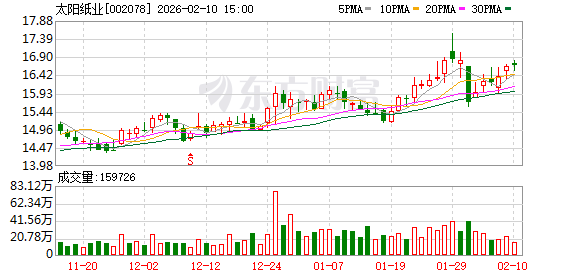
Group 1 - The stock price of Sun Paper Industry (002078) closed at 16.69 yuan on February 10, 2026, with a slight increase of 0.18% and a turnover rate of 0.58% [1] - The trading volume for Sun Paper Industry on the same day was 159,700 shares, resulting in a transaction amount of 267 million yuan [1] - On February 10, the net outflow of main funds was 6.15 million yuan, while the net inflow of speculative funds was 15.06 million yuan, and retail investors experienced a net outflow of 8.91 million yuan [2][3] Group 2 - A block trade of 4.10 million yuan occurred for Sun Paper Industry on February 10 [2][3] - The company’s secretary responded to an investor inquiry regarding the impact of a 1% appreciation of the RMB against the USD on net profit, indicating that the effect depends on the company's import dependency and financial structure [2] - The appreciation of the RMB is expected to lower the costs of imported raw materials and production equipment, as the company primarily settles its overseas purchases in USD [2]

造纸行业月报:1月行业提价逐步落地,盈利进入改善通道-20260210
GUOTAI HAITONG SECURITIES· 2026-02-10 14:22
Investment Rating - The report rates the paper industry as "Overweight" [4] Core Insights - In January, hardwood pulp prices increased, while white cardboard continued to issue price increase notices. Cultural paper prices stabilized, but profitability faced slight pressure. The hardwood pulp market is expected to see supply decrease initially before increasing, with insufficient demand follow-up. White paper prices are gradually transmitting, while black paper prices are under pressure [2][3] Summary by Sections Cultural Paper - Prices: The market average price for 70g hardwood high white double glue paper as of January 28 is 4725 CNY/ton, down 0.08% month-on-month and down 12.66% year-on-year. The price stability is influenced by cautious purchasing from distributors and limited new orders from the publishing sector [7][19] - Supply and Demand: A decrease in operating rates is expected to exacerbate supply-demand contradictions, with a forecasted supply-demand gap widening in January and February [9][10] - Profitability: The average theoretical gross margin for double glue paper as of January 28 is -11.29%, indicating a decline in profitability due to rising costs and falling prices [19] White Cardboard - Prices: The market average price for 250-400g flat white cardboard as of January 28 is 4268 CNY/ton, up 0.73% month-on-month but down 0.74% year-on-year. Price increases are limited due to cautious replenishment intentions from distributors [22][32] - Supply and Demand: The supply-demand gap is expected to continue to widen, with supply increases outpacing demand increases [24][25] - Profitability: The gross margin for white cardboard as of January 28 is slightly down, reflecting a situation where price increases do not keep pace with rising costs [32] Boxboard and Corrugated Paper - Prices: The average price for boxboard as of January 28 is 3584 CNY/ton, down 7.15% month-on-month. The average price for AA-grade corrugated paper is 2751 CNY/ton, down 11.60% month-on-month [35][36] - Supply and Demand: The supply-demand gap is expected to increase, with demand decreasing and inventory levels rising [37][38] - Profitability: The gross margin for corrugated paper is down to reflect that price declines exceed cost declines, while boxboard profitability is also under pressure due to similar dynamics [49][50]
太阳纸业:人民币的升值有益于降低公司进口原材料、生产设备等的采购成本
Zheng Quan Ri Bao· 2026-02-10 13:37
Core Viewpoint - The appreciation of the RMB positively impacts the paper industry by reducing raw material costs and increasing foreign exchange gains, with the extent of impact depending on the company's import dependency and financial structure [2]. Group 1: Impact of RMB Appreciation - The appreciation of the RMB primarily benefits the company by lowering the costs of imported raw materials, production equipment, and other purchases, which are mainly settled in USD [2]. - The company's foreign procurement of raw materials includes wood pulp, wood chips, and chemical raw materials, which are significantly affected by currency fluctuations [2]. Group 2: Financial Management Strategies - The company's foreign exchange business is determined based on actual import amounts, and it also utilizes forward foreign exchange contracts and other financial derivatives to manage exchange rate risks [2].

太阳纸业:人民币升值有益于降低公司进口原材料、生产设备等的采购成本
Sou Hu Cai Jing· 2026-02-10 04:06
Core Viewpoint - The company, Sun Paper (002078), addressed investor inquiries regarding the impact of a 1% appreciation of the RMB against the USD on its net profit for 2026 compared to 2025, highlighting the effects of currency fluctuations on raw material costs and exchange gains [1] Group 1: Impact of RMB Appreciation - The appreciation of the RMB primarily affects the paper industry by reducing raw material costs and increasing exchange gains [1] - The specific impact of RMB appreciation on the company's net profit depends on its reliance on imports and financial structure [1] - The company sources raw materials such as wood pulp, wood chips, and chemical materials mainly in USD, meaning RMB appreciation can lower procurement costs for imports and production equipment [1] Group 2: Currency Risk Management - The company's foreign exchange operations are determined based on actual import amounts, and it utilizes forward foreign exchange contracts to manage currency risk [1]
太阳纸业20260119
2026-01-20 03:54
Summary of the Conference Call on Sun Paper Industry Company and Industry Overview - The conference call focused on **Sun Paper Industry**, a key player in the **paper manufacturing** sector in China, discussing its competitive advantages and strategic positioning within the industry [1][3]. Key Points and Arguments Cost Advantages and Industry Positioning - The primary competitive edge in the paper industry is **cost efficiency**, with companies striving to minimize production costs [1]. - Sun Paper has established a **vertical integration** model from forestry to pulp and paper, which is crucial as the scarcity of resources increases along the supply chain [1][3]. - The **wood segment** is identified as the most challenging and scarce resource, with regulatory hurdles in China limiting private ownership of forestry land [2][3]. Strategic Overseas Expansion - Sun Paper is unique among Chinese paper companies for having established its own **forestry land** in Laos, allowing it to control its supply chain more effectively [3][4]. - The company began its investment in Laos in **2007-2008**, a time when the region was underdeveloped, which deterred other international firms from entering [6][8]. - The initial challenges included significant infrastructure development and the cultivation of trees, which delayed large-scale production until **2018** [9][10]. Production and Supply Chain Dynamics - As of **2023**, Sun Paper's self-supply rate of wood chips is only **4%**, indicating a reliance on external sources for raw materials [10][12]. - The cost of self-produced wood chips is estimated to be significantly lower than that of externally sourced chips, providing a competitive edge in production costs [12][13]. - The company plans to increase its planting area by **10,000 to 12,000 hectares annually**, potentially reaching over **80,000 hectares** by the end of **2025** [14][15]. Financial Performance and Market Outlook - Sun Paper's profitability is expected to improve as it increases its self-supply of wood chips, which will enhance its cost structure [16][17]. - The company has a **barrier profit** of approximately **400-600 RMB** per ton in the cultural paper segment, indicating a strong competitive position even in a challenging market [18][19]. - The anticipated market conditions suggest a potential recovery in paper prices, particularly in the **spring of 2024**, aligning with seasonal demand patterns [29][30]. Safety Margins and Cyclical Resilience - Sun Paper's **safety margin** is bolstered by its ability to maintain profitability even during industry downturns, with a projected market value of around **370 billion RMB** based on historical performance metrics [20][21]. - The cyclical nature of the paper industry suggests that Sun Paper is well-positioned to benefit from an eventual market upturn, supported by its operational efficiencies and strategic resource management [22][23][25]. Additional Important Insights - The call emphasized the importance of **raw material sourcing** and cost management as critical factors for future profitability [16][17]. - The potential for **vertical integration** from forestry to paper production is highlighted as a strategic advantage that could lead to enhanced market positioning [1][3]. - The discussion included insights into the broader **macroeconomic environment** affecting the paper industry, including commodity price trends and supply chain dynamics [26][27][28]. This summary encapsulates the key insights from the conference call regarding Sun Paper Industry's strategic positioning, operational efficiencies, and market outlook within the paper manufacturing sector.
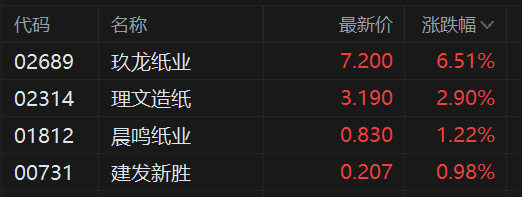
纸业股再度活跃,玖龙纸业涨6.5%续刷阶段新高,月内累计升幅达22%
Ge Long Hui· 2026-01-12 03:50
Group 1 - The core viewpoint of the article highlights the recent surge in Hong Kong paper stocks, particularly Nine Dragons Paper, which rose by 6.5%, marking a cumulative increase of 22% for the month [1] - Major packaging paper companies, including Nine Dragons, Shanying, Lee & Man, and Rongcheng, have initiated large-scale maintenance shutdowns to proactively reduce production capacity [1] - Several manufacturers of white card and cultural paper, such as Bohui, APP, and Asia Pulp & Paper, have collectively announced price increases [1] Group 2 - According to CICC, a short-term supply-demand gap for wood chips is expected to emerge by 2026, with a positive outlook for the recovery of wood chip and pulp price levels [1] - Despite recent large-scale domestic production of self-made pulp, the construction cycle for high-quality wood chip resources is lagging behind equipment production, leading to a projected supply gap in the domestic wood chip market by 2026 [1] - The tightening of raw material supply is anticipated to elevate cost pressures, while marginal improvements in demand could lead to a recovery in pulp price levels by 2026, benefiting leading companies with full supply chain capabilities [1]