
蚂蚁集团

Search documents
独家丨具身智能,诞生一笔豪华天使轮
投中网· 2026-02-10 03:33
Core Viewpoint - The article discusses the recent angel round financing of DaXiao Robotics, which is expected to set a record in China's embodied intelligence sector, highlighting the increasing competition and investment in this emerging industry [3][4]. Group 1: Financing and Investment - DaXiao Robotics recently completed an angel round financing led by Ant Group, with participation from several prominent investors, indicating strong market interest and confidence in the company [3][11]. - The financing amount has not been disclosed, but it is anticipated to break records in the Chinese embodied intelligence sector [4]. - The investment landscape shows a significant head effect, with leading players like Zhiyuan and Yushu entering mass production and pursuing IPOs, while less competitive companies face bankruptcy [4][6]. Group 2: Company Background and Leadership - DaXiao Robotics is founded by Wang Xiaogang, a key figure from SenseTime, who has a strong academic and professional background in AI and robotics [7][9]. - Wang Xiaogang has notable achievements, including developing the DeepID facial recognition technology and winning the ImageNet competition, showcasing his expertise in the field [8][9]. - The company operates independently and boasts a high talent density, with two of the top five Chinese computer scientists on its team, indicating a strong foundation for innovation [10]. Group 3: Technological Advancements - DaXiao Robotics has introduced the ACE embodied R&D paradigm, which aims to address data collection challenges in the industry through a comprehensive technical system [12]. - The ACE paradigm allows for extensive data collection, potentially resolving the "data scarcity" issue that has hindered the development of embodied intelligence [13]. - The company has established strategic partnerships with various industry players, enhancing its capabilities and market reach [14]. Group 4: Market Position and Commercialization - DaXiao Robotics is positioned to capitalize on existing market demands due to its affiliation with SenseTime, which has established customer and channel resources across various sectors [14]. - The company has already validated its products in diverse applications such as inspection and cultural tourism, indicating a successful path toward commercialization [14].


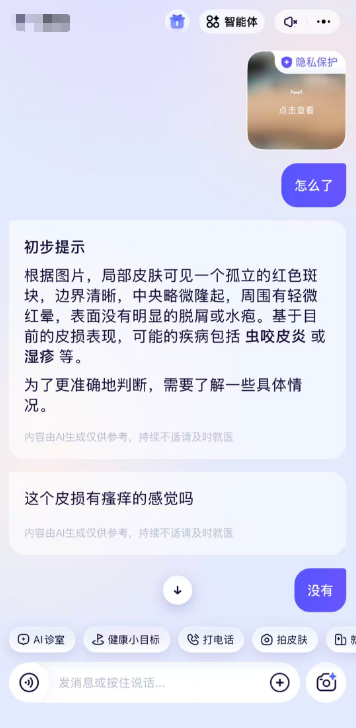
AI问诊,靠谱吗?
Huan Qiu Wang· 2026-02-10 02:00
Core Viewpoint - The rise of AI medical consultation in China is transforming healthcare access and efficiency, but concerns about reliability and data protection persist [4][11][14]. Group 1: AI Medical Consultation Overview - By the end of 2025, AI medical consultation advertisements are expected to be ubiquitous in Beijing, indicating a significant market presence [1]. - Users like Liu Yu are turning to AI for quick medical advice, completing processes that traditionally take hours in just minutes [3][4]. - Major companies such as JD Health, Ant Group, and Baidu are launching AI medical products, reflecting a competitive landscape in the sector [4]. Group 2: Functionality and Training of AI - AI medical products are categorized into two main types: those for general patients and those for healthcare professionals [7][10]. - The training of AI involves extensive input of medical knowledge and real patient interaction data to enhance diagnostic accuracy [7][12]. - Current AI models have shown a top-5 diagnostic accuracy rate of 97%, with the first suggestion accuracy at approximately 80% [12]. Group 3: Advantages and Limitations - AI consultation offers convenience, operating 24/7 without the need for appointments, which alleviates pressure on overburdened hospitals [10][11]. - AI is best suited for managing minor symptoms and chronic conditions, while complex cases still require in-person consultations [11][14]. - The technology's limitations include potential inaccuracies and the inability to replace physical examinations, which are crucial for accurate diagnosis [11][12]. Group 4: Legal and Ethical Considerations - The question of liability in cases of AI misdiagnosis remains unresolved, with current regulations not clearly defining responsibility [13][14]. - Experts suggest that AI should be viewed as a supportive tool rather than a replacement for human doctors, emphasizing the need for transparency in AI recommendations [12][14]. - The development of a regulatory framework is necessary to ensure the safe and effective use of AI in healthcare, with suggestions for a tiered system similar to that used in autonomous driving [16].

“惠民保”最大服务商再冲港股IPO!镁信健康半年两递表
Cai Jing Wang· 2026-02-10 01:46
Core Viewpoint - The company, Shanghai Magnesium Health Technology Group, is making a second attempt to go public on the Hong Kong Stock Exchange (HKEX) after its initial application expired in June 2025, driven by the need for financing amid ongoing losses and pressure from investors [1][2]. Company Summary - The company submitted its IPO application on January 16, 2026, with Goldman Sachs, CICC, and HSBC as joint sponsors [1]. - The latest financial data shows that the company's revenue has been growing, with operating income increasing from 1.069 billion yuan in 2022 to 2.035 billion yuan in 2024, and a 33.88% year-on-year increase in the first ten months of 2025 [2]. - Despite revenue growth, the company has been experiencing continuous losses, with net losses of 446 million yuan in 2022, 288 million yuan in 2023, and 76 million yuan in 2024, totaling nearly 1.2 billion yuan in cumulative losses over four years [3]. Financial Performance - The company's operating costs remain high, with sales and distribution expenses exceeding 1.8 billion yuan from 2022 to 2024, accounting for 41.36% of total revenue during that period [3]. - In the first ten months of 2025, sales and distribution expenses rose to 705 million yuan, with marketing and promotion costs reaching 404 million yuan [3]. - The proportion of sales and distribution expenses to revenue has shown a declining trend, from 52.1% in 2022 to 37.6% in the first ten months of 2025 [3]. Business Model Analysis - The company's "medical + pharmaceutical + insurance" integration model has structural imbalances, leading to a situation where revenue growth does not translate into profitability [4]. - The main business segments include intelligent pharmaceutical solutions and intelligent insurance solutions, with the former accounting for 62.7% of revenue but only achieving a gross margin of 10% [4]. - The "drug-to-insurance" model, a key component of the intelligent pharmaceutical solutions, faces regulatory scrutiny due to compliance issues [4]. Industry Context - The challenges faced by the company reflect broader issues within the multi-payment healthcare sector in China, where the payment structure is imbalanced, with personal cash expenditures making up 49% of the total [5]. - Despite ongoing policy efforts to integrate commercial health insurance with pharmaceutical payments, significant barriers remain, including the lack of precise risk management capabilities among insurers [5]. - The competitive landscape is intensifying, with several companies in the same sector, such as Ping An Good Doctor and Easy Health, already established and facing their own challenges [6]. Future Outlook - The success or failure of the company's IPO will serve as a critical indicator for investor confidence in the healthcare payment sector, potentially influencing future financing and valuations [6]. - The industry is expected to undergo a significant reshaping over the next 3-5 years, transitioning from a focus on "traffic connection" to "data empowerment," with compliance and value creation in medical payments becoming key differentiators [6].
清华系创企拿下国内视频生成领域最大单笔融资!技术领跑,商业落地双提速
Sou Hu Cai Jing· 2026-02-09 15:40
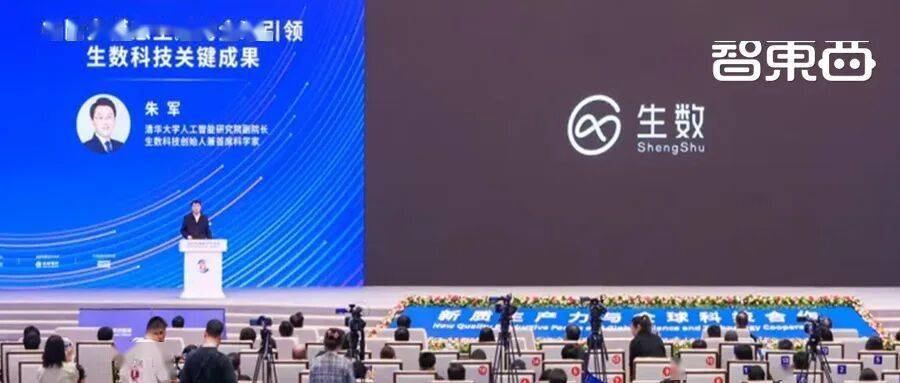
Group 1 - The core point of the article is that Beijing-based multimodal generation technology startup, Shengshu Technology, has completed over 600 million RMB in Series A+ financing, setting a new record in the domestic video generation sector, surpassing the previous record of 430 million RMB held by Aishi Technology [1] Group 2 - Shengshu Technology was founded in March 2023 and is recognized as a "Tsinghua system" enterprise, with co-founders having strong ties to Tsinghua University, including the vice president of the university's AI research institute [3] - The company is one of the earliest teams to research multimodal generation algorithms, having proposed the U-ViT architecture in September 2022, three months before OpenAI's DiT architecture [3] - In 2024, Shengshu Technology launched the Vidu model for video generation, with the latest Vidu Q3 model released on January 30, 2026, ranking first in China and second globally in authoritative benchmark tests, only behind xAI's Grok [3] Group 3 - The financing announcement revealed that Shengshu Technology achieved over 10 times growth in users and revenue by 2025, with its business covering over 200 countries and regions globally [4] - The company has a clear commercialization path and a broad customer ecosystem, serving major players in the film industry, including Sony Pictures, Tencent Animation, and iQIYI, as well as giants in the internet and hardware sectors like ByteDance and Samsung [4] - Strategic partnerships include deep collaborations with companies like Zhipu AI, leveraging a MaaS platform, and previous investments from Baidu, Huawei, and Ant Group [4] Group 4 - Shengshu Technology aims to go beyond content generation, with co-founder Zhu Jun emphasizing the ultimate goal of building a "world model" that understands real physical laws to support machine decision-making [7] - The company's "reference life video" technology addresses complex multi-agent consistency challenges in commercial videos, laying the groundwork for advanced applications [7] - The record-breaking financing not only confirms market recognition of Shengshu Technology's technical path and commercial capabilities but also marks a new phase for Chinese video generation AI startups, transitioning from technology catch-up to competing alongside global giants [7]
年终奖新贵诞生了
3 6 Ke· 2026-02-09 09:17
最近,一则年终奖信息在社交平台流传—— 公司:拓竹科技 年终奖发放月数:9月 年终奖发放金额:45万 岗位:市场 满意度:远超预期 每到年末,打工人的日历只有两个日子:发年终奖那天,和确定不发的那天。 关于拓竹年终奖,职场社交平台上还流传着更让人吃惊的一幕:最高超200万,月份最高25个月,整体 年终奖金总包比去年上涨超50%。 甚至还有员工爆料称,拓竹年会头奖是100g金条,价值超10万,连实习生都有"阳光普照奖"。 尽管拓竹方面对投资界表示"含泪辟谣",但也有来自拓竹的员工表示,10个月左右的年终奖并不夸张。 一位接近拓竹的人士告诉投资界:以去年的百亿营收来看,拓竹大手笔年终奖有迹可循,"他们真的很 赚钱"。 你可能不知道,这只是一家成立仅5年的公司。2020年,离开大疆的陶冶叫上几个老同事一起创业,切 入一个当时并不被看好的小众赛道——消费级3D打印,拓竹由此成立。 没想到,公司成长速度惊人:不到两年推出产品,在海外一战成名;不到三年实现盈利,如今拓竹营收 已破百亿。 如此迅速崛起,员工成为第一回馈对象。不久前,拓竹做了一件让行业震惊的"壮举"——宣布在发放 2025年终奖时,同步给10所员工母校捐赠一 ...
春节期间最大热点?AI红包大战开启,人工智能渗透率有望再攀新高
Xuan Gu Bao· 2026-02-09 07:23
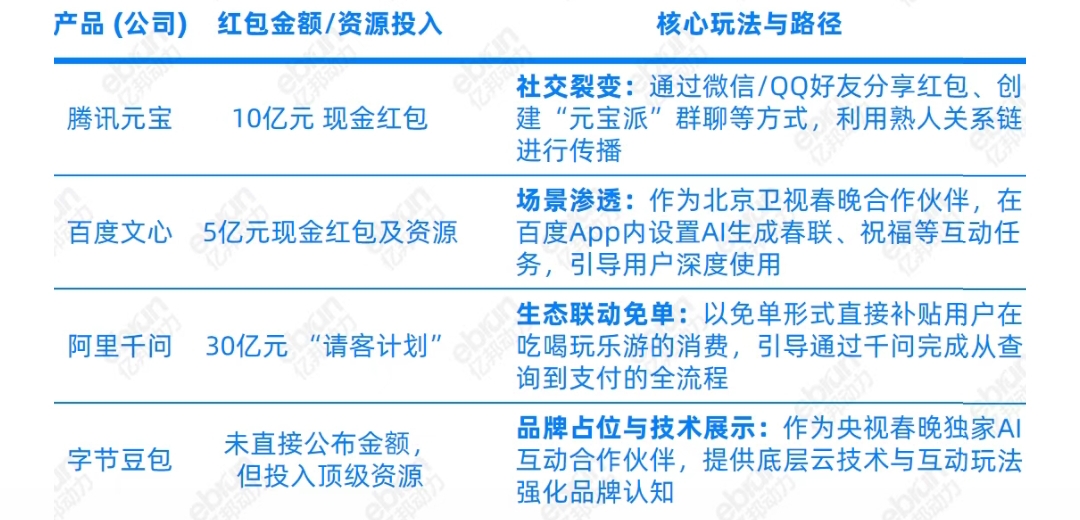
Group 1 - The core event is the "Spring Festival Red Packet War," where major tech companies are leveraging AI applications to attract users during the holiday season, with a total marketing budget exceeding 4.5 billion yuan [1][2] - Tencent's Yuanbao App is distributing 1 billion yuan in cash red packets, with individual packets reaching up to 10,000 yuan, focusing on social sharing through WeChat and QQ [2][3] - Baidu is offering 500 million yuan in red packets, integrating its AI product, Wenxin Assistant, into the user experience by providing interactive tasks within the Baidu App [2][3] - Alibaba's Qianwen App has launched a 3 billion yuan "treating guests plan," subsidizing users' dining and entertainment expenses, thus driving user engagement from inquiry to payment [2][3] - ByteDance has not disclosed its red packet amount but has secured a strategic partnership as the exclusive AI cloud provider for the CCTV Spring Festival Gala, gaining significant exposure [1][2] Group 2 - Analysts suggest that the red packet strategy aims to create a habitual use of AI applications among users, potentially leading to higher retention rates post-holiday [2][3] - The Spring Festival serves as a unique opportunity for AI applications to penetrate the market, similar to how WeChat Pay gained traction through the Spring Festival red packets [3] - Data shows that by the end of 2025, Doubao, a leading AI application, achieved 163 million monthly active users, nearly doubling from earlier in the year, while Yuanbao grew from 13.12 million to 84.38 million users [4][5] - The competitive landscape for AI applications is expected to evolve, with various platforms and super apps continuing to educate users and integrate AI functionalities [6] Group 3 - The launch of Ant Group's Lingguang AI assistant, which supports natural language and multimodal content generation, has seen rapid adoption, reaching over 1 million downloads within four days [7] - The AI application sector has experienced significant stock market activity, with several companies seeing their shares surge following announcements related to AI developments [8]


7秒支付、0.5米精度导航:科技为视障者打开独立生活之门
Hua Xia Shi Bao· 2026-02-09 03:38
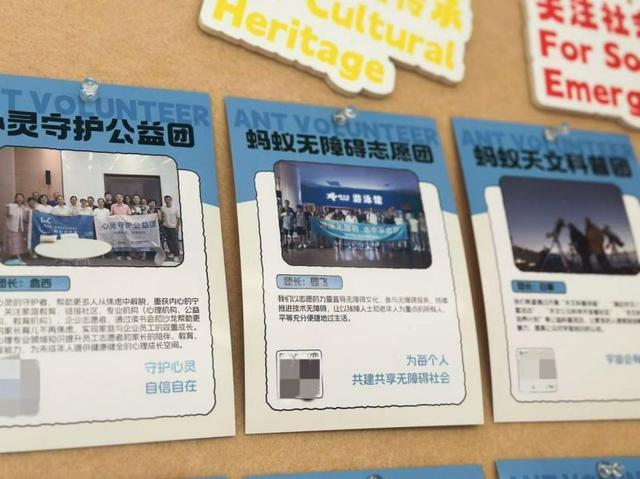
Core Viewpoint - Ant Group is leveraging technology to enhance accessibility for visually impaired individuals, focusing on innovations in payment and navigation services to address their specific challenges in daily life [2][4][20]. Payment Innovations - Ant Group has introduced several features in Alipay to facilitate "barrier-free payment" for visually impaired users, including "wave to pay," "draw to pay," and "voiceprint rapid payment" [4][5]. - The "wave to pay" feature allows users to complete human-machine verification through voice prompts that guide them in performing specific gestures, enhancing accessibility [4][8]. - "Draw to pay" enables users to input a pre-set shape on the screen for password entry, which is not visible to others, thus maintaining privacy [5][8]. - "Voiceprint rapid payment" allows users to verbally state the payment amount, streamlining the payment process and reducing reliance on touch-screen accuracy [5][8]. User Experience and Efficiency - A test showed that a visually impaired user could complete a payment in a convenience store in approximately 23 seconds using traditional methods, while using "wave to pay" reduced this time to just 7 seconds [7]. - The integration of voice feedback throughout the payment process ensures that visually impaired users can confidently complete transactions [8]. Indoor Navigation Solutions - Ant Group has developed an indoor navigation product utilizing AR and spatial positioning technology to assist visually impaired individuals in navigating indoor spaces independently [12][15]. - The navigation system has achieved a positioning accuracy of approximately 0.5 meters, significantly improving the user experience compared to earlier versions [13][15]. - The project began as a volunteer initiative and has expanded to cover multiple venues, providing users with voice-guided navigation to their destinations [15][16]. Social Responsibility and Future Plans - Ant Group has opened 16 patents related to accessibility and is committed to further developing services that cater to the needs of visually impaired users [8][20]. - The company aims to standardize its navigation products and expand their reach, enhancing the independence of visually impaired individuals in various environments [16][20]. - The broader context includes supportive policies like the "Barrier-Free Environment Construction Law" and the "14th Five-Year Plan for the Protection and Development of Disabled Persons," which guide the development of accessible services [18][17].
无惧OpenAI,2026年国内最值得期待的十个医疗大模型
3 6 Ke· 2026-02-09 01:31
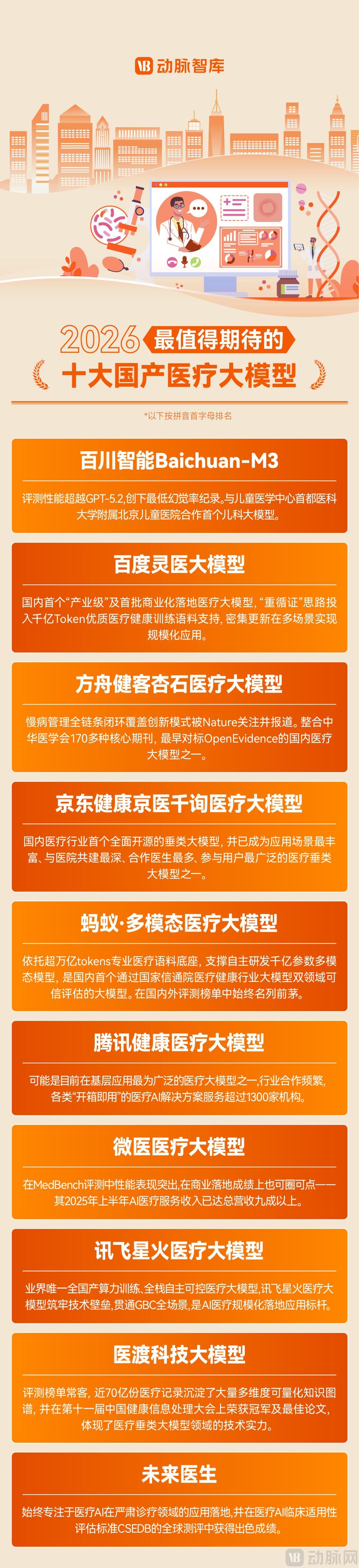
Core Insights - The medical large model sector is experiencing significant advancements, particularly with the recent launches from OpenAI, Anthropic, and Google, indicating a competitive landscape in healthcare AI [1][3][4] - Domestic companies in China, such as Baichuan Intelligence and Ant Group, are making substantial progress, showcasing their capabilities and innovations in the medical AI field [5][6][10] Group 1: OpenAI's Developments - OpenAI launched ChatGPT Health and OpenAI for Healthcare, which comply with HIPAA regulations and aim to enhance patient care services [2] - ChatGPT Health integrates a new module based on the latest GPT-5 model, allowing users to connect personal health data while ensuring data privacy [2] - OpenAI for Healthcare targets medical institutions, offering enterprise-level solutions for clinical environments, including automated documentation [2] Group 2: Competitors' Responses - Anthropic released Claude for Healthcare, directly competing with OpenAI's offerings, highlighting its commitment to the healthcare sector [3] - Google updated its open-source medical large model, MedGemma 1.5, improving its capabilities in text, medical records, and medical imaging [3] Group 3: Domestic Innovations - Baichuan Intelligence launched Baichuan-M3, surpassing GPT-5.2 in benchmark tests, with a hallucination rate of only 3.5%, which was later improved to 2.6% [4][5] - Ant Group's medical model has gained significant traction, achieving 30 million monthly active users and doubling daily inquiries within a month [5] - JD Health and other domestic firms are also releasing new models and solutions, contributing to a vibrant competitive landscape in China's medical AI sector [5][10] Group 4: Benchmarking and Performance - HealthBench and MedBench are the primary benchmarking systems for evaluating medical large models, assessing safety, clinical applicability, and professional reasoning [7][8] - The performance of medical large models is crucial, with ongoing iterations and resource investments being necessary for advancements [8] Group 5: Industry Trends and Future Outlook - The medical large model sector is expected to grow significantly, with various domestic models emerging as strong contenders in 2026 [6][10] - The integration of local clinical guidelines and data security measures positions domestic models as more suitable for the Chinese market [6] - The increasing support from the government and the focus on localized solutions are likely to enhance the competitiveness of domestic models [6]


破译“健康福”,今年第一个健康玄学
Xin Lang Cai Jing· 2026-02-08 10:18
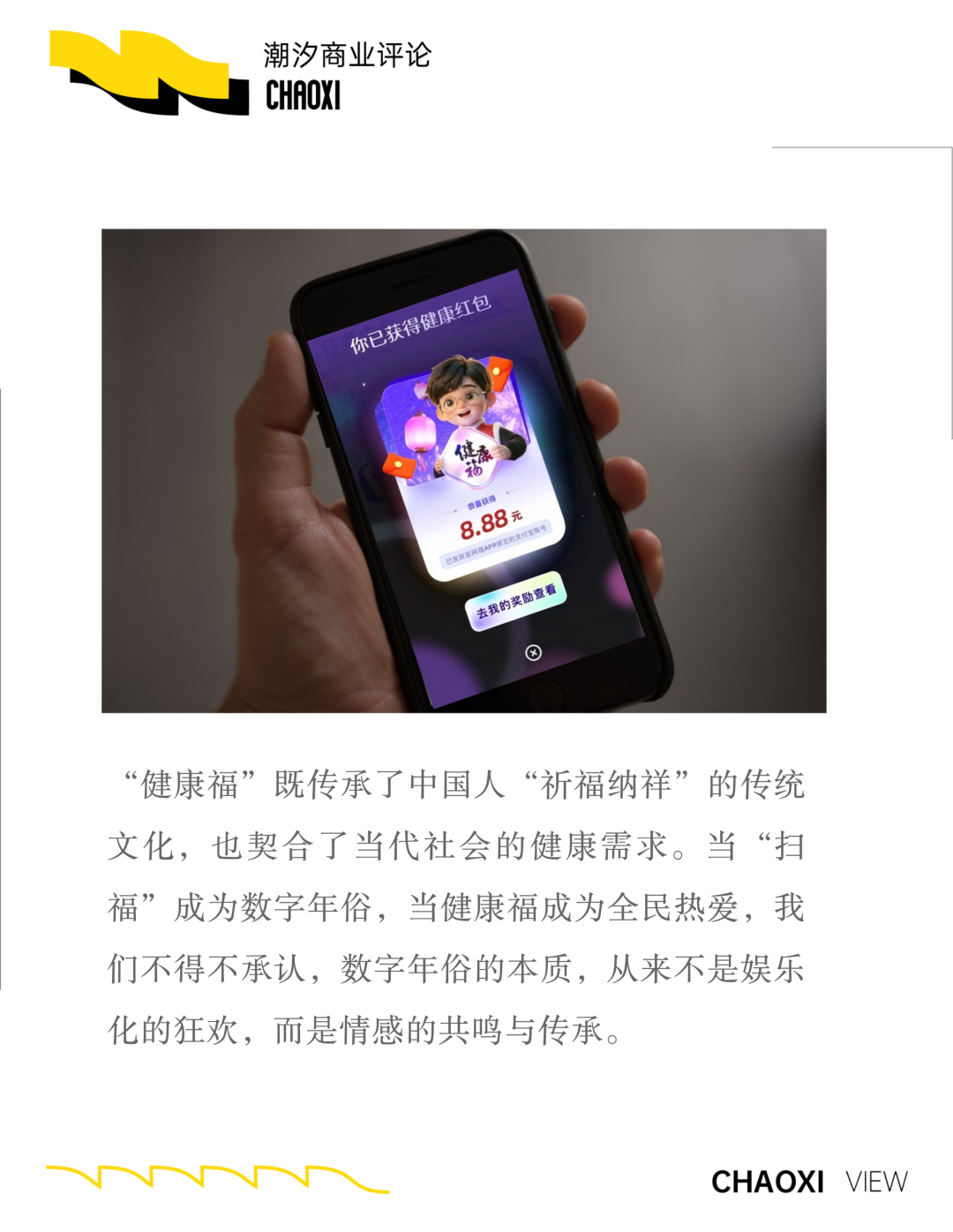
Core Insights - The article discusses the rise of the "Health Blessing" card in the context of the Chinese New Year, highlighting its ability to resonate with millions and shift the focus from monetary rewards to health and well-being [3][12]. Group 1: Health Blessing Card Overview - The "Health Blessing" card was introduced as part of the Alipay's annual "Collect Five Blessings" event, aiming to provide immediate joy rather than the traditional method of collecting cards for monetary rewards [4][12]. - The initiative sparked a social media movement, with hashtags trending and users actively seeking the "Health Blessing" [4][12]. - The card's appeal lies in its simplicity and accessibility, allowing users to easily obtain it through the Ant Fortune app without complex requirements [15][17]. Group 2: Cultural and Emotional Significance - The "Health Blessing" reflects a shift in societal values, where health has become a primary concern, moving from a luxury to a necessity for many [12][18]. - The phenomenon serves as a modern expression of traditional Chinese culture, emphasizing the importance of health and well-being during the festive season [15][20]. - The widespread participation across various demographics indicates a collective acknowledgment of health as a shared value, fostering connections among individuals [20][21]. Group 3: User Engagement and Technology Integration - The Ant Fortune app has become a vital platform for health-related inquiries, with millions of users engaging with its features, including health assessments and personalized advice [17][20]. - The app's user-friendly design caters to all age groups, particularly the elderly, making health information more accessible [17][20]. - The initiative has transformed the act of sharing health blessings into a proactive approach to health management, encouraging users to take charge of their well-being [19][20].
中国家庭财富与消费报告2025年第四季度-蚂蚁集团研究院
Sou Hu Cai Jing· 2026-02-07 11:10
Group 1: Household Wealth Situation - The average annual income of surveyed households is 50,300 yuan, with wage income being the core source at 61.6% [10][11] - There is a notable income disparity between first-tier cities and non-first-tier cities, with first-tier city households earning significantly more across all age groups [37] - The proportion of families with no housing is 28.9%, while 47.5% own one property, indicating a stable housing ownership structure [11][46] Group 2: Household Debt and Asset Management - The debt ratio is improving, with 50.5% of families being debt-free, although 10.4% have a debt ratio exceeding 100% [11][12] - Financial asset allocation shows a decline in cash and deposits, with first-tier cities showing a higher engagement in stocks and other financial products, reaching a holding rate of 49.2% [11][49] - Families are managing housing leverage more cautiously, with 59.3% of homeowners having no mortgage [11][46] Group 3: Consumption Patterns - The average monthly consumption per household is 2,421 yuan, with first-tier cities spending significantly more at 3,424 yuan [12][13] - Consumption patterns vary by demographic, with youth focusing on entertainment and dining, while middle-aged individuals prioritize education and healthcare [12][13] - Households with housing tend to have stronger consumption support, and those with multiple properties spend more than those with a single property [14][15] Group 4: Future Consumption Expectations - Overall consumption expectations are stable but show signs of weakening, with only 11% of families planning to increase consumption [15][16] - Employment stability is a key factor influencing consumption willingness, particularly among the unemployed and flexible employment groups [15][16] - The report suggests that families prioritize cutting discretionary spending in response to income uncertainty [16][17] Group 5: Policy Recommendations - The report recommends stabilizing employment and enhancing social security, particularly for youth and flexible employment groups [17][19] - It suggests optimizing household asset and debt structures and promoting inclusive financial products to enhance financial literacy [17][19] - Targeted measures are proposed to release consumption potential across all age groups, focusing on reducing rigid expenditure pressures [17][19]
