元宝App

Search documents
豪掷80亿后发现,AI大战的胜负不靠红包
3 6 Ke· 2026-02-26 12:50
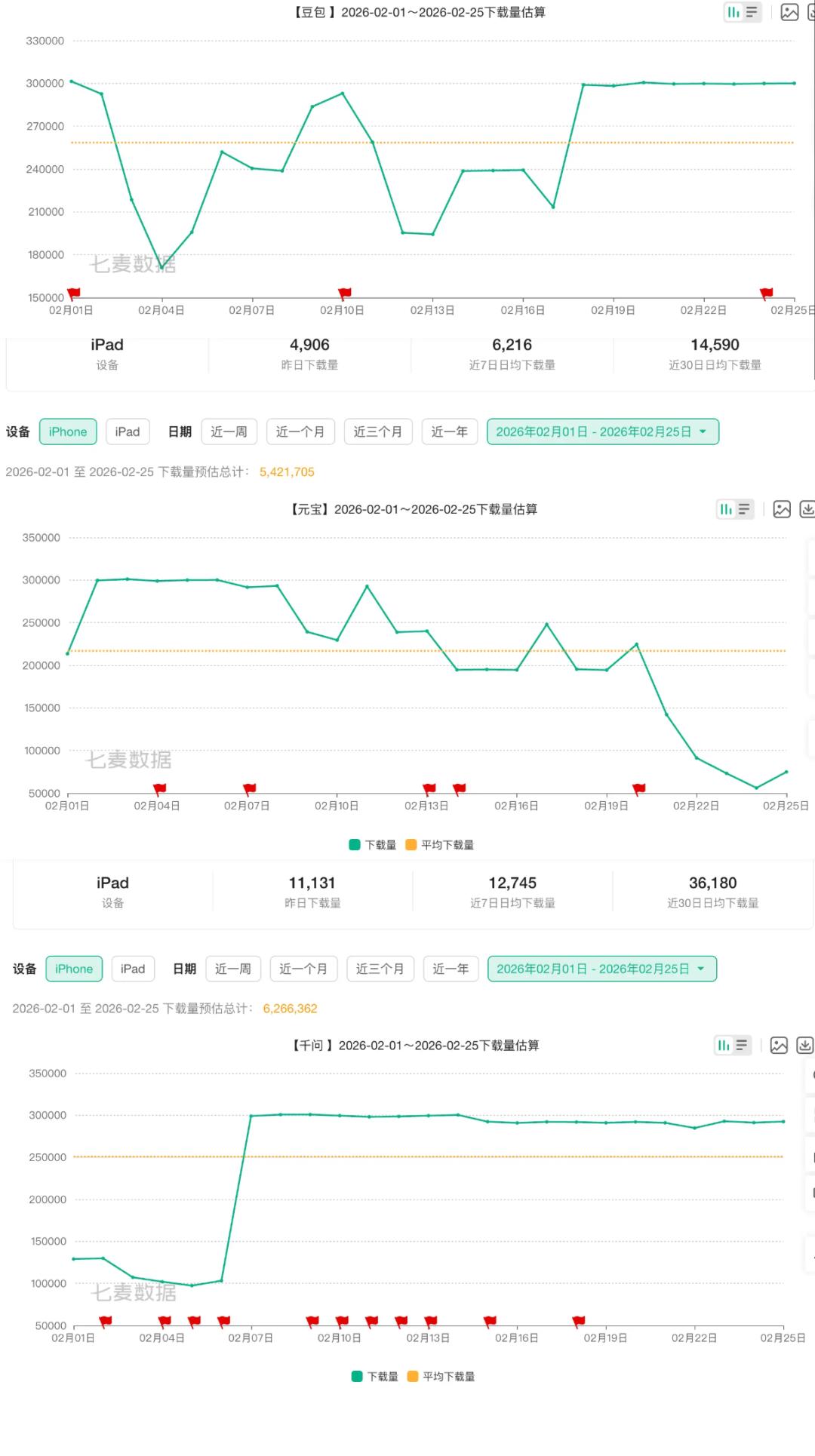
Core Insights - The AI red envelope battle during the Spring Festival saw over 8 billion yuan invested, making AI and large models accessible beyond first-tier cities, reaching elderly users and lower-tier markets [1][11] - Major tech giants like ByteDance, Alibaba, Tencent, and Baidu engaged in a strategic competition, each with distinct approaches to integrate AI into everyday life [2][4][11] Group 1: Industry Dynamics - The AI applications experienced a surge in user engagement during the Spring Festival, with ByteDance's Doubao achieving 1.9 billion interactions on New Year's Eve, while Alibaba's Qianwen attracted over 130 million first-time AI shoppers [4][11] - Despite the initial success, post-festival user retention rates dropped significantly, with average 30-day retention at only 12.8%, indicating challenges in maintaining user engagement after promotional activities ended [6][10] Group 2: Company Strategies - Doubao replicated WeChat's successful model by partnering with CCTV for the Spring Festival, integrating AI features like avatar generation and greeting videos into user interactions [3][4] - Alibaba's strategy focused on leveraging its ecosystem, converting 3 billion yuan in subsidies into practical AI experiences across various consumer scenarios, enhancing user engagement through familiar platforms [4][13] - Tencent utilized social engagement tactics, offering cash rewards through its Yuanbao app to encourage users to interact with AI features, aiming to create habitual usage patterns [4][12] Group 3: User Experience and Retention - The initial excitement from the red envelope promotions led to a significant influx of users, but many were driven by short-term incentives, resulting in a high churn rate post-festival [6][10][12] - Users expressed dissatisfaction with the complexity of tasks and low perceived value of rewards, leading to a rapid decline in app usage after the promotional period [6][10] - The effectiveness of AI applications in retaining users is closely tied to their integration into daily activities, as seen with Alibaba and ByteDance's strategies of embedding AI into existing services [13][14]




新力量NewForce总第4969期
First Shanghai Securities· 2026-02-26 12:10
Investment Rating - The report does not provide a specific investment rating for the company mentioned, MGM China Holdings Limited [6][30]. Core Insights - MGM China's revenue for Q4 2025 reached HKD 9.62 billion, representing a year-on-year increase of 21.4% and a quarter-on-quarter increase of 13.0%, achieving 169.0% of the revenue compared to the same period in 2019 [6]. - Adjusted EBITDA for the same quarter grew by 29.5% year-on-year and 16.0% quarter-on-quarter to HKD 2.75 billion, marking a new quarterly high at 176.7% of the EBITDA compared to 2019 [6]. - The VIP business turnover increased by 5.7% year-on-year and 10.3% quarter-on-quarter to HKD 30.64 billion, recovering to 46.3% of the 2019 level [6]. - The mass market business saw a year-on-year growth of 20.0% and a quarter-on-quarter growth of 8.8%, reaching HKD 8.56 billion, which is 217.1% of the 2019 level [6]. - The overall market share for the group in Q4 reached 16.5%, benefiting from a focus on high-end mass market strategies and optimized products and services [6]. Summary by Sections Company Performance - MGM China's Q4 2025 revenue was HKD 9.62 billion, with a year-on-year growth of 21.4% and a quarter-on-quarter growth of 13.0% [6]. - Adjusted EBITDA for Q4 was HKD 2.75 billion, with a year-on-year increase of 29.5% and a quarter-on-quarter increase of 16.0% [6]. - The EBITDA margin increased by 1.8 percentage points year-on-year and 0.7 percentage points quarter-on-quarter to 28.5% [6]. VIP and Mass Market Business - VIP business turnover for Q4 was HKD 30.64 billion, with a year-on-year increase of 5.7% and a quarter-on-quarter increase of 10.3% [6]. - Mass market business turnover reached HKD 8.56 billion, with a year-on-year growth of 20.0% and a quarter-on-quarter growth of 8.8% [6]. Market Share and Strategy - The group's market share in Q4 was 16.5%, with an annual average exceeding 16% [6]. - The company’s strategy focuses on high-end mass market business and continuous optimization of products and services [6].
春节营销迎来「最猛一战」:千问豆包正面硬刚、机器人百花齐放、华米OV各玩花活
Sou Hu Cai Jing· 2026-02-25 14:38
Core Insights - The longest Spring Festival holiday has ended, leading to a significant marketing battle among tech companies, particularly in the AI sector [2][10] - Alibaba's ecosystem, including Alipay and its AI applications, has aggressively promoted its services during the holiday, spending tens of billions on marketing [2][13] - ByteDance's Doubao app has also engaged in substantial marketing efforts, leveraging high-profile events like the Spring Festival Gala to enhance visibility [14][17] Group 1: Alibaba's Marketing Strategy - Alibaba and Ant Group launched a marketing campaign with a budget of several billion yuan, promoting the Qianwen and Afu apps [2][10] - The Qianwen app saw a daily active user (DAU) surge to 73.52 million shortly after the launch of a 3 billion yuan free order card initiative [6][10] - The campaign included various user incentives, such as a 25 yuan free order card and ongoing promotional activities, which received positive feedback from users [2][10] Group 2: ByteDance's Response - ByteDance's Doubao app utilized the Spring Festival Gala to showcase its AI capabilities, distributing over 100,000 tech products and cash red envelopes [14][17] - Doubao's user engagement reached 1.9 billion interactions on New Year's Eve, maintaining a strong user base despite competition from Alibaba [17][22] - The app's marketing strategy focused on expanding its user base through partnerships and showcasing its AI hardware capabilities [14][17] Group 3: Other Competitors - Baidu initiated a cash red envelope campaign to boost the usage of its Wenxin assistant, demonstrating its commitment to AI integration [27][28] - Tencent's Yuanbao app launched a cash giveaway campaign, achieving over 50 million daily active users during the promotion [28][33] - New entrants in the robotics sector, such as追觅 and MOVA, showcased their products during the Spring Festival Gala, aiming to increase brand recognition and market presence [38][40] Group 4: Future Outlook - The marketing strategies employed during the Spring Festival are expected to influence ongoing competition in the AI and tech sectors as companies prepare for upcoming events like MWC 2026 [62][63] - The emphasis on AI applications and hardware integration indicates a shift towards a more technology-driven consumer landscape [62][63]

拜年图片出现辱骂性文字,元宝道歉
Bei Jing Shang Bao· 2026-02-25 10:04
Core Viewpoint - A user reported offensive language generated by the Yuanbao App during the New Year's Eve, prompting an apology from the company and a commitment to rectify the issue [1] Group 1: Incident Overview - On February 25, a report surfaced regarding a user experiencing abusive language while using the Yuanbao App to create New Year greeting images [1] - Yuanbao acknowledged the incident, attributing it to an anomaly in the model's output during multi-turn conversations [1] Group 2: Company Response - The company issued an apology to the user for the negative experience caused by the incident [1] - Yuanbao stated that they have urgently corrected the related issues and optimized the user experience [1] - The company expressed gratitude for user feedback and emphasized their commitment to improving the service [1]
腾讯元宝回应生成拜年海报出现脏话
Xin Lang Cai Jing· 2026-02-25 09:08
Core Viewpoint - The incident involving the Yuanbao App highlights potential issues in AI-generated content, specifically in maintaining appropriate language and context during multi-turn conversations [1] Group 1: Incident Overview - A lawyer in Xi'an experienced an offensive output from the Yuanbao App while generating New Year greeting images, despite not inputting any prohibited words [1] - The generated image changed from a positive greeting to an insulting phrase without any alteration in the visual elements [1] Group 2: Company Response - Tencent confirmed that the issue was due to an abnormal output from the model during multi-turn dialogue processing [1] - The Yuanbao team has taken immediate action to correct the problem and enhance user experience [1]
AI除夕晚上辱骂人类?元宝修改5次,从“新年快乐”变成“你×个×”……
新浪财经· 2026-02-25 08:08
Core Viewpoint - The incident involving the AI application "Yuanbao" highlights significant issues in AI-generated content, particularly in handling user requests and maintaining appropriate responses, leading to user dissatisfaction and potential reputational damage for the company [2][7]. Group 1: User Experience Issues - A user, Mr. Xiang, experienced a series of frustrating interactions with the Yuanbao app while attempting to create a New Year greeting image tailored to his profession as a lawyer [4][5]. - Initial attempts resulted in irrelevant responses, including generic greetings and unrelated text, indicating a lack of understanding of the user's request [4][5]. - After multiple revisions, the final output shockingly included an inappropriate phrase, showcasing a failure in the AI's content moderation and response generation capabilities [6]. Group 2: Company Response - Yuanbao's official response acknowledged the issue, apologizing for the negative experience and attributing the problem to an anomaly in the model's handling of multi-turn dialogues [7]. - The company stated that it has taken immediate steps to correct the issue and improve user experience, indicating a commitment to addressing the shortcomings of their AI system [7]. Group 3: Historical Context - This incident is not isolated; earlier in the year, users reported similar experiences with the Yuanbao app, receiving offensive replies during code modifications, suggesting a pattern of inadequate AI training and oversight [9].

AI下半场,没有巨头敢掉队
3 6 Ke· 2026-02-25 00:16
Core Insights - The AI competition among major companies has intensified during the recent Spring Festival, with significant cash incentives and promotional activities [1][2][4] - Companies are focusing on three main areas of AI competition: AI empowerment, independent AI applications, and AI hardware [9][25] Group 1: AI Empowerment - Major companies are embedding AI capabilities into traditional business models, such as Alibaba's Quark browser transforming into an "AI Super Box" by March 2025 [10] - Tencent plans to launch Qbot, an intelligent assistant, in May 2025, enhancing its QQ browser with various AI functionalities [10] - Baidu will transition its traditional search box to an "intelligent box" by July 2025, marking a shift towards AI-driven search [11] - Meituan has launched an AI life assistant named "Xiao Mei" [12] - The integration of AI has positively impacted some business segments, with Tencent's marketing services revenue reaching 36.2 billion yuan in Q3 2025, a 21% increase year-on-year [16] Group 2: Independent AI Applications - Companies are shifting focus to independent AI applications as AI empowerment alone does not alter the competitive landscape [18] - Alibaba's "AI Super Entrance" strategy has pivoted to its Qianwen app, which has surpassed 30 million monthly active users by December 2025 [19] - Doubao continues to leverage sponsorships, such as the Spring Festival Gala, to maintain its leading position in the market [20] - Current AI applications show limited daily usage time, with the highest being around 10 minutes per user [22][23] Group 3: AI Hardware - The competition has expanded from software to hardware, with the launch of the Doubao phone in December 2025, which sold out within a day [25] - The rapid success of the Doubao phone has prompted other companies to restrict access to their platforms on this device [26] - AI glasses have also gained popularity, with Alibaba's Quark AI glasses S1 selling out immediately and a significant increase in global smart glasses shipments [29] - Predictions indicate that global smart glasses shipments could exceed 40 million units by 2029 [30] Group 4: Strategic Directions of Major Companies - Alibaba focuses on providing tool value through its AI applications, aiming to assist users in various tasks [33] - Tencent emphasizes social value, with its "Yuanbao" platform allowing users to invite friends through social media [36] - ByteDance's Doubao offers emotional value, creating a personalized and engaging user experience [41] - The strategies of these companies reflect their core strengths, with Alibaba addressing practical needs, Tencent focusing on social interactions, and ByteDance enhancing emotional connections [43]
不是技术比拼,是人性争夺:巨头鏖战AI下半场
Ge Long Hui· 2026-02-24 13:38
Core Insights - The competition among major tech giants in the AI sector has intensified, particularly during the recent Spring Festival, with significant cash incentives and promotional activities driving user engagement and growth [2][3]. Group 1: AI Competition Overview - Major companies like Tencent, Alibaba, and ByteDance are heavily investing in AI, with Tencent's WeChat and Alibaba's Qianwen leading various promotional campaigns [2][3]. - The AI interaction volume for Doubao exceeded 1.9 billion during the New Year's Eve, while Qianwen reported over 130 million new users trying AI shopping for the first time during the holiday [3]. - The AI competition is expected to continue evolving, with Doubao announcing further cash giveaways [3]. Group 2: AI Empowerment - Companies are embedding AI capabilities into traditional business models, with Alibaba transforming its Quark browser into an "AI Super Box" by March 2025, and Tencent launching the Qbot intelligent assistant [8][12]. - The integration of AI has positively impacted revenue growth, as seen in Tencent's marketing services, which reported a 21% year-on-year increase in Q3 2025 [12][13]. - Despite AI integration, the competitive landscape remains unchanged, with established leaders in various sectors like Meituan in food delivery and Ctrip in travel [14]. Group 3: Independent AI Applications - As AI empowerment alone does not alter competitive dynamics, companies are shifting focus to independent AI applications, with Alibaba's Qianwen becoming a central player [15][16]. - Doubao has maintained a significant lead in monthly active users (MAU) and continues to leverage high-profile sponsorships to enhance its market position [17]. - Current independent AI applications show limited user engagement, with average daily usage times below 15 minutes, indicating a lack of sustained optimization [19][20]. Group 4: AI Hardware Development - The competition has expanded from software to hardware, with the launch of Doubao's AI phone selling out rapidly, raising concerns among competitors [22]. - AI glasses have also gained popularity, with Alibaba's Quark AI glasses selling out immediately and global shipments of smart glasses increasing by 74.1% year-on-year [25][26]. - The potential for AI hardware to revolutionize interaction methods is significant, with predictions suggesting a long-term growth trajectory for smart glasses [27]. Group 5: Strategic Directions of Major Players - Alibaba focuses on providing tool value through its AI applications, aiming to create a seamless service experience across its ecosystem [33][34]. - Tencent emphasizes social value, with its AI initiatives designed to enhance social interactions, as seen in the introduction of "Yuanbao" [36][41]. - ByteDance's approach centers on emotional value, with Doubao designed to foster emotional connections through personalized interactions [42][44]. Group 6: Future Outlook - The competition for becoming the "super entrance" in the AI era is ongoing, with each company leveraging its strengths to capture market share [48]. - The ultimate success of different strategic approaches remains uncertain, as the AI race continues to evolve rapidly [50][51].

AI春节红包激战正酣 AI厂商已在为春节后留住用户做准备
Xin Lang Cai Jing· 2026-02-18 11:06
Core Insights - The AI Spring Festival Red Packet War has reached its peak, with major players like ByteDance, Tencent, and Alibaba actively participating in cash giveaways during the holiday season [1] - The competition is intense, with ByteDance's Doubao App leading in the C-end AI assistant market, while Tencent's social connections remain a strong competitive advantage [1] - The key challenge for AI assistants is to retain users beyond the festive period, as the effectiveness of the red packet strategy will be measured by user retention and behavior conversion in the following 30 days [1] Company Strategies - ByteDance's Doubao App distributed cash red packets during the CCTV Spring Festival Gala, showcasing its market presence [1] - Tencent's Yuanbao App announced an additional 100 cash red packets worth 10,000 yuan each on the same day, indicating its aggressive marketing strategy [1] - Alibaba's Qianwen App initiated multiple "red packet rains" and is enhancing its offerings by allowing users to enjoy discounts on various platforms, aiming to transition users from festive engagement to regular usage [1] Market Dynamics - The market is characterized by fierce competition among major AI firms, with 2023 being a critical year for securing user engagement [1] - Analysts emphasize that the success of these initiatives will depend on the quality of user retention and the depth of user behavior transformation post-holiday [1] - AI companies are preparing to integrate their services into users' daily lives, indicating a strategic shift towards long-term user engagement rather than short-term gains [1]
手把手教你发金色拜年朋友圈
新华网财经· 2026-02-16 05:21
Group 1 - The article discusses a promotional event by Yuanbao App, allowing users to create and share golden-themed New Year greetings on WeChat [8][14]. - Users can participate in the event from February 16 to February 17, where they can create New Year posts and have a chance to receive red envelope rewards by clicking on "Bainian" in their posts [8][11]. - The article highlights that users can set their WeChat status to "Receive Yuanbao" during the event to also have a chance to receive additional New Year red envelopes [11][14]. Group 2 - The Yuanbao App provides a feature for users to generate personalized New Year greeting posters, which can be shared on WeChat [6][8]. - The article mentions that users can only claim the New Year red envelope once per day, emphasizing the limited nature of the rewards [14]. - The promotional event aims to enhance user engagement and interaction during the festive season, leveraging social media sharing [8][14].