华为

Search documents
2026答案秀·思想者春晚| 任家栋:商业航天所有卡脖子技术均已攻克,这个行业就要爆发
Guan Cha Zhe Wang· 2026-01-26 00:25
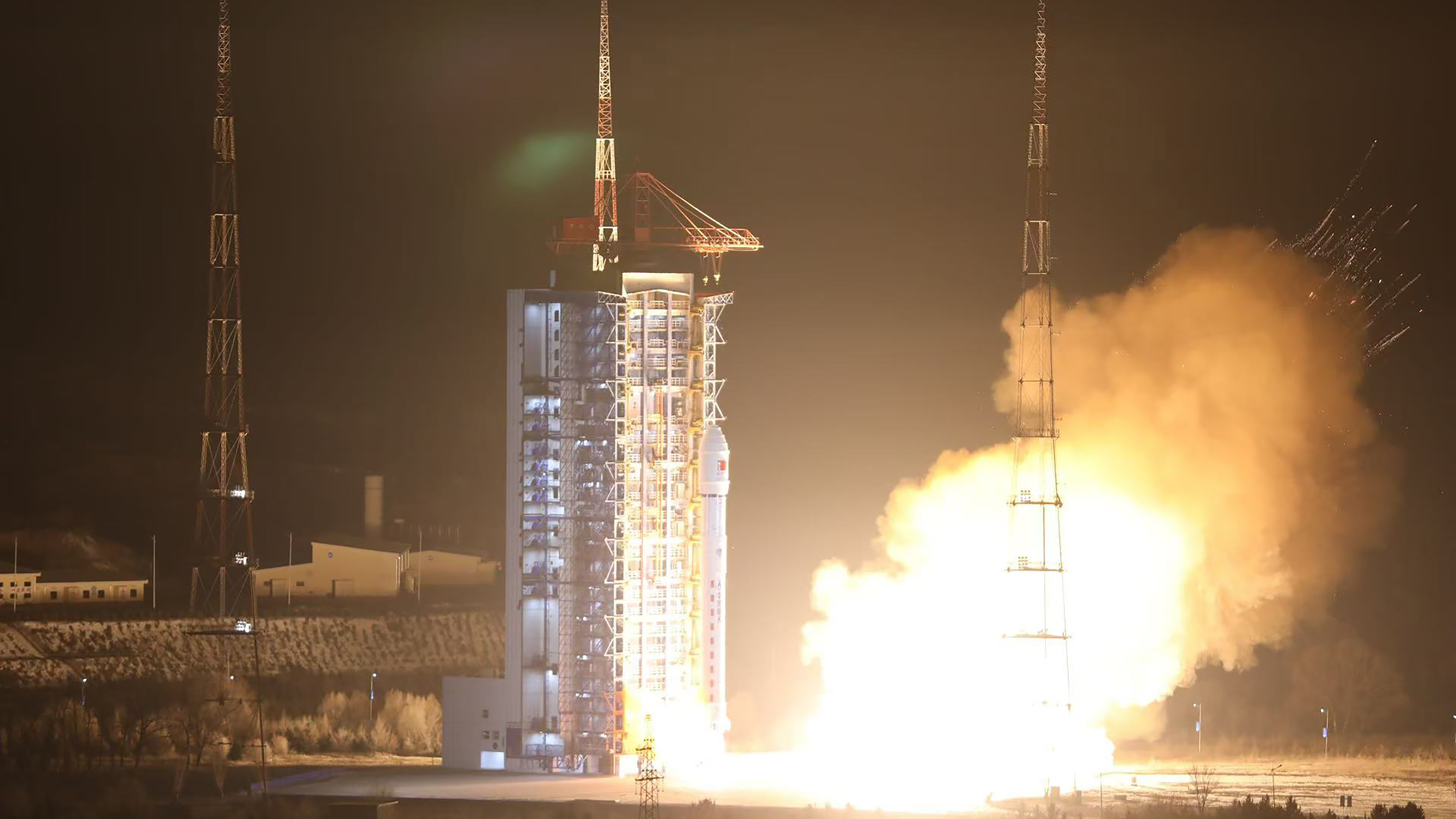
Core Viewpoint - The commercial space industry has transitioned from a state-controlled domain to a rapidly evolving commercial sector, with China positioned as a key player in this global trend [1][2]. Group 1: Current State of Commercial Space - The commercial space industry has reached a significant milestone, with the number of satellites launched annually expected to exceed 4,000 by 2025, compared to just over 1,000 active satellites currently [8]. - The establishment of the Commercial Space Administration by the National Space Administration signifies a major opportunity for the commercial space sector in China [8]. - The industry is moving from a research-focused phase to a commercial phase, as evidenced by the increasing discussions around satellite quantities and pricing at industry events [4][8]. Group 2: China's Position in Commercial Space - China is not merely a follower in the commercial space race but is among the few countries defining the rules, particularly in remote sensing and communication sectors [12]. - The successful launch of the "Hongtu-1" satellite, which utilizes an innovative four-satellite formation for global measurement, highlights China's leadership in SAR remote sensing technology [12]. - In communication, China's advancements in low-orbit broadband satellites have led to the development of satellites with capacities reaching 40 Gbps, showcasing international competitiveness [13]. Group 3: Key Challenges and Technological Breakthroughs - The commercial space industry faces challenges in supply chain expansion and technological innovation, with a focus on transforming space capabilities into societal industrial capabilities [16]. - The industry has seen a significant increase in suppliers, from around 100 in 2018 to over 1,000 by 2025, indicating a robust supply chain development [17]. - Key technological advancements include electric propulsion systems, flexible solar panels, and laser communication technologies, which are essential for the future of low-orbit communication satellites [19][20][21]. Group 4: Future Trends and Projections - By 2025, the total value of commercial contracts is expected to equal the total of the past five years, indicating a significant growth trajectory for the industry [24]. - The commercial space sector in China is anticipated to enter a phase of scale economy, with rapid increases in satellite launches and a shift towards a more competitive landscape [24][25]. - The integration of computing power into satellite technology is expected to create a new paradigm in space communication, enabling direct connections between mobile devices and satellites [25].

商业航天所有卡脖子技术均已攻克,这个行业就要爆发
Guan Cha Zhe Wang· 2026-01-26 00:18
Core Viewpoint - The commercial space industry has transitioned from a state-controlled domain to a rapidly evolving commercial sector, with China positioned as a significant player in this global trend [1][2]. Industry Development Stage - The commercial space industry has evolved significantly, with a notable shift from experimental systems to industrialization, exemplified by the launch of over 1,000 active satellites globally [5]. - By 2025, it is projected that over 4,000 satellites will be launched in a single year, indicating a robust industrial framework [5]. Key Opportunities and Trends - The establishment of the Commercial Space Administration in China and the mention of commercial space in government reports signal a major opportunity period for the industry [6]. - The integration of satellite communication with terrestrial networks is expected to reshape information systems, marking a significant advancement in the industry [6]. China's Position in Commercial Space - China is not merely a follower but is among the few countries defining the rules in the commercial space sector, particularly in remote sensing and communication [8][9]. - The successful launch of the "Hongtu-1" satellite, which utilizes all-electric propulsion, showcases China's innovative capabilities in the field [8]. Technological Breakthroughs - The industry has made significant strides in supply chain expansion and overcoming key technological challenges, such as electric propulsion and flexible solar panels [12][16]. - The development of laser communication technology and phased array antennas represents critical advancements that enhance satellite communication capabilities [18][19]. Future Outlook - By 2025, the total value of commercial contracts is expected to equal the total of the past five years, indicating a substantial growth trajectory [22]. - The commercial space sector in China is anticipated to enter a phase of scale economy, with rapid increases in satellite launches and a shift towards a more competitive landscape [22][23]. - The integration of computing power into satellite systems is expected to create a new paradigm in satellite communication, enabling direct connections between mobile devices and satellites [23].
早报:苹果2025高端出货占比98%!雷军谈小米造车初心
Sou Hu Cai Jing· 2026-01-26 00:15
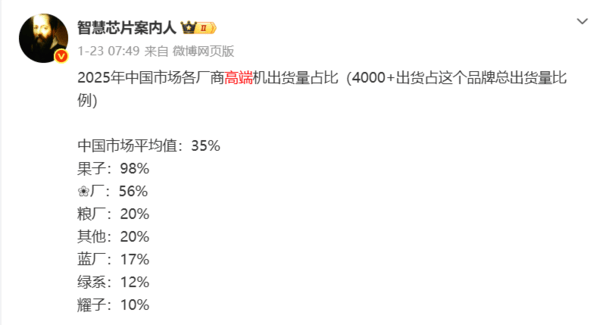
Group 1 - The core viewpoint of the article highlights the competitive landscape of the high-end smartphone market in China, where Apple leads with a 98% market share, followed by Huawei at 56%, and Xiaomi at 20% [1][3] - The average market share of high-end smartphones (priced above 4000 yuan) in China is 35%, indicating significant growth potential for other manufacturers [1][3] - In the domestic SUV quality ranking for Q4 2025, Xiaomi's YU7 achieved a complaint-to-sales ratio of 0.9 per ten thousand, significantly lower than the industry average of 24.8, ranking first among 358 models evaluated [3] Group 2 - Xiaomi's SU7 electric sedan boasts a one-year resale value of 70.22%, leading its segment, with a second-hand car resale rate of 80.1%, reflecting strong consumer recognition and market competitiveness [6] - Samsung's chairman Lee Jae-Yong emphasized the need for the company to avoid complacency despite recent performance improvements, highlighting ongoing structural risks in the competitive landscape [6][8] - The South Korean robotics market ranks fourth globally in installation numbers, with a robot density that is the highest worldwide, but 71.2% of total shipments are for domestic use, indicating a low export ratio compared to Japan [10]


徕卡又要出售了,中资买下百年可乐标?|硅谷观察
Xin Lang Cai Jing· 2026-01-26 00:11
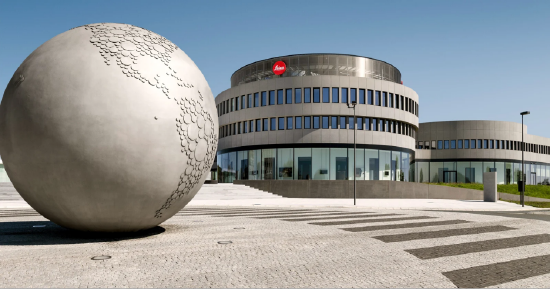
Core Viewpoint - Leica Camera's major shareholders, ACM and Blackstone, are considering selling their controlling stake, with an estimated valuation of €10-12 billion ($12-15 billion) [1][34][35] Group 1: Company Background - Leica's origins trace back to 1849 when Carl Kellner founded the "Optical Institute" in Germany, which later evolved into the Leica brand [2][37] - The first 35mm camera prototype, Ur-Leica, was designed by Oskar Barnack in 1914, marking a significant milestone in photography history [6][39] - Leica has become synonymous with documentary photography, capturing pivotal moments throughout the 20th century [6][39] Group 2: Financial History and Ownership Changes - In 2004, Andreas Kaufmann acquired a majority stake in Leica for approximately €65 million ($82 million), rescuing the company from near bankruptcy [8][41] - Blackstone invested about €130 million ($179 million) in 2011 for a 44% stake, valuing Leica at approximately €278 million [9][42] - Currently, ACM holds 55% and Blackstone holds 45% of Leica's shares [9][42] Group 3: Brand Transformation and Market Performance - Blackstone's involvement has transformed Leica from a traditional workshop into a global luxury brand, positioning it as the "Rolls Royce of imaging" [12][44] - Leica's revenue has grown from €450 million to €596 million over the past four fiscal years, despite a declining traditional camera market [14][45] - The company has successfully diversified its business and adopted a luxury branding strategy, which has significantly increased its profit margins [12][45] Group 4: Exit Strategy and Market Dynamics - Blackstone is looking to exit its investment as it has surpassed the initial 5-7 year exit period agreed upon at the time of investment [15][46] - The potential sale is driven by a slowdown in revenue growth, with the last fiscal year's growth rate dropping to 7.6% [16][46] - The sale process has attracted interest from various potential buyers, including Chinese private equity firm HSG, European funds, and optical groups [1][35][56] Group 5: Strategic Partnerships - Leica has formed strategic partnerships with Huawei and Xiaomi, significantly boosting its presence in the mobile imaging market [14][49][52] - The collaboration with Huawei led to the successful launch of the P9 smartphone, which sold over 12 million units within a year, enhancing both brands' market positions [17][51] - Following the end of the partnership with Huawei, Leica has sought new collaborations, notably with Xiaomi, to maintain its growth trajectory in mobile imaging [20][52] Group 6: Future Prospects and Challenges - The upcoming sale of Leica's controlling stake may lead to significant changes in its operational strategy and market approach [25][56] - Potential buyers like Zeiss and HSG could influence Leica's future direction, particularly in expanding its market share in China, which has seen a 25% increase in sales [25][56] - The need for Leica to maintain brand prestige while increasing sales volume remains a critical challenge for its new ownership [31][62]
中信建投:AI多模态和世界模型或重塑多个行业的业务逻辑
智通财经网· 2026-01-26 00:07
Core Insights - The report from CITIC Securities highlights the advancements in multimodal technology by leading companies like Google and Kuaishou, addressing challenges in character consistency and physical logic, marking a shift from entertainment to productivity [1][2] - AI-generated content, particularly AI comic dramas, is emerging as a new growth area, with platforms like ByteDance incentivizing high-quality content creation, potentially reshaping advertising and gaming asset production [1][7] Group 1: Company Developments - Google has established strong barriers in long-context understanding and native audio-video integration with models like Veo, Gemini, and Nanobanana [2] - Kuaishou's Keling model integrates multiple creative tasks into a unified engine, achieving a victory ratio of 247% in image reference tasks and 230% in instruction transformation tasks [3] - Alibaba's Tongyi Wanshang 2.6 model introduces commercial role-playing capabilities, ensuring character consistency across different shots and supporting high-definition video generation [4] - Zhizhu's GLM-Image model, developed in collaboration with Huawei, is the first to complete full-process training on a domestic computing platform, addressing industry challenges like Chinese character rendering [5] Group 2: Market Trends and Opportunities - Kuaishou's Keling AI has seen a significant increase in active users, surpassing 12 million, with a 350% growth in paid users, indicating a shift of multimodal AI tools from entertainment to essential productivity tools in industries like film and advertising [6] - The AI comic drama sector is rapidly expanding, with ByteDance implementing aggressive incentive policies to promote high-quality content, reflecting a potential market size growth for short dramas and comic dramas [7][8] - The evolution of multimodal technology is expected to reshape business logic across various industries, including search and marketing, entertainment, and gaming, with advancements in generative AI leading to new commercial opportunities [8]


iPhone Air 惨败中国,降价2900元,产能猛砍八成,终成苹果「战略弃子」?
3 6 Ke· 2026-01-25 23:46
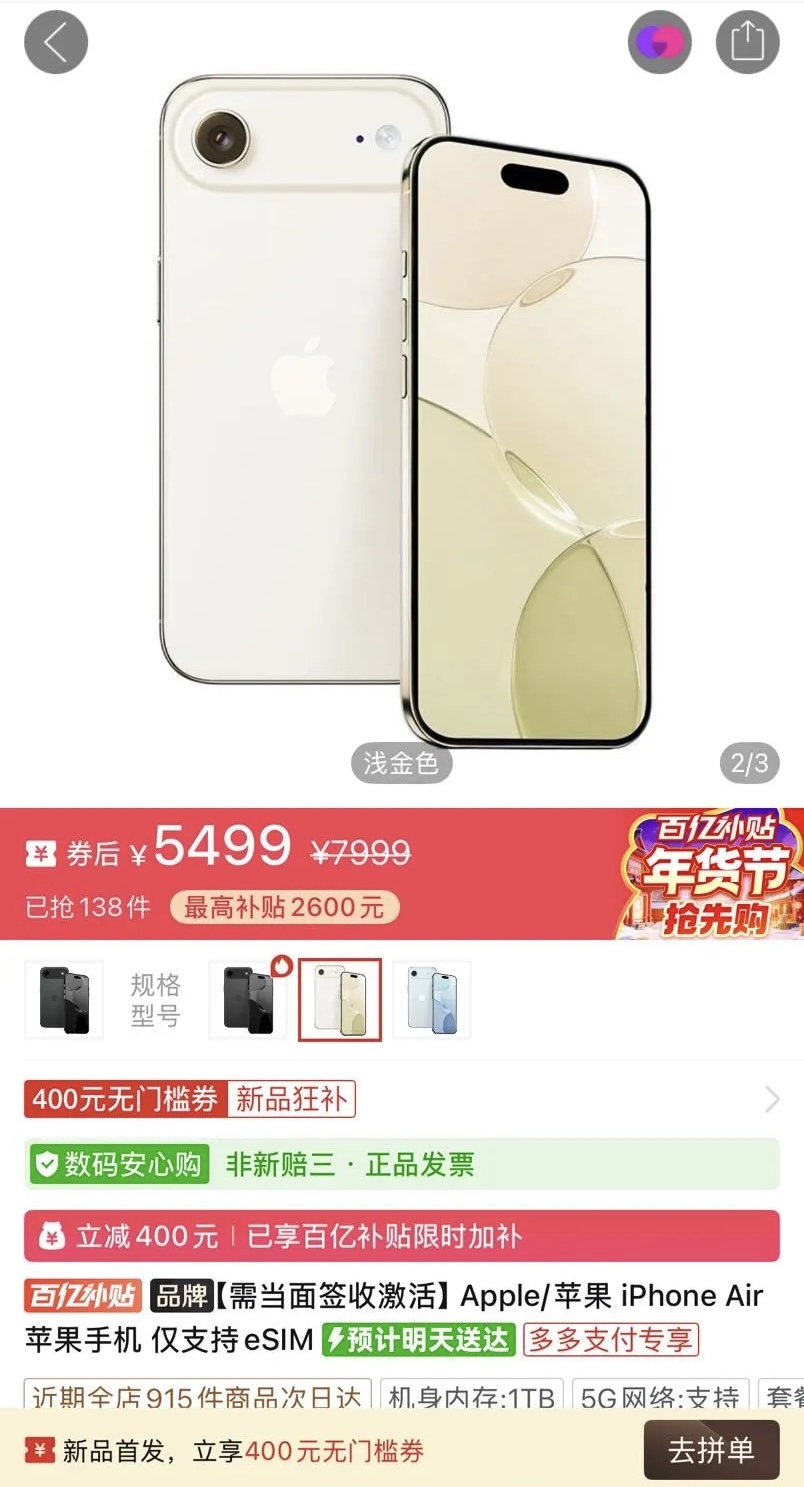
Core Viewpoint - The significant price reduction of the iPhone Air in China, initiated by Apple, is an unexpected move aimed at clearing inventory and reallocating resources for other iPhone models, rather than boosting sales performance [4][6][8]. Pricing Strategy - The iPhone Air, launched at a starting price of 7999 yuan, has seen a price drop of 2000 yuan, with additional subsidies bringing the price down to as low as 5099 yuan, marking a total reduction of 2900 yuan from its original price [1][4]. - The promotion is set to last until at least February 11, indicating a large-scale effort across multiple sales platforms, including Apple’s own stores [1]. Sales Performance - Despite the aggressive pricing strategy, the iPhone Air has not achieved significant sales, with only 13,000 units participating in the promotional activities compared to 200,000 units for the iPhone 17 series [6][9]. - The activation rate for the iPhone Air is notably low, accounting for only about 1% of the total new iPhone activations, while the iPhone 17 series models have much higher activation rates [9][10]. Production and Inventory Management - Apple is reportedly reducing the production capacity of the iPhone Air by over 80% due to poor market performance, indicating a need to clear out existing inventory [7][12]. - The early price drop suggests that Apple is looking to manage its production resources more effectively, allowing for better allocation to the more successful iPhone 17 series and upcoming models [10][12]. Market Reception and Challenges - The iPhone Air has faced challenges in the market, particularly as a pioneer for eSIM technology in China, which has not resonated well with consumers [13][16]. - The product's performance has been disappointing, with significant depreciation in resale value compared to other iPhone models, indicating a lack of consumer interest [14][15]. Future Outlook - Apple is expected to focus on preparing for the launch of new models, including a potential foldable iPhone, by reallocating resources away from the iPhone Air [12][18]. - The lessons learned from the iPhone Air's market performance may influence future product strategies and the promotion of eSIM technology in China [17][19].
超八成展品搭载AI“科技年货”引爆新春
Nan Fang Du Shi Bao· 2026-01-25 23:12
Core Viewpoint - The "Guangdong Goods Going Global" spring action for consumer electronics in Shenzhen's Huaqiangbei has successfully showcased the innovation of local brands in the AI wave, attracting significant consumer interest and boosting the electronic information industry chain [3][6][10]. Group 1: Event Overview - The event gathered 50 leading consumer electronics companies, including Huawei and DJI, to display their products, emphasizing "Guangdong Manufacturing" and "Shenzhen Creation" [3][4]. - Huaqiangbei experienced an additional 100,000 visitors on the event day, a 15% increase year-on-year, highlighting the area's popularity as a consumer electronics hub [3][4]. Group 2: Consumer Engagement - The event attracted a diverse group of foreign buyers from regions such as the Middle East and Southeast Asia, indicating strong international interest in "Guangdong Goods" [4][5]. - Local enterprises showcased innovative products like AI glasses and collaborative robots, which resonated well with both domestic and international consumers [5][6]. Group 3: Product Innovation - Over 80% of the exhibited products featured AI capabilities, transforming traditional hardware into smart lifestyle companions [6][7]. - Shenzhen's consumer electronics have evolved from traditional goods to AI hardware and smart terminals, representing a significant upgrade in manufacturing [6][7]. Group 4: Market Dynamics - Huaqiangbei serves as a critical hub for global sourcing, with over 7,000 foreign buyers visiting daily and more than 300 million packages shipped annually [7][8]. - The event has stimulated the entire electronic information industry chain, enhancing the connection between local manufacturing and global markets [8][9]. Group 5: Internationalization Efforts - The event featured international volunteers providing translation and procurement assistance, reflecting a commitment to facilitating global trade [10]. - The initiative aims to promote Guangdong's manufacturing on a global scale, enhancing its reputation and driving consumer engagement [10].

让数智资源长板成为产业跳板
Xin Lang Cai Jing· 2026-01-25 22:24
转自:贵州日报 "十四五"期间,数智经济成为驱动贵州高质量发展的重要引擎。如何将资源"长板"转化为产业"跳板"?记者 专访贵州省社会科学院区域经济研究所所长、贵州省数字经济实验室执行主任、研究员罗以洪,系统解读贵 州数智经济发展的独特优势基础、战略转化路径与关键支撑体系。 记者:贵州在数智资源方面有哪些独特性优势? 罗以洪:贵州已形成四大独特性数智资源优势: 算力基础设施的规模与结构优势。贵州依托自然条件与能源禀赋,已建成全国领先的算力保障基地。截至目 前,全省重点数据中心达50个,算力总规模突破150EFLOPS,其中智算占比超过97%,贵安集群成为全国智 算资源最富集的区域之一。 罗以洪:关键在于"战略前瞻、基建先行、场景驱动、生态集聚"四方面协同。 政策法规与制度创新优势。据不完全统计,2013年以来,贵州出台与大数据、数字经济、人工智能等相关的 省级文件数量全国领先。贵州率先出台全国首部大数据地方性法规,近期修订的《贵州省大数据发展应用促 进条例》,进一步从法治层面巩固"算力—数据—应用—产业"联动发展架构。 记者:这些优势如何进一步转化为差异化战略竞争力? 罗以洪:推动四大优势向差异化战略竞争力转化 ...

AI逼停电网!美国13州停电,中国“算电协同”破局全球能源危机
Sou Hu Cai Jing· 2026-01-25 22:17
Core Viewpoint - The global energy crisis is driven by the exponential demand for AI computing power, which is outpacing the linear growth of electricity supply, leading to significant risks of power shortages and increased electricity costs in various regions, particularly in the U.S. [1][3] Group 1: AI Power Demand and Energy Crisis - The demand for AI computing power has surged, with requests for electricity from AI data centers in Northern Virginia reaching 47 gigawatts, exceeding the grid's capacity of 32 gigawatts, resulting in a 30% power shortfall dedicated to AI [3] - A single large AI data center can consume up to 360 GWh annually, equivalent to the annual electricity usage of 500,000 average households, while major companies like Microsoft and Google are projected to add 5,000 GWh of electricity consumption per year from new AI data centers [3] - The energy consumption of AI is increasing exponentially, with energy requirements for training models rising 1,000 times as parameters increase from 10 billion to 1 trillion, complicating load management for power grids [3] Group 2: Global Impact and Responses - The electricity crisis has spread globally, with European data center electricity costs rising by 40% in a year, Singapore halting approvals for new AI data centers, and South Korean tech firms relocating AI training tasks overseas due to insufficient power quotas [5] - The previous bottleneck in AI development due to chip shortages has now shifted to power shortages, becoming a critical barrier for the industry [5] Group 3: China's Strategic Response - China has adopted a "computing and electricity coordination" strategy to ensure AI development without compromising residential energy needs, utilizing cross-regional scheduling to balance power supply and demand [5][6] - The "East Data West Computing" initiative allows AI training tasks to be dynamically moved to regions with abundant renewable energy, achieving a 65% green energy usage rate in western data centers and saving over 10 million yuan in annual electricity costs for individual centers [6] - Technological innovations, such as liquid cooling technology, have reduced AI server energy consumption by over 30%, while integrated solutions like Huawei's "smart photovoltaic + energy storage" provide 24-hour green electricity supply [6] Group 4: Policy and Future Trends - China's policies mandate that new large AI data centers maintain a Power Usage Effectiveness (PUE) of no more than 1.25 and a green energy usage ratio of at least 50%, promoting a shift towards a greener, low-carbon industry [8] - The future of AI and energy is envisioned as a symbiotic relationship rather than a conflict, with the potential for AI to optimize energy systems and contribute positively to electricity management [8][10] - By 2030, it is expected that AI-related electricity consumption will account for 5.2% of total electricity usage globally, emphasizing the importance of integrating computing power with green energy [8]
破圈出海 中国品牌加速登陆全球市场(国际论道)
Ren Min Ri Bao· 2026-01-25 21:23
Core Insights - Chinese brands are rapidly expanding their presence in global markets, showcasing a shift from previous challenges to a new era of growth and innovation [4][5][6] Group 1: Market Expansion - Chinese brands are increasingly establishing physical stores and local operations in various countries, enhancing brand recognition and local engagement [12] - The market share of Chinese automotive brands in Kazakhstan has surged from approximately 2% in 2020 to 34.5% in the first nine months of 2025, indicating a significant increase in their presence [7] - Chinese tea brands have successfully entered the U.S. market, with several brands expanding their operations internationally, including Southeast Asia and Europe [7] Group 2: Brand Perception and Consumer Trends - There is a notable shift in consumer attitudes towards Chinese products, particularly among younger demographics in the U.S., who are increasingly embracing Chinese technology and brands [6] - The global trust index for Chinese brands has significantly improved over the past six years, reflecting a growing acceptance and recognition of their quality and innovation [9] - Chinese brands are not only competing on price but are also focusing on quality and creativity, challenging the previous perceptions of low-quality Chinese products [10] Group 3: Innovation and Cultural Influence - Innovation is a key driver for the success of Chinese brands, with many companies emphasizing their cultural roots and unique product offerings [10][11] - The rise of Chinese brands is accompanied by a cultural wave that is reshaping global perceptions of China, with the country becoming a center for trends and creativity [14][15] - The transition from merely selling products to building ecosystems marks a significant evolution in the strategy of Chinese brands in the global market [13]