OPPO

Search documents
iPhone Air平替?国产Air新机来了
3 6 Ke· 2025-09-29 23:33
Group 1 - Xiaomi has launched the Xiaomi 17 series, directly targeting Apple's entire lineup, but notably lacks an "Air" version [1][4] - Lenovo's Moto X70 Air is set to launch in late October, aiming to fill the gap left by Xiaomi and directly compete with the iPhone Air [1][4] - The Moto X70 Air is expected to feature a thickness of less than 5.5mm, weight under 160g, and a battery capacity between 4500-5000mAh, while retaining a physical SIM card slot [6][7] Group 2 - Lenovo's mobile strategy has evolved since acquiring Motorola in 2014, focusing on a multi-series product layout with Moto as the core [8][10] - Lenovo's Moto brand has seen significant growth in the foldable phone market, with its market share doubling from 14% to 28% year-over-year [10] - Other Chinese smartphone manufacturers, including OPPO and Vivo, are also increasingly mimicking Apple's designs and features in their new products [11][15] Group 3 - The Moto X70 Air represents Lenovo's first use of the "Air" branding in smartphones, drawing from its experience with the YOGA Air series in laptops [6][8] - The competitive landscape is shifting as domestic brands emphasize compatibility with Apple's ecosystem while also leveraging their own strengths in areas like photography and battery life [15][16] - Over-reliance on mimicking Apple could risk the unique identity of these brands in the long term, suggesting a need for differentiation in the high-end market [16]




“期待与中国企业深化合作,实现互利共赢”(第一现场)
Ren Min Ri Bao· 2025-09-29 22:30
Core Insights - Chinese smartphone brands have gained significant market share in Indonesia, with four out of the top five brands being Chinese, accounting for nearly 70% of the market [1] Group 1: Market Presence and Strategy - Vivo has established a strong presence in Indonesia with nearly 50 million users and has built approximately 14,000 sales and service points, along with nearly 130 after-sales service centers [2] - The company has implemented various customer service initiatives, such as a one-hour quick repair service and free screen replacements, to enhance customer satisfaction [2] - Vivo collaborates with local designers to create culturally relevant smartphone models, which have become popular among Indonesian consumers [3] Group 2: Technological Advancements and Production - Vivo's manufacturing facility in Indonesia features advanced automation, with an average production time of one complete phone every 11.4 seconds and over 50% automation coverage [4] - The factory employs over 200 quality control tests to ensure product reliability, utilizing equipment that simulates Indonesia's high humidity and temperature conditions [5] - The factory has adopted green practices, saving 6,200 tons of water and reducing carbon emissions by approximately 293.73 tons in the past year [5] Group 3: Local Talent Development and Collaboration - Over 96% of Vivo's workforce in Indonesia consists of local talent, with a training system in place that includes on-the-job training and opportunities for advanced studies in China [6] - Vivo has localized its supply chain, achieving a 35% local component sourcing rate, and has created over 1,300 direct jobs in the region [7] - The company's efforts in local production and employment have positively impacted the Indonesian telecommunications industry, fostering resilience and growth [7]

vivo印尼公司助力当地产业链绿色、协同发展 印尼合作伙伴表示——“期待与中国企业深化合作,实现互利共赢”(第一现场)
Ren Min Ri Bao· 2025-09-29 21:53
Core Insights - Chinese smartphone brands have gained significant market share in Indonesia, with four out of the top five brands being Chinese, accounting for nearly 70% of the market [1][8] - Vivo has established a strong presence in Indonesia with nearly 50 million users and has built a local manufacturing facility since 2016, enhancing its service network [2][3] Market Strategy - Vivo's strategy includes extensive local manufacturing, with approximately 14,000 sales and service points and nearly 130 after-sales service centers across Indonesia [2] - The company has introduced various customer service initiatives, such as free repairs and quick service options, to enhance customer satisfaction [2] Cultural Integration - Vivo has successfully integrated local cultural elements into its products, launching limited edition models that resonate with Indonesian consumers [3] - The company has optimized its products for local preferences, particularly in photography features, which has led to strong brand loyalty among young consumers [3] Technological Advancements - Vivo's manufacturing facility in Indonesia features advanced automation, with over 50% automation coverage and a production rate of one complete phone every 11.4 seconds [4] - The company employs rigorous quality control measures, including over 200 testing procedures to ensure product reliability in Indonesia's climate [4] Sustainability Efforts - Vivo's production processes emphasize sustainability, achieving significant reductions in water and energy consumption, as well as CO2 emissions [5] - The factory has implemented eco-friendly practices, such as using recyclable packaging materials, contributing to Indonesia's sustainable development goals [5] Local Talent Development - Vivo has established a comprehensive training system for local employees, with over 96% of its workforce being local talent [7] - The company collaborates with local suppliers to enhance the local supply chain, achieving a 35% localization rate for components [7] Industry Impact - Chinese smartphone brands, including Xiaomi and OPPO, have also made significant investments in local production, contributing to job creation and local industry growth [8] - The collaboration between Chinese companies and Indonesian industries is seen as a model for mutual benefit and economic development [8]
OPPO、vivo入局手持影像赛道,大疆、影石怕了吗?
2 1 Shi Ji Jing Ji Bao Dao· 2025-09-29 15:52
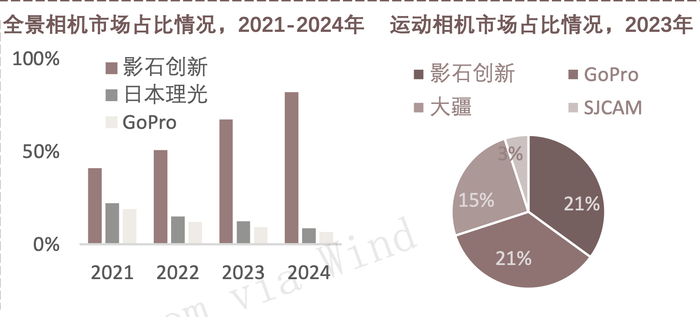
Core Viewpoint - The handheld imaging market is experiencing new competition as smartphone giants OPPO and vivo are entering the market with handheld smart imaging devices, targeting products from DJI [1][2] Group 1: Market Dynamics - The smartphone market is slowing down, prompting manufacturers to explore new growth areas, with the handheld imaging market emerging as a promising sector [2] - The global smart imaging device market is highly concentrated, with the top three companies expected to hold 78.9% market share by 2024, including DJI, Insta360, and GoPro [3][6] Group 2: Competitive Landscape - Insta360 is projected to grow its market share from 28.4% in 2023 to 35.6% in 2024, while GoPro's share is expected to decline from 38.2% to 30.1%, and DJI's from 19.1% to 13.2% [6] - The handheld imaging market, particularly in China, shows significant growth potential, with a compound annual growth rate (CAGR) of 17.8% for panoramic cameras and 26.1% for action cameras from 2023 to 2027 [7] Group 3: Technological Advantages - Smartphone manufacturers possess inherent competitive advantages in the handheld imaging market due to their established supply chains and expertise in hardware and software development [8] - The transition from smartphone imaging capabilities to handheld imaging devices is seen as a strategic move for companies like OPPO and vivo, which are facing growth challenges in their core smartphone business [7][9] Group 4: Future Prospects - OPPO plans to launch its new imaging product line in 2026, while vivo is also expected to introduce related products soon [12] - The handheld imaging market is anticipated to offer substantial profit margins, with companies like Insta360 reporting gross margins above 50% in their core business [11]

OPPO、vivo入局手持影像赛道 大疆、影石怕了吗?
2 1 Shi Ji Jing Ji Bao Dao· 2025-09-29 15:37
Core Viewpoint - The handheld imaging market is witnessing new entrants like OPPO and vivo, who are developing handheld smart imaging devices to compete with established products from DJI [1][2] Group 1: Market Dynamics - OPPO has confirmed the launch of a new imaging product series based on over 17 years of experience in mobile imaging, with plans for release in 2026 [1][14] - The global smart imaging device market is highly concentrated, with the top three players expected to hold 78.9% market share by 2024, including companies like DJI, Insta360, and GoPro [3][6] - The Chinese market for panoramic cameras is projected to grow at a compound annual growth rate (CAGR) of 17.8% from 2023 to 2027, significantly outpacing other regions [6][7] Group 2: Competitive Landscape - Insta360 is the fastest-growing player, increasing its market share from 28.4% in 2023 to 35.6% in 2024, while GoPro's share is declining from 38.2% to 30.1% [6][7] - The mobile imaging market is seen as a new growth area for smartphone manufacturers, especially as their core mobile business faces saturation [7][10] Group 3: Technological Advantages - Smartphone manufacturers possess inherent competitive advantages in the mobile imaging sector due to their established supply chains and expertise in hardware and software development [9][10] - The transition of capabilities from smartphones to handheld imaging devices is supported by advancements in stabilization, AI algorithms, and color reproduction [7][9] Group 4: Future Prospects - The handheld imaging market is expected to provide significant growth opportunities and profitability, with companies like Insta360 reporting gross margins above 50% in their core business [13][14] - OPPO's new imaging products are anticipated to surprise consumers in 2026, while vivo is also expected to launch related products soon [14]
重要资质 三大通讯巨头都拿到了!
Shang Hai Zheng Quan Bao· 2025-09-29 12:07
Group 1 - The Ministry of Industry and Information Technology (MIIT) has issued satellite mobile communication business licenses to China Mobile, following China Telecom and China Unicom, enabling them to conduct satellite direct connection services and enhance applications in emergency communication, maritime communication, and remote area communication [1][2] - The MIIT aims to optimize market access for satellite communication and strengthen regulatory oversight to promote high-quality development of the satellite communication industry, supporting the construction of a strong network, aerospace, and digital China [1][3] - China Telecom launched satellite direct connection services globally in September 2023, collaborating with major brands to introduce approximately 30 terminal devices supporting this feature by April 2025 [2][3] Group 2 - The MIIT's guidelines encourage telecom operators to explore the potential of high-orbit satellites like Tiantong and Beidou, promoting the direct connection of mobile devices to satellites and expanding high-speed data services based on low-orbit satellite internet [3][4] - China has established two major autonomous high-orbit satellite systems, Tiantong and Beidou, which theoretically can achieve global coverage with just three satellites, although the return on investment is long [4] - The development of low-orbit satellite constellations is expected to enhance overall service capabilities and expand coverage, creating a synergistic effect with high and medium-orbit satellites [4]



氪星晚报|光线传媒积极探索微短剧市场并筹划组建相关公司 ;DeepSeek V3.2、GLM4.6等大模型即将发布;工信部等六部门印发《机械行业稳增长工作方案(2025-2026年)》
3 6 Ke· 2025-09-29 11:43
Group 1: OPPO and Under Armour - OPPO has initiated a new imaging product series, leveraging over 17 years of mobile imaging technology, with plans to launch by 2026 [1] - Under Armour has opened its first flagship outdoor store in Shanghai, expanding its presence in 22 provinces and municipalities across China [1] Group 2: Strategic Partnerships and Projects - Xiamen Tungsten New Energy signed a strategic cooperation framework agreement with Zhongwei New Materials, projecting annual supply and demand of 40,000 tons for cobalt tetroxide and 50,000 tons for ternary precursors from 2025 to 2028 [2] - Donghua Technology's lithium carbonate project in Tibet has completed a 120-hour functional assessment, marking its readiness for official production [3] Group 3: Media and Entertainment - Light Chaser Animation is exploring the micro-short drama market and is planning to establish a related company [4] Group 4: Technology and Financing - DeepSeek V3.2 and GLM-4.6 models are set to be released soon, with the former already uploaded to HuggingFace [5] - "Linghou Robotics" completed over 100 million yuan in Series A financing, aimed at R&D and capacity expansion in industrial automation [7] - "Maike Technology" also secured Series A financing in the range of hundreds of millions, focusing on TGV process development [9] Group 5: Investment Trends - Fidelity International reports a significant increase in global investor interest in Chinese assets, with hedge funds actively participating in the Chinese stock market [10] - The National Development and Reform Commission supports private enterprises' deep involvement in the "Artificial Intelligence+" initiative, highlighting the growth of AI-related private companies [11] Group 6: Industry Growth Plans - The Ministry of Industry and Information Technology and other departments issued a plan for the mechanical industry, targeting an average annual revenue growth rate of around 3.5% and aiming to exceed 10 trillion yuan in revenue by 2026 [12]

OPPO ColorOS 16录音支持“AI人声增强” 可消除嘈杂背景、会议室混响等噪音
Feng Huang Wang· 2025-09-29 10:45
Group 1 - The core point of the article is the introduction of the new features in ColorOS 16, specifically the "AI Voice Enhancement" and "AI Summary" functions aimed at improving user experience during recordings and summarizing content efficiently [1] Group 2 - The "AI Voice Enhancement" feature addresses the common issue of background noise and reverberation in meetings, allowing users to hear every word clearly during playback [1] - The upgraded "AI Summary" function supports a variety of summary templates, such as for meetings, interviews, and academic lectures, and can intelligently identify content to match the most suitable template [1]
深圳发布新规,腾讯、华为等签下承诺书
21世纪经济报道· 2025-09-29 10:27
Core Viewpoint - The article discusses the newly released "Shenzhen Plan" which includes 15 clear guidelines aimed at enhancing personal information protection, reflecting a shift towards stricter compliance for companies handling personal data [1][4]. Summary by Sections Privacy Policy Standards - The guidelines require application distribution platforms and apps to provide easily accessible and long-term effective privacy policies, which must include rules for personal information processing, user rights, and complaint channels. Special rules must be established for handling minors' personal information [1][2]. User Consent Management - Operators must inform users about personal information processing in a prominent manner, prohibiting default selections or bundled authorizations. Sensitive personal information requires "separate consent," and users must have effective means to withdraw consent [2][4]. Data Processing Compliance - Operators are mandated to adhere to the principles of "minimum and necessary" data processing, prohibiting blanket authorizations and frequent pop-up requests. Personalized recommendations must offer non-targeted options or easy refusal methods. Generative AI services are restricted from indiscriminately collecting or retaining personal information, and any training data involving personal information must comply with legal standards [2][4]. User Rights Protection - Operators are required to inform users of their rights to access, copy, correct, delete, and restrict processing of their personal information. User requests must be processed within 15 working days without artificial barriers [2][4]. Multi-Party Governance Framework - The initiative aims to establish a multi-party governance framework for personal information protection, involving government regulation, corporate autonomy, industry self-discipline, and social oversight. Key application software distribution platforms have signed a compliance commitment to enhance personal information protection [4][5]. Ongoing Efforts and Future Directions - Shenzhen's efforts include exploring a "law enforcement + service" model, transitioning from punitive measures to proactive legal education and rectification. The city plans to continuously improve long-term mechanisms for personal information protection and enhance collaborative enforcement capabilities [5].




AI硬件的“实用”临界点,到来了吗?
3 6 Ke· 2025-09-29 09:56
Core Insights - The article emphasizes the growing importance of AI hardware in 2025, highlighting three main segments: AI learning machines, smartphones, and AI glasses [1][5][10] - AI education hardware is identified as a stable demand driver, while AI glasses are rapidly emerging as a new product category, leading to a competitive landscape [1][18] - The integration of large models into various devices is transforming user experiences and opening new possibilities for future lifestyles [1][10] AI Hardware Landscape - AI hardware is evolving beyond mere computational power, focusing on user needs, technology, and application scenarios [4][6] - The concept of "remaking" products with AI is prevalent, addressing previously unmet needs in traditional solutions [4][5] AI Education Hardware - AI learning machines are experiencing a resurgence due to their ability to meet the personalized and interactive learning demands of parents and students [5][6] - Leading companies in the AI education sector, such as Haoweilai and Zuo Ye Bang, are collaborating with Alibaba Cloud to enhance educational experiences through AI [5][6] AI Ecosystem Development - The construction of AI ecosystems is becoming a common strategy across various smart hardware sectors, enhancing device collaboration and service integration [6][7] - Companies like Midea and Tuya Smart are integrating AI with IoT to create smarter home environments [6][7] Smartphone Evolution - Smartphones are positioned as the primary consumer entry point for AI, with major manufacturers collaborating with large models to enhance user experiences [10][12] - The trend of AI integration in smartphones is seen as a model for other industries to follow [11][12] AI Glasses Market - AI glasses are emerging as a significant product category, with brands like Thunderbird and Halliday innovating to capture market share [18][19] - The success of AI glasses will depend on their ability to demonstrate value in high-frequency, essential use cases [23][24] Development Efficiency - The introduction of Alibaba Cloud's multi-modal interaction development suite is significantly reducing development cycles for smart hardware manufacturers [24] - Over 100,000 smart terminal clients have integrated with the multi-modal model, indicating a shift towards a more interconnected and intelligent hardware ecosystem [24]