易方达基金

Search documents
越跌越买!加仓
Zhong Guo Ji Jin Bao· 2025-12-03 06:07
Group 1 - On December 2, the A-share market experienced a collective decline, with the ChiNext Index down 0.69%, the Shenzhen Component Index down 0.68%, and the Shanghai Composite Index down 0.42% [1] - Despite the market volatility, stock ETFs saw a relatively stable fund flow, with a net inflow of 16.19 billion yuan on the same day [1] - Dividend ETFs, non-ferrous metal ETFs, and securities ETFs attracted significant capital, while the CSI 300 ETF, defense industry ETF, and banking ETF experienced minor outflows [1] Group 2 - As of December 2, the total scale of 1,267 stock ETFs in the market reached 4.55 trillion yuan, with a net inflow of 16.19 billion yuan for the day [2] - The dividend sector saw a notable net inflow of 20.2 billion yuan, with the E Fund's Hang Seng Dividend Low Volatility ETF alone attracting 1.56 billion yuan, reaching a record high of 64.06 billion yuan [2] - Other dividend ETFs, including those from Hua Bao, Hua An, and Morgan, also reported net inflows [2] Group 3 - The non-ferrous metals, securities, pharmaceuticals, and Hang Seng Technology sectors also saw significant net inflows, amounting to 6.4 billion yuan, 5.7 billion yuan, 4 billion yuan, and 3.8 billion yuan respectively [3] - E Fund's ETFs reported a total scale of 807.68 billion yuan, with a net inflow of 5.1 billion yuan on the previous trading day, and a total increase of 207.03 billion yuan since 2025 [3] - Other notable inflows included the Hang Seng Technology ETF with 1.22 billion yuan, and various ETFs from Hua Xia, including the benchmark government bond ETF and the AI ETF, which saw inflows of 3.44 billion yuan and 1.98 billion yuan respectively [3] Group 4 - The broad-based ETFs experienced significant outflows, with a total net outflow of 25.2 billion yuan, primarily from the CSI 300 and CSI 500 index ETFs, each seeing outflows of 7 billion yuan [4] - Other sectors with notable outflows included defense industry, petrochemical, and banking, each exceeding 3 billion yuan in net outflows [4]
越跌越买!加仓
中国基金报· 2025-12-03 06:03
Core Viewpoint - On December 2, the A-share market experienced a collective decline, but the stock ETF market showed relative stability with a net inflow of 16.19 billion yuan, indicating a shift towards dividend assets as attractive investment options amid market volatility [2][4]. Group 1: ETF Market Performance - The total scale of all stock ETFs in the market reached 4.55 trillion yuan as of December 2, with a net inflow of 16.19 billion yuan on that day [4]. - The dividend sector saw significant inflows, totaling 20.2 billion yuan, with notable contributions from various ETFs, including the Everbright Fund's Hang Seng Dividend Low Volatility ETF, which had a net inflow of 1.56 billion yuan, reaching a historical high of 64.06 billion yuan [4][5]. - Other sectors such as non-ferrous metals, securities, pharmaceuticals, and Hang Seng Technology also attracted substantial inflows, amounting to 6.4 billion yuan, 5.7 billion yuan, 4 billion yuan, and 3.8 billion yuan respectively [5]. Group 2: Fund Manager Insights - Fund manager Huo Huaming from GF Fund highlighted that with the upcoming Federal Reserve meeting, market volatility is expected to increase, making dividend assets more appealing due to their defensive nature [4][5]. - The Hang Seng Index is currently trading at approximately 12 times PE and 1.2 times PB, which are considered low valuations compared to major global markets, further enhancing the attractiveness of dividend stocks [4]. Group 3: ETF Inflows and Outflows - The top inflowing ETFs on December 2 included the S&P Dividend ETF with a net inflow of 3.69 billion yuan and the Industrial Non-Ferrous ETF with 2.82 billion yuan [6]. - Conversely, the broad-based ETFs experienced significant outflows, with a total of 25.2 billion yuan leaving the market, primarily from the CSI 300 Index and the CSI 500 Index ETFs, which saw outflows of 7 billion yuan each [9][10].


企业年金近三年赚12.08%!规模突破4万亿元,两家公募管理超3000亿元
Sou Hu Cai Jing· 2025-12-03 05:20
Core Insights - The national enterprise annuity fund investment assets net value has exceeded 4 trillion yuan, reaching approximately 4.06 trillion yuan by the end of Q3 2025, showing an increase from about 3.8 trillion yuan at the end of Q2 2025 [2][3] - The cumulative return rate for enterprise annuity funds over the past three years is 12.08% [3][4] - Pension products achieved a return of 3.11% in Q3 2025, with a year-to-date return of 4.66% [9] Enterprise Annuity Fund Data - As of the end of Q3 2025, the net value of enterprise annuity fund investment assets is 40,629.99 billion yuan, with 6,057 established portfolios [3][4] - The cumulative return rate for fixed income portfolios is 10.48%, while equity-inclusive portfolios have a cumulative return rate of 12.53% [3][4] - In single plans, there are 1,410 fixed income portfolios with assets of 3,365.64 billion yuan, and 4,289 equity-inclusive portfolios with approximately 33,253.83 billion yuan in assets [4][5] Fund Management Scale - Two fund companies manage over 300 billion yuan in assets: ICBC Credit Suisse Asset Management and E Fund Management, with their scales increasing from Q2 to Q3 2025 [6] - ICBC Credit Suisse Asset Management increased from 332.5 billion yuan to 370.4 billion yuan, while E Fund Management grew from 318.8 billion yuan to 332.6 billion yuan [6] - Other companies managing over 100 billion yuan include Southern Fund, Fortune Fund, Guotai Fund, and Huaxia Fund, all showing slight growth [6][7] Pension Product Performance - By the end of Q3 2025, there are 649 registered pension products, with 568 actively operating, and a net asset value of approximately 2.46 trillion yuan [9][10] - Ordinary stock-type products have a net asset value of 1,804.92 billion yuan, achieving a Q3 return of 22.56% and a year-to-date return of 27.24% [9][10] - Hong Kong stock-type products have a net asset value of 208.35 billion yuan, with a Q3 return of 25.41% and a year-to-date return of 43.97% [9][10]

督察长与财务负责人同日卸任!融通基金“二次成长”成效待考
Sou Hu Cai Jing· 2025-12-03 05:15
机构之家注意到,继副总经理邹曦离任后,融通基金又迎来高管变动。 12月2日,融通基金接连发布两则高级管理人员变更公告,在公司任职超过十四年督察长涂卫东因"个人原因"卸任,与此同时,财务负责人王智鲲亦宣布离 任。在公募基金行业竞争日趋白热化的背景下,两名分别执掌"合规"与"财务"两大核心命脉的高管同时离任,这不仅是继2025年10月任职超24年的投研"元 老"邹曦离职后的又一次重大人事变动,更是将融通基金近年来持续动荡的高管团队问题推向了舆论风口浪尖。 | 因任高级管理人员职务 | 图席长 | | --- | --- | | 以任高级管理人员姓名 | 徐卫东 | | 风任给国 | 个人原因 | | 风任日期 | 2025年12月2日 | | 转任本公可具也工作岗位的说明 | | 图片来源:融通基金官网 从股权变更到高管"大换血" 提及融通基金近年来的高管频繁变动,还要追溯到其股权结构的变革。2022年4月13日,融通基金实际控制人正式变更为中国诚通控股集团有限公司(以下 简称诚通集团)。自此,融通基金正式进入"央企公募时代"。 | 肉任高级管理人员职务 | 财务负 | | --- | --- | | 离任高级管 ...

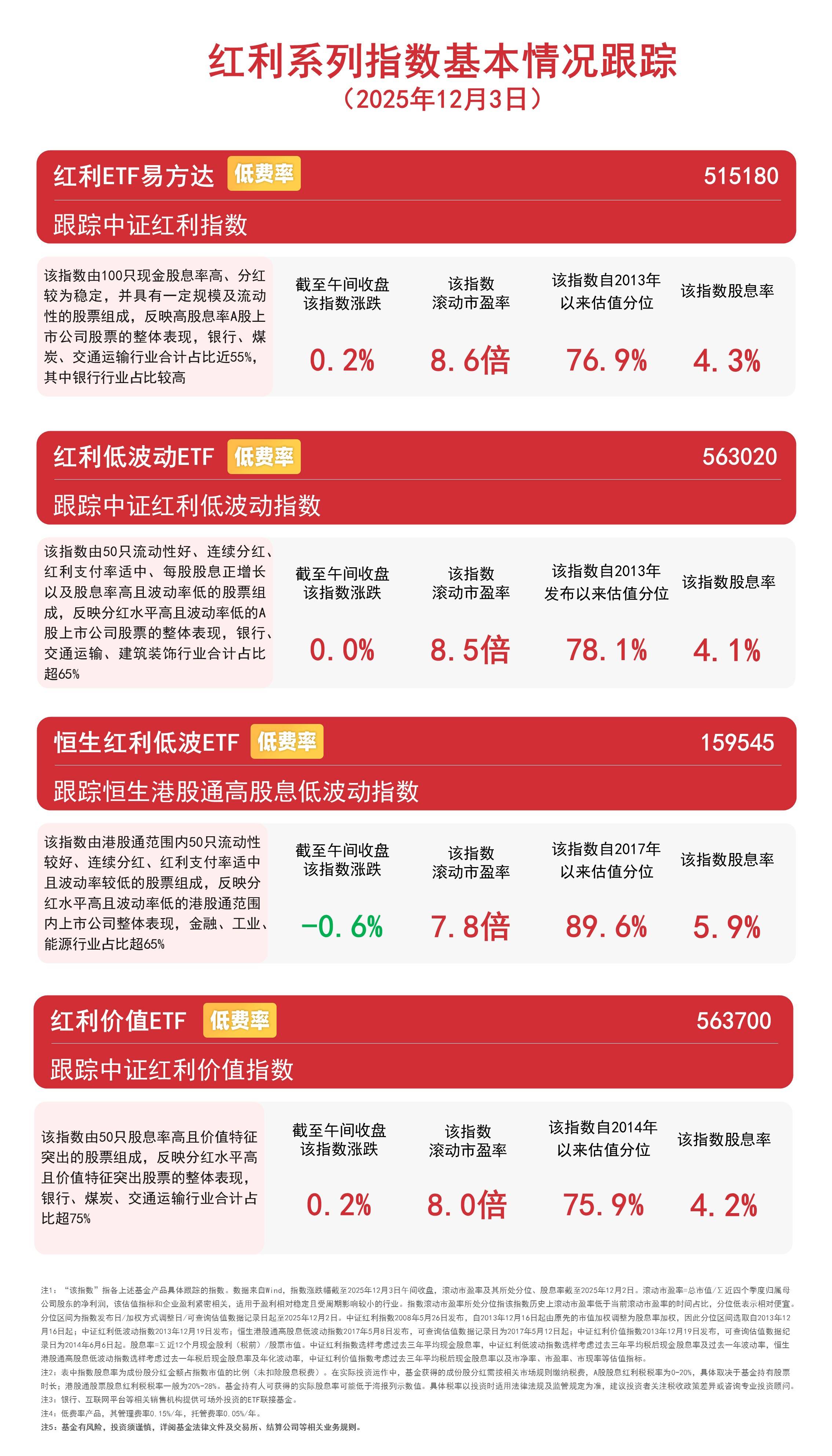
红利板块震荡分化,资金持续加仓,恒生红利低波ETF(159545)半日净申购超1亿份
Sou Hu Cai Jing· 2025-12-03 05:15
Group 1 - The core viewpoint of the news highlights the performance of dividend-related indices, with the CSI Dividend Value Index and CSI Dividend Index both rising by 0.2%, while the Hang Seng High Dividend Low Volatility Index decreased by 0.6% [1][6] - E Fund is noted as the only fund company offering low fee rates for all dividend ETFs, with management fees set at 0.15% per year for various products, facilitating low-cost investment in high-dividend assets [1][5] - The CSI Dividend Index comprises 50 stocks characterized by good liquidity, continuous dividends, moderate payout ratios, positive growth in dividends per share, and low volatility, with banking, transportation, and construction industries accounting for over 65% of the index [4] Group 2 - The Hang Seng High Dividend Low Volatility Index consists of 50 stocks within the Hong Kong stock market that exhibit good liquidity, continuous dividends, moderate payout ratios, and low volatility, with financial, industrial, and energy sectors making up over 65% of the index [6] - The Hang Seng Low Dividend ETF (159545) has seen a net subscription exceeding 100 million units in the first half of the day [1]
年底“发行战”!超60只新基金,定档12月
Zhong Guo Zheng Quan Bao· 2025-12-03 04:37
Core Insights - The issuance of new funds remains strong in December, with over 60 funds starting or about to start issuance as of December 2, 2023, marking a significant increase compared to previous years [1][2][3] Fund Issuance Trends - As of December 2, 2023, a total of 1450 new funds have been issued this year, surpassing last year's total of 1143 and reaching a three-year high [1][3] - On December 1 alone, 28 new funds were launched, indicating a competitive environment for fund issuance in December [1][2] Types of Funds Issued - Equity funds are the dominant category among newly issued funds, with 26 stock funds and 16 mixed funds launched in December, primarily consisting of passive funds [2][3] - Notable fund managers are involved in the management of some new equity funds, such as Yang Dong for the Guangfa Quality Selection fund [2] - In addition to equity funds, 14 bond funds, 7 Funds of Funds (FOFs), and 1 Qualified Domestic Institutional Investor (QDII) fund were also issued in December [2] Fund Company Activity - Major fund companies are leading the issuance, with several launching multiple new funds simultaneously, including Ping An Fund and Penghua Fund, each with 4 new funds [2] - Other companies like China Merchants Fund and Guotai Fund have also launched multiple new funds, indicating a trend among larger firms to expand their offerings [2] Fund Characteristics - Some new funds have short subscription periods, with certain funds having a subscription period of only 1 day or 5 days [2] - The total issuance volume for new funds this year has reached 10,359.09 million units, with a significant portion attributed to equity funds [3] Innovation in Fund Offerings - The public fund industry is innovating with new product lines, including credit bond ETFs, Sci-Tech Board comprehensive ETFs, and floating rate funds, enhancing the investment landscape [4]
两市ETF两融余额减少7676.87万元丨ETF融资融券日报
2 1 Shi Ji Jing Ji Bao Dao· 2025-12-03 02:41
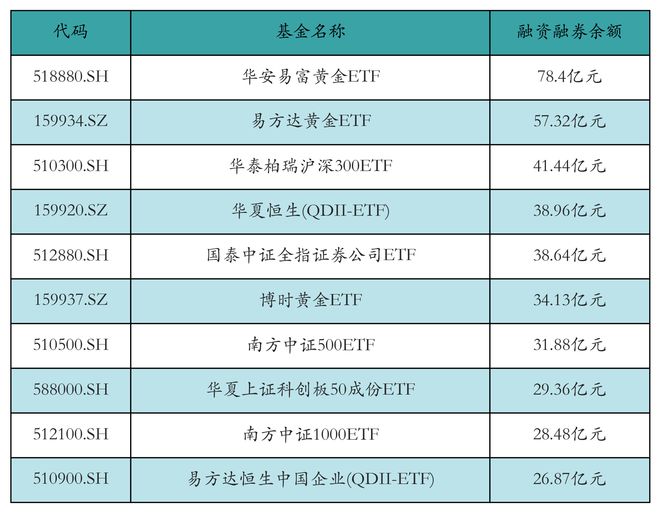
Market Overview - As of December 2, the total ETF margin balance in the two markets is 118.26 billion yuan, a decrease of 76.77 million yuan from the previous trading day [1] - The financing balance is 110.18 billion yuan, down by 40.66 million yuan, while the securities lending balance is 8.08 billion yuan, a decrease of 36.11 million yuan [1] - In the Shanghai market, the ETF margin balance is 82.76 billion yuan, a decrease of 13 million yuan, with a financing balance of 75.66 billion yuan, down by 102 million yuan [1] - In the Shenzhen market, the ETF margin balance is 35.50 billion yuan, an increase of 53.54 million yuan, with a financing balance of 34.51 billion yuan, up by 61.76 million yuan [1] ETF Margin Balances - The top three ETFs by margin balance on December 2 are: - Huaan Yifu Gold ETF (7.84 billion yuan) - E Fund Gold ETF (5.73 billion yuan) - Huatai-PB CSI 300 ETF (4.14 billion yuan) [2] ETF Financing Buy Amounts - The top three ETFs by financing buy amounts on December 2 are: - Haifutong CSI Short Bond ETF (857 million yuan) - Huatai-PB Southern Dongying Hang Seng Technology Index (646 million yuan) - Bosera CSI Convertible Bonds and Exchangeable Bonds ETF (610 million yuan) [3][4] ETF Financing Net Buy Amounts - The top three ETFs by financing net buy amounts on December 2 are: - Huaxia Shanghai Stock Exchange Sci-Tech Innovation Board 50 ETF (32.47 million yuan) - Penghua CSI Wine ETF (27.71 million yuan) - Bosera Shanghai Stock Exchange 30-Year Treasury Bond ETF (27.06 million yuan) [5][6] ETF Securities Lending Sell Amounts - The top three ETFs by securities lending sell amounts on December 2 are: - Southern CSI 500 ETF (44.09 million yuan) - Southern CSI 1000 ETF (27.26 million yuan) - Bosera CSI Convertible Bonds and Exchangeable Bonds ETF (14.80 million yuan) [7][8]
券商发债融资刷新历史纪录,年内发行规模1.71万亿;公募扎堆上报科技类ETF | 券商基金早参
Mei Ri Jing Ji Xin Wen· 2025-12-03 01:16
Group 1 - The bond financing by brokerages has reached a historical high, with a total issuance scale exceeding 1.71 trillion yuan, marking a year-on-year increase of 44.94% [1] - A total of 923 bonds have been issued by brokerages, representing a year-on-year growth of 46.97%, indicating strong expansion momentum in the industry driven by liquidity and business needs [1] - Major brokerages such as Galaxy Securities, Guotai Junan Securities, and Huatai Securities have issued over 100 billion yuan in bonds, which will strengthen their capital positions and support stock price valuations [1] Group 2 - The total fundraising scale of newly established funds has surpassed 1 trillion yuan this year, with the top ten fund companies capturing 33.9% of the total market funds [2] - E Fund has raised over 50 billion yuan from newly established funds, ranking first, while 38 small and medium-sized public funds have raised less than 1 billion yuan, highlighting a significant disparity in the market [2] - The recovery in fund issuance indicates a return of capital to equity assets, but the increasing concentration of funds among leading firms may intensify survival pressures for smaller companies [2] Group 3 - A surge in the number of technology-themed ETFs has been observed, with seven public fund companies launching AI-related ETFs, indicating a rapid influx of new capital into the technology sector [3] - The approval of multiple technology ETFs, including those focused on AI, semiconductors, and robotics, is expected to enhance market attention on related tech companies and drive valuation adjustments [3] - The expansion of technology ETFs provides investors with convenient investment tools and may boost market sentiment, signaling a potential shift in market focus towards technological innovation [3] Group 4 - CITIC Securities executed a large block trade of 15.37 million shares, amounting to 380 million yuan, with a transaction price reflecting a discount of 1.98% compared to the closing price [4] - Over the past three months, the total transaction amount for this stock has reached 746 million yuan, indicating ongoing adjustments in holdings by certain funds [4] - The increased activity in block trades may support market liquidity, but the occurrence of discounted transactions raises concerns about short-term volatility risks [4]
A股赚钱效应显著公募百亿定增扫货
2 1 Shi Ji Jing Ji Bao Dao· 2025-12-03 00:57
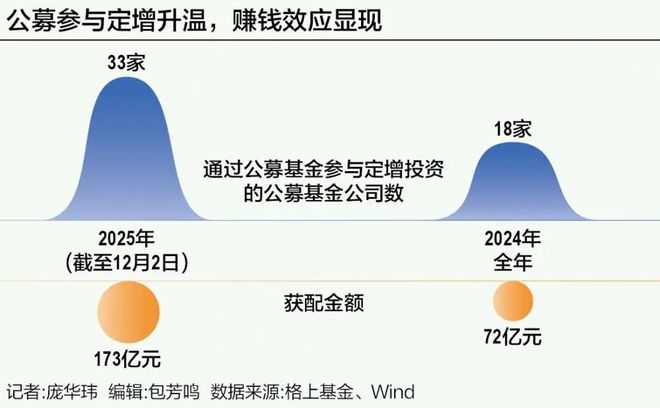
Core Insights - The A-share private placement market is experiencing significant participation from public funds in 2025, with 33 fund companies involved and a total allocation amounting to 17.3 billion yuan, representing a 140% increase compared to the entire year of 2024 [1][5][8] Group 1: Market Participation - Public funds have shown a marked increase in enthusiasm for private placements, with a total allocation of 17.3 billion yuan in 2025, up from 7.2 billion yuan in 2024, indicating a growth of over 100 billion yuan [5][6] - Leading public fund companies include E Fund with 3.687 billion yuan, followed by GF Fund, Fortune Fund, and China Universal Fund with allocations of 2.288 billion yuan, 1.529 billion yuan, and 1.463 billion yuan respectively [5][6] Group 2: Investment Focus - The investment focus of public funds is heavily concentrated in hard technology sectors, particularly in semiconductors, artificial intelligence, and innovative pharmaceuticals, reflecting a strong alignment with the ongoing "technology bull" market [6][8] - Notable allocations in the electronics sector reached 7.45 billion yuan, while the biopharmaceutical sector saw allocations of 5.6 billion yuan, targeting companies like Cambricon, Chipone, and innovative drug firms [6][8] Group 3: Market Drivers - The resurgence of private placements is driven by three main factors: policy incentives, a safety margin due to discount pricing, and significant profit potential observed by participating public funds [8] - The current trend shows increased participation, improved returns, and a strong focus on technology and high-end manufacturing sectors, with expectations for continued growth in public fund involvement in private placements [8]




A股赚钱效应显著公募百亿定增扫货
21世纪经济报道· 2025-12-03 00:47
Core Insights - The A-share private placement market is experiencing significant growth, with public funds participating deeply in 2025, leading to a total allocation of 17.3 billion yuan, a 140% increase compared to the entire year of 2024 [1][3][4] Group 1: Market Participation - A total of 33 public fund companies have participated in private placements, with the leading fund, E Fund, securing 3.687 billion yuan [3][4] - Other notable funds include GF Fund, Fortune Fund, and China Universal Fund, with allocations of 2.288 billion yuan, 1.529 billion yuan, and 1.463 billion yuan respectively [3][4] - The trend shows a competitive landscape where larger funds dominate, but smaller funds are also actively participating [3][4] Group 2: Investment Focus - Public funds are primarily focusing on hard technology sectors, particularly semiconductors, artificial intelligence, and innovative pharmaceuticals, reflecting a strong alignment with industry trends [4][5] - The electronic industry received 7.45 billion yuan in allocations, while the biopharmaceutical sector saw 5.6 billion yuan, with key companies like Cambricon, Chipone, and Bairi Tianheng being major targets [4][5] Group 3: Market Drivers - The resurgence in private placements is driven by three main factors: policy incentives, built-in discount safety, and significant profit potential [7] - The favorable policy environment encourages capital market support for the real economy, especially in technology sectors [7] - The overall performance of public funds in private placements has been strong, further motivating institutional participation [7]