
小米

Search documents
小米旗下瀚星创投等入股宁波坤林科技
Xin Lang Cai Jing· 2025-09-22 06:53
Group 1 - Ningbo Kunlin Technology Co., Ltd. has undergone a business change, with Xiaomi's Huanxing Venture Capital Co., Ltd. and Astrend V (Hong Kong) Beta Limited added as shareholders [1] - The registered capital of Ningbo Kunlin Technology has increased from 6.25 million RMB to approximately 7.35 million RMB [1] - The company was established in November 2023, with Zhang Xiangfu as the legal representative, and its business scope includes research and sales of household appliances [1] Group 2 - The current shareholders include Zhang Xiangfu, Kunmao (Ningbo) Enterprise Management Partnership (Limited Partnership), Biyi Co., Ltd. (603215), and the newly added shareholders [1]
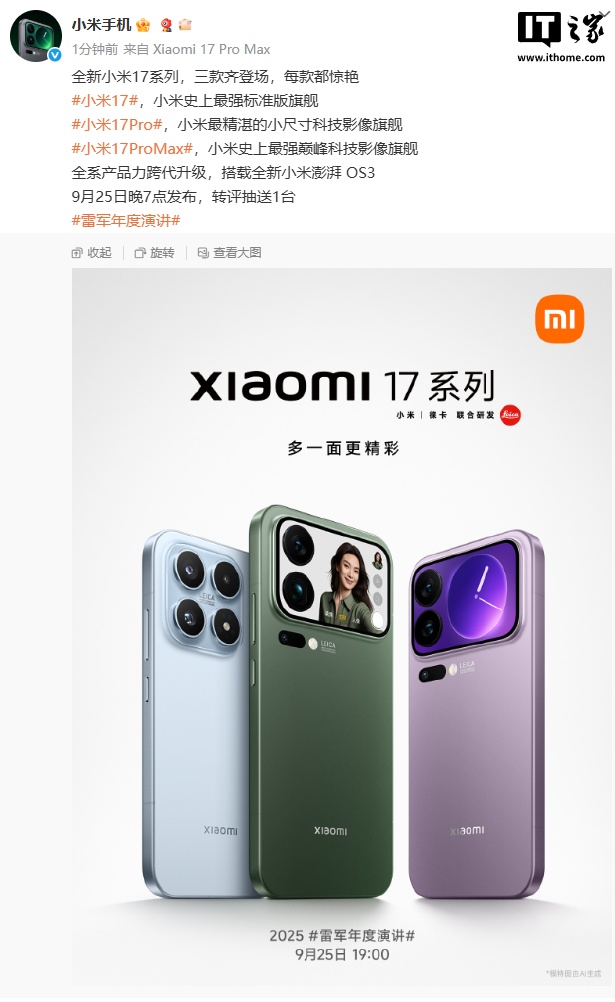
小米 17 系列手机官宣 9 月 25 日发布:三款齐登场,搭载澎湃 OS3
Xin Lang Cai Jing· 2025-09-22 05:37
Core Points - Xiaomi has announced the launch of the new Xiaomi 17 series, which will debut on September 25 at 7 PM [1][2] - The series includes three models: Xiaomi 17, Xiaomi 17 Pro, and Xiaomi 17 Pro Max, each representing significant upgrades in product capabilities [1][2] - All models will feature the new Xiaomi Surge OS 3, indicating a cross-generation enhancement in technology [1][2] Product Details - Xiaomi 17 is described as the strongest standard flagship in the company's history [1][2] - Xiaomi 17 Pro is positioned as the most refined small-sized technology imaging flagship [1][2] - Xiaomi 17 Pro Max is touted as the strongest peak technology imaging flagship ever produced by Xiaomi [1][2]

手机厂商与面板巨头加深捆绑
2 1 Shi Ji Jing Ji Bao Dao· 2025-09-22 04:47
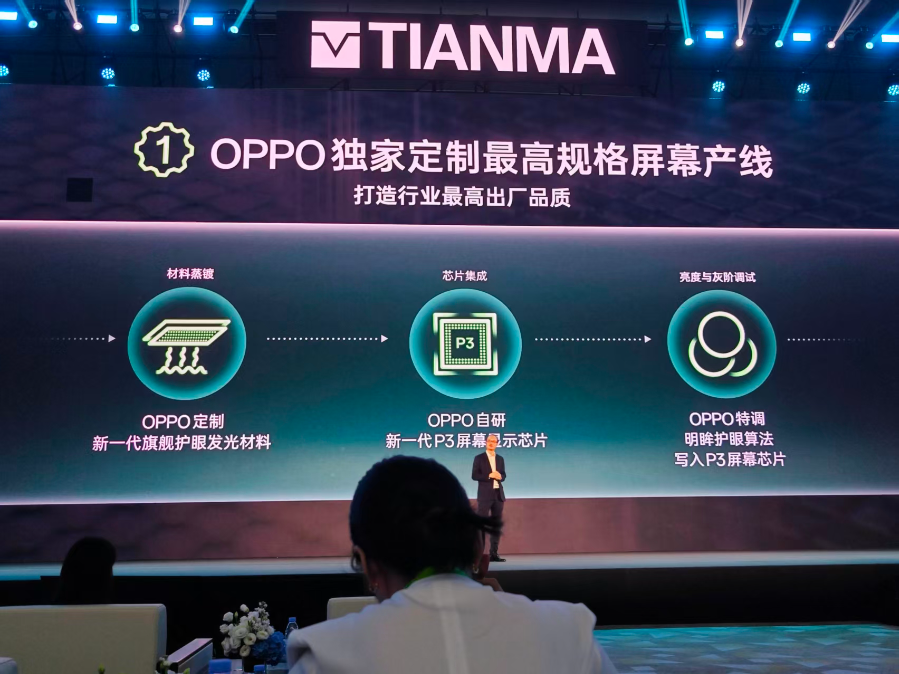
Core Viewpoint - The smartphone industry is witnessing a shift from a traditional "buyer-supplier" relationship to a collaborative model where manufacturers engage deeply in the definition, development, and production of display technologies, reshaping the competitive landscape of the display panel industry [2][4][8]. Group 1: New Collaboration Paradigm - Smartphone manufacturers are no longer passive purchasers but are becoming strategic partners with panel manufacturers, engaging in joint research and deep customization [2][4]. - OPPO has invested over 1 billion in establishing its own "display science production line," allowing it to control the entire process from design to production [4][5]. - The collaboration between Xiaomi and TCL Huaxing has evolved into a long-term partnership, creating an "innovation display joint laboratory" to streamline technology development and production [5][8]. Group 2: Industry Dynamics - The traditional supply chain structure is being transformed from a linear model to a networked "industry alliance," enhancing the bargaining power of smartphone manufacturers [8][9]. - Chinese panel manufacturers are expected to capture over 70% of the global smartphone panel market by 2025, providing manufacturers with more options and stronger negotiation capabilities [8][10]. - The shift to deep collaboration is accelerating technological iteration and redefining market competition rules, moving the focus from macro parameters to underlying technologies [10][11]. Group 3: Technological Advancements - The competition in the smartphone market is increasingly centered around display technology, with companies like OPPO and Tianma developing advanced features such as precise light control at ultra-low brightness [10][11]. - The joint development model allows manufacturers to align market needs with technological paths early in the research phase, significantly reducing the time from lab to market [10][11]. - The relationship between Apple and Samsung exemplifies a unique "co-opetition," where stringent standards and large orders from Apple drive Samsung to innovate continuously [6][10].

手机厂商与面板巨头加深捆绑
21世纪经济报道· 2025-09-22 04:41
Core Viewpoint - The article discusses the evolving relationship between smartphone manufacturers and panel suppliers, highlighting a shift from a traditional procurement model to a collaborative co-creation model, which enhances competitive advantages in the smartphone market [2][10]. Group 1: New Collaboration Paradigm - Smartphone manufacturers are no longer passive "purchasers" but are deeply involved in defining, developing, and producing display technologies, forming strategic partnerships with panel giants [2][5]. - This shift from "procurement" to "co-creation" is a natural outcome of the smartphone industry's transition from product-level competition to supply chain-level competition, accelerating technology iteration and reshaping the global display panel industry's power dynamics [2][10]. Group 2: Case Studies of Collaboration - OPPO has invested over 1 billion in establishing its own "display science production line" and has customized a dedicated production line with Tianma, allowing it to control the entire process from design to production [5][11]. - Xiaomi and TCL Huaxing have established an "Innovation Display Joint Laboratory," creating a complete closed loop from technology research to mass production, which enhances their collaborative growth [6][10]. - The relationship between Apple and Samsung is characterized by a unique "co-opetition," where Apple drives Samsung's technological innovation through stringent standards and large orders, influencing industry technology trends [7][10]. Group 3: Industry Impact and Market Dynamics - The deepening collaboration between smartphone manufacturers and panel suppliers is fundamentally reshaping the supply chain's power structure and the speed of technology iteration [9][10]. - The rise of Chinese panel manufacturers like BOE and TCL Huaxing is changing the competitive landscape, with predictions that their market share in the global smartphone panel market will exceed 70% by 2025 [10]. - The traditional linear supply chain is evolving into a networked "industry alliance," where smartphone manufacturers provide precise market demands and panel manufacturers contribute their expertise in materials and processes [10][11]. Group 4: Future Considerations - The deep customization and joint development require significant upfront investment, raising questions about whether these costs will be passed on to consumers, potentially increasing flagship smartphone prices [12]. - The trend towards exclusive custom screens may reduce their universality, leading to higher repair costs for consumers, prompting ongoing observation of whether the industry will continue down a path of deeper customization or establish new, higher industry standards [12].
港股午评:恒指跌0.99%,科技股、金融股弱势,半导体股继续活跃
Ge Long Hui A P P· 2025-09-22 04:09
Market Overview - The Hong Kong stock market experienced a collective decline in the morning session, with all three major indices dropping over 1.1% [1] - As of the midday break, the Hang Seng Index fell by 0.99%, the Hang Seng China Enterprises Index decreased by 1.3%, and the Hang Seng Tech Index dropped by 1.18% [1] Sector Performance - Major technology stocks, which serve as market indicators, collectively declined, with Meituan, Kuaishou, and JD.com each falling nearly 3%, and NetEase down by 2% [1] - Other significant players like Xiaomi, Tencent, and Alibaba also reported losses, while Baidu saw a contrary increase of over 2% [1] - The financial sector, including banks, insurance, and brokerage firms, showed weak performance overall [1] Shipping and Logistics - The impending implementation of high port fees led to a broad decline in shipping and port-related stocks, with China Merchants Energy and Seaspan International among the hardest hit [1] Other Sector Movements - Stocks related to Tesla, sports goods, automotive, home appliances, coal, catering, and military industries all experienced declines [1] - Conversely, strong pre-order demand for new iPhone models in China, coupled with anticipated AI features, boosted Apple-related stocks, with Hong Teng Precision surging over 17% [1] - Semiconductor stocks, particularly those involved in domestic replacements, saw a general increase, with leading firm SMIC rising over 3% [1] - Additionally, paper, biopharmaceutical, and gold stocks mostly experienced upward movements [1]
特斯拉Optimus Gen3订单“利空”被证伪,产业链上市公司迎催化!
Robot猎场备忘录· 2025-09-22 04:03
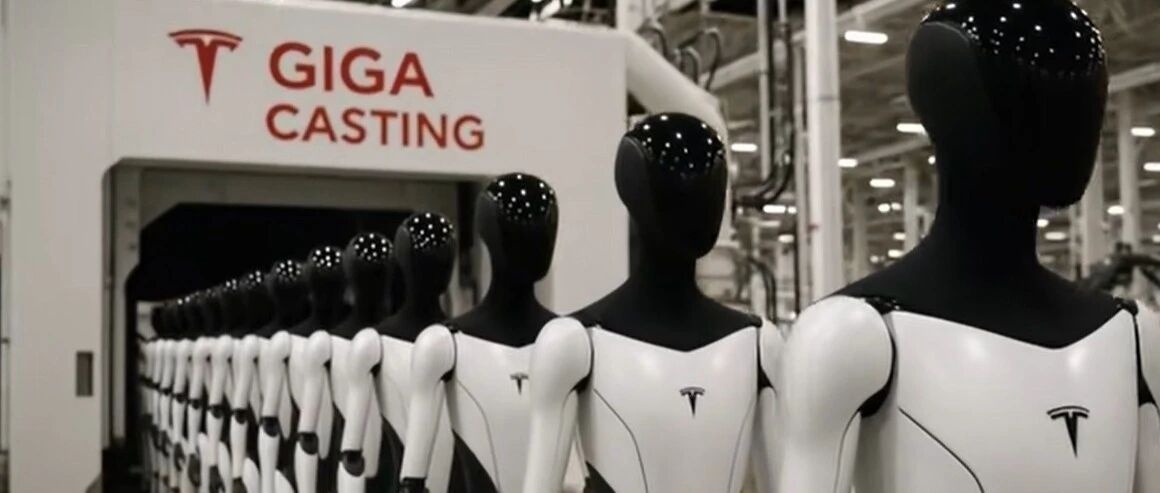
Core Viewpoint - The article discusses the recent developments in the robotics sector, particularly focusing on Tesla's Optimus and the T-chain, highlighting the correction of misinformation regarding a supposed order for 10,000 units of Optimus, which was deemed false [3][6][7]. Summary by Sections Tesla Optimus Developments - The article mentions that the initial negative news regarding Tesla's Optimus was proven false, leading to a more rational perspective on the situation [3][4]. - A significant point of contention was a report from PharmAGRI claiming a letter of intent for 10,000 units, which was later denied by Elon Musk, indicating that the information was misleading [3][6]. Market Reactions - Following the clarification of the misinformation, Tesla's stock rose over 2%, showing resilience against the perceived negative news [6]. - The article notes that the robotics sector experienced volatility, with significant fluctuations in stock prices, particularly among T-chain companies [4][7]. External Supplier Insights - Recent communications from potential T-chain suppliers indicate positive developments, with clear order guidance from Tesla and successful collaborations with Tier 1 suppliers [8][9]. - Specific suppliers have reported progress in developing robotic modules and are entering testing phases, which bodes well for the overall supply chain [9]. Upcoming Events and Expectations - The article outlines key upcoming events that could impact the robotics sector, including Tesla's production meetings and the anticipated IPO of Yushutech, which are expected to generate further interest and investment [11]. - The overall sentiment in the robotics sector is cautiously optimistic, with expectations for more positive developments in the fourth quarter [11].

「一页纸」吃透产业链之:人形机器人,Figure链与特斯拉Optimus链
3 6 Ke· 2025-09-22 03:38
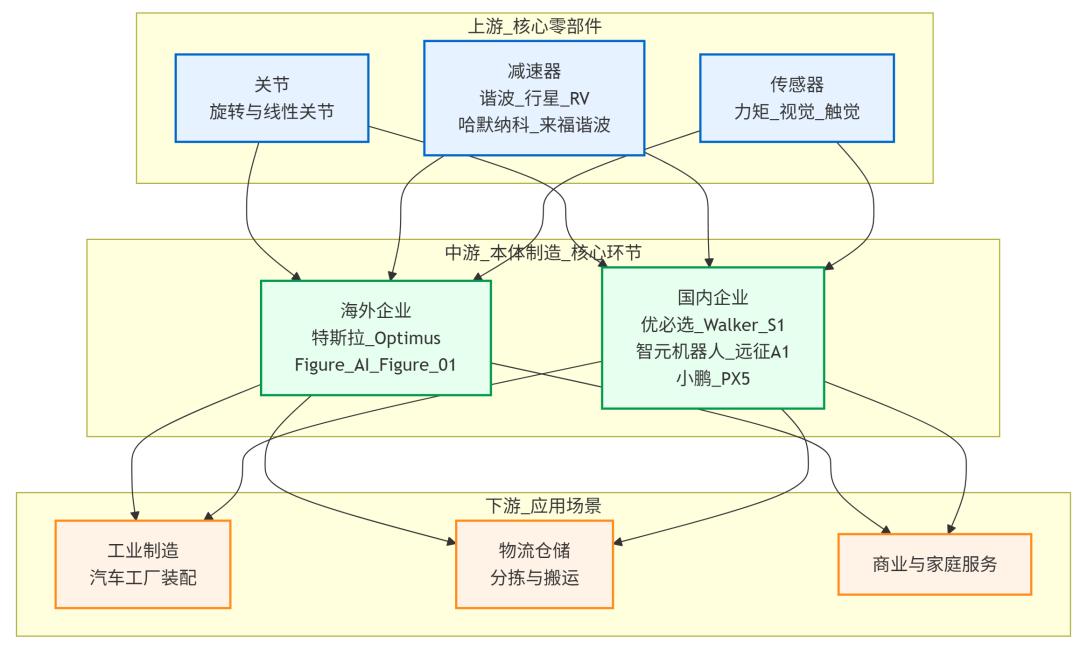
Group 1 - The humanoid robot industry is at a critical turning point, transitioning from R&D demonstrations to mass production, with 2025-2026 seen as key for scaling and commercialization [1][17] - Major players like Tesla (Optimus plan for mass production in 2026), Figure AI, and domestic companies such as UBTECH are driving the industry forward [1][2] - The industry is characterized by a dual approach of "hardware cost reduction" and "software intelligence enhancement," primarily driven by B-end industrial applications, especially in automotive manufacturing [1][2] Group 2 - The global competitive landscape is forming, with overseas giants like Tesla and Figure AI leading in AI algorithms and system integration, while domestic companies leverage China's strong automotive and 3C supply chains for cost advantages [2][22] - The humanoid robot supply chain consists of three main segments: upstream core components, midstream body manufacturing, and downstream application scenarios [3][6] Group 3 - The humanoid robot industry faces significant challenges, including high hardware costs, insufficient mass production capabilities, and limited battery life [8][9][11] - Software challenges include inadequate generalization capabilities, scarcity of high-quality data, and constraints on real-time performance and computing power [12][13][14] Group 4 - The market for humanoid robots is expected to explode, with projections of over 70 million units shipped globally and a market size exceeding 10 trillion yuan by 2045 [17][18] - The industrial manufacturing sector is the primary focus for breakthroughs, with applications expanding into logistics and eventually household services [19][20] Group 5 - Key players in the humanoid robot industry include overseas giants like Tesla and Figure AI, domestic first-tier startups like UBTECH and ZhiYuan Robotics, and cross-industry automotive companies [22][23] - Tesla's Optimus robot is advancing towards mass production, with ambitious production targets and technological enhancements aimed at improving human-like dexterity and interaction capabilities [29][30]

300家机构齐调研汇川技术,机器人板块热度高企!机器人ETF基金(159213)涨近1%,连续5日获资金净申购!国产人形机器人的产业化进程到哪了?
Sou Hu Cai Jing· 2025-09-22 03:27
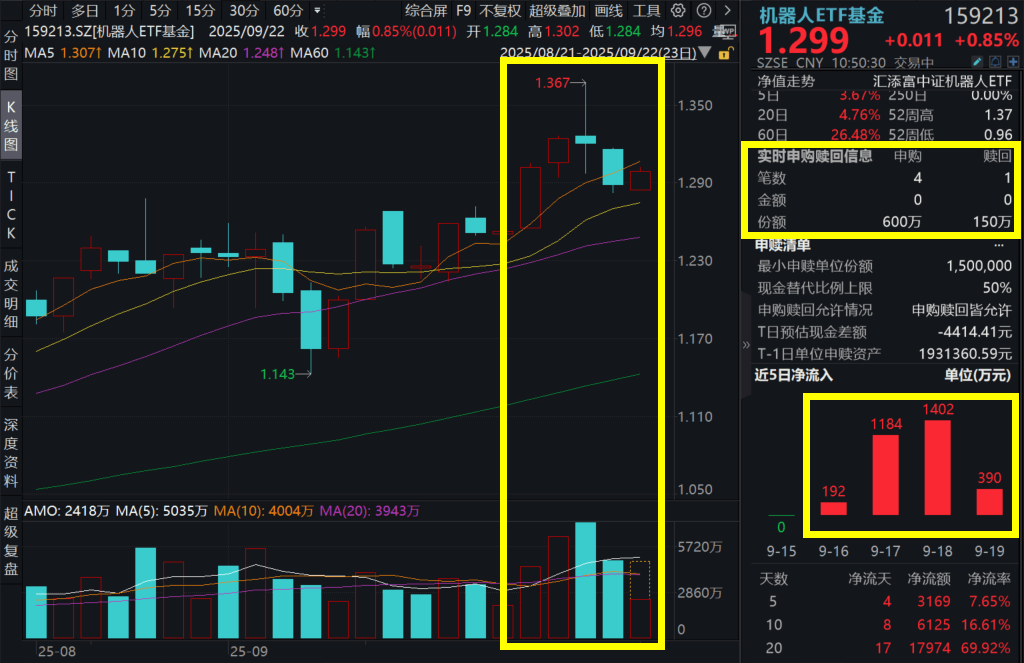
Core Viewpoint - The robotics sector is experiencing a resurgence, with significant investment and interest in humanoid robots, driven by policy support, technological advancements, and active capital participation [5][6][9]. Group 1: Market Performance - On September 22, technology stocks rebounded, with the robotics ETF (159213) rising nearly 1% and attracting a net subscription of 6 million yuan, following four consecutive days of over 30 million yuan in net inflows [1]. - The component stocks of the robotics ETF showed mixed performance, with Dazhu Laser rising over 6% and Shitou Technology dropping over 7% [2][3]. - In September, Huichuan Technology was investigated by 320 institutions, including 157 foreign institutions and 48 fund companies, indicating high market interest in the robotics sector [4]. Group 2: Industry Development - The humanoid robot industry in China is accelerating due to policy support, with a "three-step" goal set by the central government and regional differentiation in development strategies [6]. - Domestic companies are achieving significant results in core component localization and lightweight design, while foreign firms lead in hardware design and AI decision systems [6]. - Leading startups like Yushu Technology and UBTECH are beginning small-scale deliveries, with production capacity expected to ramp up, potentially leading to mass production cycles [6]. Group 3: Technological Innovations - Domestic automotive and technology companies are rapidly entering the humanoid robot field, employing different strategies [7]. - Tech companies focus on software capabilities, while automotive firms leverage existing technologies and supply chains for quick deployment [7]. - Companies like Xiaomi and GAC are integrating their technologies into humanoid robots, creating diverse ecological layouts [7]. Group 4: Commercialization and Future Outlook - The commercialization of humanoid robots is progressing rapidly, with several startups expected to emerge in 2024 [9]. - Notable companies have established commercial partnerships with well-known automotive and logistics firms, with some already achieving large-scale deliveries [9]. - The year 2025 is anticipated to be a key production milestone for many startups, with significant sales expected as domestic companies fulfill orders and meet growing demand [9].

华为将投150亿发展生态;淘宝闪购团购业务上线丨新鲜早科技
2 1 Shi Ji Jing Ji Bao Dao· 2025-09-22 02:35
Group 1: Technology Sector Developments - Huawei plans to invest 15 billion yuan in ecosystem development, with over 1,300 software and hardware products compatible with HarmonyOS and 17 million devices running HarmonyOS 5 [2] - Neuralink aims to start brain-computer interface trials in October for individuals who have lost their ability to speak, allowing them to convert thoughts into text without a keyboard [3] - Xiaomi's collaboration with Apple allows for deeper integration of Apple CarPlay in Xiaomi vehicles, with over 50% of Xiaomi SU7 owners using Apple phones [4] Group 2: Regulatory and Compliance Responses - Weibo has established a special rectification team to address issues raised by regulatory authorities regarding the management of trending topics and information content [5] - Kuaishou has also formed a special team to improve its trending topic management mechanisms in response to regulatory feedback [6] - TikTok's parent company, ByteDance, is committed to complying with Chinese laws while ensuring TikTok's continued operation in the U.S. [7] Group 3: Business Collaborations and Investments - Midea Group and Huawei have signed a strategic cooperation agreement to leverage their strengths in technology and information communication across various sectors [9] - Zhejiang Shikong Daoyu has secured 2 billion yuan in investments for its global headquarters project and business development in satellite communications [15] - Baoli International plans to invest in semiconductor testing equipment company Hongtai Technology, reflecting confidence in the semiconductor testing industry [16] Group 4: Market and Product Launches - Taobao has launched a trial for its flash purchase group buying service in cities like Shanghai and Shenzhen, covering various food categories [8] - Microsoft will increase the prices of several Xbox consoles in the U.S. starting in October due to changes in the macroeconomic environment [10]
国星光电(002449) - 2025年9月19日投资者关系活动记录表
2025-09-22 01:19
Group 1: Business Expansion and Strategy - The company plans to optimize its layout and actively pursue investment and mergers to promote business synergy, focusing on expanding LED applications and developing new products in emerging industries [2][3] - The company is extending its industrial chain by developing ultra-high-definition display modules and smart home display modules while also exploring new business products like optical coupling products and automotive LED products [3][4] Group 2: Financial and Investment Activities - The company is currently preparing the necessary documentation for a private placement, targeting up to 35 specific investors, including its controlling shareholder, Foshan Lighting [3][4] - The company has decided to optimize its financing structure by shifting from short-term financing notes to a private placement based on a comprehensive assessment of market conditions and funding needs [3][4] Group 3: Product Development and Market Position - The automotive LED division is focused on developing and selling LED devices and modules for automotive lighting and displays, with products covering both exterior and interior applications [3][4] - In the first half of 2025, the company's overseas business revenue accounted for 21.56%, indicating a strategic push to enhance its international market presence [4]
