蔚来

Search documents
AI+消费品:日常生活的智能重混
艺恩· 2025-12-28 06:01
Investment Rating - The report does not explicitly state an investment rating for the "AI + Consumer Products" industry. Core Insights - The integration of AI into consumer products is driven by technological advancements and evolving market demands, creating new value and experiences for consumers [14]. - The market for "AI + Consumer Products" is expected to grow significantly, with projections indicating that by 2027, the penetration rates for AI smartphones and AI personal computers will reach 40% and 68% respectively [12][14]. - Social media discussions around "AI + Consumer Products" have surged, with a 117% year-on-year increase in social media volume, indicating a deepening market education phase [22]. Summary by Sections Part 01: Development Progress - The historical evolution of the consumer goods industry has laid the groundwork for AI applications, with the rise of generative AI marking a significant milestone in consumer-facing AI hardware and applications [12][14]. - The report outlines the transition from "Internet +" to "AI +" phases, highlighting the rapid growth of AI-native applications and consumer hardware [12]. Part 02: Social Media Discussion Overview - The demographic profile of social media discussions indicates that males aged 25-34 in high-tier cities are the primary audience for "AI + Consumer Products," with significant interest also from individuals over 44 [23]. - Major brands like Xiaomi and DJI have effectively utilized social media to promote their products, leading to high engagement and interaction rates [25]. Part 03: Usage Scenario Content Analysis - The report identifies four core scenarios for "AI + Consumer Products": Learning, Home/Personal Care, Entertainment/Creation, and Travel/Wearable, each with distinct product categories and technologies [18]. - In the Learning scenario, products like AI learning machines and translation pens dominate, while in the Home/Personal Care scenario, smart cleaning and health products are gaining traction [48][51]. - The Entertainment/Creation scenario features products like AI cameras and smart musical instruments, which are becoming increasingly popular among consumers [38][40]. - The Travel/Wearable scenario highlights the emergence of smart vehicles and AR glasses, showcasing significant market potential [54][57].
350亿,又一家新势力宣布破产
凤凰网财经· 2025-12-27 11:46
Core Viewpoint - The demise of Qoros Auto serves as a warning for the Chinese automotive industry, highlighting the challenges of transitioning from product development to market success in the rapidly evolving landscape of new energy vehicles [3][4]. Group 1: Qoros Auto's Exit - Qoros Auto has officially entered bankruptcy proceedings, marking the end of a brand once seen as a benchmark for high-end domestic vehicles in China [4]. - The bankruptcy was initiated by a supplier due to Qoros's long-standing debt issues, with over 1,000 enforcement actions and a total frozen equity amount exceeding 35 billion yuan [4][5]. - The company's failure reflects the harsh realities faced by traditional fuel vehicle manufacturers in the wake of the new energy and intelligent transformation wave [4][11]. Group 2: Strategic Missteps - Qoros Auto's challenges stemmed from both inherent weaknesses and strategic miscalculations, including high R&D costs and an overly ambitious product positioning that led to prices comparable to established brands without a solid consumer trust base [5][6]. - Despite initial success with its first model, Qoros 3, the company struggled with sales, averaging around 10,000 units annually from 2014 to 2016, resulting in cumulative losses exceeding 6 billion yuan [5][6]. - The acquisition by Baoneng Group in 2017, which promised significant investment, ultimately failed to revitalize the brand as Baoneng faced its own liquidity crisis, leading to operational disruptions at Qoros [6][7]. Group 3: Industry Implications - The bankruptcy of Qoros Auto is emblematic of broader systemic issues within the automotive industry, including brand building, market positioning, and technological pathways [8][11]. - The case illustrates the importance of establishing consumer trust and brand recognition over time, as Qoros's high-end positioning did not resonate with consumers unfamiliar with the brand [8][9]. - The need for strategic agility and market responsiveness is underscored, as Qoros failed to adapt to the rapid shift towards electric and intelligent vehicles, leading to its marginalization [9][10]. Group 4: Future of the Industry - The new energy vehicle sector is entering a critical phase where the focus will shift from merely having vehicles to ensuring they are user-friendly and worth long-term investment [12][17]. - Companies must evolve from being "car manufacturers" to "smart mobility technology enterprises," necessitating a comprehensive upgrade in organizational capabilities and business models [12][13]. - The competitive landscape will increasingly depend on understanding real-life scenarios and providing tailored solutions, moving away from mere technical specifications [13][14]. - The transition to software-defined vehicles will become crucial, with a focus on delivering value through software services and user engagement throughout the vehicle lifecycle [14][15]. - Global expansion will be essential for new players, as domestic markets become saturated, with emerging markets presenting new opportunities for growth [15][16]. - Sustainable development will shift from being a moral choice to a business necessity, as regulatory pressures increase and companies must build low-carbon systems across the entire supply chain [16][17].

失去的,宁德时代要拿回来|深氪
36氪· 2025-12-27 09:48
Core Viewpoint - The article discusses the competitive dynamics between leading companies in the electric vehicle battery market, particularly focusing on CATL (宁德时代) and its strategies to regain market share amidst rising competition from companies like Xiaomi and Li Auto [4]. Group 1: Negotiation Dynamics - A negotiation took place between CATL's chairman, Zeng Yuqun, and Xiaomi's chairman, Lei Jun, regarding battery supply agreements, with Xiaomi seeking to secure favorable rebate conditions [5][6]. - Xiaomi's first car, the SU7, had a high dependency on CATL for battery supply, but the second model, YU7, saw a shift towards BYD batteries, reducing CATL's share significantly [6][7]. - Xiaomi's successful sales of 130,000 units of the SU7 in its first year highlight its effective supply chain management, which has attracted numerous suppliers [7][8]. Group 2: Market Share and Financial Performance - CATL's market share in the domestic battery market has declined from 53% in 2021 to 43% currently, while its battery gross margin has also decreased to around 23% [11][12]. - The competitive landscape has forced CATL to restructure its sales team and adopt a more aggressive approach to regain lost market share [12][13]. - CATL's financial performance remains strong, with a profit of 30.5 billion yuan in the first half of the year, surpassing the total profits of 17 car manufacturers combined [55]. Group 3: Strategic Responses - CATL is expanding its production capacity, aiming to reach 1,000 GWh by next year, to meet the increasing demand for batteries [24]. - The company is also adopting a "2C strategy" to enhance its brand presence among consumers, investing nearly 10 billion yuan in marketing efforts [41][42]. - CATL's ability to deliver batteries quickly and efficiently has positioned it favorably against competitors, allowing it to capture significant orders from emerging car manufacturers like Zero Run [30][31]. Group 4: Competitive Tactics - CATL employs a "blocking tactic" by preparing resources in advance and quickly stepping in to fill gaps left by competitors, ensuring it remains a preferred supplier [31][32]. - The company has successfully captured orders from various automakers by offering competitive pricing and rapid delivery, which has made it difficult for second-tier battery manufacturers to compete [36][37]. - CATL's strategic investments in its brand and technology have solidified its position as a leader in the high-performance battery market, particularly in the ternary lithium battery segment [45][46]. Group 5: Industry Trends and Future Outlook - The article suggests that the ongoing competition between battery suppliers and automakers will continue, with companies striving to establish control over their supply chains [61]. - As automakers like Li Auto and Xiaomi explore their own battery production capabilities, the dynamics of the battery supply market are expected to evolve further [56][58]. - The future of the industry will depend on balancing cost efficiency with the need for high-quality, high-density batteries, as well as the ability to navigate the complexities of supply chain management [60].

最近的蔚来,让人倒吸一口凉气
自动驾驶之心· 2025-12-27 02:07
Core Viewpoint - NIO has experienced a remarkable turnaround in 2023, overcoming significant challenges and criticisms to achieve impressive sales milestones and operational improvements [5][10][20]. Group 1: Sales Performance - NIO's new ES8 model has achieved over 30,000 deliveries, setting a record for electric vehicles priced above 400,000 yuan [9]. - As of November 30, NIO's cumulative delivery volume reached 950,000 units, nearing the milestone of one million [13][14]. - In November, NIO delivered 36,275 vehicles, marking a year-on-year increase of 76.3%, with the NIO brand delivering 18,393 units [20]. Group 2: Organizational Changes - NIO's CEO, Li Bin, has implemented significant organizational changes, focusing on accountability and operational efficiency through a new CBU mechanism [10][25]. - The theme of NIO Day 2023 was "Growth," reflecting the company's transformation and renewed focus on operational effectiveness [24]. - NIO has restructured its business into 12 core operational units, each with clear performance targets [25]. Group 3: Market Trends - The market for high-end electric vehicles is rapidly expanding, with pure electric SUVs surpassing hybrid and fuel models in sales for the first time [36]. - The penetration rate of pure electric vehicles in the 300,000 yuan and above market has increased from 12% to 18% year-on-year [36]. - NIO's product offerings, including the ES8 and L90, align well with market trends, positioning the company for future growth [44]. Group 4: Future Outlook - NIO plans to launch three new models in 2024, which are expected to perform well in the expanding electric vehicle market [44]. - The company aims to achieve profitability in Q4 2023, with a target of delivering between 120,000 to 125,000 vehicles [22][31]. - NIO's extensive battery swap network, with 3,631 stations, enhances its competitive advantage and addresses consumer concerns about charging [44].

贵金属狂欢引领年末行情,美股微跌终结连涨,中概股逆势走强
Jin Rong Jie· 2025-12-27 01:04
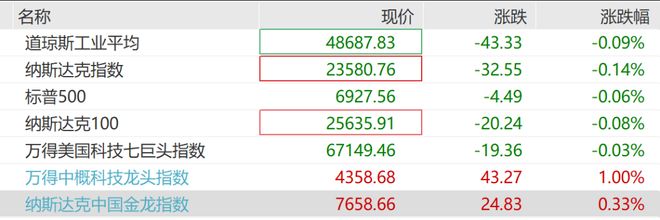
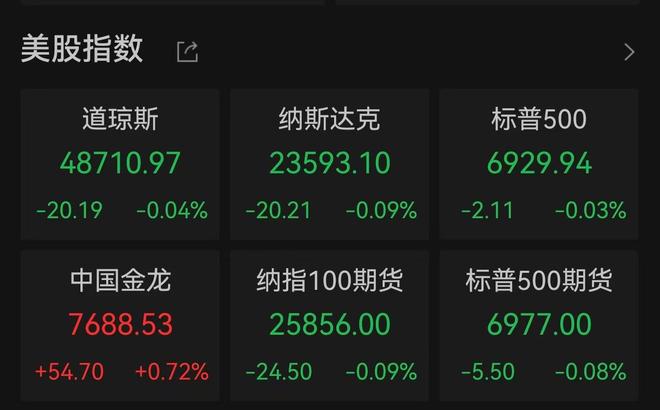
在年末的钟声即将敲响之际,全球金融市场再次展现了其变幻莫测的一面。美股市场在经历了一波连涨 之后,于周五(12月26日)出现了窄幅震荡,三大指数集体微跌,为全年的行情画上了一个暂时的逗 号。与此同时,贵金属市场却异军突起,金银价格同步创下历史新高,成为年末市场的一大亮点。 美股震荡,科技股与芯片股表现分化 周五,美股市场呈现出窄幅震荡的态势,道琼斯指数微跌0.04%,报48710.97点;标普500指数下跌 0.03%,收于6929.94点;纳斯达克综合指数也下滑0.09%,至23593.10点。尽管三大指数均有所回落, 但市场分析人士指出,这更多是技术性调整和仓位布局的结果,而非基本面出现重大变化。 在个股方面,大型科技股表现分化。英伟达凭借与AI芯片初创公司Groq的技术授权协议及人才招揽, 股价上涨超过1%,收于11月13日以来的最高水平。然而,特斯拉、脸书、谷歌、苹果和微软等科技巨 头则纷纷下跌,跌幅在0.06%至2.1%之间。芯片股方面,费城半导体指数微涨0.05%,但个股表现参差 不齐,台积电涨超1%,而ARM和恩智浦半导体则下跌超过1%。 | 名称 | 现价 | 涨跌 -- | | --- | ...
中概股拉升 小鹏涨超6% 蔚来涨超4% 白银暴涨10% 国际油价跳水
2 1 Shi Ji Jing Ji Bao Dao· 2025-12-26 23:39
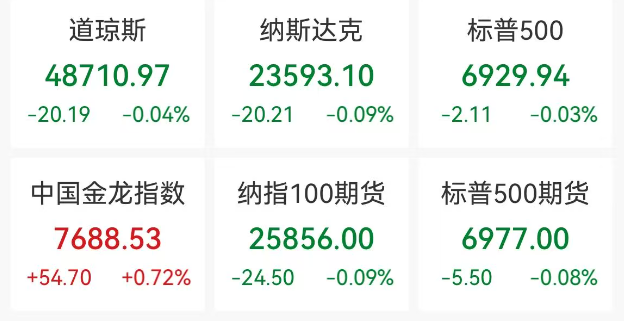
Market Overview - On December 26, the three major U.S. stock indices experienced slight declines, with the Dow Jones down 0.04% at 48,710.97 points, the S&P 500 down 0.03% at 6,929.94 points, and the Nasdaq down 0.09% at 23,593.10 points [1][2]. Technology Sector - Most large tech stocks fell, with the Wande American Technology Seven Giants Index down 0.06%. Notable declines included Tesla down over 2%, Facebook down 0.64%, Google down 0.18%, Apple down 0.15%, and Microsoft down 0.06%. However, Amazon rose 0.06% and Nvidia increased by over 1% [3]. - The Philadelphia Semiconductor Index saw a mixed performance, up 0.05%, with TSMC rising over 1% and Broadcom up 0.55%, while ARM fell over 1% and NXP Semiconductors dropped by more than 1% [3]. Chinese Stocks - Chinese stocks mostly rose, with the Nasdaq China Golden Dragon Index up 0.72% and the Wande Chinese Technology Leaders Index up 1.23%. Key performers included XPeng Motors up over 6%, Dingdong Maicai up over 5%, NIO up over 4%, Li Auto up over 3%, and Hilltop Metal Mining up over 3% [3][4]. Commodity Market - In the commodities market, safe-haven assets gained appeal amid geopolitical tensions, with gold and silver prices rising significantly. Spot gold surpassed $4,530, and spot silver exceeded $79, both marking substantial increases of over 10% [5][6]. - Conversely, international oil prices dropped sharply, with both WTI and Brent crude oil falling over 2% [5][6]. Cryptocurrency Market - The cryptocurrency market saw most assets rise, with Bitcoin regaining above $87,000. Over the past 24 hours, more than 80,000 traders faced liquidation [6][8].



中概股拉升,小鹏涨超6%,蔚来涨超4%,白银暴涨10%,国际油价跳水
2 1 Shi Ji Jing Ji Bao Dao· 2025-12-26 23:33
记者丨黎雨桐 编辑丨金珊 周五(12月26日),美国三大股指小幅收跌,道指跌0.04%报48710.97点,标普500指数跌0.03%报 6929.94点,纳指跌0.09%报23593.1点。 | 道琼斯 | 纳斯达克 | 标普500 | | --- | --- | --- | | 48710.97 | 23593.10 | 6929.94 | | -20.19 -0.04% | -20.21 -0.09% | -2.11 -0.03% | | 中国金龙指数 | 纳指100期货 | 标普500期货 | | 7688.53 | 25856.00 | 6977.00 | | +54.70 +0.72% | -24.50 -0.09% | -5.50 -0.08% | 大型科技股多数下跌,万得美国科技七巨头指数跌0.06%。个股方面,特斯拉跌超2%,脸书跌0.64%, 谷歌跌0.18%,苹果跌0.15%,微软跌0.06%,亚马逊涨0.06%,英伟达涨逾1%。 加密货币多数上涨,比特币重回87000美元上方。过去24小时超8万人爆仓。 | 13 | BTC w 7/2 $563.6亿 -0.6% | 87396 | ...
中概股拉升,小鹏涨超6%,蔚来涨超4%,白银暴涨10%,国际油价跳水
21世纪经济报道· 2025-12-26 23:27
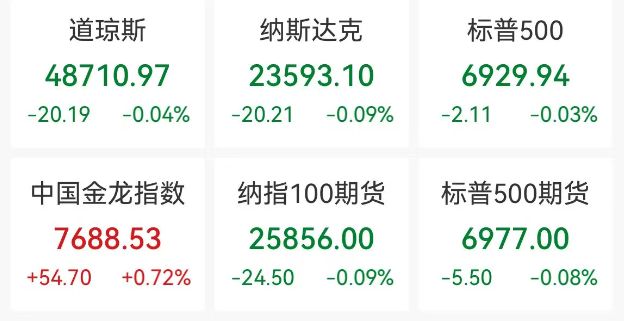
Market Overview - The three major U.S. stock indices experienced slight declines, with the Dow Jones down 0.04% at 48710.97 points, the S&P 500 down 0.03% at 6929.94 points, and the Nasdaq down 0.09% at 23593.1 points [1][2]. Technology Sector - Most large tech stocks fell, with the Wande American Technology Seven Giants Index down 0.06%. Notable declines included Tesla down over 2%, Facebook down 0.64%, Google down 0.18%, Apple down 0.15%, and Microsoft down 0.06%. However, Amazon rose 0.06% and Nvidia increased by over 1% [3]. Semiconductor Stocks - Semiconductor stocks showed mixed performance, with the Philadelphia Semiconductor Index up 0.05%. TSMC rose over 1%, Broadcom increased by 0.55%, while ARM fell over 1% and NXP Semiconductors dropped by more than 1% [3]. Chinese Stocks - Chinese stocks mostly rose, with the Nasdaq China Golden Dragon Index up 0.72% and the Wande Chinese Technology Leaders Index up 1.23%. Notable gainers included XPeng Motors up over 6%, Dingdong Maicai up over 5%, NIO up over 4%, and Li Auto up over 3% [3][4]. Commodity Market - In the commodity market, gold and silver prices increased significantly due to heightened geopolitical tensions, with spot gold surpassing $4530 and spot silver exceeding $79, both marking over 10% increases [5][6]. - Conversely, international oil prices dropped sharply, with both WTI and Brent crude oil down over 2% [6]. Cryptocurrency Market - The cryptocurrency market saw most cryptocurrencies rise, with Bitcoin regaining above $87000. Over the past 24 hours, more than 80,000 traders faced liquidation [7][8]. Geopolitical Developments - Ukrainian President Zelensky announced plans to meet with U.S. President Trump to discuss security guarantees and sensitive issues related to Ukraine. Zelensky emphasized the need for discussions on the new 20-point peace plan and related economic agreements [9][10].



美股三大指数集体微跌,金银铜铝板块涨幅居前,中概股多数收涨
Feng Huang Wang· 2025-12-26 23:03
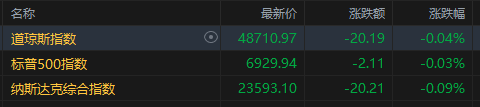
Market Overview - US stock market experienced slight declines on December 26, ending a five-day winning streak, with the Dow Jones down 0.04% at 48,710.97 points, S&P 500 down 0.03% at 6,929.94 points, and Nasdaq down 0.09% at 23,593.10 points [1][2] - For the week, the Dow Jones rose 1.2%, S&P 500 increased by 1.4%, and Nasdaq gained 1.22% [2] Analyst Insights - Tom Hainlin, a national investment strategist at U.S. Bank Asset Management, noted that the market is seeing profit-taking and buying on dips, with limited information available on corporate earnings and economic data, suggesting a focus on technical analysis and positioning [2] - Hainlin highlighted that the recent expansion trend in the stock market presents an opportunity for year-end trading, driven by financial and industrial sectors rather than technology [2] Economic Outlook - Craig Johnson, chief market technician at Piper Sandler, expressed confidence in 2026, citing benefits from the tax reform signed in July and interest rate cuts in Q4, which are favorable for the market [3] - The market remains constructive, supported by improving economic breadth and easing inflation, contributing to expectations of a holiday rally [3] Stock Performance - Major tech stocks showed mixed performance, with Nvidia rising 1.02% to its highest level since November 13, following a technology licensing agreement with AI chip startup Groq [4][5] - Other notable stock movements included Apple down 0.15%, Alphabet down 0.22%, Microsoft down 0.06%, Amazon up 0.06%, Meta down 0.64%, Broadcom up 0.55%, and Tesla down 2.10% [5] Sector Performance - The Philadelphia Semiconductor Index rose 0.05%, marking its sixth consecutive day of gains, with TSMC up 1.35% and ASML up 0.68% [6] - Precious metals saw significant gains, with silver prices exceeding $79 per ounce for the first time, and Silvercorp Metals rising 3.61% [6] Chinese Stocks - The Nasdaq Golden Dragon China Index increased by 0.72% for the week, with notable gains in Chinese stocks such as Xpeng up 6.18%, Li Auto up 3.93%, and NIO up 3.87% [6] Industry Developments - The US is re-evaluating its graphite mining strategy due to the rapid expansion of the global battery industry, with Titan Mining planning to commercialize graphite production by 2028, aiming for an annual output of approximately 40,000 tons [7] - Novo Nordisk's long-acting growth hormone, Noziv, has been approved in China for treating growth delays in children aged 2.5 years and older due to endogenous growth hormone deficiency [8] - Toyota plans to exceed a global production of 10 million vehicles by 2026, responding to strong demand for hybrid vehicles in North America [9]
美股翻绿,热门中概股深夜爆发,小鹏涨超7%,理想、蔚来集体上涨,钯金暴涨10%
2 1 Shi Ji Jing Ji Bao Dao· 2025-12-26 15:48
Market Overview - On the first trading day after Christmas, U.S. stock indices opened mixed, with the Nasdaq up 0.14% and the S&P 500 up 0.08%, while the Dow Jones fell 0.03%. However, all three indices dropped later, with the Chinese tech index showing strong performance, rising by 1% [1][2]. Company Highlights - Nvidia shares rose nearly 1.5% after U.S. President Trump announced that the government would allow Nvidia to sell H200 AI chips to China. Additionally, Nvidia's acquisition of AI chip startup Groq for approximately $20 billion set a record for the largest deal ever [2]. - Sidus Space, a space concept stock, initially surged over 40% and had a cumulative increase of over 160% for the week, although it later retreated to a 24% gain [3]. - Chinese tech stocks saw significant gains, with Dingdong Maicai rising over 20%, Xiaopeng up over 7%, and Li Auto and NIO both increasing by over 2% [3][4]. Commodity and Precious Metals - Gold and silver futures prices continued to rise, with spot gold surpassing $4,527 and spot silver reaching $75, marking the highest premium levels since 1980. Copper futures also hit a historical high, with a nearly 2% increase [7][9]. - Palladium experienced a significant increase of 10%, reaching $1,865.13 per ounce [8]. Cryptocurrency Market - The cryptocurrency market saw a decline, with Bitcoin dropping below $87,000 and Ethereum falling below $3,000. Over 95,000 traders faced liquidation in the past 24 hours [10].