中国联通

Search documents
前瞻全球产业早报:中国自研超高速实时示波器发布
Qian Zhan Wang· 2025-10-16 09:31
Group 1: Electric Vehicle Charging Infrastructure - The National Development and Reform Commission aims to establish 28 million charging facilities nationwide by the end of 2027, providing over 300 million kilowatts of public charging capacity to meet the charging needs of more than 80 million electric vehicles, achieving a doubling of charging service capacity [2] Group 2: Deep Earth Energy Exploration - China's deep drilling project in Jian'ge County, Sichuan, has successfully surpassed a depth of 10,000 meters, marking a significant advancement in deep earth energy exploration and entering the complex geological conditions of the Sichuan Basin [3] Group 3: Semiconductor Industry Developments - A self-developed 90GHz real-time oscilloscope was launched at the 2025 Bay Area Semiconductor Industry Ecosystem Expo, representing a breakthrough in high-end electronic measurement instruments, which will support advancements in next-generation communications, AI, and aerospace [4] - A subsidiary of Xinkailai released two domestically developed EDA design software products at the same expo, achieving industry-leading performance improvements of 30% and reducing hardware development cycles by 40% [7] Group 4: Trade and Economic Events - The 138th Canton Fair opened in Guangzhou, featuring a record exhibition area of 1.55 million square meters, with over 32,000 participating companies, focusing on advanced manufacturing and new energy vehicles [5] Group 5: Strategic Collaborations - SenseTime and Cambricon Technologies signed a strategic cooperation agreement to enhance software and hardware optimization and develop integrated solutions for vertical industry applications [6] Group 6: AI and Technology Initiatives - Neuralink announced a breakthrough in brain-machine interface technology, enabling a patient with ALS to perform fine motor tasks independently, showcasing advancements in assistive technology for disabled individuals [12] - OpenAI is developing new revenue channels and funding strategies as part of a five-year plan to cover over $1 trillion in commitments [14] Group 7: Economic Growth Targets - Vietnam aims for an annual GDP growth rate of at least 10% from 2026 to 2030, with a target of reaching a per capita GDP of $8,500 by 2030 [10][11]


通信行业10月16日资金流向日报
Zheng Quan Shi Bao Wang· 2025-10-16 09:23
Market Overview - The Shanghai Composite Index rose by 0.10% on October 16, with seven industries experiencing gains, led by coal and banking sectors, which increased by 2.35% and 1.35% respectively [1] - The communication industry also saw a rise of 0.74% [1] - Conversely, the steel and non-ferrous metals industries faced declines, with decreases of 2.14% and 2.06% respectively [1] Capital Flow Analysis - The main capital flow showed a net outflow of 54.29 billion yuan across both markets, with five industries recording net inflows [1] - The banking sector led the net inflow with 939 million yuan, followed by the communication industry with a net inflow of 895 million yuan [1] - A total of 26 industries experienced net outflows, with the non-ferrous metals sector seeing the largest outflow of 9.242 billion yuan, followed by the electronics sector with 7.403 billion yuan [1] Communication Industry Performance - The communication industry had a net inflow of 895 million yuan, with 125 stocks in the sector, of which 23 rose and 100 fell [2] - Notable stocks with significant net inflows included ZTE Corporation, which saw an inflow of 1.327 billion yuan, followed by Zhongji Xuchuang and Xinyi Sheng with inflows of 672 million yuan and 276 million yuan respectively [2] - The sector also had six stocks with net outflows exceeding 100 million yuan, with Zhongtian Technology, Guanghetong, and Yongding shares leading the outflows at 228 million yuan, 136 million yuan, and 129 million yuan respectively [3] Top Gainers in Communication Sector - The top gainers in the communication sector included: - ZTE Corporation: +7.20% with a turnover rate of 8.37% and a capital flow of 1.327 billion yuan [2] - Zhongji Xuchuang: +3.63% with a turnover rate of 3.10% and a capital flow of 671 million yuan [2] - Xinyi Sheng: +0.67% with a turnover rate of 3.52% and a capital flow of 276 million yuan [2] Top Losers in Communication Sector - The top losers in the communication sector included: - Zhongtian Technology: -2.73% with a capital outflow of 227 million yuan [3] - Guanghetong: -5.18% with a capital outflow of 136 million yuan [3] - Yongding Shares: -3.37% with a capital outflow of 128 million yuan [3]




eSIM国内松绑,安全问题怎么管?
Jing Ji Guan Cha Wang· 2025-10-16 09:21
近日,中国联通、中国移动、中国电信先后官宣,已正式获得开展eSIM手机运营服务商用试验的批 复,并在全国上线eSIM手机办理业务。 事实上,早在2020年前后,华为、小米、苹果等品牌已陆续上线支持eSIM的智能设备,但因管理机制 与安全体系尚不健全,eSIM迅速成为部分电信诈骗案件的"温床"。分析指出,eSIM"'一卡多号'+远程 配置"的设计,易被不法分子钻漏洞。 如,某国曾发生大规模"养号"案件,犯罪集团租用云服务器批量生成虚拟eSIM身份,每个主账号下挂 载数十个子号码,用于群发刷单返利类诈骗信息。另外,eSIM技术的跨区域远程配置功能,使得诈骗 分子可以轻松地在不同国家和地区之间切换号码,增加了追踪和打击的难度。 例如,诈骗分子可以利用eSIM技术,在中国配置一个虚拟号码,然后在东南亚等地区进行诈骗活动。 后来,国内部分二手交易平台出现"代激活eSIM"灰色服务,卖家声称能绕过运营商审核为用户开通境 外号码,实则将这些号码打包卖给电信诈骗团伙用于跨境作案。 传统SIM卡被盗,至少还需要物理接触和更换,而eSIM的远程配置特性,一旦遭遇数字身份盗用,不法 分子可能无需接触设备,便能远程劫持用户的通信服务 ...
OPPO将发布首款国产eSIM手机,兼容三大运营商
Xin Lang Cai Jing· 2025-10-16 09:01
Core Viewpoint - OPPO is set to launch its new product, the OPPO Find X9, which will feature an eSIM version, marking it as the first domestic eSIM smartphone in China [1] Group 1: eSIM Technology - eSIM, or embedded SIM card, is integrated into the device's chip, eliminating the need for physical SIM cards and enhancing waterproof and dustproof capabilities [5] - China Mobile and China Unicom have received approval to conduct commercial trials for eSIM mobile services, while China Telecom has opened eSIM service in 31 provinces [5] - As of the latest update, over 193,000 users have pre-registered for China Unicom's eSIM service [5] Group 2: OPPO's Market Position - OPPO's brand loyalty is strong, with 45% of its users opting for brand-switching, ranking it second overall and first among Android brands [6] - The OPPO Find X9 series is noted for its 200-megapixel camera, which is expected to revolutionize mobile imaging quality [8] - The new flagship series will feature a battery capacity of 7000mAh, with the standard version at 7025mAh and the Pro version at 7500mAh [8] Group 3: Smartphone Market Dynamics - According to IDC, the Chinese smartphone market is projected to see a shipment of 69 million units by Q2 2025, reflecting a 4% year-on-year decline [9] - In the latest market report, Huawei leads with a shipment of 12.5 million units, followed by Vivo and OPPO with 11.9 million and 10.7 million units, respectively [9]
港股收盘 | 恒指收跌0.09% 生物医药股表现亮眼 新消费概念走势分化
Zhi Tong Cai Jing· 2025-10-16 08:57
Market Overview - Concerns over tariffs have led to a decline in Hong Kong stocks, with the Hang Seng Index closing down 0.09% at 25,888.51 points and a total turnover of HKD 275.43 billion [1] - The Hang Seng Tech Index fell 1.18%, indicating weakness in the technology sector, while the Hang Seng China Enterprises Index saw a slight increase of 0.09% [1] Blue-Chip Stocks Performance - Pop Mart (09992) continued its upward trend, closing up 5.57% at HKD 288.2, contributing 17.6 points to the Hang Seng Index [2] - Morgan Stanley upgraded Pop Mart's investment rating to "Overweight," raising the target price from HKD 300 to HKD 320, citing attractive valuation and upcoming catalysts [2] - Other notable blue-chip performances included New Oriental-S (09901) up 8.86% and BYD Electronic (00285) up 5.01%, while Xiaomi Group-W (01810) and SMIC (00981) faced declines of 3.6% and 2.76%, respectively [2] Sector Highlights - Large technology stocks showed weak performance, with Xiaomi down 3.6%, Tencent down 1.12%, and Alibaba down 0.25% [3] - Coal and banking stocks performed well, with China Coal Energy (601898) rising over 7% and Agricultural Bank of China up nearly 3% [3] - The pharmaceutical sector continued to rise, with notable gains from Xuan Bamboo Biotechnology-B (02575) up 10.27% and Yiming Oncology-B (01541) up 5.13% [3] New Consumption Trends - The new consumption sector showed mixed results, with Lao Pu Gold (06181) up 6.21% and Pop Mart (09992) up 5.57%, while Giant Bio (02367) fell 15.31% [4] - Morgan Stanley highlighted the brand value enhancement of Lao Pu Gold, naming it a top pick in the Chinese consumer sector [4] Dividend Stocks Activity - Dividend stocks were active, with China Coal Energy (01898) up 7.26% and Agricultural Bank of China (01288) up 2.98% [5] - The market is shifting focus towards geopolitical risks, corporate earnings fundamentals, and policy effects, with a potential rotation towards value and dividend stocks [5] Apple-Related Stocks - Apple-related stocks saw some gains, with BYD Electronic (00285) up 5.01% and Hong Teng Precision (06088) up 3.05% [6] - Recent visits by Apple executives to key suppliers in China indicate ongoing collaboration and investment in the region [6] Notable Stock Movements - Yunji (02670) debuted with a significant rise of 26.05%, closing at HKD 120.5, indicating strong market interest [7] - Think Academy (01769) surged 26.48% after announcing a share issuance to enhance educational quality and fund AI projects [8] - Fenbi (02469) rose 7.09% following strong sales of its AI-driven exam preparation system [9] - Sanhua Intelligent Control (002050) fell 6.13% after clarifying rumors about large robot orders were unsubstantiated [10] - Hong Kong Telecom-SS (06823) declined 4.37% due to potential operational license revocation in the U.S. based on national security concerns [11]

工信部:到2027年基本形成全域覆盖、高效畅通的城域毫秒用算网络能力体系
Di Yi Cai Jing· 2025-10-16 08:56
Core Viewpoint - The Ministry of Industry and Information Technology (MIIT) has launched a special action plan to develop a metropolitan "millisecond computing" network, aiming for a coverage rate of at least 70% by 2027, enhancing the efficiency and accessibility of computing resources across the country [1][3]. Group 1: Overall Strategy and Goals - The initiative focuses on developing a high-speed, low-latency metropolitan network that provides millisecond-level computing resource accessibility, with specific targets for interconnection and access times [4]. - By 2027, the plan aims to achieve less than 1 millisecond latency for interconnections between medium and large computing centers and less than 10 milliseconds for applications to computing centers [4]. Group 2: Action Content - The plan includes three main actions: 1. Promoting "millisecond interconnection" between computing centers, with a target of 50% deployment of 400Gbps connections by 2027 [5]. 2. Enhancing "millisecond access" to computing resources, aiming for a coverage rate of at least 70% for 1 millisecond latency circles by 2027 [5]. 3. Improving "millisecond accessibility" for applications, targeting a network latency of less than 10 milliseconds from application terminals to computing servers by 2027 [6]. Group 3: Implementation Requirements - Local communication management departments are tasked with selecting cities with high computing resource density and good network infrastructure to implement the action plan, with a maximum of three cities per province [7]. - A mid-term evaluation will be conducted one year after the action's initiation, requiring local departments to report network monitoring data to the national platform [7]. - At the end of the action period, a summary of the implementation will be required, with results evaluated and published by the MIIT [8].
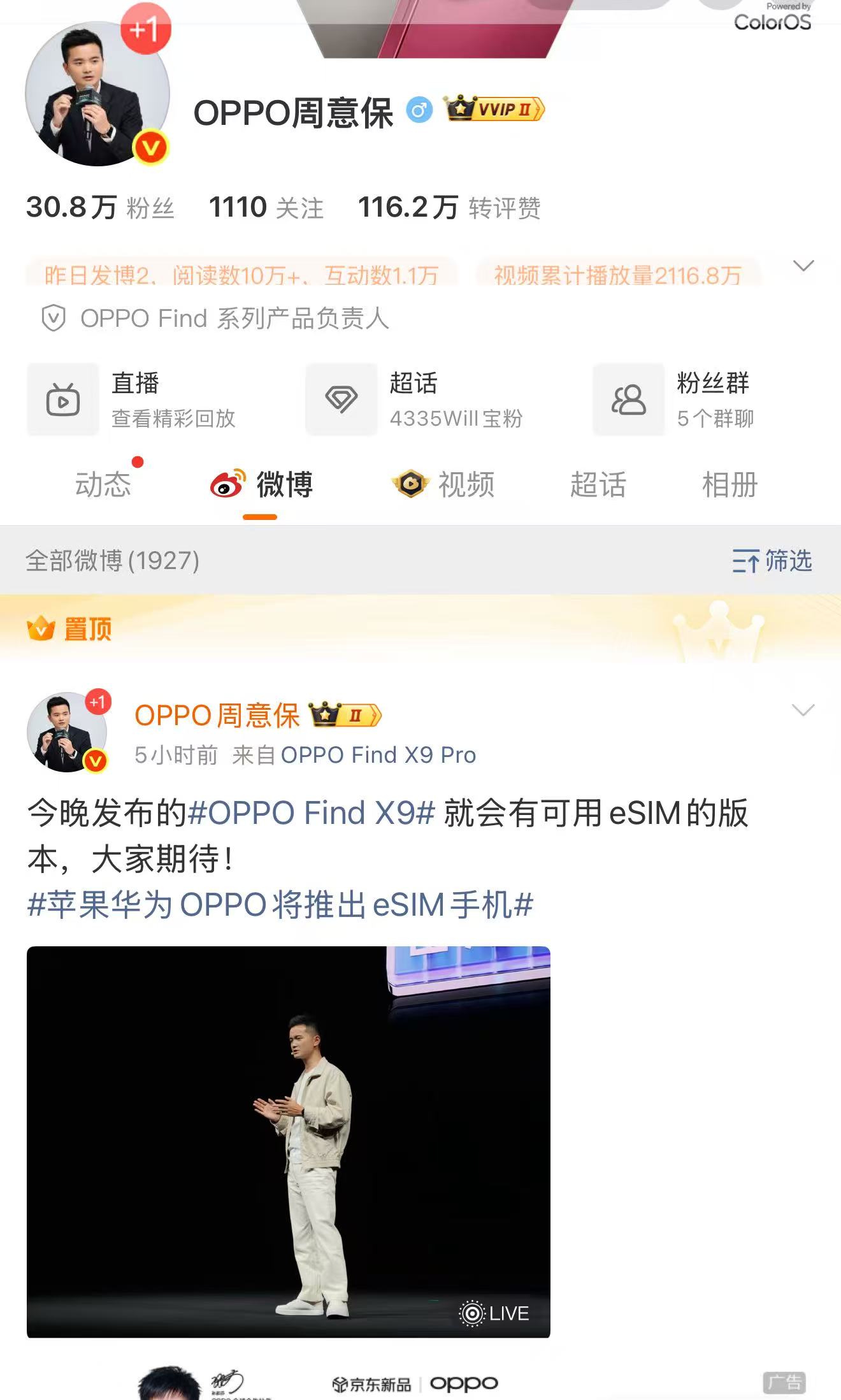
OPPO将发布首款国产eSIM手机
Bei Jing Shang Bao· 2025-10-16 08:53
Core Viewpoint - OPPO Find X9 will be the first eSIM-enabled smartphone from a domestic brand in China, marking a significant advancement in the local smartphone market [1] Group 1 - OPPO Find X9 is set to be released on October 16, featuring a version that supports eSIM technology [1] - Major Chinese telecom operators, including China Unicom, China Mobile, and China Telecom, have recently announced that they have received approval to conduct commercial trials for eSIM mobile services [1]
港股收盘(10.16) | 恒指收跌0.09% 生物医药股表现亮眼 新消费概念走势分化
智通财经网· 2025-10-16 08:52
Market Overview - Concerns over tariffs have led to a decline in Hong Kong stocks, with the Hang Seng Index closing down 0.09% at 25,888.51 points and a total trading volume of 275.43 billion HKD [1] - The Hang Seng Technology Index fell by 1.18%, indicating weakness in the tech sector, while the Hang Seng China Enterprises Index saw a slight increase of 0.09% [1] Blue-Chip Stocks Performance - Pop Mart (09992) continued its upward trend, closing up 5.57% at 288.2 HKD, contributing 17.6 points to the Hang Seng Index [2] - Morgan Stanley upgraded Pop Mart's investment rating to "Overweight," raising the target price from 300 HKD to 320 HKD, citing attractive valuation and upcoming catalysts [2] - Other notable blue-chip performances included New Oriental (09901) up 8.86% and BYD Electronics (00285) up 5.01%, while Xiaomi Group (01810) and SMIC (00981) faced declines of 3.6% and 2.76%, respectively [2] Sector Performance - Large tech stocks showed weak performance, with Xiaomi down 3.6%, Tencent down 1.12%, and Alibaba down 0.25% [3] - Coal and banking stocks performed well, with China Coal Energy rising over 7% and Agricultural Bank of China up nearly 3% [3] - The pharmaceutical sector continued to rise, with notable gains from Xuan Bamboo Biotechnology (02575) up 10.27% and Honor Bio (09995) up 4.77% [3] New Consumption Trends - The new consumption sector showed mixed results, with Lao Pu Gold (06181) up 6.21% and Pop Mart (09992) up 5.57%, while Giant Bio (02367) fell over 15% [4] - Morgan Stanley highlighted Lao Pu Gold as a top pick in the Chinese consumer sector, noting a clear trend in brand value enhancement [4] Dividend Stocks Activity - Dividend stocks were active, with China Coal Energy (01898) up 7.26% and Agricultural Bank of China (01288) up 2.98% [5] - The market is shifting focus towards geopolitical risks, corporate earnings fundamentals, and policy effects, with a potential rotation towards value and dividend stocks [5] Apple-Related Stocks - Several Apple-related stocks saw gains, including BYD Electronics (00285) up 5.01% and Hong Teng Precision (06088) up 3.05% [6] - Recent visits by Apple executives to key suppliers in China indicate ongoing collaboration and investment in the region [6] Notable Stock Movements - Yunji (02670) debuted with a significant gain of 26.05%, closing at 120.5 HKD, as a leading AI-enabled robotics service provider [7] - Think Academy (01769) surged 26.48% after announcing a share issuance to enhance educational quality and fund AI projects [8] - Fenbi (02469) rose 7.09% following strong market response to its AI-driven exam preparation system [9] - Sanhua Intelligent Control (02050) fell 6.13% after clarifying rumors about large robot orders were untrue [10] - Hong Kong Telecom (06823) faced a decline of 4.37% due to potential operational license revocation in the U.S. [11]
当手机用上eSIM,会带来哪些连锁反应?
Xin Jing Bao· 2025-10-16 08:42
Core Insights - The three major telecom operators in China, China Telecom, China Mobile, and China Unicom, have received approval from the Ministry of Industry and Information Technology for the commercial trial of eSIM mobile services, marking the official launch of eSIM services across 31 provinces and regions in China [1][3] - The introduction of eSIM technology signifies a shift towards a "cardless era," where the functionality of physical SIM cards is integrated into the phone's internal chip, enhancing user convenience and potentially transforming the mobile industry [1][2] Impact on Mobile Industry - The removal of physical SIM card slots allows for more streamlined and compact phone designs, aligning with trends pursued by manufacturers like Apple and Huawei towards fully sealed devices [2] - eSIM technology will simplify the manufacturing process by eliminating the need for SIM card slots and related components, potentially affecting hundreds of small suppliers in the industry [2] - The integration of eSIM will lead to a redesign of mobile phone motherboards, enhancing the dominance of chip manufacturers like Qualcomm and MediaTek in communication control [2] Changes in Operator Dynamics - The activation and management of eSIMs through cloud services may diminish the traditional advantages held by telecom operators, as consumers will no longer need to visit physical stores [3] - Mobile manufacturers could gain more influence over the customer experience, potentially sharing user data with operators and altering the competitive landscape [3] - The transition to eSIM technology may facilitate easier number portability for users, prompting operators to focus more on service quality and transparency rather than customer retention through binding contracts [3] Regulatory Considerations - The cautious rollout of eSIM services in China highlights the need for a new regulatory framework to address data security and identity management, given the unique context of mobile numbers in China [4] - The transition from physical SIM cards to eSIMs poses significant challenges in terms of data security, necessitating robust mechanisms to prevent identity theft and data breaches [4] - The eSIM initiative is not just a technological advancement but also a critical step in the evolution of China's digital identity system, requiring a balance between convenience and security [4]


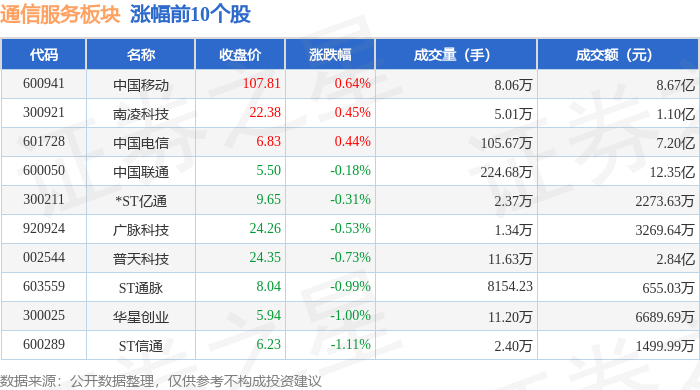
通信服务板块10月16日跌0.25%,三维通信领跌,主力资金净流出6.29亿元
Zheng Xing Xing Ye Ri Bao· 2025-10-16 08:27
Market Overview - On October 16, the communication services sector declined by 0.25%, with Sanwei Communication leading the drop [1] - The Shanghai Composite Index closed at 3916.23, up 0.1%, while the Shenzhen Component Index closed at 13086.41, down 0.25% [1] Stock Performance - Key stocks in the communication services sector showed varied performance: - China Mobile (600941) closed at 107.81, up 0.64% with a trading volume of 80,600 shares and a turnover of 867 million yuan [1] - Sanwei Communication (002115) closed at 11.38, down 4.53% with a trading volume of 1,035,100 shares and a turnover of 1.192 billion yuan [2] - China Telecom (601728) closed at 6.83, up 0.44% with a trading volume of 1,056,700 shares and a turnover of 720 million yuan [1] - China Unicom (600050) closed at 5.50, down 0.18% with a trading volume of 2,246,800 shares and a turnover of 1.235 billion yuan [1] Capital Flow - The communication services sector experienced a net outflow of 629 million yuan from institutional investors, while retail investors saw a net inflow of 537 million yuan [2][3] - Notable capital flows included: - China Mobile saw a net inflow of 22.97 million yuan from institutional investors [3] - Puhua Technology (002544) had a net inflow of 20.09 million yuan from institutional investors [3] - Sanwei Communication experienced a significant net outflow of 11.92 billion yuan [2]