OPPO

Search documents
雷军:不少人有偏见,固执地认为小米没啥技术、就是组装厂
Guan Cha Zhe Wang· 2025-09-26 01:13
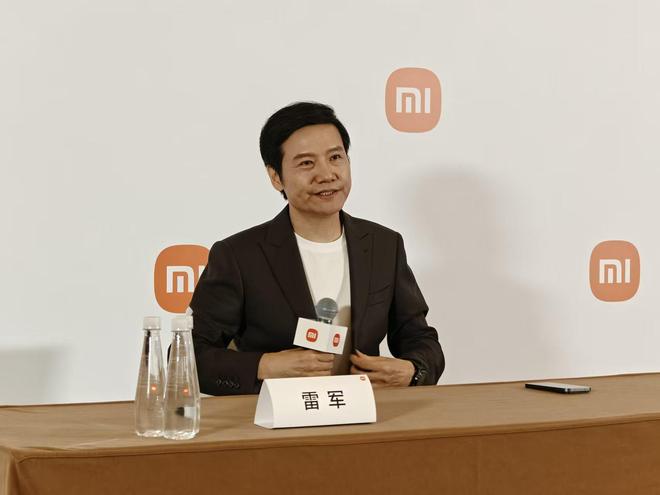
Core Insights - Xiaomi's chairman Lei Jun addressed the company's journey towards becoming a technology-driven firm, emphasizing the importance of self-developed chips and electric vehicles in the face of intense competition from giants like Apple, Samsung, and Huawei [1][11] - The company has faced skepticism regarding its technological capabilities, often being labeled merely as an assembly factory [1][11] Chip Development - Xiaomi launched its first flagship 3nm chip, the Xuanjie O1, marking a significant achievement in its chip development journey [4][10] - The company previously faced challenges with its chip division, particularly with the failure of its first chip, the Surge S1, which led to a temporary halt in SoC development [6][7] - The decision to re-enter the chip market was driven by the belief that self-developed chips are essential for success in the tech industry [8][10] Market Competition - The smartphone market is described as highly competitive, with six major players each holding an average market share of 15-16% in China [1][11] - Xiaomi aims to adopt a long-term strategy in the smartphone market, focusing on sustained growth rather than quick wins [19] Automotive Ventures - Xiaomi's entry into the automotive sector has been met with significant challenges, including public skepticism and competition from established players [22] - The company has emphasized the importance of collaboration within the automotive industry to foster a positive environment for growth [22] - Xiaomi's electric vehicle models, such as the SU7 and YU7, are seen as critical to its automotive strategy, with a focus on unique design rather than following competitors [20][22]


2025年Q2越南智能手机出货量中5G份额首次突破50%
Counterpoint Research· 2025-09-26 01:02
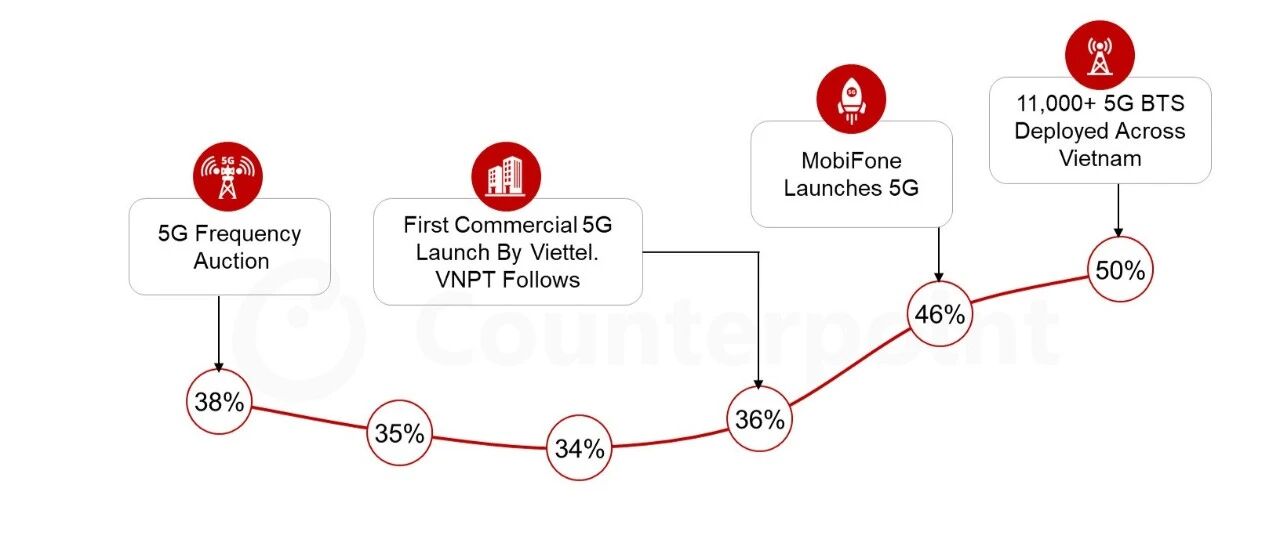
Core Insights - In Q2 2025, 5G smartphones in Vietnam achieved a significant milestone by surpassing 50% of the overall smartphone shipment volume, driven by collaborative efforts across the ecosystem to promote 5G adoption [4][5]. - Despite challenges in the market and macroeconomic uncertainties leading to a decline in overall smartphone shipments, the shipment volume of 5G smartphones in Vietnam still experienced a 13% year-on-year growth in Q2 2025, indicating strong consumer demand for 5G devices since the launch of 5G services [5][7]. - The average selling price (ASP) of 5G smartphones decreased by 12% year-on-year in Q2 2025, enhancing product affordability and accessibility for consumers [5]. Market Dynamics - Global OEMs played a dominant role in driving the growth of 5G smartphone shipments in Vietnam, with Apple and Samsung contributing a combined 73% of the 5G shipment volume in Q2 2025 [7][9]. - Apple emerged as the leading brand in Vietnam's 5G smartphone market, accounting for 40% of the total 5G smartphone shipments in Q2 2025, supported by discounts and promotions on both new and older iPhone models [9]. - Samsung ranked second, with 60% of its smartphone shipments in Vietnam being 5G models, and offered promotional incentives such as three months of free 5G data for users purchasing specific models [9][10]. Competitive Landscape - OPPO ranked third in 5G smartphone shipments, leveraging its Reno14 series, which supports 5G across its entire lineup [9]. - Chinese manufacturers like Xiaomi and vivo are actively expanding their 5G product lines, with Xiaomi launching the 5G-enabled Redmi Note 14 and vivo transitioning from 4G to 5G models [10]. - The introduction of more 5G models across various price segments is expected to further accelerate the adoption of 5G smartphones in Vietnam, with projections indicating that the share of 5G smartphones in overall shipments will exceed 50% by the end of 2025 [10].

全球智能手机平均售价将从2025年的370美元升至2029年的412美元
Counterpoint Research· 2025-09-26 01:02
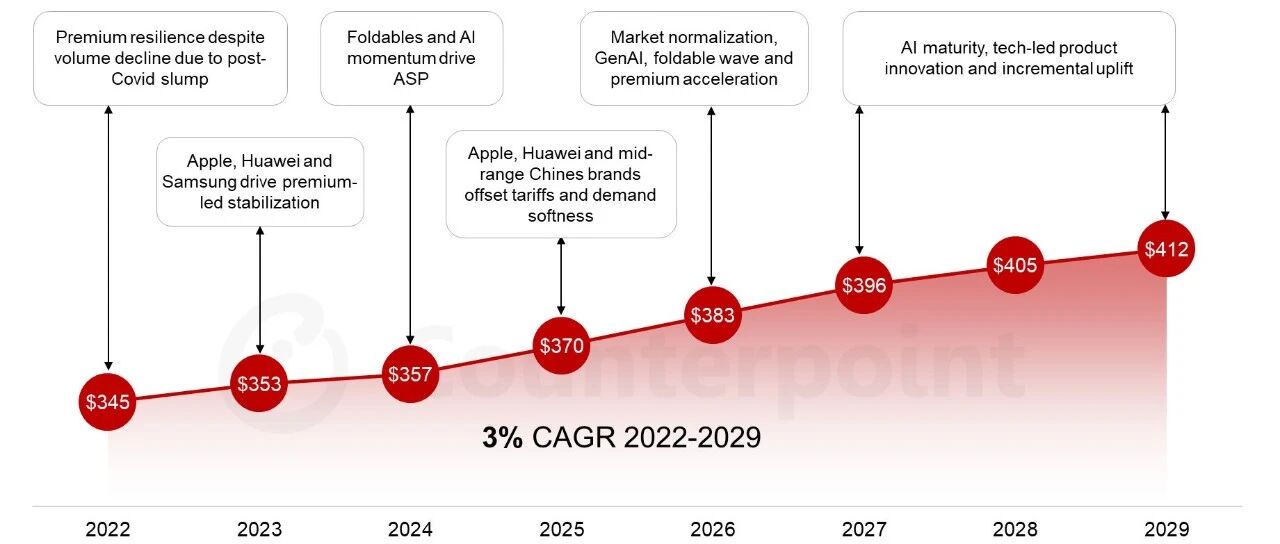
Core Viewpoint - The global smartphone average selling price (ASP) is projected to increase from $370 in 2025 to $412 in 2029, with a compound annual growth rate (CAGR) of 3% driven by high-end trends and the adoption of 5G technology [4][6][10]. Market Trends - The global smartphone market is expected to see a 2.5% year-on-year growth in shipments in 2025, an increase from the previous forecast of 1.9% [6]. - The ASP is anticipated to rise by 3.5% to $370 in 2025, influenced by price increases in North America and economic recovery in India and other Asia-Pacific regions [6][10]. - Smartphone revenue is projected to grow nearly 6% year-on-year in 2025, with a long-term CAGR of 5% from 2025 to 2029, reaching $564 billion by 2029 [10]. Regional Insights - In North America, the ASP is expected to grow by 7% year-on-year, while in China, it is projected to increase by 3.6%, primarily driven by high-end models [10][11]. - India’s ASP is expected to remain below $250 in 2025 but will gradually rise to $287 by 2029 due to the high-end trend [12]. Brand Performance - Apple is projected to maintain its position as a leader in high-end smartphone ASP, with an expected increase from $919 in 2025 to nearly $1000 by 2029 [10][12]. - Samsung's ASP is expected to remain stable, with flagship models impacting overall ASP but supported by foldable phones and GenAI integration [14]. - Huawei is strengthening its ASP growth in China, driven by its Mate and Pura series, as well as foldable phones [14]. Technology Impact - The introduction of GenAI smartphones is expected to increase the bill of materials (BoM) cost by $40-60 per device, initially raising prices but transitioning to value-driven ASP growth as AI features become more integrated [14][15]. - Foldable smartphones, although currently representing less than 2% of global shipments, are anticipated to elevate consumer perceptions of high-end products [15]. Conclusion - The global smartphone ASP outlook is optimistic, with stabilizing supply chains and diminishing tariff impacts, alongside the proliferation of high-end smartphones, GenAI, and foldable innovations driving gradual ASP increases [15].
高通祭出全球最快移动SoC!卢伟冰携全球首发小米17Pro现身
机器之心· 2025-09-25 23:54
Core Viewpoint - Qualcomm has officially launched its latest flagship mobile SoC, the Snapdragon 8 Elite Gen 5, which boasts significant improvements in performance, energy efficiency, and AI capabilities compared to its predecessor [3][4]. Group 1: Performance Enhancements - The Snapdragon 8 Elite Gen 5 features a 16% overall performance increase and extends battery life by up to 1.8 hours [4]. - The new architecture includes the third-generation Oryon CPU, with a peak frequency of 4.6GHz for the super core and 3.62GHz for performance cores, achieving the fastest speeds in its class [12]. - Single-core performance has improved by 20%, multi-core performance by 17%, and response speed by 32%, with energy efficiency enhanced by 35% [12][14]. - Geekbench scores show single-core performance exceeding 3800 and multi-core performance surpassing 12000, indicating robust capabilities [15]. Group 2: Graphics and AI Capabilities - The next-generation Adreno GPU features a peak frequency of 1.2GHz, with overall performance up by 23% and ray tracing performance up by 25% [21]. - The Hexagon NPU has achieved a 37% performance increase, with 16% more performance per watt, enhancing AI processing capabilities [27]. - The NPU supports real-time AI processing on devices, improving privacy and responsiveness [25][32]. Group 3: Imaging and Connectivity - The Snapdragon 8 Elite Gen 5 introduces a 20-bit ISP, enhancing dynamic range fourfold for better detail capture [35]. - It features the world's first hardware APU codec, improving video processing efficiency and quality [37]. - The 5G modem supports peak download speeds of 12.5Gbps, with a 30% increase in overall AI inference speed for optimized network connections [43][44].

6G终端有了时间表,AI扮演什么角色?
第一财经· 2025-09-25 14:58
Core Viewpoint - Qualcomm is the first global tech company to provide a clear timeline for 6G pre-commercial terminal launch, expected in 2028, indicating its ambition beyond mobile chips and into AI integration across various devices [3][4]. Group 1: AI Integration in Chip Design - Qualcomm is focusing on integrating AI capabilities directly into chip design, enhancing the performance of NPU and GPU to address the challenges of AI in small devices [3][6]. - The latest Snapdragon 8 Gen 2 features a 20% performance increase in CPU, a 23% increase in GPU performance, and a 37% enhancement in NPU performance, laying the groundwork for advanced AI applications on devices [6][7]. Group 2: Future Applications and Market Predictions - Qualcomm predicts that robots and various wearable smart glasses will potentially match or exceed the scale of smartphone applications in the future, emphasizing the need for strong edge computing capabilities [9][10]. - The automotive sector is highlighted as a prime application for edge AI, necessitating local processing for safety and responsiveness [9][10]. Group 3: Evolution of Intelligent Agents - The shift from mobile-centric to intelligent agent-centric systems is anticipated, with intelligent agents expected to possess advanced contextual understanding and proactive problem-solving capabilities [10][11]. - Domestic smartphone manufacturers are actively developing intelligent agents, with various companies integrating AI capabilities into their operating systems to enhance user experience [12].

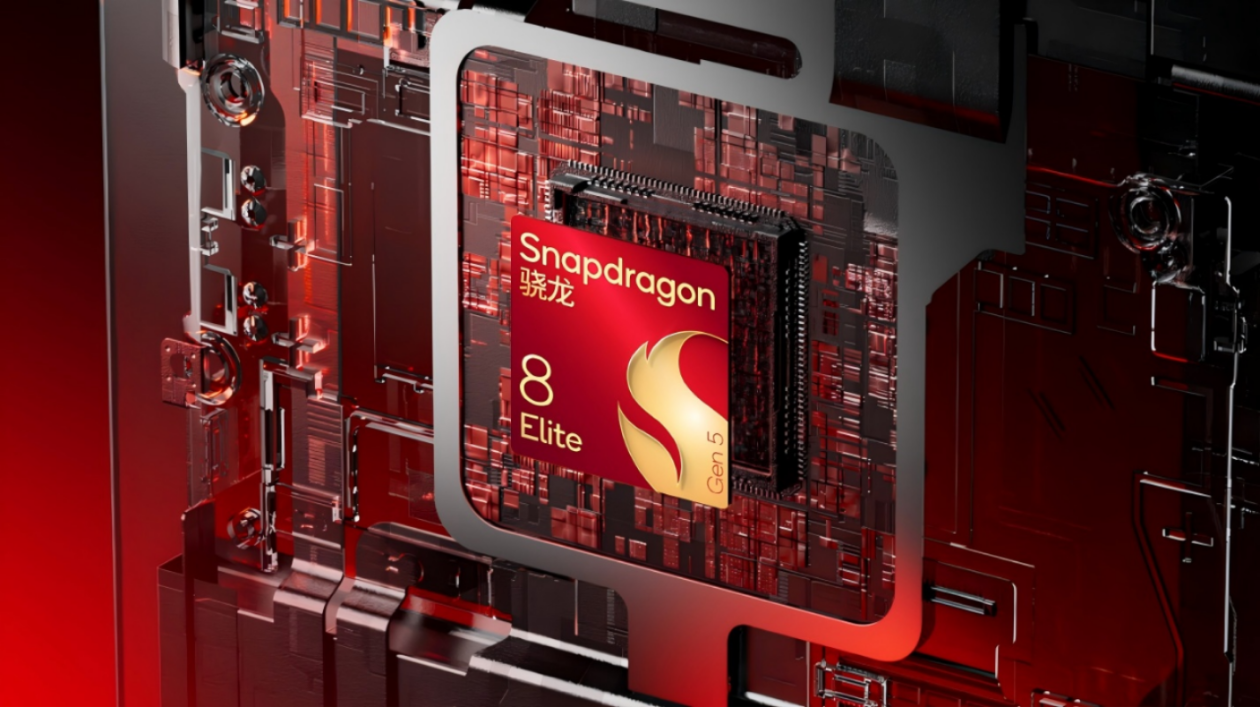
高通发布全新第五代骁龙8至尊版
Xin Lang Cai Jing· 2025-09-25 14:46
Core Insights - Qualcomm has launched the world's fastest mobile SoC, the fifth-generation Snapdragon 8 Gen 2 mobile platform, designed to enhance core user experiences and drive innovation [2] - The Snapdragon 8 Gen 2 features significant upgrades in performance, efficiency, and on-device AI processing capabilities, with a 20% performance increase in the third-generation Qualcomm Oryon CPU and a 23% improvement in graphics performance from the new Adreno GPU [6] - Major global OEMs and smartphone brands, including Xiaomi, vivo, OPPO, and ZTE, will adopt the Snapdragon 8 Gen 2 in their flagship devices, which are set to be released in the coming days [9] Performance Enhancements - The Snapdragon 8 Gen 2 enhances user expectations for mobile devices with features such as ultra-fast multitasking, smooth app switching, and extended gaming durations while maintaining excellent performance and efficiency [3] - The platform supports advanced professional video codec recording, enabling professional-grade video production and creative capabilities [4] AI and User Experience - The Snapdragon 8 series empowers personalized AI assistants that can provide customized operations across applications, utilizing on-device learning and real-time awareness to understand user needs [3] - The platform's AI capabilities are expected to redefine personal AI experiences, allowing users to engage with technology in a more intuitive manner [8] Industry Partnerships - Xiaomi's new flagship series will be the first to feature the Snapdragon 8 Gen 2, highlighting the collaboration between Qualcomm and Xiaomi in the high-end market [8] - Other brands, including vivo, OPPO, and ZTE, have also expressed their commitment to leveraging the Snapdragon 8 Gen 2's capabilities to enhance their product offerings and user experiences [8][9]
曲面屏:一场注定消退的 “炫技” 狂欢(念念有余)
Zheng Quan Shi Bao Wang· 2025-09-25 14:05
Core Insights - The smartphone industry is witnessing a shift from curved screens to flat screens, indicating a return to practical design preferences over aesthetic trends [1][2] - The rise of curved screens began with Samsung's Galaxy S6 edge in 2015, which set a trend among Android flagship models, associating curved screens with high-end positioning [1][2] - The high production costs and limited supply of curved screens contributed to their initial popularity, allowing manufacturers to create a sense of scarcity and justify higher pricing [2] Industry Trends - The trend towards curved screens was closely linked to the industry's pursuit of high screen-to-body ratios, with manufacturers adopting various design innovations to minimize bezels [1] - However, the actual benefits of curved screens have been questioned, as issues like color distortion and uncomfortable grip have diminished user experience [1][2] - The decline of curved screens began with the 2024 MWC, where Samsung's Galaxy S24 Ultra was introduced with a flat screen, prompting other manufacturers like Huawei, OPPO, and Xiaomi to follow suit [2] Market Dynamics - Curved screens face challenges such as high repair costs and low resale value, indicating limited market acceptance [2] - The initial dominance of curved screens was partly due to a lack of innovation in other smartphone components, making screen design a key differentiator for manufacturers [2] - Apple's consistent avoidance of curved screens highlights a different approach focused on simplicity and user-friendliness, emphasizing continuous optimization of flat screen technology [3] Future Outlook - The competition surrounding curved screens may have ended, but the smartphone industry is expected to continue innovating, with a hope for future developments to align more closely with genuine user needs rather than mere aesthetic enhancements [3]
6G终端有了时间表,AI扮演什么角色?
Di Yi Cai Jing· 2025-09-25 11:44
Core Insights - Qualcomm is the first global tech company to provide a clear timeline for 6G pre-commercial terminal launch, expected in 2028 [1] - The rise of AI is expected to elevate various "edge" devices, including smartphones, PCs, wearables, and robots, into potential blockbuster products [1] - Qualcomm aims to enhance AI capabilities in smart terminals by integrating NPU and GPU technologies during the chip design phase [1] Group 1: AI Integration in Chip Design - Qualcomm showcased its self-developed Oryon architecture at the Snapdragon Summit, emphasizing its superior SoC capabilities for AI processing and energy efficiency [2] - The self-developed Oryon architecture allows Qualcomm to reduce dependency on other companies, particularly in licensing fees and long-term development [2] Group 2: Performance Enhancements - The fifth-generation Snapdragon 8 flagship chip, utilizing 3nm process technology, has achieved a 20% performance increase in CPU, 23% in GPU, and 37% in NPU for AI applications [3] - Major smartphone brands like Honor, Xiaomi, Vivo, and OPPO plan to adopt the fifth-generation Snapdragon 8 in their flagship products [3] Group 3: AI Applications and Collaborations - Qualcomm and Honor are collaborating on developing edge AI model solutions to enhance user experience in applications like image recognition and color extraction [4] - The partnership aims to create GPU-NPU heterogeneous AI technologies to improve gaming graphics through AI learning [4] Group 4: Future AI Applications - Qualcomm predicts that robots and various wearable smart glasses could become as prevalent as smartphones in the future [6] - The automotive sector is identified as a prime application area for edge AI due to its need for local processing capabilities [6] Group 5: Evolution of Intelligent Agents - The future will shift from mobile-centric to intelligent agent-centric systems, requiring advanced understanding and decision-making capabilities [7] - 6G is expected to support real-time collaboration between edge devices and the cloud, enhancing AI-native applications [7] Group 6: Competitive Landscape - Domestic smartphone manufacturers are developing specific AI applications, with Honor's intelligent agent supporting over 200 vertical scenarios and 3000 general scenarios [8] - Other brands like OPPO, Vivo, and Xiaomi are also enhancing their AI capabilities, integrating them with their operating systems [8] Group 7: Challenges and Requirements - The development of AI intelligent agents necessitates advancements in both hardware AI chip capabilities and software interaction methods [9] - Companies must focus on personalized services through AI while addressing cost and technical challenges in their solutions [9]
东莞书写人:制造很酷,制造也是美学
经济观察报· 2025-09-25 10:26
Core Viewpoint - Dongguan's transformation from a "world factory" to a "manufacturing aesthetic city" is driven by policies as the "soil cultivator," talent as the "population," and the industrial ecosystem providing the "climate and environment" [18]. Group 1: Historical Context of Dongguan Manufacturing - Dongguan has evolved from a "processing trade" hub to a center for major brands like OPPO, vivo, and Huawei, reflecting the broader narrative of China's manufacturing upgrade [2]. - The book "New Dongguan Manufacturing" aims to present how the city has transitioned from a manufacturing base to a city of manufacturing aesthetics through report literature [2][4]. Group 2: Insights from the Interview - The authors chose report literature to provide a more humanistic and artistic perspective on Dongguan's manufacturing story, emphasizing the importance of people and their experiences [8]. - The narrative structure of the book moves from macro to micro perspectives, focusing on individual stories to illustrate the broader economic phenomena [9]. Group 3: Challenges and Resilience - The 2008 financial crisis prompted many Dongguan entrepreneurs to pivot and innovate, leading to the emergence of brands like "Dibao" and "Moshi" [11]. - Dongguan's unique development path has often been overshadowed by its proximity to Guangzhou and Shenzhen, with many still viewing it as merely a "processing base" [10]. Group 4: Key Transition Points - Dongguan's transformation involved several key stages, including the shift from agriculture to industrialization and the establishment of the Songshan Lake High-tech Zone, marking a transition from population-driven growth to innovation-driven development [14][15]. Group 5: Future Opportunities and Risks - Dongguan faces three main opportunities: high-end ascension amid industrial chain restructuring, new avenues in the context of carbon neutrality, and the integration of digitalization with traditional manufacturing [20]. - The city must navigate risks such as the migration of low-value-added production to Southeast Asia, technological competition, and the challenge of achieving carbon neutrality while maintaining competitiveness [20]. Group 6: Manufacturing Aesthetics and Urban Development - Dongguan needs to enhance its industrial design and cultural soft power while updating urban spaces to embody "manufacturing aesthetics," which can help reshape its image from a "world factory" to a city of beauty and innovation [25][26]. - The integration of industry and urban space in areas like Songshan Lake and the Coastal Bay New Area reflects a new industrial city model that harmonizes industry, city, and nature [26]. Group 7: Lessons for Other Cities - Dongguan's experience highlights the importance of being an "entity-based city" and adapting to changing circumstances, emphasizing the need for continuous evolution rather than being defined by past successes [27].

第五代骁龙8至尊版发布,性能、AI、影像全面升级
Huan Qiu Wang· 2025-09-25 10:13
Core Insights - Qualcomm has launched the fifth-generation Snapdragon 8 Gen 2 mobile platform, enhancing core mobile experiences through upgrades in performance, AI, and imaging technology [1][3]. Hardware Upgrades - The platform features significant hardware improvements, including a 20% increase in single-core performance and a 17% increase in multi-core performance, with a maximum clock speed of 4.6GHz [3]. - The new Qualcomm Adreno GPU shows a 23% improvement in graphics performance and a 25% increase in ray tracing performance, optimizing graphics-intensive gaming experiences [3]. - Utilizing a 3nm process, the overall SoC power consumption is reduced by 16%, with a 10% improvement in CPU energy efficiency and a 20% increase in AI performance per watt [3]. AI Capabilities - The Hexagon NPU's performance has improved by 37%, supporting new precision formats and hardware matrix acceleration, enhancing AI inference speed and efficiency [3]. - The platform enables personalized AI assistants that can provide customized operations across applications, with a focus on user data security through local storage [3]. Imaging and Video Technology - As the first mobile platform to support Advanced Professional Video codecs, it features a 20-bit ISP that enhances dynamic range by four times and supports advanced video recording and post-production capabilities [4]. - The platform includes an AI-enabled 5G modem with peak download speeds of 12.5Gbps and AI-optimized Wi-Fi technology, reducing gaming latency by 50% [4]. Market Adoption - Several OEMs and smartphone brands plan to adopt this platform in their flagship products, including Xiaomi, vivo, and OPPO, with specific models like the Xiaomi 17 series and iQOO 15 series set to launch soon [6]. - Qualcomm's senior vice president highlighted that the Snapdragon 8 Gen 2 platform positions users at the core of mobile experiences, with real-time synchronization of user needs through personalized AI [6].