
会稽山

Search documents
从“卖产品”到“卖文化” 营销变革下酒企出海新征程
Bei Jing Shang Bao· 2025-12-25 13:30
Core Viewpoint - The Chinese liquor industry is increasingly focusing on international markets as domestic competition intensifies, with a significant number of companies expanding overseas to seek new growth opportunities [1][7]. Group 1: Market Expansion - As of December 25, 2023, 63.9% of Chinese liquor companies are either expanding or have already established a presence in overseas markets [1]. - Major brands like Kweichow Moutai, Wuliangye, and Luzhou Laojiao are actively entering international markets, alongside traditional yellow wine brands like Guyue Longshan and Kuaijishan [1][2]. Group 2: Product Strategy - Companies are adopting two distinct strategies for internationalization: "cultural integration" with tailored products for foreign markets and "value output" by exporting established domestic products [2]. - Kweichow Moutai has launched a series of new products specifically designed for overseas markets, marking a significant expansion after six years [2]. - Luzhou Laojiao is innovating with products like ready-to-drink cocktails and oak barrel liquor to cater to international consumer preferences [3]. Group 3: Cultural Integration - The liquor industry recognizes that cultural storytelling is essential for successful international expansion, with many companies engaging in high-profile cultural activities to promote Chinese liquor [4][5]. - Initiatives like Wuliangye's "He Mei Global Tour" and the opening of tasting houses by Guyue Longshan in Paris highlight the industry's focus on cultural exchange [5][6]. Group 4: Market Challenges - Despite the enthusiasm for international markets, challenges remain, including a reliance on Chinese consumers abroad and the need for deeper localization to appeal to diverse international tastes [7][8]. - The Southeast Asian market is identified as a primary target for expansion, supported by a significant Chinese diaspora that influences local consumption patterns [7]. Group 5: Future Directions - Industry experts suggest that to penetrate mainstream markets, liquor companies must innovate and adapt products to local tastes, potentially developing lower-alcohol or pre-mixed beverages [8]. - There is a call for greater integration of liquor with Chinese cuisine to enhance market appeal and consumer acceptance [8].





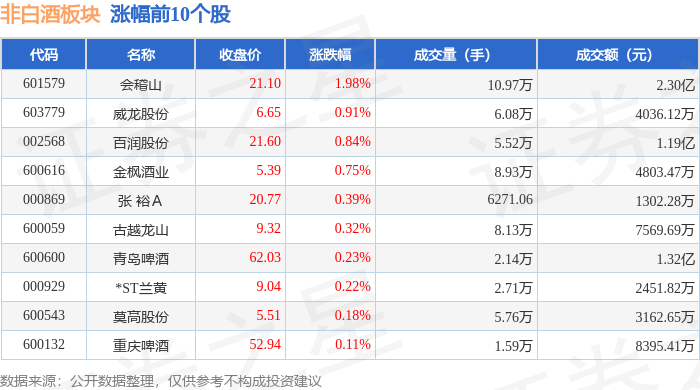
非白酒板块12月25日涨0.12%,会稽山领涨,主力资金净流入3861.1万元
Zheng Xing Xing Ye Ri Bao· 2025-12-25 09:07
Core Viewpoint - The non-white liquor sector experienced a slight increase of 0.12% on December 25, with Kuaijishan leading the gains. The Shanghai Composite Index closed at 3959.62, up 0.47%, while the Shenzhen Component Index closed at 13531.41, up 0.33% [1]. Group 1: Market Performance - Kuaijishan (601579) closed at 21.10, with a rise of 1.98% and a trading volume of 109,700 shares, resulting in a transaction value of 230 million yuan [1]. - Weilang Co. (603779) saw a closing price of 6.65, up 0.91%, with a trading volume of 60,800 shares [1]. - Zhirun Co. (002568) closed at 21.60, increasing by 0.84%, with a trading volume of 55,200 shares [1]. - The overall non-white liquor sector had a net inflow of 38.61 million yuan from main funds, while retail investors experienced a net outflow of 17.34 million yuan [2]. Group 2: Fund Flow Analysis - Huichuan Beer (600573) had a main fund net outflow of 29.06 million yuan, with a retail net outflow of 13.31 million yuan [3]. - Kuaijishan (601579) recorded a main fund net inflow of 10.01 million yuan, but a retail net outflow of 6.47 million yuan [3]. - Jinfeng Wine Industry (600616) experienced a main fund net inflow of 6.48 million yuan, with a significant retail net outflow of 5.36 million yuan [3].


白酒股异动 水井坊涨停
Zheng Quan Shi Bao Wang· 2025-12-25 05:33
Group 1 - The core point of the article highlights a significant surge in the Chinese liquor sector, particularly with stocks like Shui Jing Fang (600779) hitting the daily limit, indicating strong market interest and investor confidence [1] - Other liquor companies such as Huangtai Liquor (000995), Huazhi Liquor (300755), Kweichow Moutai (601579), Jiu Gui Jiu (000799), Shede Liquor (600702), and Jinzhongzi Liquor (600199) also experienced notable increases in their stock prices, reflecting a broader positive trend in the industry [1]




古越龙山人事变动引发市场热议,“父辈的酒”如何打动年轻人的心 换个董秘90后,能让黄酒成潮饮?
Shen Zhen Shang Bao· 2025-12-24 23:19
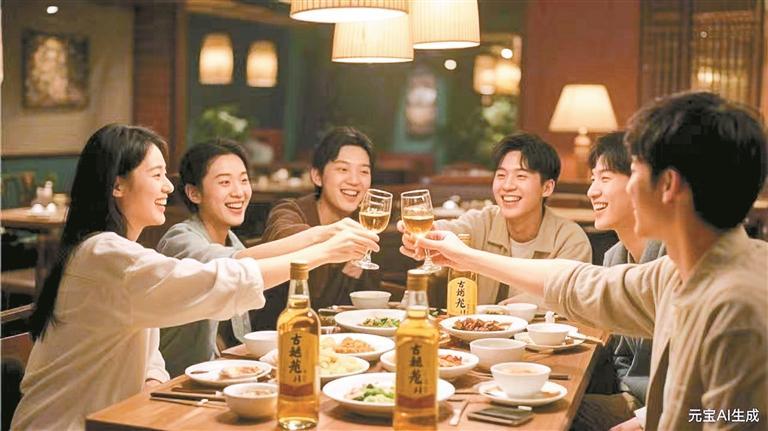
Core Viewpoint - The goal of the Huangjiu industry is to transform Huangjiu from a "drink of the older generation" to a "trendy drink for young people" Group 1: Management Changes - Gu Yue Long Shan appointed 90s-born Zhang Leiguang as the company secretary, aiming to bring fresh financial thinking and communication methods to engage with a new generation of investors [1] - The appointment has sparked debate among shareholders, with some expressing skepticism about whether a young executive can attract younger consumers [1] Group 2: Financial Performance - In the first three quarters of 2025, Gu Yue Long Shan reported revenue of 1.186 billion yuan, a year-on-year decline of 8.10%, while net profit grew only 0.17% to 135 million yuan [2] - Competitor Kuaijishan surpassed Gu Yue Long Shan with revenue of 1.212 billion yuan, marking a year-on-year increase of 14.12% [2] Group 3: Product Innovation - Gu Yue Long Shan launched innovative products like coffee Huangjiu and low-sugar variants, targeting young consumers' preferences for novelty and social drinking [3] - The "No High Low" product sold over 3.3 million bottles and topped sales charts on Douyin, although consumer reviews were polarized [3] - A strategic partnership with China Resources Beer led to the co-launch of "Yue Xiao Pi," a product aimed at young consumers, although its availability on major platforms was not found [3] Group 4: Industry Challenges - Industry experts noted that Gu Yue Long Shan faces challenges such as a lack of standout products, stagnant brand recognition, and delayed market impact [4] - The company must balance scale expansion with refined operations to overcome these hurdles and establish a strong market presence [4] Group 5: Competitive Landscape - Kuaijishan successfully marketed its sparkling Huangjiu, achieving sales of 50 million yuan during the 618 shopping festival and diversifying its presence across various social and entertainment platforms [5][6] - Kuaijishan's dual strategy of "premiumization + youthfulness" aims to reshape the Huangjiu industry, focusing on cultural branding and quality enhancement [6] Group 6: Learning from International Examples - The success of Japan's Dassai sake brand offers insights for Huangjiu's youth-oriented development, emphasizing the importance of brand storytelling and long-term strategic commitment [7] - Analysts suggest that the Huangjiu industry should focus on enhancing brand recognition and creating distinctive narratives, similar to Dassai's approach [7]
换个董秘90后,能让黄酒成潮饮?
Shen Zhen Shang Bao· 2025-12-24 17:27
Group 1 - The core objective of the Huangjiu industry is to transform Huangjiu from a "drink of the older generation" to a "trendy drink for young people" [2] - The appointment of 90s-born Zhang Leiguang as the secretary of the board at Guyue Longshan has sparked discussions, with some investors skeptical about whether a younger executive can attract young consumers [2][3] - Guyue Longshan's revenue for the first three quarters of 2025 was 1.186 billion yuan, a decrease of 8.10% year-on-year, while its net profit only grew by 0.17% to 135 million yuan [3] Group 2 - Guyue Longshan has launched innovative products like coffee Huangjiu and bubble ice sculpture, targeting young consumers' preferences for novelty and social drinking [4] - The "Wugao Di" product has sold over 3.3 million bottles and topped the Douyin sales charts, indicating a positive reception among young consumers [4][5] - However, consumer feedback on the "Wugao Di" product is polarized, with some praising its quality while others find it unpalatable [5] Group 3 - Competitor Kuaijishan has successfully marketed its sparkling Huangjiu, achieving sales of 50 million yuan during the 618 shopping festival and implementing a dual strategy of high-end and youth-oriented products [6] - Kuaijishan's approach includes cultural empowerment and quality upgrades, aiming to establish itself as a leader in the high-end Huangjiu market [6] Group 4 - The experience of Japan's Dassai sake brand offers insights for the Huangjiu industry, highlighting the importance of brand storytelling and long-term strategic development [7] - Dassai's sales increased from 4.6 billion yen in 2014 to 19.5 billion yen by 2024, demonstrating the potential for growth through strategic branding and market positioning [7]
2025年第51周:酒行业周度市场观察
艾瑞咨询· 2025-12-24 00:04
Industry Environment - The Chinese liquor industry faces three major challenges by 2025: demographic changes, deepening technological revolution, and internal industry adjustments. The shift from "scale expansion" to "structural optimization" is necessary due to population decline and a decrease in the main consumer demographic. AI technology is driving the smart transformation of the industry, reshaping production and marketing models. Solutions include returning to pragmatic values, upgrading technology and quality to meet diverse consumer demands, and enhancing brand IP and emotional connections to build a symbiotic commercial ecosystem [2][3] 1919 Strategic New Vision - The liquor distribution industry is transitioning from traditional inventory models to user operation and instant retail. 1919, as an industry leader, is implementing a "center store + front warehouse" model and a F2B2C supply chain, developing six core capabilities (brand, scale, online customer acquisition, offline fulfillment, supply chain, data sales) for efficient localized service. Collaborations with platforms like Taobao and Meituan have led to significant growth, with plans to expand to over 100,000 front warehouses by 2026. This strategy aligns with young consumer demands, potentially capturing 60%-70% of liquor retail market share [4] Insights from Cross-Industry Products - The introduction of cross-industry products like Mingren soda water has highlighted the collective anxiety within liquor channels due to high inventory and slow sales. Mingren's positioning as a beverage for both before and after drinking has penetrated liquor consumption scenarios, with over 3 million terminal outlets. This case emphasizes the need to shift from product selling to providing scene-based solutions and creating closed-loop experiential marketing [5] "Liquor + New Energy" Growth Potential - Several liquor companies are forming strategic partnerships with new energy giants to explore new paths for industry integration. Collaborations aim to reduce high energy costs in liquor production and build green supply chains, responding to carbon neutrality goals. Leading companies are leveraging these partnerships to expand high-end consumer bases and explore new growth points [6][7] E-commerce Tax Implications - New e-commerce tax regulations set to take effect in October 2025 will require platforms to report merchant data, eliminating tax ambiguities in liquor e-commerce. While small merchants are exempt, larger businesses will face stricter compliance, curbing practices like price dumping. This policy shift is expected to foster fair competition, pushing the industry towards value-based competition rather than price wars [8] New Survival Coordinates for Liquor Merchants - As competition intensifies and channels flatten, traditional profit models based on price differences are becoming obsolete. Merchants must enhance service capabilities, focusing on sales rates, user engagement, and data operations. Manufacturers are shifting from price support to funding market actions for distributors, creating a new formula of "price difference + service commission" [9] Transformation of Tobacco Shops - The traditional tobacco shop industry is undergoing significant transformation, facing challenges but not extinction. The industry is characterized by a "pyramid structure," with small shops leveraging low costs and new channels. Future directions include using digital tools to enhance efficiency and optimizing product offerings to stimulate repeat purchases [10][11] Insights on the Beer Industry - The Chinese beer industry is entering a phase of sustainable development and smart manufacturing, with a focus on high-end products and craft beers. The industry is shifting from scale expansion to value realization, emphasizing health and specialty in product development [12] Changes in Sichuan Banquet Alcohol Consumption - The Sichuan banquet alcohol market is witnessing a shift from traditional "white wine + red wine" combinations to "white wine + low-alcohol beverages," with over 50% of low-alcohol drinks being served. This trend reflects changing consumer preferences towards practicality and cost-effectiveness [12] New Trends in Liquor Chains - The liquor industry is experiencing structural changes driven by diversified consumption, fragmented channels, and personalized demands. The focus is shifting from "single-point breakthroughs" to "full-domain integration," emphasizing the importance of service value and user relationships [13] Brand Dynamics - The health-focused liquor market is rapidly growing, with brands like Zhenjiu leveraging technology and quality assurance to meet consumer demands. The market for health-oriented liquor is projected to reach 58.36 billion yuan by 2024 [14] Cultural Empowerment in Branding - Tiananmen Sauce Liquor emphasizes quality and cultural heritage during industry adjustments, showcasing its commitment to traditional craftsmanship and cultural transmission [15] Young Consumer Engagement Strategies - Wuliangye's collaboration with Pure K to target young consumers has resulted in significant sales growth, demonstrating innovative paths for integrating liquor into youth culture [16][17] Strategic Planning for Future Growth - Xifeng Liquor is focusing on brand youthfulness and internationalization, leveraging technology and cultural confidence to enhance its market position [18] Quality as a Competitive Edge - The liquor industry is transitioning from scale expansion to value enhancement, with quality and culture becoming key competitive factors. Companies like Congtai Liquor are emphasizing quality assurance and regional collaboration to drive growth [19] Evolution of Instant Retail - The liquor industry is moving towards "full-domain retail," emphasizing efficiency and value over price competition. Companies are encouraged to adopt a holistic approach to retail strategies [20] Low-Alcohol Product Success - The introduction of low-alcohol products like Guojiao 1573 has achieved significant market success, highlighting the trend towards healthier drinking options [21] Innovative Marketing Strategies - The collaboration between Wuliangye and FIFA for a new product launch demonstrates the effectiveness of sports marketing in engaging younger audiences [22] Cultural Exchange through Alcohol - The partnership between Chinese and French brands during a state visit symbolizes the cultural exchange and recognition of Chinese liquor on the international stage [28] New Consumption Scenarios - The launch of new products by JunTai Liquor targets both everyday celebrations and high-end collections, reflecting the evolving consumption landscape [29] Commitment to Quality and Development - Xifeng Liquor is reinforcing its commitment to quality and cultural heritage, aiming to lead the industry towards high-quality development [30]

会稽山(601579.SH):公司暂无规划进入文旅产业
Ge Long Hui· 2025-12-23 08:47
Core Viewpoint - The company, Kuaijishan (601579.SH), has no plans to enter the cultural tourism industry, focusing instead on a collaboration project with the Didiang Street to promote the contemporary inheritance of Shaoxing yellow wine culture [1] Group 1 - The yellow wine art street project is a collaboration between the company and Didiang Street, aligning with the overall planning for the development of specialized cultural and creative parks [1] - The project aims to provide a sustainable practical space for the contemporary transmission of Shaoxing yellow wine culture [1] - The company will consider partnerships with quality cultural tourism landmarks and service areas in the future to create iconic attractions related to yellow wine [1]
酒行业周度市场观察-20251223
Ai Rui Zi Xun· 2025-12-23 07:39
Investment Rating - The report does not explicitly provide an investment rating for the industry Core Insights - The Chinese liquor industry is expected to face challenges in the next five years due to demographic changes, technological advancements, and internal adjustments, necessitating a shift from scale expansion to structural optimization [1] - The liquor distribution sector is transitioning from traditional inventory models to user operation and instant retail, with companies like 1919 leading the way by building over 100,000 pre-positioned warehouses [2] - The collaboration between liquor companies and new energy giants aims to reduce high energy costs in production and align with carbon neutrality goals, indicating a trend towards sustainability in the industry [5] - The introduction of e-commerce tax regulations is expected to create a more equitable market environment, benefiting compliant businesses while phasing out non-compliant ones [6] - The industry is witnessing a shift from profit based on price differences to a focus on service capabilities, emphasizing the importance of user engagement and data operations [7] Industry Trends - The liquor industry is projected to grow through three main variables: demographic changes, deepening technological revolutions, and internal adjustments, with a focus on value creation and AI-driven transformations [1] - The transition to instant retail is characterized by the development of core capabilities such as brand management, online customer acquisition, and supply chain efficiency [2] - The success of cross-industry products, like soda water, highlights the need for differentiated offerings in a market facing high inventory and slow sales [5] - The integration of new energy technologies in liquor production aims to lower costs and enhance sustainability, responding to both market pressures and environmental goals [5] - The e-commerce tax reform is set to regulate online sales, promoting fair competition and encouraging a shift from price wars to value-based competition [6] - The traditional liquor retail model is evolving, with a focus on service and user experience becoming critical for survival in a competitive landscape [7] Top Brand News - 1919 is leading the liquor distribution transformation by implementing a "center store + pre-positioned warehouse" model, aiming to enhance local service efficiency [2] - The launch of low-alcohol products like the 38-degree Guojiao 1573 has positioned it as a market leader, reflecting a growing consumer preference for healthier drinking options [16] - The collaboration between Guojiao 1573 and the Australian Open showcases the brand's commitment to cultural resonance and global outreach [19] - The introduction of new products by brands like JunTai emphasizes the importance of aligning with consumer trends in both everyday celebrations and high-end collections [22]
葛卫东,日赚近200亿元
Shang Hai Zheng Quan Bao· 2025-12-18 07:01
Core Viewpoint - The significant rise in the stock price of Muxi Co., Ltd. on its debut led to a substantial increase in the wealth of investor Ge Weidong, with his net worth increasing by approximately 19.5 billion yuan in a single day due to the stock's performance [2][9]. Group 1: Company Overview - Muxi Co., Ltd. went public on December 17, with its stock price experiencing a maximum intraday increase of 755% and closing up 692.95%, resulting in a market capitalization exceeding 300 billion yuan [2][9]. - Ge Weidong holds a total of 14,338,176 shares directly and an additional 12,599,744 shares through his investment firm, Chaos Investment, representing 3.58% and 3.15% of the total shares, respectively [4][6]. Group 2: Investment Details - On the first trading day, Ge Weidong's shares increased by 725.34 yuan each, leading to a total wealth increase of 19.54 billion yuan [9]. - Ge Weidong invested in Muxi Co., Ltd. through capital increases in early 2023, contributing 300 million yuan and 500 million yuan in February and March, respectively [9]. - The initial public offering price of Muxi Co., Ltd. was 104.66 yuan per share, making it the second-highest IPO price of the year, with investors earning over 360,000 yuan for a single lot of shares [9]. Group 3: Ge Weidong's Investment Strategy - Ge Weidong has transitioned from futures trading to heavily investing in technology stocks over the past seven to eight years, achieving significant profits from companies like iFLYTEK and Zhongke Shuguang [11][16]. - As of the third quarter of 2025, Ge Weidong's holdings in various technology stocks, including Zhaoyi Innovation and Zhongke Shuguang, have substantial market values, indicating a strategic focus on high-growth sectors [12][13]. - His investment philosophy emphasizes patience and precision, advocating for a calculated approach to stock trading [15].
从8万到103.5万,酒类拍卖背后的价值分化与行业信号
Xin Lang Cai Jing· 2025-12-17 12:59
Core Insights - The auction results reflect a significant shift in the perception of high-end Chinese liquor from mere consumer goods to collectible assets, as evidenced by record-breaking sales at major auctions [2][11]. Group 1: High-Value Transactions and Market Dynamics - The auction market for liquor in 2025 continues to showcase the strong value appeal of top brands, with a 100% sales rate for 133 bottles of aged Wuliangye at Sotheby's [3][12]. - Notable sales include a limited edition Wuliangye 1909 artist series sold for 190,000 HKD (approximately 237,500 HKD with fees) and a 1990 Moutai fetching 1,035,000 HKD [2][12]. - Online auction platforms are gaining traction, with special edition Wuliangye zodiac wines achieving significant sales, indicating a growing interest in collectible liquor [4][12]. Group 2: Trends and Market Significance - The auction market is experiencing a rationalization phase, moving away from speculative bubbles towards a focus on genuine consumption and collection [8][17]. - The contribution of spirits to auction sales has slightly decreased, indicating a cooling market, yet Moutai's market share has doubled, reflecting its status as a safe asset [8][17]. - The market is becoming more stratified, with high-value unique items at the top, reliable mainstream aged brands in the middle, and more liquid newer products at the bottom, enhancing price mechanisms [8][17]. Group 3: Strategic Implications for the Industry - The rationalization and diversification of the auction market provide strategic value benchmarks for companies, encouraging them to enhance their "old liquor strategies" to stabilize pricing and prepare for market recovery [9][18]. - The high performance of auctioned aged liquor supports narratives of value appreciation, motivating consumers to "store new liquor, drink old liquor," thus activating inventory turnover [9][18]. - As the auction market matures, the understanding of liquor value is evolving, incorporating cultural, investment, and social attributes into assessments [9][18].
