
海螺水泥

Search documents
中材科技取得风电叶片铺层缺陷检测专利
Sou Hu Cai Jing· 2026-02-06 06:43
中国建材集团有限公司,成立于1981年,位于北京市,是一家以从事批发业为主的企业。企业注册资本 1713614.628692万人民币。通过天眼查大数据分析,中国建材集团有限公司共对外投资了20家企业,参 与招投标项目5000次,财产线索方面有商标信息236条,专利信息793条,此外企业还拥有行政许可5 个。 声明:市场有风险,投资需谨慎。本文为AI基于第三方数据生成,仅供参考,不构成个人投资建议。 国家知识产权局信息显示,中材科技风电叶片股份有限公司取得一项名为"风电叶片铺层过程缺陷检测 方法、装置、电子设备和介质"的专利,授权公告号CN117495796B,申请日期为2023年10月。 天眼查资料显示,中材科技风电叶片股份有限公司,成立于2007年,位于北京市,是一家以从事通用设 备制造业为主的企业。企业注册资本75419.3524万人民币。通过天眼查大数据分析,中材科技风电叶片 股份有限公司共对外投资了21家企业,参与招投标项目251次,专利信息483条,此外企业还拥有行政许 可10个。 来源:市场资讯 ...

国务院国资委重磅发布!中核集团、中国石油、国家电网、中国华能等榜上有名
中国能源报· 2026-02-06 06:01
Core Viewpoint - The State-owned Assets Supervision and Administration Commission (SASAC) has announced the "Model Central Enterprises" for 2025, emphasizing the importance of promoting advanced deeds and spirits of model enterprises to inspire high-quality development in central enterprises [1][3]. Group 1: Announcement of Model Central Enterprises - The 2025 "Model Central Enterprises" include notable teams and individuals such as Chen Liang from China National Nuclear Corporation, the "9·3" military parade aviation equipment support team from Aviation Industry Corporation of China, and the deep well attack team from China National Petroleum Corporation [3]. - Zhang Yuzhuo, the Secretary of the SASAC Party Committee, expressed high respect for the awarded teams and individuals, highlighting their contributions to the high-quality development of state-owned enterprises [3]. Group 2: Inspirational Messages and Responsibilities - Zhang emphasized that the new era is one for strivers, and the model representatives embody the spirit of dedication and patriotism, motivating countless employees to pursue progress and innovation [4]. - Central enterprise party committees are urged to pay attention to and care for the model representatives, widely publicizing their advanced deeds to inspire employees to contribute to the national economic and social development [4].



中金:消费建材价格有望温和修复 玻璃业盈利受压
Zhi Tong Cai Jing· 2026-02-05 07:28
Group 1: Consumer Building Materials Industry - The consumer building materials industry is expected to experience a mild price recovery, with potential marginal improvement in the gross margins of leading companies [1] - Recent price increases have been announced by leading companies in segments such as waterproofing, gypsum boards, and municipal channels, driven by supply optimization and rising prices of upstream raw materials like PVC and emulsions [1] - Companies to watch include Oriental Yuhong (002271), Sankeshu (603737), Beixin Building Materials (000786), China Liansu (02128), and Weixing New Materials (002372) [1] Group 2: Glass Industry - The glass industry is under profit pressure, with expectations for accelerated cold repair processes [2] - As of January 29, the average price of float glass was 1,145 RMB per ton, with negative gross margins for various production inputs, indicating ongoing profitability challenges [2] - Companies to focus on include Xinyi Glass (00868) and Qibin Group (601636) [2] Group 3: Cement Industry - The cement industry is experiencing weak profits during the off-season, with ongoing internal competition [2] - Current gross margins for cement are at historical lows, with limited room for further decline [2] - The industry is expected to see marginal improvements in capacity utilization due to the continuation of anti-involution policies, with companies to watch including Conch Cement (600585) and Shangfeng Cement (000672) [2]
电子布淡季再提价,楼市成交企稳修复
Ping An Securities· 2026-02-05 02:28
Investment Rating - Industry investment rating is "Outperform the Market" indicating an expected performance that exceeds the market by more than 5% over the next six months [5]. Core Insights - The report highlights that electronic fabric prices are increasing even during the off-season, with significant price hikes observed in January 2026. This trend is attributed to high demand from downstream AI applications, leading to a production shift towards high-end products, creating a capacity gap for traditional fabrics [4][3]. - The traditional building materials sector is also experiencing price increases, driven by a need for profitability amidst thin margins. Companies like Yuhong and Keshun have already raised prices for waterproof coatings, and this trend is expected to continue as demand improves post-holiday [4]. - The real estate market is showing signs of stabilization, with increased transactions in key cities and a reduction in listings. This recovery is anticipated to support price stabilization as the market enters the traditional demand peak in March [4]. Summary by Sections Electronic Fabric Market - Prices for electronic fabrics and yarns have risen significantly, with Linzhou Guangyuan's mainstream price for electronic fabric reported at 5.3-5.5 yuan/meter, up from 4.8-4.9 yuan/meter at the end of January [4]. - The ongoing price increases are expected to continue into the peak demand season of March and April 2026 [4]. Traditional Building Materials - The report notes that major companies in the building materials sector are actively pursuing price increases, with a focus on waterproof coatings and gypsum board products [4]. - The report suggests that if production limits are strictly enforced, it could lead to improved capacity utilization and price recovery in the cement market [4]. Real Estate Market - The report indicates a recovery in the real estate market, with a notable increase in second-hand home transactions in major cities and a decrease in listings [4]. - It emphasizes the expectation of supportive policies in 2026, particularly regarding mortgage rate adjustments, which could further stabilize the market [4].
如何看当前时点地产链投资机会
2026-02-05 02:21
Summary of Conference Call Records Industry: Real Estate Key Points - The real estate industry has undergone a deep cleansing of its fundamentals, with positive policy signals expected to gradually restore holdings, leading to valuation elasticity. In January, the second-hand housing market in core cities showed signs of recovery, with increased transaction volumes and decreased listing volumes, optimizing supply-demand relationships and narrowing price declines [1][2][3] - Multiple authoritative media outlets have released positive signals regarding the financial asset attributes of real estate and the cancellation of restrictive measures. Many real estate companies are no longer required to report the "three red lines" indicators monthly, indicating a period of intensive policy implementation, which enhances the investment value of the real estate sector [3] - The investment strategy for the building materials industry chain should focus on balance and early layout of related opportunities. Global expansion of balance sheets and marginally increasing liquidity in the A-share market support potential excess return opportunities in the building materials sector [1][4] - The A-share market's IPO financing is expected to be at historical average levels, but the second half of the year may see quarterly financing amounts exceeding expectations, which could signal a warning for the technology sector as relative returns may decrease [5] - The current economy is at the end of a Kondratiev wave depression, with non-ferrous metals and commodities being favorable investment options. The adjustment in the real estate market is nearing its end, with potential investment opportunities expected to emerge [6] Additional Insights - The real estate sector is currently in a core configuration window with high win rates and odds. As of Q4 2025, the sector's holdings accounted for approximately 0.43% of stock investment value, indicating a significant underweight that has persisted for 24 quarters [2] - The recovery of the Hong Kong real estate sector serves as a reference for the mainland market, with historical data suggesting that the adjustment in actual housing prices in China has been sufficient, leading to an increase in the sector's win rate [2] - The building materials sector's investment strategy emphasizes early positioning in response to market changes, with a focus on companies with low valuations and strong resource reserves, such as China Trade and Greentown China [4] - The cement industry is highlighted for its potential, with profitability closely tied to capacity utilization rates. Companies like Conch Cement are expected to see significant profit increases if prices rise [10] - The home appliance sector is anticipated to recover as real estate data stabilizes, which will directly boost demand for white goods and kitchen appliances [13] Industry: Building Materials Key Points - The investment strategy for the building materials industry should focus on both expansion and balance, with an emphasis on early positioning in real estate-related opportunities [4] - Companies with low valuations and strong resource reserves, such as China Trade and Greentown China, are recommended for investment [4] - The cement industry is expected to enter a new recovery cycle, with significant profit potential linked to price increases [10] Industry: Home Appliances Key Points - The home appliance sector is nearing the end of its darkest period, with potential investment opportunities arising as real estate data stabilizes and consumer demand is expected to recover [13] - The sector's current low valuations present opportunities for growth, particularly in white goods and kitchen appliances, which are closely tied to real estate performance [13] Additional Insights - Companies like Midea, Haier, and Gree are highlighted for their strong dividend yields, making them attractive investment options [13] - Newer companies in the market, such as Roborock and Ecovacs, are also noted for their competitive positioning and potential for valuation recovery [13]
海螺水泥控股子公司4.34亿元项目环评获同意
Mei Ri Jing Ji Xin Wen· 2026-02-04 10:07
Group 1 - The core viewpoint of the article highlights that Conch Cement's subsidiary, Zhenjiang Conch Cement Co., Ltd., has received approval for an environmental impact assessment for its new projects, which include a 2 million-ton new environmentally friendly cement grinding station and a 1.2 million cubic meter high-end commercial concrete facility [2] - The total investment for the approved projects amounts to 434 million yuan [2] - The approval information was disclosed by relevant regulatory authorities on January 22, 2026 [2]
水泥板块2月4日涨2.79%,韩建河山领涨,主力资金净流出9660.22万元
Zheng Xing Xing Ye Ri Bao· 2026-02-04 08:57
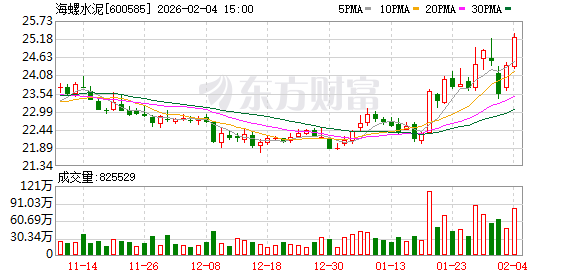
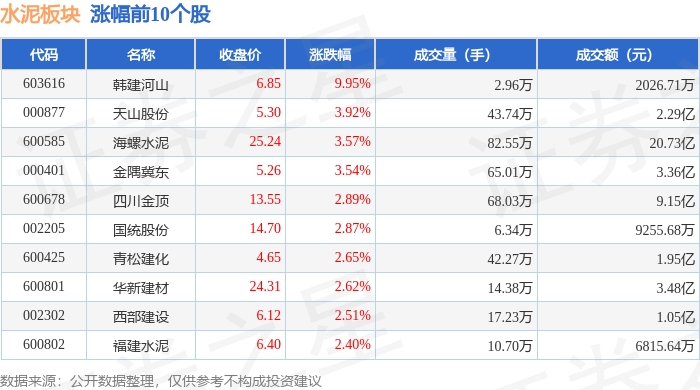
Market Performance - The cement sector increased by 2.79% compared to the previous trading day, with Hanjian Heshan leading the gains [1] - The Shanghai Composite Index closed at 4102.2, up 0.85%, while the Shenzhen Component Index closed at 14156.27, up 0.21% [1] Individual Stock Performance - Hanjian Heshan (603616) closed at 6.85, with a rise of 9.95% and a trading volume of 29,600 lots [1] - Tianshan Shares (000877) closed at 5.30, up 3.92%, with a trading volume of 437,400 lots [1] - Conch Cement (600585) closed at 25.24, increasing by 3.57%, with a trading volume of 825,500 lots [1] - Other notable stocks include Jinyu Modong (000401) at 5.26 (+3.54%), Sichuan Jinding (600678) at 13.55 (+2.89%), and Guotong Shares (002205) at 14.70 (+2.87%) [1] Capital Flow Analysis - The cement sector experienced a net outflow of 96.60 million yuan from institutional investors, while retail investors saw a net inflow of 79.28 million yuan [1] - The capital flow for individual stocks shows that Sichuan Jinding had a net inflow of 43.37 million yuan from institutional investors, but a net outflow of 27.60 million yuan from retail investors [2] - Hanjian Heshan had a significant institutional net inflow of 15.74 million yuan, but also faced a retail net outflow of 9.54 million yuan [2]




海螺水泥(00914) - 截至二零二六年一月三十一日止之股份发行人的证券变动月报表
2026-02-04 08:48
FF301 公司名稱: 安徽海螺水泥股份有限公司 呈交日期: 2026年2月4日 I. 法定/註冊股本變動 | 1. 股份分類 | 普通股 | 股份類別 | H | | 於香港聯交所上市 (註1) | | 是 | | | --- | --- | --- | --- | --- | --- | --- | --- | --- | | 證券代號 (如上市) | 00914 | 說明 | H股 | | | | | | | | | 法定/註冊股份數目 | | | 面值 | | 法定/註冊股本 | | | 上月底結存 | | | 1,299,600,000 | RMB | | 1 RMB | | 1,299,600,000 | | 增加 / 減少 (-) | | | 0 | | | RMB | | | | 本月底結存 | | | 1,299,600,000 | RMB | | 1 RMB | | 1,299,600,000 | | 2. 股份分類 | 普通股 | A 股份類別 | | | 於香港聯交所上市 (註1) | | 否 | | | --- | --- | --- | --- | --- | --- | --- ...
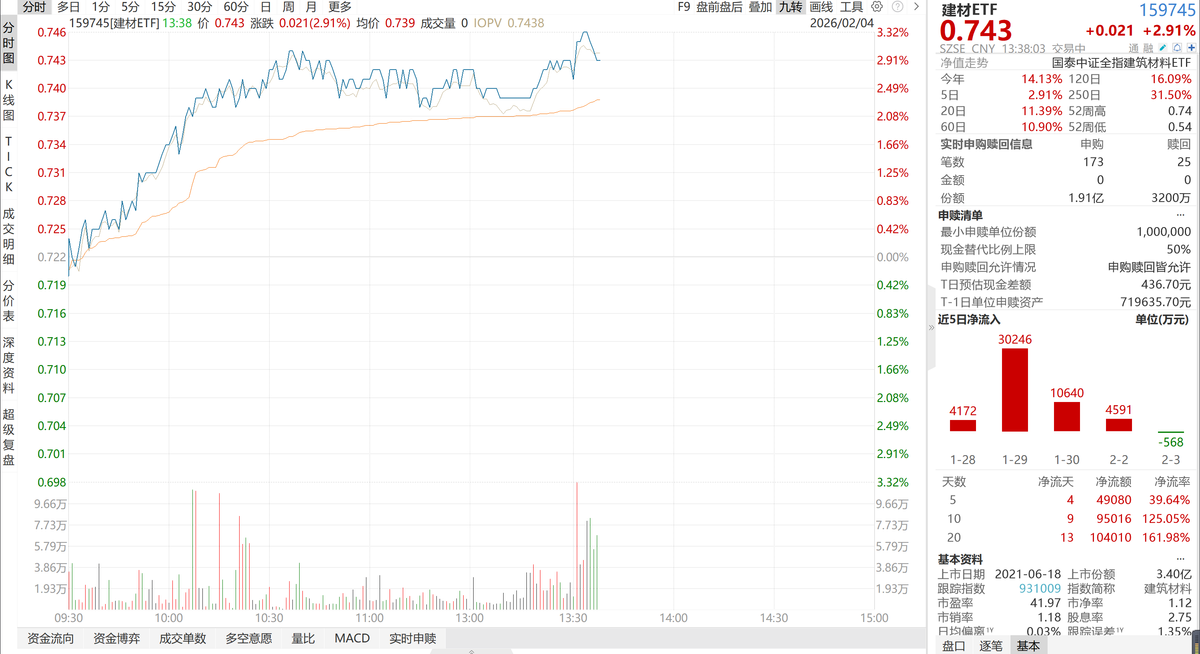
科技板块回调,顺周期板块领涨市场,建材ETF(159745)涨超3%
Mei Ri Jing Ji Xin Wen· 2026-02-04 06:01
Core Viewpoint - The construction materials sector is experiencing a phase of recovery driven by multiple favorable factors, including steady growth policies, improved expectations in the real estate chain, and an optimized supply structure, leading to a dual restoration of fundamentals and valuations [1][3]. Demand Side - Infrastructure investment is increasing, providing a solid demand foundation, with significant projects in urban renewal and water conservancy driving demand for construction materials like cement and waterproofing products [4]. - The real estate sector is seeing a recovery in demand due to policies supporting project completion and an uptick in second-hand home transactions, leading to increased consumption of materials such as gypsum boards and tiles [4]. - Emerging demands in high-end materials are being driven by new industries like AI servers and electric vehicles, creating new growth opportunities in the sector [4]. Supply Side - The construction materials industry is undergoing supply-side reforms, with a focus on reducing excess capacity through measures like staggered production and environmental restrictions, leading to a tightening supply-demand balance [5]. - Major companies are increasing their market share as inefficient capacities are eliminated, and the industry shifts from price competition to value competition [5]. Profitability - The decline in prices of upstream raw materials, combined with the implementation of price increases in the industry, is alleviating cost pressures for construction material companies, leading to a recovery in profitability [6]. - Key players in segments like cement and fiberglass are seeing improvements in gross and net profit margins, providing a solid foundation for sector growth [6]. Investment Logic - The construction materials sector is highlighted as a core cyclical investment, benefiting from a shift in market funds from high-valuation tech stocks to undervalued cyclical sectors [7]. - Continued government focus on stabilizing investment and infrastructure spending supports long-term demand for construction materials, while policies promoting green and prefabricated buildings open up new growth avenues [7]. - The sector's current valuation is at a historical low, with leading companies trading at price-to-earnings ratios significantly below those of consumer and tech sectors, indicating a high margin of safety [7]. Valuation Characteristics - The construction materials sector has seen its overall valuation drop to historical lows, with the index reflecting a significant valuation advantage compared to other cyclical and growth sectors [8]. - There is a clear differentiation in valuations among sub-sectors, with traditional materials like cement and glass showing lower valuations, while high-growth segments command higher valuations due to faster earnings growth [8]. Dividend Characteristics - Leading companies in the construction materials sector, such as Conch Cement and Huaxin Cement, typically offer high dividend yields exceeding 4%, making them attractive for long-term investors [9]. ETF Investment Opportunity - The Construction Materials ETF (159745) tracks the overall performance of the construction materials sector, providing an efficient tool for investors to gain exposure to leading companies in the industry [10]. - With the current market environment favoring cyclical sectors, the ETF presents an opportunity for both short-term trading and long-term investment in undervalued, high-dividend sectors [10].
研判2026!中国低碳经济行业发展历程、相关政策、市场规模、重点企业及未来展望:低碳经济加速崛起,引领绿色发展新范式[图]
Chan Ye Xin Xi Wang· 2026-02-04 01:24
Core Viewpoint - China, as the largest developing country and greenhouse gas emitter, has made significant progress in low-carbon economic development, aiming to peak carbon emissions by 2030 and achieve carbon neutrality by 2060 through green energy and clean technology initiatives [1][12]. Low-Carbon Economy Overview - The low-carbon economy is based on low energy consumption, low emissions, and low pollution, focusing on technological innovation, institutional reform, industrial transformation, and renewable energy development [3][4]. Industry Development History - The concept of a low-carbon economy emerged in the UK in 2003, with significant milestones including the 2006 Stern Report advocating for global transition to low-carbon economies and China's first national climate change assessment report [4][6]. Industry Policies - A series of policies have been implemented to promote low-carbon economic development, including the 2025 government work report emphasizing the acceleration of green low-carbon economy development and the establishment of a national carbon market [7][8]. Industry Chain - The low-carbon economy industry chain includes upstream low-carbon energy supply and technology research, midstream low-carbon enterprises, and downstream applications such as green buildings and renewable energy generation [8]. Current Industry Status - The national carbon trading market is a key component of the low-carbon economy, with significant growth in trading volume and value, reaching a cumulative transaction volume of 865 million tons and a transaction value of 57.663 billion yuan by the end of 2025 [9][10]. Key Enterprises - Major companies in China's low-carbon economy include Dongjiang Environmental Protection, Ningde Times, BYD, and others, each focusing on various aspects of environmental services, clean energy, and technology innovation [14][15]. Industry Development Trends - Technological innovation is crucial for low-carbon economic growth, with advancements in renewable energy and storage technologies driving down costs and improving efficiency [17]. - Government support through policies and funding will continue to encourage research and development in low-carbon technologies [18]. - Increasing market demand for low-carbon products, driven by consumer awareness and global climate governance, will further stimulate growth in the low-carbon economy [18].





