
建材ETF(159745)

Search documents
反内卷政策催化建材行业,资金抢筹布局,建材ETF(159745)近20日净流入超16亿元
Mei Ri Jing Ji Xin Wen· 2026-02-26 04:05
Group 1 - The cement industry is expected to maintain proactive supply-side adjustments, accelerating the exit of outdated and zombie capacities, which will likely improve the clinker capacity utilization rate in the medium term [1] - By 2026, under the leadership of industry leaders, the consensus on supply discipline is expected to strengthen, enhancing the staggered production efforts and providing support for profit bottoms, although frequent rebalancing of supply and demand will limit profit elasticity due to unstable demand [1] - If physical demand stabilizes and improves, there is considerable price elasticity during the peak season for cement, with industry profits expected to show a fluctuating improvement in 2026 compared to the second half of 2025 [1] Group 2 - Certain provinces with significant demand increases from key infrastructure projects are expected to outperform the national average in terms of industry prosperity [1] - Policies aimed at reducing internal competition will guide orderly competition in the industry and facilitate the exit of inefficient capacities, thereby solidifying the medium to long-term profit foundation for the industry [1] - The building materials ETF (159745) tracks the construction materials index (931009), which primarily includes companies engaged in the production and sale of building materials, including but not limited to cement, glass, and ceramics [1]

上海发布“沪七条”楼市新政,关注建材ETF(159745)投资机遇
Mei Ri Jing Ji Xin Wen· 2026-02-26 03:33
Core Viewpoint - The new housing policy "沪七条" released in Shanghai is expected to stabilize housing prices in the outer ring area by lowering purchase thresholds and increasing purchasing power for non-local families [1] Summary by Categories Policy Changes - Non-local families' social security requirement for purchasing homes in the outer ring is reduced from 3 years to 1 year [1] - Non-local families can purchase one additional property in the outer ring [1] - Families with a residence permit of 5 years can buy one property [1] - The first home provident fund loan limit is increased from 1.6 million to 2.4 million [1] - The provident fund policy shifts to "recognizing the house, not the loan" [1] Market Impact - The new policy is expected to improve the supply-demand relationship in the outer ring housing market [1] - There has been a steady decline in housing listings since Q4 2025, with high transaction volumes in the second-hand housing market [1] - New home transaction volumes during the recent Spring Festival showed significant growth compared to the same period in 2025 [1] Investor Sentiment - Market views suggest that the new policy aligns with expectations and may stimulate demand for first-time homebuyers [1] - The recovery in the housing market is anticipated to catalyze sectors such as building materials and real estate [1] - The building materials sector is expected to continue optimizing its supply-demand structure amid a trend against over-competition [1] - Investors are encouraged to consider the largest building materials ETF (159745) as a potential opportunity [1]

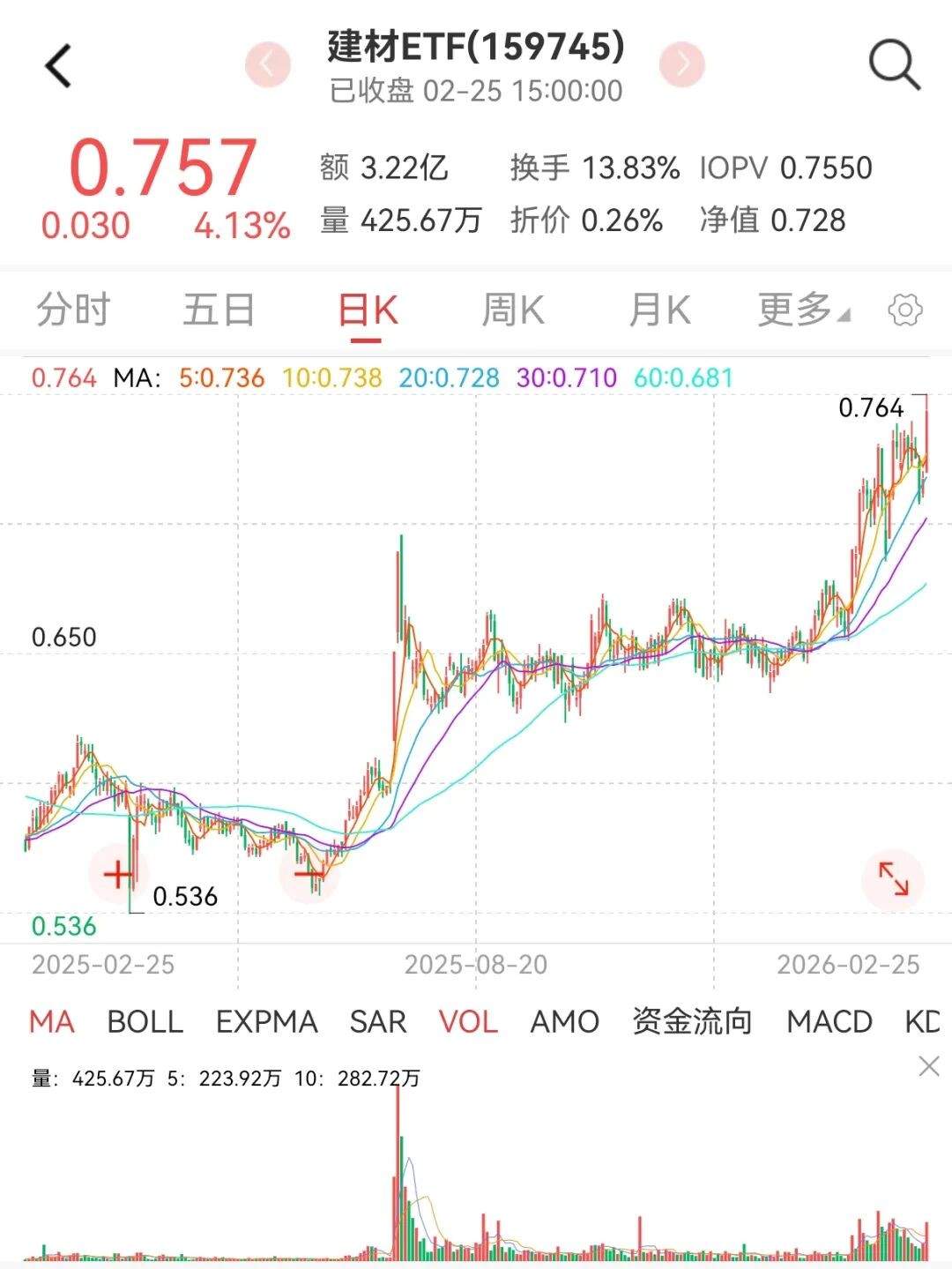
2月25日盘后播报:午后上海官宣楼市新政,建材板块活跃
Mei Ri Jing Ji Xin Wen· 2026-02-25 10:25
Group 1: A-Share Market Performance - The A-share market opened high and closed higher, with the Shanghai Composite Index rising by 0.72% to 4147.23 points, the Shenzhen Component Index increasing by 1.29%, and the ChiNext Index up by 1.41% [1] - The total trading volume for the day was 2.48 trillion yuan, compared to 2.22 trillion yuan the previous day [1] Group 2: Semiconductor Equipment Sector - The Semiconductor Equipment ETF (159516) experienced a significant increase, closing up by 4.56% after an initial drop, driven by expectations of major customer orders in the storage segment [1] - This cycle of semiconductor equipment is characterized by benefits from global AI-driven high demand, differing from previous cycles focused on recovery or domestic substitution [1] Group 3: Shanghai Real Estate Policy - Shanghai introduced new real estate policies, including reducing the social security requirement for non-local families from 3 years to 1 year for purchasing homes within the outer ring, allowing an additional purchase for non-local families, and increasing the first home provident fund loan limit from 1.6 million to 2.4 million yuan [2] - The new policies are expected to stimulate demand for housing and lower financial barriers for homebuyers, potentially boosting the building materials and real estate sectors [2] Group 4: Steel Sector Insights - The steel sector saw a significant rise, with the Steel ETF (515210) increasing by 4.27%, driven by both demand-side and supply-side catalysts [2] - Demand is expected to be supported by favorable real estate policies in key cities, while supply is anticipated to contract by 2026, with low inventory levels potentially leading to upward price elasticity if demand increases [2]
建材ETF(159745)大涨超4%,盘中净流入超1.1亿份,“反内卷”政策有望引导行业中长期盈利改善
Mei Ri Jing Ji Xin Wen· 2026-02-25 06:25
Core Viewpoint - The construction materials ETF (159745) experienced a significant increase of over 4%, with a net inflow of more than 1.1 billion shares, indicating strong market interest driven by the "anti-involution" policy, which is expected to lead to long-term profitability improvements in the industry [1][2]. Group 1: Market Performance - The construction materials ETF (159745) saw a net inflow of 1.15 billion shares, reflecting aggressive capital allocation by investors [2]. - The ETF tracks the construction materials index (931009), which represents the market performance of the construction materials industry, including sectors such as cement, glass, and new building materials [2]. Group 2: Industry Outlook - Dongwu Securities suggests that the proactive adjustment of supply in the cement industry is expected to be sustained, with accelerated exit of outdated and inefficient capacities [2]. - The utilization rate of clinker capacity is anticipated to improve in the medium term, supported by a consensus on supply discipline led by industry leaders by 2026 [2]. - The industry is expected to experience a rebound in profitability, particularly in provinces with significant demand from key infrastructure projects, although the overall demand remains unstable [2]. - The "anti-involution" policy is expected to guide orderly competition and the exit of inefficient capacities, thereby solidifying the long-term profitability foundation of the industry [2].
上海发布楼市“沪七条”,建材板块受催化,建材ETF(159745)大涨超4%,盘中净流入近2亿份
Mei Ri Jing Ji Xin Wen· 2026-02-25 05:43
Group 1 - The core viewpoint of the news is that the construction materials sector is experiencing increased investment interest, driven by policy adjustments in the real estate market and improving supply-demand dynamics [1][3]. - The Shanghai Municipal Housing and Urban-Rural Development Administration and four other departments have jointly issued a notice to further optimize and adjust the city's real estate policies, effective from February 26, 2026, which includes reducing housing purchase restrictions to promote better living conditions and meet residents' reasonable housing needs [1]. - The construction materials ETF (159745) saw a net inflow of 186 million shares, indicating strong capital interest in the sector [1]. Group 2 - On the supply side, the construction materials industry has seen increasing concentration, with the cement industry eliminating 16 million tons of capacity, and significant capacity reductions in glass, waterproofing, coatings, and tiles [1]. - On the demand side, the proportion of second-hand homes in property sales is expected to rise from 45% in 2021 to 70% by 2025, with the average age of homes increasing from 16 years to 21 years, indicating a potential for renovation demand [1]. - In specific segments, cement production control and carbon trading are expected to enhance price resilience during peak seasons, while the demand for renovation in consumer building materials is becoming more pronounced, with price increases already observed in waterproofing and gypsum board [1].
建材板块迎拐点机遇,资金抢筹布局,建材ETF(159745)近20日资金净流入超15亿元
Mei Ri Jing Ji Xin Wen· 2026-02-12 02:49
Core Viewpoint - The building materials industry is experiencing a turning point in both market sentiment and valuation, with signs of demand recovery driven by stabilization in the real estate sector [1] Demand Analysis - Real estate new starts are expected to stabilize and recover, with a significant decline observed: new starts down 70% compared to 2021, completions down 40%, and new home sales down 50% [1] - An article published at the beginning of the year emphasized the need to "improve and stabilize expectations for the real estate market" [1] Valuation Insights - The current valuation levels for the cement and glass sectors are at a low point, indicating potential for upward movement [1] - The cement sector is actively implementing strict production regulations based on designed capacity, reducing actual clinker capacity from 2.1 billion tons to 1.6 billion tons, which is expected to improve industry capacity utilization [1] Profitability Outlook - Although there is still a mismatch between supply and demand, higher capacity utilization is likely to facilitate off-peak production, leading to a continuous increase in net profit per ton for the industry [1] - This trend is anticipated to drive sustained profit growth within the industry [1] ETF and Index Information - The building materials ETF (159745) tracks the construction materials index (931009), which reflects the market performance of the building materials industry [1] - The index includes listed companies in sectors such as cement, glass, and ceramics, capturing the overall trend of the building materials industry [1] - The index exhibits strong cyclical characteristics and is closely linked to real estate and infrastructure investment, serving as an important reference for observing the industry's market conditions [1]
传统建材板块有望触底回升,建材ETF(159745)盘中涨超1.6%,资金积极布局,近20日净流入超14亿元
Mei Ri Jing Ji Xin Wen· 2026-02-11 06:10
Group 1 - The traditional building materials sector is expected to bottom out and recover due to a combination of factors such as the slowdown in new real estate demand and the gradual release of stock update demand, with significant benefits for consumer building materials [1] - In the cement industry, demand is notably affected by the decline in real estate investment, but strict capacity replacement, production restrictions, carbon emission policies, and anti-competition measures are expected to accelerate capacity reduction on the supply side [1] - The ongoing urban renewal and renovation of old residential areas are expected to support demand, improving supply and demand expectations, which may provide good support for prices [1] Group 2 - The fiberglass industry is benefiting from the explosive demand for computing power, with strong demand for specialty fabrics such as electronic fiberglass cloth, leading to supply tightness and an overall increase in industry price levels [1] - The overall demand structure in the industry is changing, with significant growth potential in renovation of existing homes, urban renewal, and infrastructure-related demand [1] - The building materials ETF (159745) tracks the construction materials index (931009), which mainly includes listed companies in the cement, glass, and ceramics sectors, with constituent companies being industry leaders and possessing strong market competitiveness [1]
水泥行业筑底修复,资金抢筹建材板块,建材ETF(159745)近20日资金净流入超15亿元
Mei Ri Jing Ji Xin Wen· 2026-02-10 06:37
Group 1 - The cement industry has passed its darkest hour, with profits solidly bottoming out and showing significant recovery [1] - On the demand side, expectations for real estate policies are strengthening, and the new housing market is gradually stabilizing, with urbanization development offering ample room for transformation [1] - Annual demand for stock updates is approximately 700 million square meters, providing a solid foundation [1] Group 2 - Structural opportunities in infrastructure, such as major projects like the Western Development strategy, will lead to regional market demand prosperity [1] - On the supply side, expectations for anti-involution are continuously strengthening, with policies promoting the unification of actual and registered production capacity, expected to reduce capacity by over 40 million tons [1] - By 2026, under the anti-involution strategy, supply-side control is anticipated [1] Group 3 - The overall cash flow of the industry is favorable, indicating conditions for long-term stable dividends, with upstream coal prices expected to remain low and fluctuate [1] - It is projected that by 2026, the industry's profits will achieve overall recovery, and dividend yields are expected to increase under the trend of enhancing shareholder returns [1] - The Building Materials ETF (159745) tracks the construction materials index (931009), which mainly covers companies engaged in the manufacturing and sales of cement, glass, ceramics, and other building materials [1]
建材ETF(159745)吸金超10亿元,资金或博弈政策力度进一步加大
Sou Hu Cai Jing· 2026-02-10 01:55
Group 1 - The building materials sector has seen significant capital inflow, with the building materials ETF (159745) experiencing over 1 billion yuan in net inflows in the last 10 trading days, currently reaching a scale of over 2.3 billion yuan, ranking first among its peers [1] - Shanghai has initiated the purchase of second-hand houses for the purpose of securing rental housing, alongside various policies such as home purchase subsidies, relaxed housing fund regulations, and monetary compensation for urban renovation, which enhance expectations for demand recovery in the post-real estate cycle [1] - Although prices for cement and glass have faced short-term pressure, inventory levels are decreasing, supply-side adjustments are accelerating, and following a period of negative growth in the Producer Price Index (PPI), expectations for a recovery in the production capacity cycle are rising, indicating ample room for valuation recovery as the sector is currently at historical lows [1]
水泥供给有望快速出清,建材ETF(159745)涨超1%,近20日资金净流入近14亿元
Mei Ri Jing Ji Xin Wen· 2026-02-09 05:23
Group 1 - The construction materials industry is currently significantly underweighted from an allocation perspective, with expectations of demand recovery driven by stabilization in the real estate sector [1] - The cement and glass sectors are currently at low valuation levels, indicating potential for investment opportunities [1] - The cement sector is expected to see a rapid supply clearance due to internal competition and dual carbon constraints, with actual clinker production capacity being reduced from 2.1 billion tons to 1.6 billion tons, leading to an increase in industry capacity utilization [1] Group 2 - The industry is actively implementing strict production regulations based on designed capacity, which is expected to enhance the industry's profit margins [1] - Despite ongoing supply-demand mismatches, higher capacity utilization is likely to facilitate off-peak production, resulting in a continuous improvement in net profit per ton for the industry [1] - The construction materials ETF (159745) tracks the building materials index (931009), which includes publicly listed companies in the cement, glass, and ceramics sectors, reflecting the overall performance of these companies [1]