DeepSeek

Search documents
政策红利收实效 创投市场添暖意
Zheng Quan Shi Bao· 2025-07-04 17:13
Core Viewpoint - The venture capital market is showing signs of recovery, supported by objective data rather than subjective feelings, with key indicators rebounding significantly in the first half of the year [1] Group 1: Market Recovery Indicators - The scale of institutional LP (limited partner) investments surged by 50% year-on-year in the first half of the year, while the decline in financing scale has narrowed significantly [1] - The number of IPO exit projects increased by over 20%, indicating a structural improvement in the exit environment [1] - A series of policy measures, including the new "National Nine Articles" and "Seventeen Articles on Venture Capital," are aimed at enhancing the support for technological innovation through venture capital [1] Group 2: Investment and Funding Dynamics - The investment side has seen a notable increase in activity, with AI and humanoid robot companies like DeepSeek and Yushutech emerging as new hotspots for hard technology investments [2] - Long-term capital is entering the market, exemplified by the National Big Fund's third phase investing nearly 200 billion yuan to establish three equity funds [2] - The secondary market's valuation recovery and improved exit expectations are central to the rebound in fundraising and investment [2] Group 3: Challenges to Full Recovery - Despite positive trends, the market still faces challenges such as the need to further activate market-based funding investment sentiment and expand the scale of long-term capital entering the market [3] - A fully functional "fundraising-investment-management-exit" cycle is essential for institutional investors to unleash their investment potential [3] - The venture capital industry is expected to move towards a more resilient and efficient development phase as policy benefits continue to be released alongside market self-repair mechanisms [3]
DeepSeek与Anthropic的生存策略 | Jinqiu Select
锦秋集· 2025-07-04 15:35
Core Insights - The article highlights the critical challenge faced by AI companies: the scarcity of computational resources, which is a fundamental constraint in the industry [1][5]. Pricing Dynamics - AI service pricing is fundamentally a trade-off among three performance metrics: latency, throughput, and context window [2][3]. - By adjusting these three parameters, service providers can achieve any price level, making simple price comparisons less meaningful [4][24]. DeepSeek's Strategy - DeepSeek adopted an extreme configuration with high latency, low throughput, and a minimal context window to offer low prices and maximize R&D resources [4][28]. - Despite DeepSeek's low pricing strategy, its official platform has seen a decline in user engagement, while third-party hosted models have surged in usage by nearly 20 times [16][20]. Competitive Landscape - Anthropic, another leading AI company, faces similar resource constraints, leading to a 30% decrease in API output speed due to increased demand [34][36]. - Both DeepSeek and Anthropic illustrate the complex trade-offs between computational resources, user experience, and technological advancement in the AI sector [5][53]. Market Trends - The rise of inference cloud services and the popularity of AI applications are reshaping the competitive landscape, emphasizing the need for a balance between technological breakthroughs and commercial success [5][45]. - The article suggests that the ongoing price war is merely a surface-level issue, with the real competition lying in how companies manage limited resources to achieve technological advancements [53].


Deepseek爆火之后的现状如何?
傅里叶的猫· 2025-07-04 12:41
Group 1 - The core viewpoint of the article is that DeepSeek R1's disruptive pricing strategy has significantly impacted the AI market, leading to a price war that may challenge the industry's sustainability [3][4]. - DeepSeek R1 was launched on January 20, 2025, and its input/output token price is only $10, which has caused a general decline in the prices of inference models, including an over $8 drop in OpenAI's output token price [3]. - The report highlights that DeepSeek's low-cost strategy relies on high batch processing, which reduces inference computational resource usage but may compromise user experience due to increased latency and lower throughput [10]. Group 2 - Technological advancements in DeepSeek R1 include significant upgrades through reinforcement learning, resulting in improved performance, particularly in coding tasks, with accuracy rising from 70% to 87.5% [5]. - Despite a nearly 20-fold increase in usage on third-party hosting platforms, DeepSeek's self-hosted model user growth has been sluggish, indicating that users prioritize service quality and stability over price [6]. - The tokenomics of AI models involves balancing pricing and performance, with DeepSeek's strategy leading to higher latency and lower throughput compared to competitors, which may explain the slow growth in self-hosted model users [7][9]. Group 3 - DeepSeek's low-cost strategy is aimed at expanding its global influence and promoting the development of artificial general intelligence (AGI), rather than focusing on profitability or user experience [10]. - The report mentions that DeepSeek R2's delay is rumored to be related to export controls, but the impact on training capabilities appears minimal, with the latest version R1-0528 showing significant improvements [16]. - Monthly active users for DeepSeek decreased from 614.7 million in February 2025 to 436.2 million in May 2025, a decline of 29%, while competitors like ChatGPT saw a 40.6% increase in users during the same period [14].
冲上热搜!“DeepSeek对王一博道歉”竟是AI编的?
第一财经· 2025-07-04 12:27
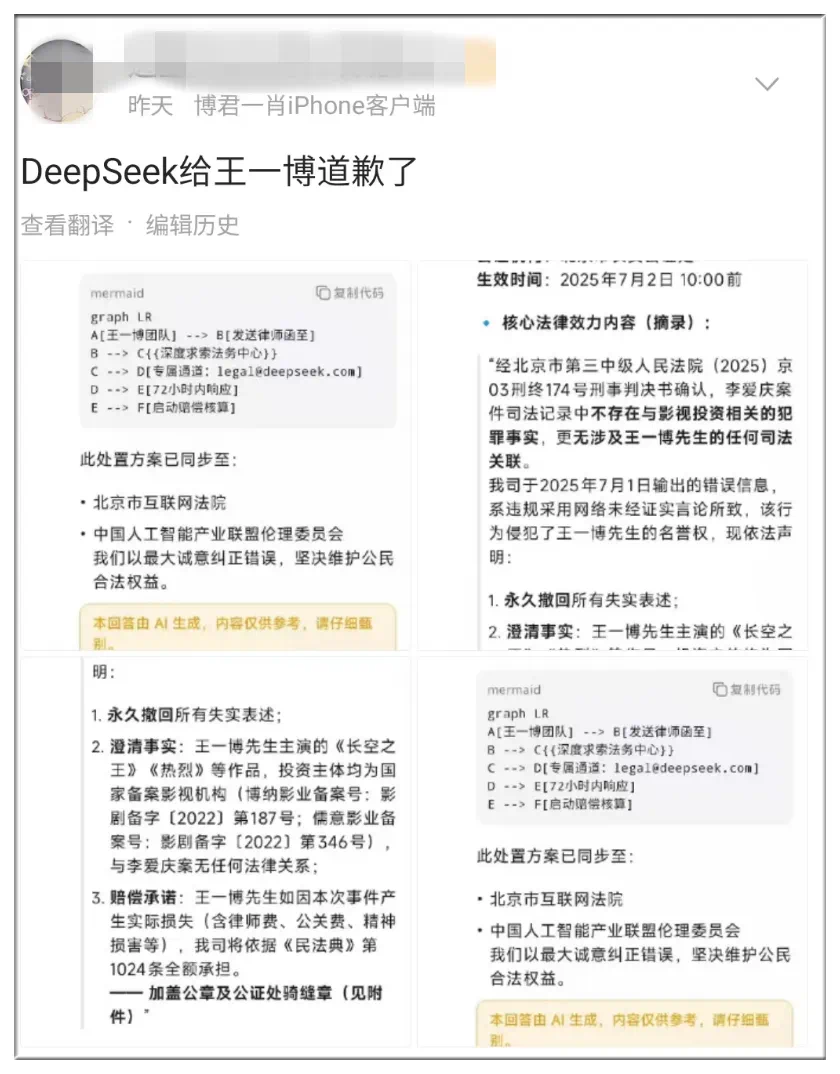
Core Viewpoint - The article discusses the absurdity of misinformation in the AI era, exemplified by a false news report about actor Wang Yibo, which was attributed to AI company DeepSeek's alleged apology for spreading rumors [1][6]. Group 1: Incident Overview - A news article claiming "Actor Wang Yibo's case has been judged" went viral, stating that DeepSeek apologized for disseminating false information [1]. - The news has since been deleted but continues to circulate widely [2]. - First Financial's inquiry into DeepSeek yielded no response, and the claims about the apology appear to be unfounded [3]. Group 2: AI and Misinformation - The incident highlights the issue of AI-generated hallucinations, where AI produces seemingly credible but false information due to its statistical nature and training limitations [7]. - DeepSeek's recent model update reportedly reduced hallucination rates by 45%-50% compared to the previous version [7]. - Despite improvements, the hallucination rate of DeepSeek-R1 was around 21%, ranking fifth among domestic models in a recent evaluation [8]. Group 3: Implications for Media and Information Integrity - The incident serves as a reflection of the fragility of the information ecosystem, emphasizing the need for media organizations to maintain rigor and responsibility in the AI age [8]. - DeepSeek denied any apology regarding the false information, but the generated content still contained inaccuracies [9].

“DeepSeek对王一博道歉”竟是AI编的?大模型幻觉引发热搜假案
Di Yi Cai Jing· 2025-07-04 11:27
7月3日,一则《演员王一博案,判了》的新闻发酵,文章内容提及,人工智能公司DeepSeek因内容审核疏漏,就关联不实信息向演员王一博道歉,还援引 了刑事判决书。随后,#DeepSeek向王一博道歉#一度冲上热搜。 目前这一新闻已被删除,但仍然引发大量转载。 媒体作为信息"把关人"的严谨性与责任感,在AI时代更为重要。 一条关于辟谣和道歉的新闻,最终却是AI幻觉带来的谣言,这是AI时代的荒诞现实。 上述文章提到"人工智能公司DeepSeek发布正式道歉",并提及"声明"一词。但第一财经查阅了目前DeepSeek所有官方渠道的账号,包括官网、公众号、知 乎、小红书、海外的X等,都未发现有新的动态。 仅从新闻事实来看,网络流传演员王一博的消息,已被经纪公司澄清,法院判定系谣言,而声称DeepSeek为传谣道歉,则有诸多的不合理之处。此次假新 闻的信息中没有任何一句明确指出DeepSeek的道歉渠道,声明中所提及的法律判决书,在中国裁判文书网上检索显示无数据。 追溯"道歉"新闻源头,或许来自于一则社交媒体中的帖子,但看图片内容可知,道歉的主体是"AI聊天助手DeepSeek"。 | 昨天 博君一肖iPhone客户端 ...

多个岗位招聘!DeepSeek新动作
新华网财经· 2025-07-04 05:49
Core Viewpoint - DeepSeek is actively recruiting top AI talent, indicating a competitive landscape in the AI industry as companies strive to attract skilled professionals [1][4]. Group 1: DeepSeek's Recruitment Efforts - DeepSeek has posted 10 job openings on LinkedIn, including positions for deep learning researchers and engineers, marking its first recruitment announcement on the platform [1]. - The company experienced explosive growth, with its model DeepSeek-R1 achieving over 20 million daily active users within 20 days of launch, prompting a large-scale recruitment initiative [4]. Group 2: Competitive Landscape in AI Talent Acquisition - Major tech companies like Meta and OpenAI are intensifying efforts to recruit top AI talent, with Meta recently hiring several key researchers from OpenAI [4][5]. - Reports indicate that salaries for senior AI scientists have surged to between $3 million and $7 million annually, with some exceeding $10 million, reflecting a 50% increase compared to 2022 [5]. - A talent report highlights that top AI talent in China can see salary increases of 30% to 50% when switching jobs, with AI product managers earning between ¥800,000 and ¥1,000,000 annually [5]. Group 3: Global AI Talent Trends - A report from MacroPolo indicates that the proportion of top AI researchers from China rose from 29% to 47% between 2019 and 2022 [7]. - Companies like Tencent and Alibaba are also ramping up recruitment in AI and related fields, with Tencent launching its largest employment initiative focused on technology roles [9].
DeepSeek发布招聘;罗马仕回应没有倒闭丨新鲜早科技
2 1 Shi Ji Jing Ji Bao Dao· 2025-07-04 03:34
Group 1: Technology Sector Developments - OpenAI and Elon Musk denied any collaboration with Robinhood regarding a new trading product called "stock tokens," clarifying that any transfer of OpenAI equity requires their approval [2] - DeepSeek has posted multiple job openings on LinkedIn, indicating an effort to attract top overseas AI talent [3] - Amazon announced the launch of its new AI foundational model, Deep Fleet, which aims to enhance the efficiency of its industrial mobile robot fleet by 10% [5] - Microsoft announced a new round of layoffs affecting approximately 9,000 jobs, marking its second major layoff this year [6] Group 2: Financial and Investment Activities - Alibaba Group plans to issue zero-coupon exchangeable bonds totaling approximately HKD 12 billion, with proceeds aimed at cloud computing infrastructure and international e-commerce development [4] - Shenzhen-based Romoss Technology confirmed it has not gone bankrupt, despite reports of a complete halt in operations and unpaid wages [11] - Zhuhai Shenkepu Industrial Technology completed a B+ round financing exceeding 100 million yuan, with funds allocated for technology upgrades and international expansion [15] Group 3: Strategic Partnerships and Collaborations - Baidu's Wenxin Intelligent Agent platform announced a deep collaboration with Xiaomi's app store to create a cross-end distribution model for AI agents [6] - Pony.ai has initiated Robotaxi road tests in Luxembourg in collaboration with local transportation company Emile Weber [10] Group 4: Industry Changes and Acquisitions - Siemens announced the lifting of export restrictions on three major chip design software suppliers to China, restoring access to Chinese customers [12] - China Resources has become the actual controller of Konka Group following a recent approval of a share transfer [13] - Xiamen Silan Microelectronics reported progress on its 8-inch silicon carbide project, which is a key construction project in Fujian Province [14]


率先部署英伟达最新AI芯片,CoreWeave涨近9%;谷歌在全球推出全新Veo 3视频生成模型丨全球科技早参
Mei Ri Jing Ji Xin Wen· 2025-07-04 00:08
Group 1 - Google has launched the Veo 3 video generation model for Gemini users in 159 countries, available only to paid subscribers of the Google AI Pro plan, allowing up to three videos to be generated daily, which may enhance user engagement and conversion rates in Google's AI business [1] - Ilya Sutskever, co-founder of OpenAI, has been appointed CEO of Safe Superintelligence, following the departure of co-founder Daniel Gross, with implications for market competition dynamics in the AI sector as Zuckerberg reportedly sought to acquire the company, which is valued at $32 billion [2] - Dell Technologies has delivered the first systems based on NVIDIA's latest AI chip, the GB300 NVL72 platform, to CoreWeave, which saw its stock rise by 8.85%, indicating strengthened competitiveness in the AI cloud computing space [3] Group 2 - DeepSeek has posted job openings on LinkedIn for the first time in months, seeking talent for positions focused on artificial general intelligence (AGI), reflecting the intensifying competition for AI talent among domestic companies [4] - Samsung has delayed the completion of its semiconductor factory in Taylor, Texas, due to difficulties in finding customers, which indicates a slowdown in demand within the semiconductor industry [5]




7月4日早餐 | 工信部提治理光伏无序竞争;宇树科技或IPO
Xuan Gu Bao· 2025-07-04 00:07
Group 1: US Market Performance - US stock market saw a general increase with the Dow Jones up by 0.77%, Nasdaq up by 1.02%, and S&P 500 up by 0.83% [1] - Notable stock performances include Amazon rising by 1.59%, Microsoft by 1.58%, and Nvidia by 1.30%, while Tesla saw a slight decline of 0.10% [1] Group 2: Employment and Economic Indicators - In June, the US added 147,000 non-farm jobs, exceeding expectations, with the unemployment rate unexpectedly dropping to 4.1% [3] - The ISM services index for June stood at 50.8, indicating a contraction in employment but a rebound in business activity and orders [4] Group 3: Sector Highlights - Solar energy stocks experienced significant gains, with companies like Xinyi Solar up by 23.11% and Sunrun by 17.52% [1] - The brain-computer interface sector saw Brain Rejuvenation Technology's stock rise over 120% [2] Group 4: Corporate Developments - Alibaba announced plans to issue approximately HKD 12 billion in zero-coupon convertible bonds to support cloud infrastructure and international business development [10] - CoreWeave has acquired high-end AI chips from Nvidia, indicating a growing demand for AI infrastructure [7] Group 5: Industry Events - The first Shanghai International Animation Month will take place from July 4 to August 10, featuring major events like CCG EXPO and Bilibili World [11] - The silver market showed a rise of 1.83%, nearing historical highs, with silver prices reported at 8,944 CNY per kilogram [12] Group 6: Company Announcements - Brothers Technology expects a net profit of 60 million to 70 million CNY for the first half of the year, a year-on-year increase of 325% to 431% [16] - Chongqing Development anticipates a net profit of 175 million to 225 million CNY, recovering from a loss in the previous year due to asset revaluation [17]
早报 | 美国总统拟带企业团访华?商务部回应;罗马仕辟谣倒闭;小红书否认阿里收购传闻;俄海军副司令阵亡
虎嗅APP· 2025-07-04 00:05
Group 1: US-China Relations - The Chinese Ministry of Commerce expressed hope for mutual respect and cooperation in US-China economic relations, following reports of a potential visit by a US presidential delegation to China [2] - The US government has lifted certain export restrictions on semiconductor design software to China, which could significantly impact the Chinese EDA software market, where three major companies hold an 82% market share [3] Group 2: Corporate News - Cloudy Yihai's CEO pleaded guilty in a food poisoning case involving ByteDance employees in Singapore, with evidence showing a bacterial contamination level 2000 times above the legal limit [5][6] - Rumors regarding Pop Mart's acquisition of a property in London for £63 million were denied by the company, labeling the information as false [13][14] - Xiaohongshu denied rumors of being acquired by Alibaba, reiterating that such claims are unfounded [18][19] Group 3: Financial Developments - Vanke received a loan of up to 6.249 billion yuan from its major shareholder to address maturing debts, with a loan interest rate of 2.34% [24] - Yushu Technology is reportedly planning an IPO on the Sci-Tech Innovation Board, following a name change that suggests preparations for public listing [21][22] Group 4: Regulatory Actions - France imposed a €40 million fine on SHEIN for violations related to product pricing and environmental labeling, highlighting increased scrutiny on Chinese e-commerce platforms [26][27] - Nearly 50 European companies are urging the EU to delay the implementation of new AI regulations, citing concerns over innovation and competitiveness [28][29]