
宇树科技

Search documents
机器人租赁平台年末火爆, 但日租价大跌
Xin Lang Cai Jing· 2025-12-26 04:41
Group 1 - The robot rental market is experiencing explosive growth due to the increase in year-end events and performances, but rental prices are returning to rational levels, with daily rental fees dropping from over 10,000 yuan to hundreds or thousands of yuan [2] - Basic embodied intelligent robots can now be rented for as low as 200 yuan per day, while advanced interactive robots range from 2,000 to 5,000 yuan per day [2] - The rental business is booming, with some platforms reporting bookings extending into February, and prices fluctuating daily [2] Group 2 - The first open robot rental platform, "Qingtian Rental," was launched, aiming to connect over 10 manufacturers, 200 service rental companies, and 300,000 rental customers by 2026 [3] - The platform currently covers 50 core cities in China and plans to expand to over 200 cities by 2026, creating an open robot rental ecosystem [3] - Popular humanoid robots on the platform are available for daily rentals starting from 1,499 yuan, with promotional offers reducing prices to as low as 699 yuan [3] Group 3 - The robot rental market has surpassed 1 billion yuan, with expectations to reach no less than 10 billion yuan next year [10] - Sales of embodied intelligent robots have surged, with transaction volumes increasing by 757% year-on-year during October and November [10] - Despite growth, consumer-grade humanoid robots still face challenges in performing complex tasks and natural emotional interactions, indicating ongoing technological upgrades [10]



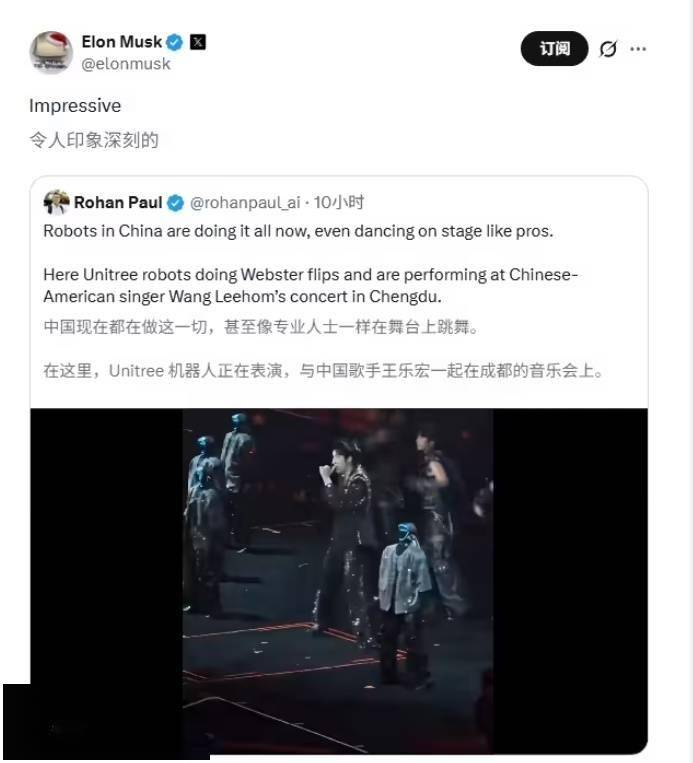
火到国外!马斯克点赞宇树机器人为王力宏伴舞,王兴兴:大家喜爱程度超过我的预估,对行业是件好事【附人形机器人行业市场分析】
Sou Hu Cai Jing· 2025-12-26 04:10
Core Viewpoint - The recent performance of humanoid robots at a concert has garnered significant attention, highlighting advancements in robotics technology and the challenges that remain for practical applications in the industry [1][3]. Group 1: Industry Developments - The performance of six humanoid robots by Yushutech at a concert marked a significant milestone, showcasing their capabilities and attracting global attention, with over 40 million views on social media after being endorsed by Elon Musk [1][3]. - Yushutech's robots have previously gained recognition at the Chinese Spring Festival Gala and the World Humanoid Robot Games, indicating a trend of increasing public interest and technological advancement in humanoid robotics [3]. Group 2: Technical Challenges - Key technical bottlenecks remain in the development of humanoid robots, particularly in data collection methods, which affect their learning and adaptability [4]. - The disparity in development between the "brain" (intelligence) and "cerebellum" (motor control) of robots is a significant challenge, as current capabilities allow for basic command understanding but struggle with precise movement execution [4]. - The lack of a unified underlying algorithm model hampers overall efficiency, as different tasks require separate algorithm development, leading to compatibility issues among components [6]. Group 3: Market and Economic Factors - The cost of humanoid robots remains a critical barrier to mass production, with current material costs around 400,000 yuan per unit, while profitability requires costs to drop below 50,000 yuan [8]. - Despite ambitious production goals set by Tesla and other domestic manufacturers, a recent Goldman Sachs survey indicates that actual production capacity will fall short, with only 12,000 units expected by 2026 [8]. - Industry experts suggest that the path to widespread adoption of humanoid robots is still long, primarily due to insufficient AI capabilities, although future technological breakthroughs could change the landscape [8].

全球人形机器人年鉴:从一级市场到二级市场
Robot猎场备忘录· 2025-12-26 04:08
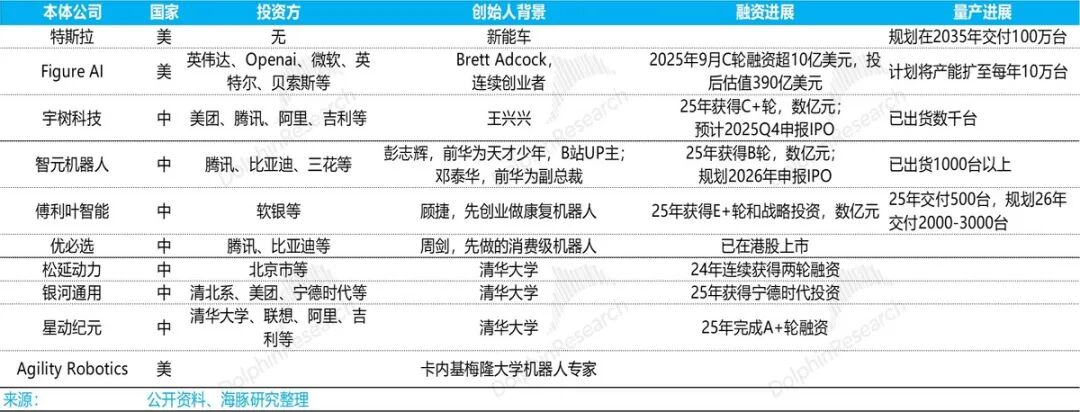
Core Insights - The humanoid robot sector is currently experiencing unprecedented attention globally, particularly in China, where it is supported by policies and government funds [2][21] - The competition among major players in the humanoid robot field is intense, with many startups likely to fail in the commercialization process [3][5] Group 1: Market Overview - Since 2025, major automotive and tech companies have adopted a dual approach of "self-research + investment" in the embodied intelligence sector, but most are still in the early stages without commercially viable bipedal humanoid robots [3][5] - The industry is characterized by a lack of consensus, with various new startups continuously emerging despite existing technological bottlenecks [4][5] Group 2: Commercialization Progress - In the second half of 2025, domestic humanoid robot startups have made significant commercialization progress, surpassing that of leading foreign companies, primarily due to better scene selection rather than advanced technology [5][22] - Current commercial applications remain limited to research, education, and entertainment, with industrial and household applications still a long way off [5][22] Group 3: Technological Development - The humanoid robot sector is entering an era focused on self-research of the robot "brain," driven by breakthroughs in artificial intelligence and large model technologies [5][6] - The dual-system architecture, specifically the VLA model, has become the mainstream approach in the field of embodied intelligence, with no consensus yet on hardware and software technologies [6][8] Group 4: Investment Trends - The secondary market is seeing a surge in interest, particularly in T-chain companies, driven by the positive developments surrounding Tesla's Optimus project [4][11] - Leading startups are increasingly pursuing IPOs, with companies like Zhiyuan Robotics and Yushun Technology initiating their IPO processes [10][11] Group 5: Future Directions - The development of dexterous hands and multi-modal tactile sensors is gaining traction, as these components are crucial for the performance of humanoid robots [9][10] - The healthcare and elderly care sectors are expected to become key focus areas for humanoid robot startups in the future [10]

推出App Store,宇树会迎来它的“苹果商店”时刻吗?
3 6 Ke· 2025-12-26 03:14
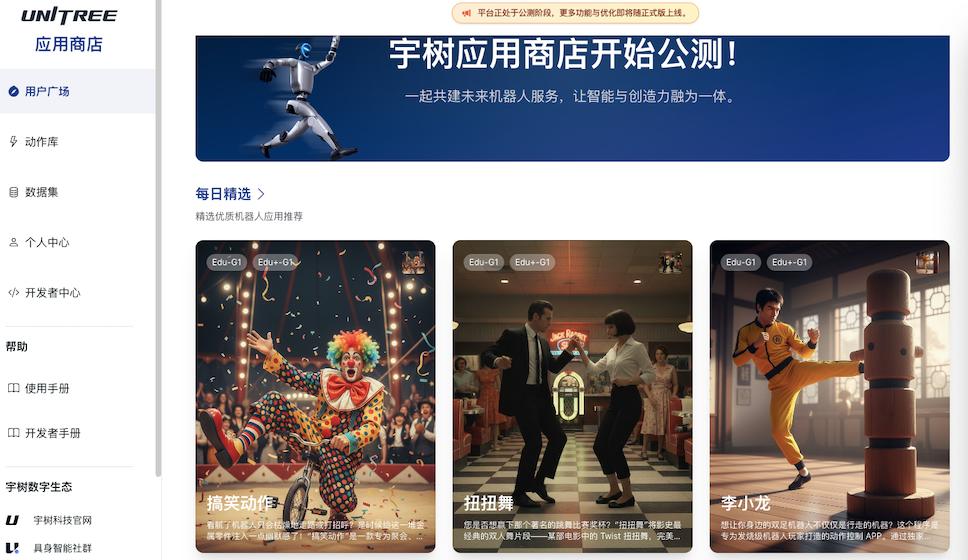
Core Viewpoint - Yushu Technology is making strides in the robotics industry by launching its own "App Store" for humanoid robots, aiming to enhance user engagement and expand its ecosystem [1][5]. Group 1: Company Developments - Yushu Technology has gained attention for its participation in high-profile events, such as the Spring Festival Gala and a concert by Wang Lihong, showcasing the impressive capabilities of its robots [1]. - The newly launched "App Store" allows users to upload and share trained models for various actions, promoting a two-way interaction model [1][2]. - The App Store currently features modules like "User Square," "Action Library," and "Developer Center," with initial offerings including dance and martial arts actions [2][4]. Group 2: User Engagement and Accessibility - The App Store is designed to lower the barrier for users, enabling them to connect their robots via a mobile app without needing coding skills [7]. - Users can upload and download data sets for training and optimizing robot algorithms, enhancing the overall user experience [7]. - This model aims to reduce the costs associated with robot usage, making it more accessible to both individual and enterprise users [7]. Group 3: Industry Implications - The introduction of the App Store model is expected to transform the robotics industry by shifting from high-cost, one-time sales to affordable, standardized hardware and software services [9]. - It may also increase orders from small and medium-sized clients, accelerating the deployment of robots in everyday scenarios [9]. - The platform could facilitate the collection and optimization of action model data, enhancing the capabilities of compatible robot models [9][10].
ROBOTAC携手宇树科技开启机器人搏击新纪元
机器人大讲堂· 2025-12-26 03:05
Core Insights - The global robotics technology is transitioning from laboratory validation to real-world application, focusing on adaptability in complex environments rather than just executing pre-set actions [1] - The role of robots is evolving to include autonomous decision-making and stable operation in uncertain environments, necessitating breakthroughs in motion control capabilities [1] - Robotics competitions are becoming crucial for driving technological evolution, serving as a testing ground for design, algorithms, and control systems under extreme conditions [1] Group 1: ROBOTAC Development - ROBOTAC (Robot + Tactic) is a national-level robotics competition in China, integrated into the national college robotics competition system since 2015 and the academic competition evaluation system since 2019 [2] - The competition emphasizes a blend of fun and technicality, characterized by the "5I" principles: Interesting, Independent Development, Interdisciplinary, Involving, and International [2] Group 2: Talent Development and Educational Value - ROBOTAC provides a platform for practical experience in robotics, guiding students through the entire process from task analysis to presentation, enhancing their practical skills and teamwork [5] - The competition promotes the development of robotics laboratories, student organizations, and curriculum reforms in universities, creating a sustainable support system for robotics education [5] Group 3: Innovation Ecosystem and Cross-Disciplinary Collaboration - ROBOTAC serves as an open innovation platform, fostering collaboration across engineering, design, and academia, creating a comprehensive competition system with various types of events [7] - The competition has established a complete event structure that includes research and application, engineering and design, and multiple levels of competition [7] Group 4: Motion Control Technology - Motion control is critical in robotics, akin to the function of a biological "cerebellum," ensuring stability and coordination in dynamic and uncertain environments [11] - The ability to perform complex tasks under external disturbances is essential for robots, particularly in high-dynamic scenarios like humanoid combat [12] Group 5: YuTree Technology's Core Advantages - YuTree Technology focuses on high-dynamic motion control, developing a systematic technology path from hardware to control algorithms [13] - The company emphasizes self-developed high-performance servo motors and gear systems to ensure reliable operation under high-frequency movements and external shocks [13] Group 6: ROBOTAC and YuTree Collaboration - The introduction of the large group humanoid kung fu competition aims to address core technical issues in motion control and strategy decision-making [15] - YuTree provides essential technical support and hardware for the competition, enabling teams to focus on advanced technological innovations rather than basic reliability [17] Group 7: Value of Competition Expansion - The competition creates a platform for students to engage with real-world robotics challenges, promoting interdisciplinary collaboration and practical application of knowledge [20] - This cycle of competition driving technology and vice versa supports the development of a robust talent pipeline from education to industry [20]

机器人大战挥别“草莽时代”
Bei Jing Shang Bao· 2025-12-26 01:41
动辄数十亿的资本联姻,参与者身份不尽相同。有的已是港股上市公司,有的没上市企业并未注入资产 和重组计划。有的是人形机器人,有的是四足机器人、特种机器人,并购对象更是涉及环保材料、园林 机械、能源运输、物流仓储等千行百业。 12月24日,优必选宣布收购A股上市公司园林机械制造商锋龙股份的43%股权,豪掷16.65亿元拿下后者 控股权。在此之前数月时间,进行了类似操作的还有智元机器人收购上纬新材、七腾机器人收购胜通能 源…… 算上反向操作的东杰智能收购遨博智能,以及明确IPO进展的宇树科技、云深处科技、乐聚机器人等, 机器人在资本市场的火爆持续到岁末年初。 从内测产品找风投,到秀舞蹈打比赛,再逐渐成为公开市场的香饽饽,以人形机器人破圈为标志的机器 人全链条迎来订单和财富的爆发期。 虽说上市只是又一个阶段的新起点,但能接受大众层级的检验,意味着机器人竞争告别了草根、草莽时 代。市场上有头部领跑者,有当红炸子鸡,有资本领域的长袖善舞,也有大厂明争暗斗和合纵连横—— 新进入者并非没有机会,竞争压力却远超过往。 近期还有市场传闻称,多家人形机器人企业正展开竞逐,不惜重金要拿下总台马年春晚亮相机会。一年 前略显笨拙的"春晚 ...

“情绪向左产业向右”,这一板块吸金盖过商业航天丨每日研选
Shang Hai Zheng Quan Bao· 2025-12-26 01:16
Core Viewpoint - The humanoid robot sector is experiencing renewed interest from investors, with significant capital inflow observed recently, indicating a potential recovery in market sentiment after a period of decline [1] Group 1: Market Dynamics - As of late November, the humanoid robot index, comprising 110 companies, saw its trading volume drop to 23.7% of the total A-share trading volume, reflecting a significant decrease in market attention [1] - The sector has undergone a price correction, with some stocks returning to relatively reasonable or undervalued levels, suggesting a high safety margin and investment value [1] - The current market sentiment is characterized by a divergence between emotional responses and industrial advancements, presenting opportunities for contrarian investments [1] Group 2: Technological Advancements - The humanoid robot industry is witnessing a qualitative transformation, with significant improvements in motion control capabilities, as demonstrated by robots like Yuzhu G1 and Tesla's Optimus [1] - The timeline for mass production is becoming clearer, with Tesla planning to prepare prototype production by February-March 2026, and other domestic companies like Xpeng aiming for mass production by the end of 2026 [2] Group 3: Financial Support - Substantial financing is fueling the industry, with Galaxy General securing over $300 million in new funding, setting a record for the humanoid robot sector, and bringing its total financing to approximately $800 million [2] - The establishment of the world's first humanoid robot power battery PACK production line by CATL signifies a major investment in intelligent manufacturing, enhancing the credibility of the sector [2] Group 4: Policy Support - Local government policies are increasingly supportive of the humanoid robot industry, with initiatives in places like Luoyang and Shandong promoting the development of related technologies and products [3] - Large-scale equipment renewal policies are providing a safety net for the manufacturing sector's transformation, indirectly benefiting the robot industry [3] Group 5: Investment Focus - Future investment strategies in humanoid robots will center around "mass production realization" and "capability evolution," with value transmission expected along the supply chain from complete machines to core components [4] - Companies with established positions in high-value segments such as joints, sensors, and dexterous hands are likely to see more pronounced earnings certainty [4] - The hand, as a critical execution unit for humanoid robots, presents significant engineering challenges, and firms with deep expertise in materials and processes are expected to benefit from the upcoming growth in humanoid robot production [4]
向“新”而行 加“数”奔腾——2025数字中国建设提质提速
Ren Min Ri Bao Hai Wai Ban· 2025-12-26 00:18
Core Insights - The digital economy in China is rapidly evolving, driven by advancements in artificial intelligence and digital technologies, leading to new business models and high-quality economic development [1][2][5]. Group 1: Digital Innovation and AI Development - China has significantly enhanced its autonomous innovation capabilities in the digital sector, with AI models like DeepSeek achieving over 22.15 million active users within 21 days of launch [2]. - The country has become the largest holder of AI patents globally, accounting for 60% of the total, with breakthroughs in AI chips and algorithms [3]. Group 2: Infrastructure and Digital Economy Growth - By the end of November, China had 4.83 million 5G base stations, a net increase of 579,000 from the previous year, representing 37.4% of all mobile base stations [4]. - The scale of China's digital economy remains the second largest in the world, with significant improvements in technological innovation and industrial competitiveness [4]. Group 3: Industry Transformation and Smart Manufacturing - The integration of digital technologies across various industries has led to a 9.2% year-on-year increase in high-tech manufacturing value added from January to November [6][8]. - Over 7,000 advanced intelligent factories have been established nationwide, with the total scale of intelligent manufacturing equipment and solutions exceeding 4.5 trillion yuan [7]. Group 4: Agricultural Innovation - The agricultural sector is experiencing revitalization through digital technologies, with 62 types of intelligent equipment achieving breakthroughs [8]. - The value added in the digital product manufacturing industry increased by 9.3% year-on-year, with significant growth in information transmission and software services [8]. Group 5: Digital Services and Public Welfare - The implementation of a two-way referral information platform in Chengdu has improved healthcare access for over 6 million people, showcasing the impact of digital services on public welfare [9]. - The digitization of public services has streamlined processes, allowing citizens to access services more efficiently, exemplified by self-service terminals in various government offices [10]. Group 6: Daily Life and Leisure Transformation - Digital technologies are reshaping daily life, with smart applications enhancing community services and leisure activities, such as AI-driven tourist assistance in scenic areas [11]. - The completion rate of digital transformation in 5A-level tourist attractions has reached 100%, indicating widespread adoption of digital technologies in enhancing visitor experiences [11]. Group 7: International Cooperation in Digital Economy - China is actively promoting international cooperation in the digital economy, with the "Suhau Cloud" platform facilitating cross-border e-commerce and achieving over 220% growth in trade volume [12][13]. - The establishment of partnerships with 36 countries under the "Silk Road e-commerce" initiative highlights China's commitment to bridging the digital divide globally [13][14].
万亿赛道从零起,人形机器人才是AI全村的希望?
3 6 Ke· 2025-12-25 23:31
Core Insights - The key focus for AI in 2026 will be on reducing computing costs and the implementation of AI investments in both software and hardware, with new hardware deployment representing true incremental opportunities [1] Industry Overview - The humanoid robot industry is expected to be significantly impacted by the upcoming mass production of Tesla's Optimus robot, which is anticipated to change human interaction and productivity [2] - The analysis of the humanoid robot supply chain will cover the composition of the industry, challenges in hardware industrialization, and opportunities in humanoid robot hardware [2] Humanoid Robot Characteristics - Humanoid robots are defined by two core features: the "form" resembling a human and the "brain" that enables multi-modal perception, continuous learning, and decision-making [2][3] - Achieving the general capabilities required for humanoid robots necessitates advancements in computing power, algorithms, data, and the integration of hardware and software [3] Hardware Challenges - The hardware requirements for humanoid robots differ significantly from other industries, with some components needing to be developed from scratch, such as highly sensitive tactile sensors [4] - The cost of hardware must be sufficiently low to enable widespread adoption, as the estimated future demand for humanoid robots is substantial [4] Supply Chain Breakdown - The humanoid robot industry can be divided into upstream, midstream, and downstream segments, with a complex supply chain similar to that of the electric vehicle industry [5][6] - Upstream focuses on collaboration between manufacturers and suppliers of actuators, sensors, and control systems, with a diverse range of cooperation models [7] - Midstream consists of manufacturers of humanoid robots, primarily concentrated in the US and China, with a mix of established companies and startups [8][9] Upstream Hardware Analysis - Tesla's Optimus robot is projected to have a production capacity of 100,000 units annually by the end of 2026, with significant potential for growth in the humanoid robot market [12] - The hardware components of the Optimus robot include perception, decision-making, and execution layers, with specific focus on sensors and actuators [14][36] Sensor Technologies - Visual sensors are critical for environmental perception, with Tesla opting for a 2D camera approach, while other manufacturers may use 3D cameras and LIDAR [15] - Tactile sensors, essential for human-like interaction, face significant technological challenges and are a key area for development [16][20] - Six-dimensional force sensors are crucial for motion control, with a focus on domestic alternatives to reduce reliance on foreign suppliers [22][27] Actuator Technologies - Electric motors are the primary drive mechanism for humanoid robots, with a focus on developing high-performance, cost-effective solutions [37] - Linear and rotary actuators are essential for joint movement, with a significant emphasis on the development of planetary roller screws and gear reducers [46][58] Market Dynamics - The humanoid robot market is characterized by high entry barriers and significant opportunities in the development of tactile sensors and actuators, particularly in the context of domestic production capabilities [69]
年初只会丢手绢 年末暴打创始人 具身智能企业今年融资370亿元
Shen Zhen Shang Bao· 2025-12-25 23:24
Core Insights - The industry of embodied intelligence is transitioning from the "proof of concept" phase to a new stage characterized by large-scale investments, concentration of leading companies, and expectations for industrialization [2][8] Investment Trends - In 2025, at least 165 embodied intelligence companies completed 303 financing rounds, accumulating nearly 37 billion yuan, a nearly 260% increase compared to the entire year of 2024 [2] - The number of companies receiving investment in 2025 reached 168, with a financing scale of 32.9 billion yuan, a year-on-year increase of 291% [3] - The total investment in the embodied intelligence sector from 2022 to 2025 amounted to 512 cases, with disclosed financing exceeding 48 billion yuan [4] Company Performance - Notable companies like ZhiYuan Robotics and Galaxy General have achieved significant financing milestones, with Galaxy General raising over 300 million USD (approximately 2.1 billion yuan) in December 2025, setting new records for single and cumulative financing [6] - ZhiYuan Robotics completed 11 financing rounds by August 2025, with a valuation reaching 15 billion yuan, and plans for an IPO in Hong Kong [6] Market Dynamics - The concentration of investment is evident, with the top 10 companies accounting for about 40% of the total financing in 2025, indicating a narrowing window for mid-tier projects [8] - The industry is experiencing a surge in entrepreneurial activity, with 53 new companies established in 2025, and 31 of them securing funding shortly after their inception [3] Future Outlook - 2025 is seen as a watershed year for financing in the embodied intelligence sector, marking a systematic increase in capital scale and a shift from "technology validation" to "pre-industrialization" [8] - The financing rhythm is expected to differentiate in 2026, with leading companies likely to secure large, low-frequency but high-certainty funding, while mid-tier companies may face a more challenging environment [8]