法国巴黎银行

Search documents
汇丰控股(HSBC.US)同意支付3亿欧元 以了结法国“Cum-Cum”税务丑闻
Zhi Tong Cai Jing· 2026-01-08 11:17
Group 1 - HSBC Holdings has agreed to pay approximately €300 million (equivalent to $350 million) to settle criminal and tax dual investigations initiated by France regarding its involvement in the "Cum-Cum" dividend tax avoidance scandal [1] - The settlement includes a fine of about €268 million and approximately €30 million in taxes already paid by HSBC, with a French judge set to decide on the approval of the agreement [1] - HSBC acknowledged the basic facts of the case, stating that the involved transactions were executed by its Paris traders between 2014 and 2019, and admitted that the relevant transactions did not pay sufficient French taxes [1] Group 2 - The "Cum-Cum" trading scheme allegedly involved lending French stocks to local banks with tax-exempt status during dividend distribution seasons, helping foreign stockholders avoid withholding taxes [2] - The French authorities have adopted a dual-track approach to combat such transactions, with the tax department aiming to recover approximately €4.5 billion in tax revenue lost due to related transactions by domestic banks [2] - Despite ongoing investigations, the French banking lobby has long denied any wrongdoing, asserting that the controversial transactions were conducted for economic purposes such as hedging short positions and not for tax evasion [2] Group 3 - The "Cum-Cum" scandal has also led to political tensions, as the French government seeks to balance the pursuit of tax fraud with maintaining Paris's attractiveness to the financial sector [3] - The French Treasury has previously opposed strict interpretations of new tax law provisions to prevent a significant loss of stock derivative trading business to other financial hubs like London [3]

指数再平衡抛压来袭!金银受冲击连跌,交易员严阵以待
Xin Lang Cai Jing· 2026-01-08 08:38
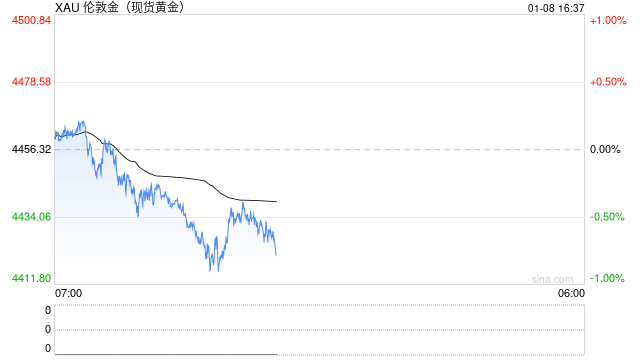
Group 1 - The core point of the article is that gold and silver prices are experiencing a decline due to the annual rebalancing of commodity indices, leading to a significant sell-off of futures contracts worth billions of dollars [1][7] - Spot gold prices have fallen below $4,420 per ounce, with a nearly 1% drop in the previous trading day, as passive tracking funds begin to sell precious metal futures to align with new index weights [1][7] - Silver has seen a drop of over 3% on Thursday, with Citigroup estimating that approximately $6.8 billion worth of silver futures may need to be sold to meet rebalancing requirements, representing about 12% of the total open contracts on Comex [1][9] Group 2 - Citigroup also indicates that the outflow from gold futures will be comparable to that of silver, driven by a sharp increase in the weight of precious metals in major commodity benchmark indices [3][9] - Despite short-term price pressure, gold and silver have shown little sign of significant correction after achieving their best annual performance since 1979, supported by substantial central bank purchases and inflows into gold ETFs [5][9] - The World Gold Council reported that global central banks net purchased 45 tons of gold in November, with the People's Bank of China increasing its gold reserves for 14 consecutive months, providing a solid foundation for gold prices [5][9] Group 3 - Geopolitical events, such as the U.S. efforts to control Venezuelan leader Maduro, have also provided support for gold prices, which saw a weekly increase of about 3% as of Wednesday's close [5][9] - Traders are focusing on upcoming key U.S. economic data, including the December non-farm payroll report, which could strengthen bets on further interest rate cuts by the Federal Reserve, benefiting non-yielding precious metals [5][9] - Silver experienced a remarkable increase of approximately 150% last year, with historical short squeezes in October and concerns over potential import tariffs in the U.S. boosting silver prices [5][10]

数十亿美元抛压将至!指数再平衡引发巨震 金银价格连续两日走低
智通财经网· 2026-01-08 07:48
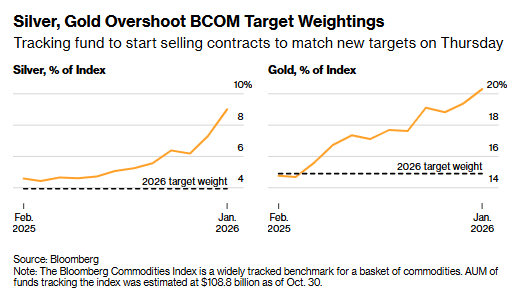
Core Viewpoint - Investors are preparing for the upcoming annual rebalancing of commodity indices, leading to significant sell-offs in gold and silver futures, causing prices to decline for the second consecutive day [1][2]. Group 1: Market Impact - Spot gold prices fell below $4,420 per ounce, with a nearly 1% drop in the previous trading day, while silver prices decreased over 3% to $76.11 per ounce [1]. - The rebalancing is expected to trigger approximately $6.8 billion in silver futures sell-offs, equivalent to 12% of the total open interest in COMEX silver futures [1][2]. - The scale of the fund flows during this rebalancing is unprecedented, according to Citigroup strategist Kenny Hu [2]. Group 2: Historical Context - Gold and silver prices have not shown significant corrections despite recording their best annual performance since 1979, supported by central bank purchases and inflows into gold ETFs [2]. - In November, global central banks added a net 45 tons of gold, with the People's Bank of China increasing its gold holdings for the 14th consecutive month, which has been a crucial support for gold prices [2]. Group 3: Future Outlook - Traders are focusing on the upcoming U.S. non-farm payroll report, as weak data could strengthen expectations for further interest rate cuts by the Federal Reserve, benefiting non-yielding precious metals [2]. - Despite short-term price pressures from the rebalancing, silver is expected to have stronger upward momentum in the long term [3].
CAC 40 Moderately Lower As Investors Digest PMI, Inflation Data
RTTNews· 2026-01-06 11:00
Market Performance - France's equity benchmark CAC 40 opened flat but drifted lower, down 49.25 points or 0.6% at 8,162.25 before noon [1] - Notable declines were seen in Legrand and Dassault Systemes, which fell 3.7% and 3.6% respectively, while Capgemini and Saint Gobain lost over 3% [1] Company Movements - BNP Paribas, Hermes International, Schneider Electric, Publicis Groupe, LVMH, Air Liquide, Accor, and Societe Generale experienced losses ranging from 1% to 1.6% [2] - In contrast, Orange and STMicroElectronics gained 2.6% and 2.5% respectively, with Michelin up 1.5% and Thales and Engie gaining 1.2% and 1.1% respectively [2] Economic Indicators - France's inflation eased to a seven-month low in December, attributed to a significant drop in energy prices [2] - The consumer price index (CPI) showed an annual increase of 0.8%, the slowest since May, following a 0.9% rise in November [3] - EU harmonized inflation also unexpectedly slowed to 0.7% in December from 0.8% in November, contrary to forecasts [3] PMI Data - The HCOB France Composite PMI for December was revised to 50.0, indicating stagnant output, with the manufacturing PMI at 50.7 and the Services PMI at 50.1 [4] - The HCOB Flash Eurozone Composite PMI for December was revised to 51.5, down from a flash estimate of 51.9 and November's 30-month high of 52.8 [5]


Explainer: how regulators worldwide are softening bank capital rules
BusinessLine· 2026-01-06 10:00
Seventeen years onfrom the global financial crisis, regulators are cutting redtape for their banks in a bid to keep lenders competitive andstimulate their economies.The Trump administration is leading the charge, including withmeasures that will reduce the amount of capital lenders need toset aside. Lowering capital requirements is worrying someobservers that the U.S. has triggered a global rowback fromregulations designed to keep financial systems safer, just aschatter about market bubbles and financia ...

Maduro Case Judge, 92, Brings History of Dealing With Trump
MINT· 2026-01-05 23:29
Core Viewpoint - The article discusses the reputation and judicial philosophy of Judge Alvin Hellerstein, highlighting his independence and fairness in high-profile cases, including the prosecution of Nicolás Maduro, and his willingness to challenge political pressures [1][2][3]. Group 1: Judge's Background and Philosophy - Judge Alvin Hellerstein, a 92-year-old native New Yorker, is known for his independent rulings and has been praised for not always siding with the government [1][2]. - Hellerstein's judicial philosophy emphasizes due process, as demonstrated by his ruling against the Trump administration's deportation efforts [4]. - His background, including his upbringing in the Bronx and Jewish values, influences his judicial decisions, reflecting a commitment to fairness and understanding [7][8]. Group 2: Notable Cases and Rulings - Hellerstein is currently overseeing the prosecution of Nicolás Maduro, who faces serious charges including narco-terrorism conspiracy [3]. - He has a history of significant rulings, including rejecting a settlement for 9/11 cleanup workers, which he deemed insufficient [6]. - In recent financial trials, Hellerstein has shown a preference for efficiency, urging lawyers to focus on key issues to maintain jury engagement [10]. Group 3: Judicial Conduct and Public Perception - Hellerstein's approach to cases has earned him respect, even from figures like President Trump, who acknowledged the judge's reputation [4]. - His handling of cases reflects a balance between legal rigor and empathy, as seen in his interactions with families affected by the 9/11 attacks [8]. - Hellerstein's rulings often consider the broader implications of free expression, as demonstrated in his past decisions involving controversial groups [9].


HSBC taps BNP Paribas exec to lead sustainable finance, transition in Asia
Yahoo Finance· 2026-01-05 12:31
This story was originally published on ESG Dive. To receive daily news and insights, subscribe to our free daily ESG Dive newsletter. Dive Brief: HSBC has hired Chaoni Huang, formerly a sustainability executive at rival bank BNP Paribas, to lead its sustainable finance and transition business in Asia, the British lender announced Monday. Huang will serve as the managing director and head of HSBC’s sustainability-focused business in the region and help its clients “decarbonize and invest in new growth,” ...

并购战略持续驱动增长!法巴力挺TransDigm(TDG.US) 重申“跑赢大盘”评级
Zhi Tong Cai Jing· 2026-01-05 02:48
Core Viewpoint - BNP Paribas reaffirms TransDigm's "outperform" rating, highlighting the company's acquisition strategy as a solid driver of growth [1] Group 1: Acquisition Details - TransDigm announced the acquisition of Stellant for $960 million from Arlington Capital Partners, which specializes in high-power electronic products for aerospace, defense, medical, and industrial markets [1] - Stellant is expected to generate approximately $300 million in revenue by 2025 and currently employs around 950 people in the U.S. [1] Group 2: Business Model and Strategy - TransDigm's core business involves designing, producing, and supplying highly engineered aircraft components essential for the safe and effective operation of commercial and military aircraft [2] - The company operates through its wholly-owned subsidiary, TransDigm Inc., and is divided into three main segments: Power & Control, Airframe, and Non-Aerospace [2] - TransDigm's business model is primarily acquisition-driven, having completed over 60 acquisitions in 25 years, creating a supply chain network of 123 subsidiaries [2] Group 3: Analyst Insights - Analyst Matthew Akers notes that the acquisition of Stellant reflects TransDigm's ongoing momentum in mergers and acquisitions, alleviating market concerns about the scarcity of quality acquisition targets [2] - BNP Paribas believes Stellant's strategic fit with TransDigm is strong, citing its approximately 50% exposure to the aftermarket and significant potential for operational improvements [3] - The estimated revenue per employee at Stellant is about half of TransDigm's current level, indicating room for efficiency enhancements [3] - Assuming a synergy effect of about 4% of the acquired business's sales, the transaction is expected to increase TransDigm's earnings per share by approximately 1% for the fiscal year 2027, with more aggressive pricing assumptions potentially raising this to 3% to 5% [3] - The analyst raised the target price for TransDigm from $1,775 to $1,900, based on higher comparable company valuation multiples while maintaining a conservative premium relative to historical transaction levels [3]

日加息失效美日分歧定走向
Jin Tou Wang· 2026-01-05 02:30
Group 1 - The core viewpoint of the articles indicates that the USD/JPY exchange rate is expected to fluctuate between 155-157 yen from late 2025 to early 2026, with the Bank of Japan's recent interest rate hike failing to prevent yen depreciation and raising concerns about a "debt and currency double whammy" [1] - The Bank of Japan raised its interest rate from 0.5% to 0.75% on December 19, marking the highest level since 1995, but the market had already priced in this expectation, leading to a decline in the yen to a near-month low of 157 yen [1] - The interest rate hike has resulted in economic polarization in Japan, benefiting older depositors while negatively impacting younger households burdened by mortgage pressures, alongside challenges faced by small and medium-sized enterprises [1] Group 2 - From a technical perspective, the USD/JPY is currently exhibiting a typical range consolidation pattern, with MACD indicators showing a diminishing upward momentum, while the RSI remains slightly bullish around 55 [2] - Institutions hold a generally pessimistic view on the long-term outlook for the yen, with predictions from major banks suggesting that the USD/JPY could reach levels of 160 to 164 yen by the end of 2026 due to persistent interest rate differentials and negative real rates in Japan [2] - Market sentiment is currently bearish on the yen, with CFTC data indicating that leveraged funds' bearish positions on the yen have reached their highest level since July 2024 as of the week ending December 9 [2]
日本散户无视日股牛市“出逃”!资本外流加剧日元长期疲软
Zhi Tong Cai Jing· 2026-01-05 01:51
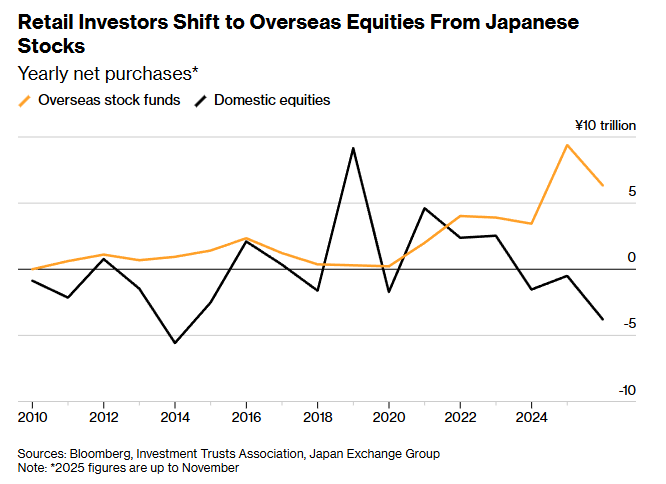
Core Insights - Japanese retail investors are shifting their focus from domestic stocks to overseas equities, with net sales of Japanese stocks reaching 3.8 trillion yen (approximately 24.3 billion USD) by November 2025, the highest level in over a decade [1] - Concurrently, net purchases of foreign stocks through investment trusts by Japanese retail investors are hovering around a record 9.4 trillion yen in 2024, indicating a strong appetite for foreign assets driven by a weaker yen [1][3] Group 1: Market Trends - The outflow of funds from Japan is exerting depreciation pressure on the yen, with expectations that it may weaken to 160 yen per dollar or more by the end of 2026 [6] - The Bank of Japan's interest rate hikes and increased government spending are influencing the yen's value, contrasting with policymakers' goals to encourage domestic investment [3][6] Group 2: Investor Sentiment - Retail investors express a belief that U.S. stocks, particularly large tech companies, hold greater potential, especially in the context of AI growth [3] - Concerns about overexposure to U.S. tech stocks may lead Japanese retail investors to reconsider their investment strategies, particularly as the AI boom shows signs of slowing [8] Group 3: Economic Indicators - The Tokyo Stock Exchange index rose by 25% in 2025, outperforming the S&P 500 index, driven by strong corporate earnings and supportive government policies [3] - Structural factors, such as the yield gap between Japanese and U.S. bonds, are contributing to the yen's lack of attractiveness for yield-seeking investors [6]