
指数再平衡

Search documents
黄金、白银齐创新高,知名机构做空白银亏了420万
2 1 Shi Ji Jing Ji Bao Dao· 2026-01-20 11:26
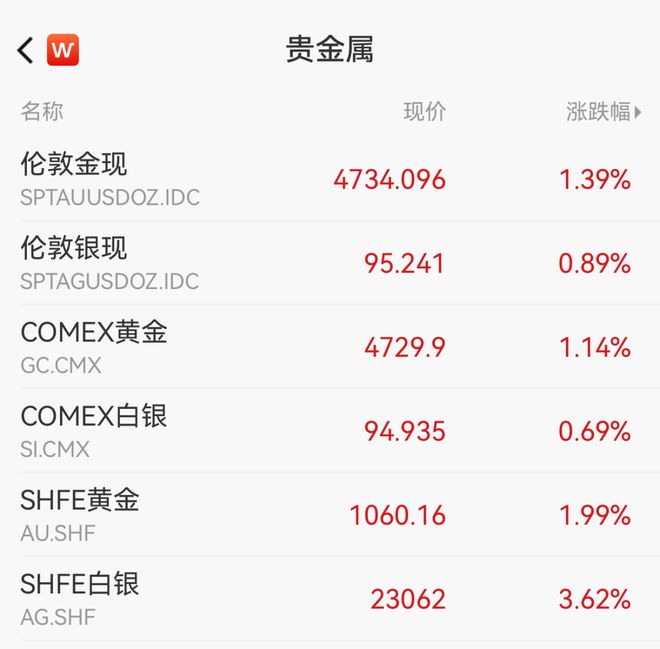
Core Viewpoint - Gold and silver prices have reached new historical highs, with gold at $4,734.096 per ounce and silver at $95.241 per ounce, marking significant increases in their respective values [1][2]. Price Movements - As of January 20, 2023, spot gold increased by 1.39% and spot silver by 0.89%, with silver's year-to-date gain exceeding 33% [1][2]. - The London silver price reached a high of $93.70 per ounce, reflecting a more than 19% increase within a week [4]. Market Dynamics - Canadian Imperial Bank of Commerce (CIBC) faced a loss of $606,000 due to short-selling silver, indicating the volatility and unpredictability of the silver market [4]. - The Bloomberg Commodity Index's rebalancing has been fully absorbed by the market, with new long positions emerging that offset approximately $7.5 billion in outflows [4]. Institutional Insights - Analysts from CIBC believe that the silver market is significantly overbought, with potential catalysts for a market correction, including the U.S. decision not to impose tariffs on silver imports [6]. - The silver market's dynamics are influenced by both financial and industrial demand, with projections suggesting that silver prices could rise to $100 per ounce in the long term [9][10]. Future Outlook - The Chicago Mercantile Exchange (CME) plans to launch a 100-ounce silver futures contract on February 9, 2026, to cater to increasing retail demand [11]. - Analysts suggest that despite short-term volatility, silver remains a key asset for investors, with macroeconomic policies and supply-demand dynamics supporting its long-term price growth [10].

白银再创历史新高 道明证券第二次做空白银失败
2 1 Shi Ji Jing Ji Bao Dao· 2026-01-20 09:49
Group 1: Silver Market Performance - Silver prices have surged significantly, reaching a historical high of $94.726 per ounce, with a year-to-date increase of over 31% [1] - The price of silver has risen by more than 150% in the past year, surpassing many analysts' expectations [1] - Notably, a prominent institution incurred a loss of $606,000 due to short-selling silver, highlighting the volatility in the market [2] Group 2: Institutional Insights and Predictions - Canadian Imperial Bank of Commerce (CIBC) faced losses from short positions in silver, with a notable loss of $606,000 after silver prices rose over 19% in a week [2] - CIBC's commodity strategist, Daniel Galley, acknowledged that the market's performance contradicted expectations of a $5 billion outflow from silver due to index rebalancing [2] - The Bloomberg Commodity Index's rebalancing has been fully absorbed by the market, with new long positions emerging that could offset significant outflows [2] Group 3: Future Market Dynamics - The annual weight adjustment for the Bloomberg Commodity Index is set for January 8-14, 2026, with silver's target weight reduced from 9% to just below 4% [3] - Analysts predict that silver will face significant selling pressure in 2026, more so than in 2025, with estimated sell-offs around $7 billion [3] - Despite the anticipated selling pressure, Galley believes that the newly established long positions could remain intact unless forced selling occurs [3] Group 4: Market Sentiment and Supply Dynamics - CIBC maintains that the silver market is severely overbought, with potential catalysts for a market correction [4] - Concerns over supply and liquidity have eased following the U.S. decision not to impose tariffs on silver imports, which could stabilize the market [4] - Analysts emphasize that the current price surge exceeds historical valuation frameworks, suggesting that investors should follow market trends rather than attempt to predict reversals [4] Group 5: New Financial Instruments - The Chicago Mercantile Exchange (CME) plans to launch a 100-ounce silver futures contract on February 9, 2026, to cater to increasing retail demand [8] - This new contract aims to provide easier access to the silver market, allowing traders to control larger positions with less capital [8] - CME's initiative is expected to enhance market liquidity and efficiency, appealing to retail investors seeking diversification [9]
又爆仓了!知名投行做空白银再遭闷杀:为何同一堵南墙要撞两次?
Xin Lang Cai Jing· 2026-01-16 03:47
Core Viewpoint - TD Securities underestimated the momentum in the silver market, leading to a forced exit from their short position for the second time since October last year, resulting in a loss of $606,000 as silver prices surged to a historical high of $93.70 per ounce [3][7]. Group 1: Market Dynamics - Silver prices increased by over 19% within a week, with a cumulative rise of over 21% since the beginning of the year, despite a recent pullback from the peak [3][8]. - The initial short position was established at $78 per ounce, and the stop-loss was triggered at $93.15 per ounce [3][8]. - The annual index rebalancing was expected to withdraw approximately $5 billion from the market, but this has been fully absorbed by the market according to the latest analysis [3][8]. Group 2: Future Outlook - The silver market appears to be significantly overbought, with a potential turning point on the horizon [5][9]. - A key catalyst for the silver market could be the decision by the Trump administration not to impose tariffs on silver, which has been designated as a critical metal [5][9]. - Concerns regarding the supply of physical silver are expected to ease due to three main factors: a record inventory replenishment wave, a reduction in shortages leading to shorter inventory coverage cycles, and improvements in the fragmented inventory system [5][9].

可可价格延续跌势 指数再平衡推升波动率
Xin Lang Cai Jing· 2026-01-12 12:52
Core Viewpoint - Cocoa prices in New York continued to decline following a 12% drop, driven by the retreat of buying momentum from index rebalancing, leading to sell-offs by exporters and speculators [1] Group 1: Price Movement - Cocoa prices experienced their largest drop since July 2024, with futures closing significantly lower as exporters locked in favorable prices amid recent buying [1] - On Monday, cocoa prices fell by 2.4% before recovering some losses, indicating high volatility in the market [1] Group 2: Market Dynamics - The rebalancing of commodity indices had previously supported cocoa prices for several weeks due to expectations of increased buying [1] - Speculative investors had built up long positions before the index rebalancing, but the subsequent rapid liquidation of these positions triggered a wave of selling [1] Group 3: Volatility Indicators - The recent price fluctuations have pushed the 60-day historical volatility index to its highest level in nearly nine months, reflecting increased market uncertainty [1]
帮主郑重:原油、铜、白银“三兄弟”,各怀心事
Sou Hu Cai Jing· 2026-01-09 00:03
Core Viewpoint - The global commodity market is experiencing divergent trends, with oil prices rising due to geopolitical risks, copper facing short-term corrections but long-term demand growth, and silver declining due to technical selling pressures from index rebalancing [3][4][5]. Group 1: Oil Market - Oil prices have rebounded over 3%, approaching $58 per barrel, driven by the return of "geopolitical risk premium" amid tensions in the Middle East and the impact of U.S. control over Venezuelan oil [3]. - The annual commodity index rebalancing is expected to lead to significant passive investment in oil futures, providing additional support to prices despite concerns over supply surplus [3]. Group 2: Copper Market - Copper prices have retreated from recent highs, influenced by a stronger dollar and normal market corrections after previous gains [4]. - Long-term demand for copper is expected to increase due to the AI race and rising global defense spending, which may lead to supply shortages, making any short-term price corrections potential buying opportunities [4]. Group 3: Silver Market - Silver has seen significant declines for two consecutive days, primarily due to the annual commodity index rebalancing, which requires passive funds to sell approximately $6.8 billion worth of silver futures [4]. - The selling pressure is largely technical and not fundamentally driven, leading to short-term price volatility [4]. Group 4: Investment Strategies - For oil, investors should adopt an event-driven and tactical approach, closely monitoring geopolitical developments and the actual flow of rebalancing funds [5]. - In copper, a "long-term view with short-term actions" strategy is recommended, taking advantage of short-term corrections while recognizing its long-term scarcity [5]. - For silver and gold, investors should be cautious of the technical selling pressure from index rebalancing, which may create attractive price points for long-term investors once selling pressure subsides [5].

指数再平衡引发抛压 白银连续第二日下跌 黄金走势趋稳
Zhi Tong Cai Jing· 2026-01-08 22:25
Group 1 - The core viewpoint of the articles highlights significant selling pressure on silver due to the upcoming annual rebalancing of commodity indices, with expectations of passive selling of silver futures worth billions of dollars [1][2] - Silver experienced a sharp decline, dropping 5.5% in one session after a nearly 4% drop the previous day, while gold remained relatively stable [1] - Citigroup estimates that approximately $6.8 billion in silver futures may be sold to meet index adjustment requirements, representing about 12% of the open interest in COMEX silver futures [1] Group 2 - Analysts express a generally optimistic long-term outlook for gold, despite short-term pressures, with expectations that gold could rise to $5,000 per ounce by mid-2026 due to geopolitical risks and fiscal deficits [2] - The World Gold Council reported that central banks collectively net purchased 45 tons of gold in November, with the People's Bank of China increasing its gold holdings for 14 consecutive months, providing crucial support for gold prices [2] - Silver's price surge last year was notably strong, with an annual increase of nearly 150%, driven by tight supply in the London spot market and tariff concerns limiting metal flows from high U.S. inventories [3]

美股异动 | 金银股普跌 赫克拉矿业(HL.US)跌超5%
智通财经网· 2026-01-08 14:56
Core Viewpoint - The precious metals market is experiencing a liquidity shock triggered by the rebalancing of the Bloomberg Commodity Index, leading to significant declines in gold and silver prices and related mining stocks [1] Group 1: Market Performance - Gold and silver stocks opened lower, with Hecla Mining (HL.US) down over 5%, First Majestic Silver (AG.US) and Endeavour Silver (EXK.US) down over 4%, and Coeur Mining (CDE.US), Pan American Silver (PAAS.US), and Gold Fields (GFI.US) down over 2% [1] - Spot silver fell over 4% to $74.48, while spot gold decreased by 0.5% to $4,433.37 [1] Group 2: Index Rebalancing Impact - The current adjustment in the precious metals market is directly linked to the annual weight rebalancing of the Bloomberg Commodity Index, which started on January 8 and will continue until January 14 [1] - Gold's weight in the index was reduced from 20.4% to 14.9%, and silver's weight was significantly cut from 9.6% to 3.94%, forcing passive funds tracking the index to make mechanical position adjustments [1] Group 3: Analyst Insights - Deutsche Bank analyst Michael Hsueh noted that the rebalancing is unfavorable for precious metals but beneficial for crude oil [1] - Silver is expected to face the largest selling pressure from the rebalancing, followed by aluminum and gold [1] - Hsueh estimates that a sale of 2.4 million ounces of gold could lead to a price drop of 2.5%-3.0%, depending on the sensitivity model and time window used for ETFs [1]






金银股普跌 赫克拉矿业(HL.US)跌超5%
Zhi Tong Cai Jing· 2026-01-08 14:51
Core Viewpoint - The precious metals market is experiencing a liquidity shock triggered by the rebalancing of the Bloomberg Commodity Index, leading to significant declines in gold and silver prices and related mining stocks [1] Group 1: Market Performance - Gold and silver stocks opened lower, with Hecla Mining (HL.US) down over 5%, First Majestic Silver (AG.US) and Endeavour Silver (EXK.US) down over 4%, and other companies like Coeur Mining (CDE.US), Pan American Silver (PAAS.US), and Gold Fields (GFI.US) down over 2% [1] - Spot silver fell over 4% to $74.48, while spot gold decreased by 0.5% to $4,433.37 [1] Group 2: Index Rebalancing Impact - The current adjustment in the precious metals market is directly linked to the annual weight rebalancing of the Bloomberg Commodity Index, which started on January 8 and will continue until January 14 [1] - The weight of gold in the index has been reduced from 20.4% to 14.9%, while silver's weight has been significantly cut from 9.6% to 3.94%, forcing passive funds tracking the index to make mechanical position adjustments [1] Group 3: Analyst Insights - Deutsche Bank analyst Michael Hsueh noted that the rebalancing is unfavorable for precious metals but beneficial for oil [1] - Silver is expected to face the largest selling pressure from the rebalancing, followed by aluminum and gold [1] - Hsueh estimates that a sale of 2.4 million ounces of gold could lead to a price drop of 2.5%-3.0%, depending on the sensitivity model of the ETFs used and the time window considered [1]
大宗商品指数迎年度再平衡,交易商提前布局致黄金白银双双下跌
Xin Lang Cai Jing· 2026-01-08 12:58
Core Viewpoint - The annual rebalancing of commodity indices has led to significant selling pressure on gold and silver, with expectations of billions of dollars in futures contracts being sold off in the coming days [1][6]. Group 1: Market Impact - Gold prices fell below $4,450 per ounce after a nearly 1% drop in the previous trading day, while silver prices experienced a decline of over 3% [1][4]. - Citigroup estimates that approximately $6.8 billion worth of silver futures contracts will be sold to meet index rebalancing requirements, representing 12% of the total open interest in Comex silver futures [1][6]. - The selling pressure on gold futures is expected to be similar to that of silver, driven by the increased weight of precious metals in commodity benchmark indices [1][6]. Group 2: Historical Context and Future Outlook - Last year, precious metals also faced selling due to index rebalancing, but it did not significantly impact market trends; however, this year, silver is facing greater selling pressure than in previous years [2][7]. - Analysts remain bullish on gold's long-term prospects, with expectations that geopolitical risks and high global fiscal deficits could push gold prices above $5,000 per ounce by mid-2026 [3][8]. - Central banks globally have been increasing their gold holdings, with a net addition of 45 tons in November, indicating strong official demand for gold [3][8]. Group 3: Economic Indicators - Traders are focusing on the upcoming U.S. non-farm payroll report, as weak data could increase bets on Federal Reserve rate cuts, which would benefit non-yielding precious metals [4][9]. - Silver experienced a remarkable annual increase of 150% last year, but supply constraints and market concerns about U.S. inventory outflows continue to exert pressure [4][9].
Mhmarkets迈汇:指数再平衡引发金银高位波动
Xin Lang Cai Jing· 2026-01-08 11:02
Core Insights - Silver prices have recently faced resistance after surpassing the $80 mark, with significant volatility risks anticipated in the short term despite strong macro bullish logic [1][3] - In 2025, both gold and silver exhibited remarkable performance, with silver rising nearly 150% and gold increasing by 64%, marking the most significant gains since 1979 [1][4] - The Bloomberg Commodity Index (BCOM) allocates approximately 11% to silver and gold, necessitating forced "sell high, buy low" operations at the beginning of the year due to substantial price increases [4] Market Dynamics - A predicted net outflow of approximately $5 billion is expected for both gold and silver markets, driven by passive index funds rebalancing their positions rather than a loss of confidence in precious metals [4][5] - The energy market is benefiting from this rebalancing process, with expected inflows of $2.6 billion into Brent crude oil and $1.7 billion into WTI crude oil, as funds shift from overvalued metals to undervalued energy assets [2][4] - The Comex silver market may see about 13% of open contracts sold in the next two weeks, which could trigger a sharp price decline due to large-scale position adjustments [5] Long-term Outlook - Despite short-term volatility driven by technical factors, silver and gold are expected to remain essential cornerstone assets in the global economy for the new year [5] - If the anticipated price corrections are solely driven by technical fund flows rather than fundamental deterioration, this could present strategic investors with an opportunity to optimize their cost basis [5]