格力电器

Search documents
公募十大重仓股出炉!这些股票被增持
Zhong Guo Zheng Quan Bao· 2025-10-28 15:00
Core Insights - Public funds have disclosed their top ten holdings for Q3 2025, with CATL (宁德时代) returning as the largest holding, followed by Tencent and several other tech stocks [1][2] Group 1: Top Holdings - CATL regained its position as the largest holding among public funds with a market value of 75.881 billion yuan [2] - Tencent Holdings dropped to the second position with a market value of 69.938 billion yuan [2] - New entrants to the top ten holdings include Zhongji Xuchuang and Industrial Fulian, while Midea Group and Xiaomi Group exited the list [1][2] Group 2: Increased Holdings - The most significant increases in holdings for Q3 were seen in Zhongji Xuchuang and New Yisheng, with increases of 40.174 billion yuan and 36.930 billion yuan, respectively [2] - Industrial Fulian, Alibaba-W, and CATL also saw substantial increases, each exceeding 20 billion yuan [2] Group 3: Decreased Holdings - Xiaomi Group was the most significantly reduced holding, with a decrease of 10.834 billion yuan [3] - Other notable reductions included Midea Group, China Merchants Bank, and SF Express, each with reductions exceeding 7 billion yuan [3][5] Group 4: Sector Performance - The technology sector performed exceptionally well in Q3, with many of the top increased holdings being tech stocks, particularly in AI-related fields [4] - Zhongji Xuchuang, New Yisheng, and Industrial Fulian saw stock price increases of over 170%, 180%, and 210%, respectively [4] Group 5: Fund Manager Insights - Fund managers express optimism about the technology sector, particularly regarding AI and its related investment opportunities [8] - There is a cautious approach towards the long-term outlook of tech stocks due to uncertainties in competition and technology evolution [8]






从“造什么卖什么”到“要什么造什么”,双11家电供应链柔性升级
第一财经· 2025-10-28 14:35
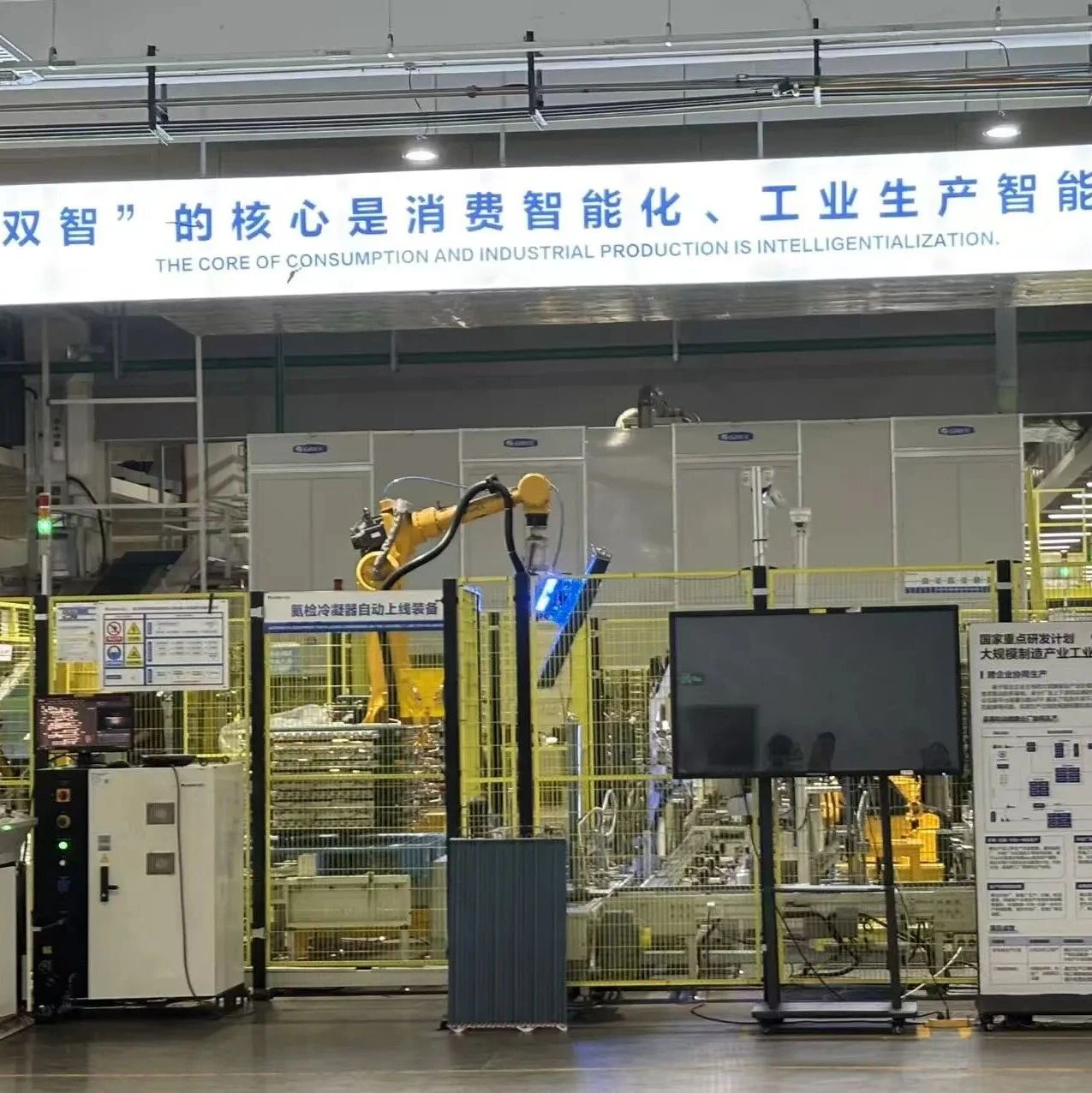
Core Viewpoint - Despite predictions of a decline in the home appliance market sales during this year's Double 11, e-commerce platforms and leading home appliance companies are striving to meet diverse consumer demands through enhanced product customization partnerships, supported by advancements in smart manufacturing [3][4]. Group 1: Market Dynamics - The sales forecast for the home appliance market during Double 11 is expected to decline year-on-year, prompting companies to innovate and adapt [3]. - Gree Electric's domestic e-commerce business head indicated that the promotional period for Double 11 is longer this year, suggesting ample opportunities remain [3]. - Gree has partnered with JD.com to launch customized products, including the "Little Cool God" air conditioner, and has also collaborated with Tmall and Douyin for product customization [3][4]. Group 2: Product Customization Efforts - JD.com has strengthened its collaboration with Gree for product customization, achieving cumulative sales of 130,000 units for the AI Energy-Saving Prince air conditioner [4]. - JD.com is also working with other brands, such as Meibang, to offer diverse product options, including the "Wind God Eye" air conditioner [4]. - Gree's market director stated that the company will tailor different products for various channels to adapt to changing consumer structures and price segments [4]. Group 3: Market Penetration Insights - Air conditioner penetration in urban areas is high, with approximately 146 units per 100 households, while rural areas, particularly in Northeast China, show much lower penetration rates of about 20 units per 100 households [4]. - Products priced below 2,100 yuan account for nearly half of the market share, indicating a shift in market structure [4]. Group 4: Challenges in Customization - A significant challenge in product customization is aligning brand perceptions with consumer data, as many brands may not recognize emerging consumer needs identified by JD.com's data analysis [5]. - Matching product performance with cost remains a critical hurdle in the customization process [5]. Group 5: Smart Manufacturing Advancements - The enhancement of smart manufacturing capabilities is providing more opportunities for product customization [6]. - Gree's smart manufacturing base in Zhuhai, with a total investment of 15 billion yuan, aims to produce 12.3 million units annually, with plans to double the number of automated production lines [6]. - The integrated smart manufacturing aims to address issues such as low efficiency in manual assembly and challenges in quality control and logistics [6].


从“造什么卖什么”到“要什么造什么” 双11家电供应链柔性升级
Di Yi Cai Jing· 2025-10-28 14:09
Group 1 - The core viewpoint of the articles highlights the challenges and strategies in the home appliance market during the Double 11 shopping festival, with a focus on product customization and smart manufacturing as key drivers for sales stability [1][2]. - Gree Electric's collaboration with major e-commerce platforms like JD.com and Tmall aims to introduce customized products, such as the "Little Cool God" air conditioner, to meet diverse consumer needs [1][2]. - JD.com has reported significant sales of customized products, with 130,000 units of the AI Energy-Saving Prince air conditioner sold, indicating a strong market response to tailored offerings [1]. Group 2 - The penetration rate of air conditioners in urban areas is high, with approximately 146 units per 100 households, while rural areas, particularly in Northeast China, show much lower penetration at about 20 units per 100 households [2]. - Gree Electric plans to customize products for different sales channels to adapt to changing consumer structures and price segments, ensuring high-quality offerings across various price points [2]. - The enhancement of smart manufacturing capabilities is enabling more flexible and efficient product customization, addressing challenges such as low assembly efficiency and quality control [3]. Group 3 - Gree's smart manufacturing base in Zhuhai, with an investment of 15 billion yuan, aims to produce 12.3 million units annually, showcasing the company's commitment to automation and efficiency in production [3]. - The integration of automated production lines is expected to double within the year, further improving the manufacturing process and addressing logistical challenges [3].
从“造什么卖什么”到“要什么造什么”,双11家电供应链柔性升级
Di Yi Cai Jing· 2025-10-28 13:28
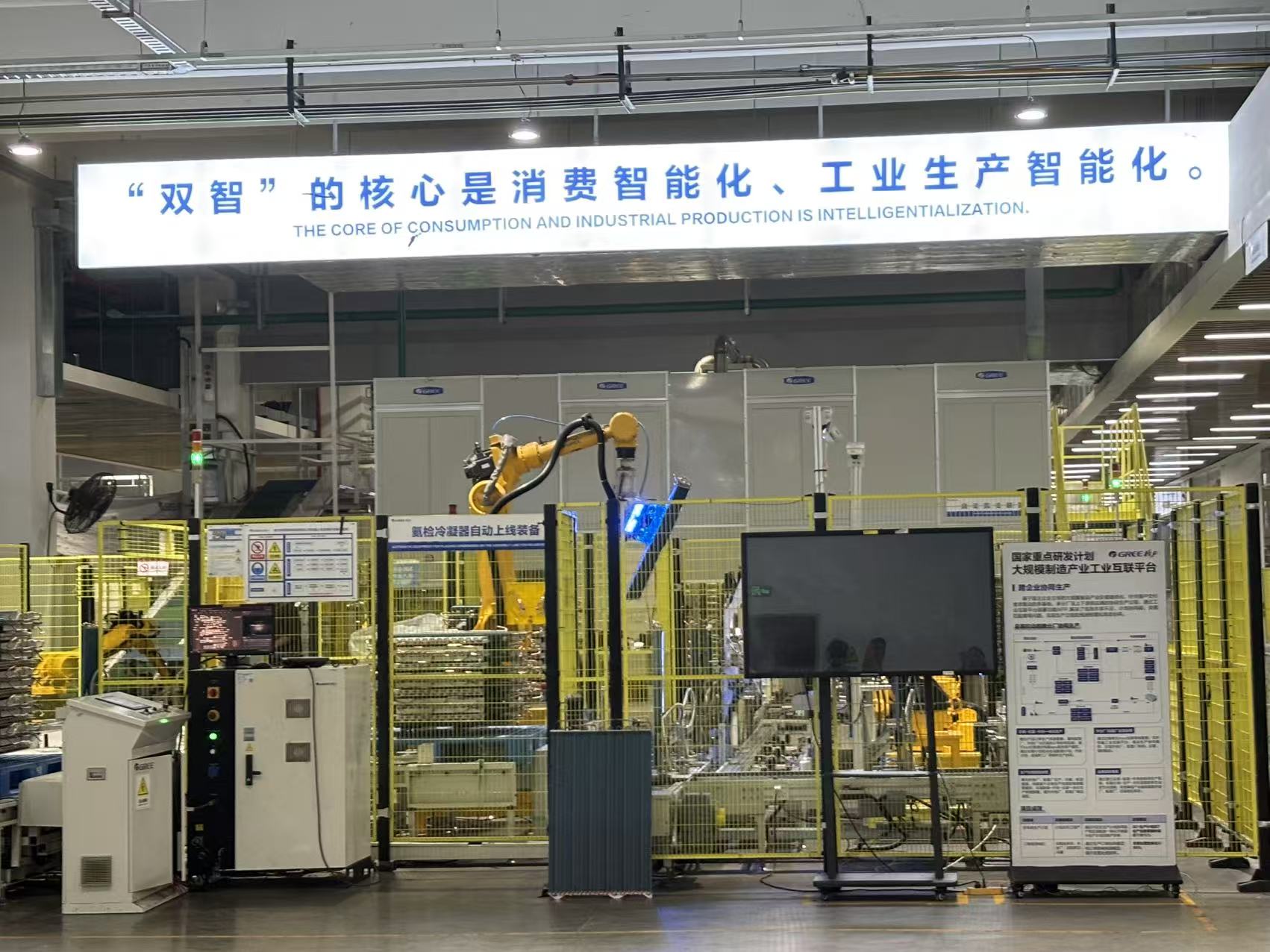
Group 1 - Despite predictions of a decline in the home appliance market sales during this year's Double 11, e-commerce platforms and leading home appliance companies are striving to meet diverse consumer demands through enhanced product customization partnerships [2] - Gree Electric's domestic e-commerce business head stated that the promotional period for Double 11 is relatively long, indicating that there are still many opportunities ahead [2] - Gree has collaborated with JD.com to launch customized products, including the "Little Cool God" air conditioner, and has also partnered with Tmall and Douyin for customized offerings [2] Group 2 - Air conditioning is widely popular in urban areas, with a penetration rate of approximately 146 units per 100 households, but remains low in rural areas, particularly in Northeast China, where the rate is about 20 units per 100 households [3] - Gree Electric's market director mentioned that the company plans to customize different products for various channels to adapt to changing consumer structures and provide high-quality products across all price segments [3] - The improvement in smart manufacturing capabilities has opened up more possibilities for product customization [3][4] Group 3 - The integrated smart manufacturing aims to address issues such as low efficiency in manual assembly, inefficiencies in switching between small orders of various products, challenges in post-production quality control, and difficulties in precise logistics [4] - The Gree air conditioning smart manufacturing base, established in 2020 with a total investment of 15 billion yuan, is expected to produce 12.3 million sets annually, with plans to double the number of automated production lines within the year [3]
雷军现身,小米又一智能工厂投产!
Zheng Quan Shi Bao· 2025-10-28 12:34
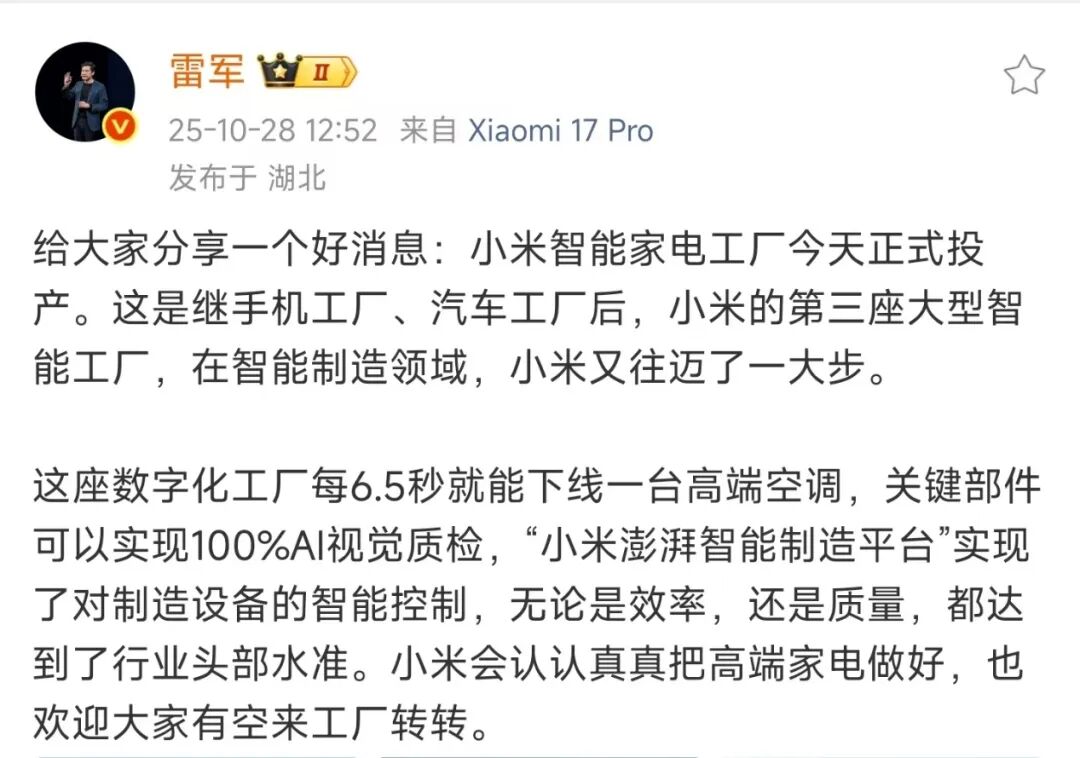
Core Insights - Xiaomi has officially launched its smart home appliance factory in Wuhan, marking a significant step in its smart manufacturing journey [2][3] - The company has seen rapid growth in its air conditioning segment, with air conditioner shipments exceeding 5.4 million units in Q2 2025, representing a year-on-year increase of over 60% [1][4] - Xiaomi's home appliance business has become a new growth engine, with revenue from smart home appliances reaching a historical high, up 66.2% year-on-year in Q2 2025 [4] Manufacturing and Technology - The Wuhan smart home appliance factory covers an area of 500,000 square meters and features six core air conditioning production lines, achieving full digitalization and intelligence in production [3] - The factory can produce one high-end air conditioner every 6.5 seconds, with 100% AI visual inspection for key components, showcasing industry-leading efficiency and quality [2][3] - Xiaomi's investment in the Wuhan factory amounts to 2.5 billion yuan, with a planned peak annual production capacity of 7 million units [3] Market Position and Strategy - Xiaomi is transitioning from an internet company to a smart manufacturing enterprise, establishing a complete industrial chain in Wuhan that includes design, research, production, and validation [3] - The company aims to enhance its competitiveness in the air conditioning market by extending the warranty period for its air conditioners from 6 years to 10 years, addressing consumer concerns about product quality [5] - Xiaomi plans to enter the European market with its home appliances and aims to become a leading player in China's home appliance industry by 2030, targeting a revenue scale of 100 billion yuan in the next five years [6]
雷军现身,小米又一智能工厂投产!
证券时报· 2025-10-28 12:33
Core Insights - Xiaomi has officially launched its smart home appliance factory in Wuhan, marking a significant step in its transition from an internet company to a smart manufacturing enterprise [2][4][6] - The factory is designed to produce high-end air conditioners with advanced AI quality inspection, achieving a production rate of one unit every 6.5 seconds [4][5] - Xiaomi's home appliance sales have seen rapid growth, with air conditioner shipments exceeding 5.4 million units in Q2 2025, reflecting a year-on-year increase of over 60% [2][8] Manufacturing and Production - The Wuhan smart home appliance factory covers an area of 500,000 square meters and has a planned peak annual production capacity of 7 million units, with an initial investment of 2.5 billion yuan [5] - The factory integrates digital and intelligent manufacturing processes, establishing a complete industrial chain in Wuhan, including design, research, production, and validation [5][6] - Xiaomi aims to position this factory as a benchmark for smart manufacturing in the industry [5] Sales Performance - The home appliance segment has become a new growth engine for Xiaomi, with a 66.2% year-on-year increase in revenue for smart home appliances in Q2 2025 [8] - In addition to air conditioners, Xiaomi's refrigerator shipments surpassed 790,000 units (up over 25%) and washing machines exceeded 600,000 units (up over 45%) [8] - Xiaomi's strategy focuses on innovation and quality rather than engaging in price wars, as evidenced by its ability to achieve growth in both volume and price [8][9] Market Strategy - Xiaomi has upgraded its air conditioner service from a 6-year to a 10-year free repair policy, addressing consumer concerns about product quality [9] - The company is actively expanding into international markets, with plans to enter the European market and establish a significant presence in Southeast Asia [9] - Xiaomi aims to rank among the top players in China's home appliance industry by 2030, targeting a revenue scale of 100 billion yuan in the next five years [9]


不再跟着西方屁股定义“卡脖子”,这样只会被动挨打
Guan Cha Zhe Wang· 2025-10-28 12:06
Core Viewpoint - The report emphasizes that China's modernization relies on technological advancement, highlighting the importance of original innovation and the integration of technology and industry to achieve high-level self-reliance in technology [1] Group 1: Technological Innovation and Industry Integration - The "14th Five-Year Plan" outlines the need for deep integration of technological innovation and industrial innovation, with a focus on addressing "bottleneck" issues in high-end chips and industrial software [1][2] - The government is encouraged to transform specific industry challenges into national technology tasks, thereby supporting enterprises in overcoming technological barriers [2][3] Group 2: Role of Enterprises in Innovation - Enterprises are identified as the main body of technological innovation, with a call for vertical integration strategies to address complex interdisciplinary challenges [3][11] - The importance of fostering a collaborative environment between enterprises and research institutions is highlighted, allowing for timely solutions to innovation challenges [5][10] Group 3: Government's Role in Supporting Innovation - The government should act as a market rule designer and key buyer, creating a long-term vision for industry participants and breaking down information barriers [5][12] - A shift from reactive support to proactive engagement with leading enterprises and scientists is recommended to better understand future industrial development directions [4][15] Group 4: AI and Industrial Applications - The report discusses the significance of artificial intelligence (AI) in driving industrial innovation, with examples of successful applications in companies like Zhejiang University Control [13][14] - The relationship between traditional industrial enterprises and AI companies is crucial, as traditional firms provide the operational context and data necessary for AI development [15][19] Group 5: Challenges in Basic Research and Industry Needs - The need for a strategic, forward-looking, and systematic approach to basic research is emphasized, ensuring alignment with industrial demands [16][20] - The report suggests that universities and research institutions must equally value both vertical and horizontal projects to effectively serve industry innovation needs [20][21] Group 6: Non-linear Relationship Between Science, Technology, and Industry - Innovation is characterized as a practical process, where the development of technology is driven by industrial needs and experiences [25][27] - The report provides examples from the dairy and agricultural sectors to illustrate how industry-driven research can lead to significant technological advancements [22][24]


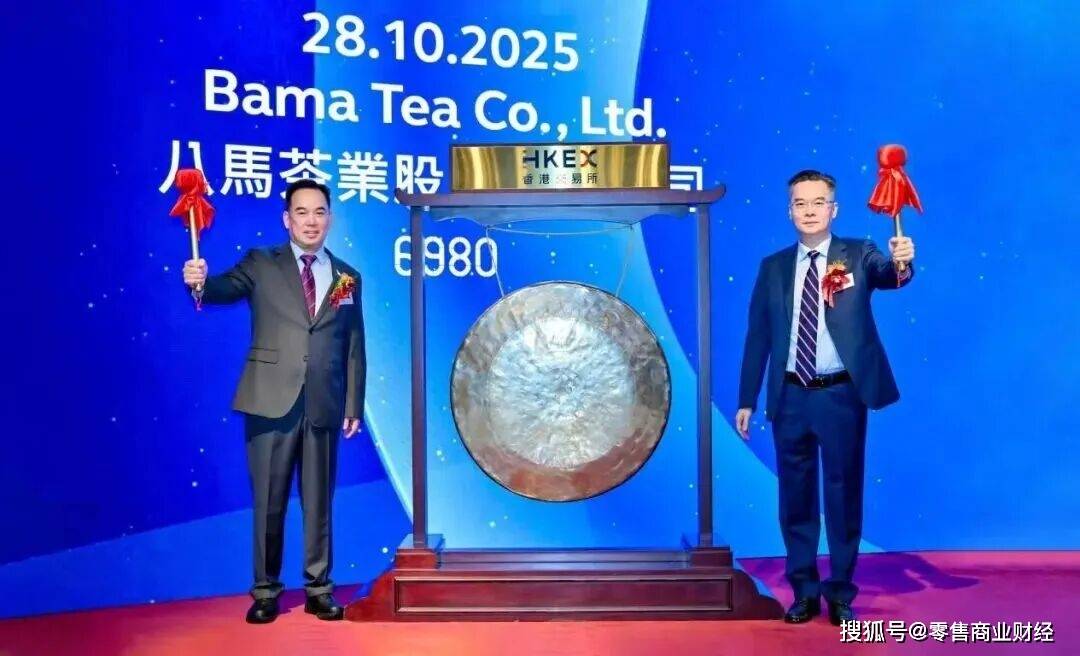
八马茶业港股上市;农夫山泉钟睒睒第四次成为中国首富
Sou Hu Cai Jing· 2025-10-28 11:50
Group 1: Baima Tea Industry - Baima Tea has officially listed on the Hong Kong Stock Exchange, with its shares opening 60% above the issue price at HKD 80 per share, and rising over 70% by 10 AM [1] - The company raised a total of HKD 450 million from the global offering of 9 million shares, netting approximately HKD 390 million after deducting listing expenses [1] - The funds will be used to expand the sales network, improve supply chain efficiency, and enhance brand promotion [1] Group 2: Meituan - Meituan has launched a nationwide social security subsidy program for all delivery riders, providing pension insurance subsidies [3] - Starting in November, riders can choose to pay social security in their registered or working locations, with additional benefits for family care and education [3] - The program aims to cover over one million riders and their families [3] Group 3: Nongfu Spring - Nongfu Spring's founder Zhong Shanshan has become China's richest person for the fourth time, with a net worth of CNY 530 billion, an increase of CNY 190 billion [4] - The company's revenue for the first half of 2025 reached approximately CNY 25.622 billion, a year-on-year increase of 15.56%, with net profit rising by 22.16% to CNY 7.622 billion [4] - The tea beverage segment has surpassed bottled water in revenue for the first time [4] Group 4: Guoquan - Guoquan reported a net increase of 361 stores in Q3, bringing the total to 10,761, a 98% year-on-year increase [4] - The company expects revenue between CNY 1.85 billion and CNY 2.05 billion, representing a year-on-year growth of 13.6% to 25.8% [4] - Core operating profit is projected to be between CNY 65 million and CNY 75 million, a year-on-year increase of 44.4% to 66.7% [4] Group 5: Three squirrels - Three Squirrels reported Q3 revenue of CNY 2.281 billion, an 8.91% year-on-year increase, but net profit attributable to shareholders fell by 56.79% [6] Group 6: Yanjinpuzi - Yanjinpuzi announced Q3 revenue of CNY 1.486 billion, a 6.05% year-on-year increase, with net profit rising by 33.55% to CNY 232 million [6] Group 7: Pupu Supermarket - Pupu Supermarket is set to open a new store in Quanzhou, increasing its total in the city to seven, while also planning to expand its kitchen business to Xiamen [6] Group 8: Qian Dama - Qian Dama has been included in the "2025 Guangdong Province Top 100 Private Enterprises" list, ranking 94th, and also made it to the "Top 50 Private Service Enterprises" at 35th [8] Group 9: Taobao - Taobao has launched 2.1 million new products globally for this year's Double Eleven, with offerings in five languages across 20 countries [8] Group 10: Walmart - Walmart has officially entered the South African market, planning to open its first stores by the end of the year and launching a mobile shopping app [9] Group 11: Suning - Suning reported that Guiyang, Chengdu, and Changsha are the top three cities for winter appliance consumption, with sales growth of 150%, 110%, and 87% respectively [10] Group 12: JD Fresh - JD Fresh will open its first store in Shijiazhuang in December, marking a significant expansion in the North China region [12] Group 13: Gree Electric - Gree Electric's sales with JD are expected to exceed CNY 20 billion again this year, with a focus on expanding sales across all product categories [14] Group 14: Meituan Health - Meituan has launched a "Health Double Eleven" event featuring special medical foods, responding to a nearly 40% increase in related searches [15] Group 15: Shanghai Jahwa - Shanghai Jahwa reported a revenue of CNY 4.961 billion for the first three quarters of 2025, a 10.8% increase, with net profit rising by 149.1% [17] Group 16: Cainiao - Cainiao is delivering automated sorting centers to multiple courier companies globally, preparing for the upcoming shopping festivals [18] Group 17: Kidswant - Kidswant reported Q3 revenue of CNY 2.438 billion, a 7.03% year-on-year increase, with net profit rising by 28.13% [19] Group 18: Tao Xiaopang - Tao Xiaopang's new store in Zhengzhou achieved sales of CNY 2.27 million on its opening day, with a strong focus on community consumption [20]


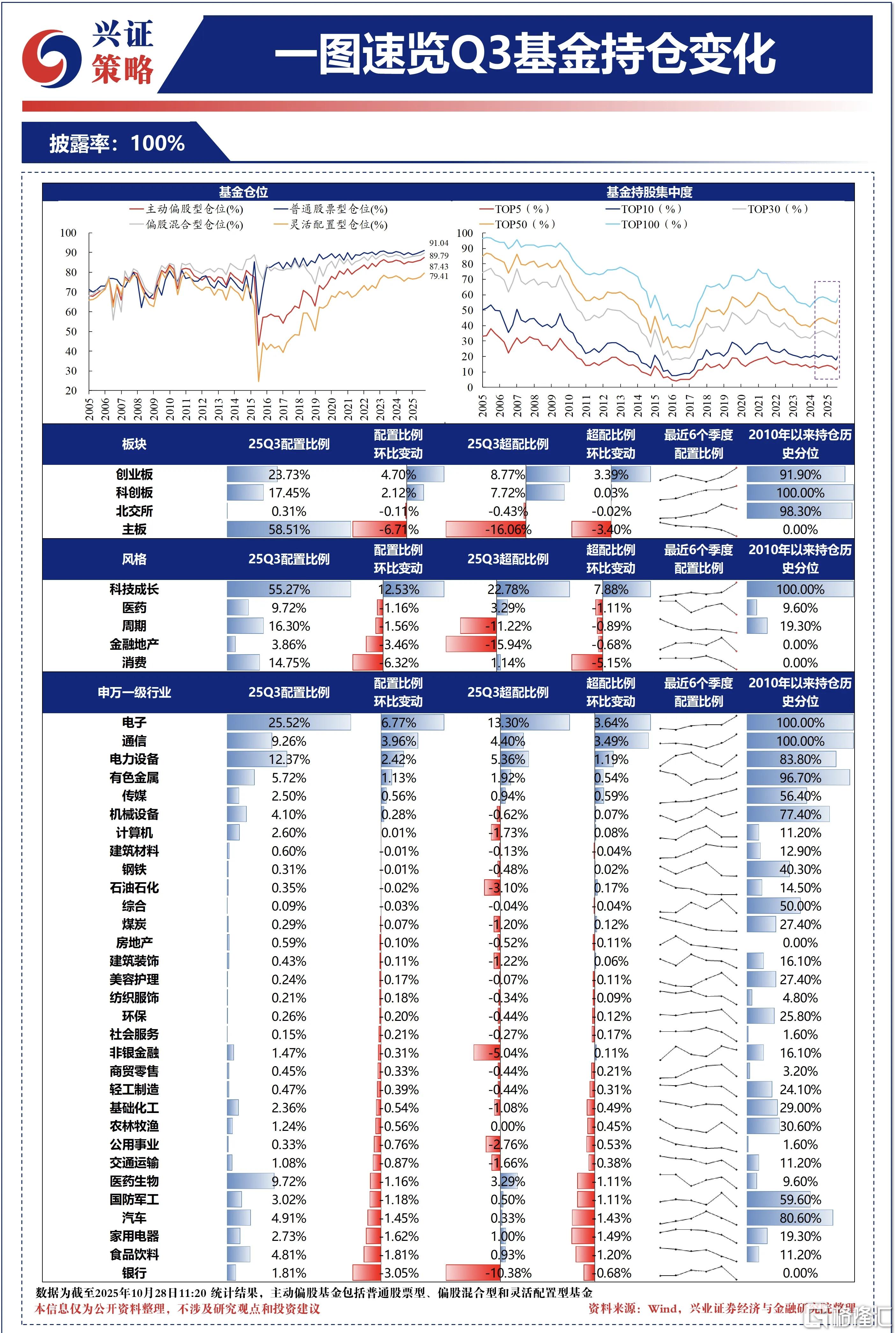
一图速览Q3基金持仓变化
Ge Long Hui· 2025-10-28 09:47
Core Insights - The report indicates a significant increase in the allocation of active equity funds, with a rise in overall positions and specific sector allocations, reflecting a strategic shift towards technology and growth sectors [2]. Fund Positioning - Active equity funds' overall position increased by 1.46 percentage points from Q2 to 87.43%, with ordinary stock funds, mixed equity funds, and flexible allocation funds rising by 0.93, 1.33, and 1.87 percentage points respectively [2]. - The allocation to the ChiNext board saw a notable increase of 4.70 percentage points to 23.7%, while the STAR Market allocation grew by 2.12 percentage points to 17.45%. Conversely, the main board allocation decreased by 6.71 percentage points to 58.51% [2]. Sector Allocation - The sectors with the highest increases in allocation include electronics (+6.77 percentage points), telecommunications (+3.96 percentage points), and electric equipment (+2.42 percentage points), indicating a focus on technology growth [2]. - The sectors with the largest reductions in allocation are banking (-3.05 percentage points), food and beverage (-1.81 percentage points), and home appliances (-1.62 percentage points) [2]. Industry Insights - In terms of secondary industries, the top increases were seen in communication equipment (+4.45 percentage points), consumer electronics (+3.09 percentage points), and semiconductors (+2.34 percentage points). The largest reductions were in white goods (-1.67 percentage points), city commercial banks (-1.45 percentage points), and liquor (-1.02 percentage points) [2]. - The individual stocks with the most significant increases in positions include Zhongji Xuchuang, Industrial Fulian, Xinyisheng, Hanwujing, and Luxshare Precision, with increases of 2.17, 2.03, 1.92, 0.91, and 0.63 percentage points respectively. The stocks with the largest decreases include Midea Group, China Merchants Bank, SF Express, Kweichow Moutai, and Gree Electric [2]. Hong Kong Market - In the Hong Kong market, the active equity fund's position slightly decreased by 0.76 percentage points to 19.09%. The sectors with increased allocations include healthcare and materials, while reductions were seen in telecommunications, finance, and energy [2]. - The stocks with the most significant increases in positions in the Hong Kong market are Alibaba, SMIC, and Tencent, while Xiaomi, Meituan, and Pop Mart saw notable reductions [2].



第八届河南·民权制冷装备博览会开幕
Zhong Guo Xin Wen Wang· 2025-10-28 09:31
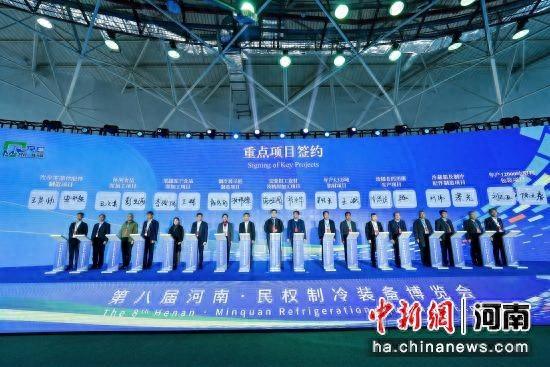
Core Points - The 8th Henan Minqian Refrigeration Equipment Expo opened on October 28, focusing on "Green Refrigeration, Intelligent Minqian" and showcasing innovations across the entire refrigeration industry chain [1] - The expo covers an exhibition area of 75,000 square meters with nearly 360 participating companies presenting over 3,100 products [4] - A total of 65,022 attendees, including exhibitors, buyers, and industry spectators, were recorded on the opening day, with 18 projects signed and a total contract value of 12.866 billion yuan [4] Industry Overview - Minqian is recognized as one of the five major refrigeration industry bases in China, housing 57 refrigeration equipment manufacturers and 84 component suppliers, with over 160 parts achieving full compatibility [5] - The annual production capacity of refrigerators and freezers accounts for one-tenth of the national total, while refrigerated and insulated vehicles represent a significant portion of domestic production [5] - Minqian's logistics advantages include access to major transportation networks and the only county-level customs office in the province, facilitating exports to over 80 countries and regions [5] Event Highlights - The expo featured various activities, including the release of the 2025 China Minqian Refrigeration Industry Index and a training base for electronic and electrical testing engineers [6] - Notable companies such as Gree, Haier, and TCL participated, alongside local enterprises like Aucma and Kangbain, showcasing a range of innovative designs and smart equipment [4][5] - The event served as a platform for international procurement, with buyers from 21 countries, including Russia and Mexico, exploring potential collaboration opportunities [4]