
小米

Search documents
小米2025年Q2财报:多元化增长全面提速
Counterpoint Research· 2025-09-04 01:04
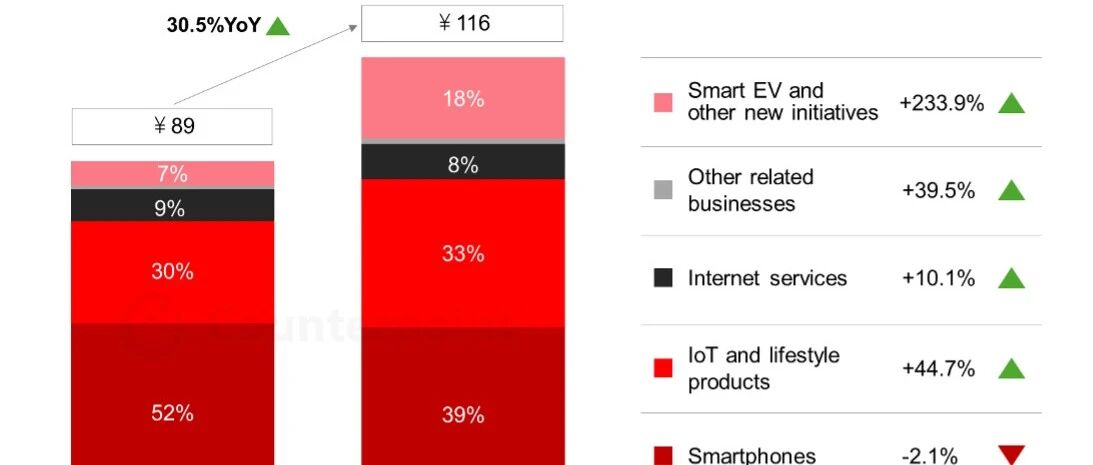
Core Viewpoint - Xiaomi's diversified strategy is supporting resilient growth, with significant contributions from its automotive and IoT businesses, despite a decline in smartphone revenue [4][10]. Financial Performance - In Q2 2025, Xiaomi's revenue grew by 30.5% year-over-year, with the smartphone business accounting for less than half of total revenue [4]. - The IoT business achieved a record revenue of 38.7 billion yuan, marking a 44.7% year-over-year increase, driven by the expansion of offline stores [8]. - Smartphone revenue declined by 2% year-over-year, with a 2.7% drop in average selling price (ASP) [10]. Product and Market Strategy - Xiaomi's smartphone shipments have seen eight consecutive quarters of year-over-year growth, although revenue was offset by ASP declines [9]. - The launch of the YU7 electric SUV exceeded expectations with over 240,000 orders in 18 hours, indicating strong demand for Xiaomi's automotive offerings [15]. - Xiaomi plans to open 1,000 new direct stores annually to enhance channel control and operational efficiency [8]. Innovation and R&D - Xiaomi's first self-developed 3nm flagship chip, XRING O1, has been officially released, showcasing its commitment to long-term innovation and breakthroughs in the high-end market [9][15]. - The company is expected to invest 30 billion yuan in R&D by 2025, with approximately 25% allocated to AI [15]. Strategic Insights - The integration of smartphones, electric vehicles, and AIoT is central to Xiaomi's strategy, creating a connected ecosystem that enhances user engagement and drives IoT hardware sales [11]. - Xiaomi's electric vehicle business is projected to achieve quarterly or monthly profitability by late 2025, although full profitability will take longer due to significant initial investments [15].

前魅族高管放狠话:要让魅族22完全卖不掉;曝小米汽车国内营收已反超小米手机;传字节分拆芯片团队,由新加坡公司接盘丨雷峰早报
雷峰网· 2025-09-04 00:31
Key Points - The former Flyme head Yang Yan has publicly stated his intention to make Meizu 22 unsellable, indicating a personal vendetta against the company [3] - Xiaomi's automotive revenue has reportedly surpassed that of its smartphone division, marking a significant shift in its business model [9] - Tesla's Model Y L has seen explosive sales in China, with daily orders reaching 10,000 units since its launch [12] - ByteDance is restructuring its chip team, transferring operations to a new entity in Singapore while maintaining employee contracts [13] - The global smart home cleaning robot market has seen significant growth, with Stone Technology leading the market [15] Group 1 - Yang Yan's comments about Meizu 22 suggest a competitive and hostile market environment [3] - Xiaomi's automotive division achieved a delivery milestone of 11,880 units in one week, indicating strong market demand [9] - Tesla's Model Y L has accumulated 120,000 orders since its launch, highlighting the demand for larger SUVs in the Chinese market [12] Group 2 - ByteDance's restructuring of its chip team may indicate a strategic shift in its approach to hardware development [13] - The smart home cleaning robot market is dominated by Chinese brands, with Stone Technology holding a 15.2% market share [15] - The competitive landscape in the automotive sector is intensifying, with companies like Xiaomi and Tesla making significant inroads [9][12]



百融云20250903
2025-09-03 14:46
Summary of Baifengyun Conference Call Company Overview - Baifengyun reported a net profit exceeding 200 million yuan in the first half of 2025, with a net profit margin of 12% and an adjusted margin of 16, indicating strong profitability [2][3] - The company employs approximately 1,400 staff, with 57% in R&D, and an average annual income exceeding 2 million yuan, reflecting a strong emphasis on R&D and high-value talent [2][3] - Baifengyun has served over 8,000 institutions, including banks, internet finance companies, and major internet firms like Alibaba and Baidu, showcasing a broad client base [2][3] Business Structure and Core Advantages - The business is divided into two main segments: Model as a Service (MaaS) and Business as a Service (BaaS) [3] - **MaaS** contributes about one-third of total revenue, providing decision-making support for financial institutions through AI technology, with over 300 million daily calls [2][3][4] - **BaaS** accounts for approximately two-thirds of revenue, utilizing intelligent voice robots for sales and customer operations, relying on generative AI technology [2][3][5] - The launch of the Cyber Star platform aims to enhance internal efficiency across various sectors, significantly reducing contract review times [2][9] Financial Performance - Baifengyun has maintained stable revenue growth of over 20% annually in recent years, with the first half of 2025 exceeding expectations [12] - The BUS financial cloud business saw a 45% year-on-year revenue growth in the first half of 2025, driven by the expansion into broader financial scenarios [14] Market Dynamics and Challenges - The company faces policy uncertainties impacting performance, particularly in the insurance sector, which has shown negative growth since 2024 due to regulatory pressures [13][14] - Despite these challenges, Baifengyun remains optimistic about long-term prospects, having demonstrated resilience in past downturns [13][22] Technological Innovations - The intelligent voice robot technology has proven effective in enhancing customer communication efficiency, with cost reductions to one-fifth of human labor costs and achieving 99% accuracy in voice recognition [7][8] - Baifengyun differentiates itself by utilizing a strong mathematical foundation for user segmentation, focusing on vertical small models rather than general large models [8] Future Outlook - The company plans to continue investing in R&D, with a 30% increase in spending in the first half of 2025, focusing on AIGC and computing clusters [19] - Baifengyun aims to expand its AI business into non-financial sectors, anticipating gradual increases in revenue contribution from these areas [19] Conclusion - Baifengyun is positioned as a resilient player in the AI technology sector, with a commitment to long-term growth despite short-term challenges, maintaining confidence in its strategic direction and market adaptability [22]
汽车板块25Q2总结:盈利分化,强者恒强
2025-09-03 14:46
Summary of Conference Call Records Industry Overview: Automotive Sector Key Points - The automotive sector is experiencing a divergence in profitability, with strong performers like BYD and Geely expected to recover in Q3, while companies like Changan and BYD face challenges due to increased sales and R&D expenses [1][2] - The overall performance of the automotive sector in Q2 showed improvement in retail and wholesale data compared to Q1, with a notable increase in new energy vehicle penetration, surpassing 50% [1][8] - Concerns regarding the reduction of new energy vehicle purchase tax and subsidy cuts are present, but stable pricing and new model launches may drive demand [1][5] Company-Specific Insights - **BYD**: Expected to see better profitability recovery in Q3, with a focus on sales alpha without significant price wars [2] - **Geely**: Q2 operating profit was 31.8 billion yuan, with new models expected to launch in Q3 and Q4, aiming for a profit target of 20 billion yuan for the year [13] - **Li Auto**: Q2 performance was under pressure with sales of approximately 110,000 vehicles, but Q3 delivery is expected to be between 90,000 and 95,000 vehicles [9] - **Great Wall Motors**: Q2 net profit was approximately 4.6 billion yuan, with new product cycles expected to provide opportunities [12] - **Xpeng Motors**: Q2 performance slightly exceeded expectations, with a gross margin over 14%, and profitability expected in Q4 2025 [16] Automotive Parts Sector Key Points - The automotive parts sector showed moderate growth in Q2, with a self-owned market share reaching 68.5% [19] - Companies like Fuyao Glass and Huguang Electronics exceeded expectations due to customer structure optimization and scale effects [3][19] - The overall revenue growth of the parts sector was 7.6% year-on-year, lagging behind the 13% growth in passenger vehicle wholesale sales [19] Company-Specific Insights - **Fuyao Glass**: Expected to see improved profitability in H2 2025 due to enhanced production efficiency and increased industry demand [20] - **Huguang Electronics**: Q2 performance exceeded market expectations, with significant contributions from new models [21] - **Yuanpu**: Anticipated to see sustained growth in H2 2025, with new business developments in the seating assembly and robotics sectors [22] Robotics Industry Key Points - The robotics industry has a positive outlook, driven by new technology iterations and upgrades in customer relationships among several companies [6][7] - Companies like Haoneng Fuda and Wuxi Zhenhua are highlighted for their strong performance and advantageous customer structures [6] Heavy Truck Sector Key Points - The heavy truck sector's performance in Q2 was in line with expectations, but profitability did not show significant surprises due to intense competition [31] - The sector is viewed as defensive, with steady but slow growth anticipated, supported by high dividend rates [31][32] Financial Automotive Sector Key Points - Financial Automotive reported a positive performance in Q2, marking a significant turnaround in profitability [33] - The company aims to improve its profitability to match competitors, indicating substantial growth potential if successful [33]





那些为小米信仰充值的人
雷峰网· 2025-09-03 11:45
Core Viewpoint - The article highlights the unwavering faith and community spirit among Xiaomi investors, particularly within the "Xiaomi Porridge" group, which has grown to over 3,000 members since its inception in 2021. This group represents a unique blend of Xiaomi enthusiasts and serious investors who have supported the company through its ups and downs, especially during challenging times when the stock price fell significantly [2][51]. Group 1: Xiaomi's Stock Journey - Xiaomi's stock price has seen significant fluctuations, reaching nearly 40 HKD by the end of 2024 after previously dropping below 10 HKD due to skepticism surrounding its car manufacturing ambitions [2][10]. - The stock was initially listed at 17 HKD in July 2018, but by the end of 2018, it had plummeted to around 8 HKD, prompting early investors like Will to increase their holdings [6][7]. - The stock experienced a brief rebound to over 30 HKD after being included in the U.S. sanctions list, but it subsequently fell back to around 10 HKD, marking a challenging period for investors [10][12]. Group 2: Community and Investor Sentiment - The "Xiaomi Porridge" community serves two main purposes: facilitating information exchange and promoting rational investment among its members, who often exhibit extreme loyalty to the brand [12]. - Members of the community, such as Will and CC, have shared personal stories of their investment journeys, highlighting their commitment to Xiaomi despite market volatility [14][17]. - The community's collective belief in Xiaomi's potential, especially regarding its automotive ventures, has led to significant pre-orders for the Xiaomi SU7, indicating strong investor confidence [18][30]. Group 3: Individual Investor Stories - Will, a key figure in the "Xiaomi Porridge" group, initially invested in Xiaomi during its IPO and has since become a vocal supporter, leveraging his financial background to analyze the company's prospects [6][9]. - CC's journey from a casual user of Xiaomi products to a dedicated investor reflects the brand's ability to convert customers into loyal shareholders [15][17]. - Professor Shen, another prominent member, has been a long-time supporter of Xiaomi, investing heavily in its stock and even reserving a parking space for the anticipated Xiaomi car, showcasing his deep trust in the brand [28][30]. Group 4: Xiaomi's Product Development and Market Position - The article discusses the anticipation surrounding Xiaomi's entry into the automotive market, with early indicators suggesting strong demand for its vehicles, particularly the SU7 [18][34]. - The community's members have expressed confidence in Xiaomi's ability to compete with established automotive brands, citing the company's innovative approach and product quality [46][48]. - The narrative emphasizes the emotional connection between Xiaomi and its users, with many members viewing their investment as a form of support for a brand they believe in deeply [25][47].

博众精工(688097.SH):在开拓三星、oppo、传音、荣耀、小米等客户
Ge Long Hui· 2025-09-03 07:53
格隆汇9月3日丨博众精工(688097.SH)在投资者互动平台表示,公司在消费电子行业内深耕二十余年, 具备成熟的项目经验及深厚的自动化设备技术积累。除了目前服务的大客户外,公司也在横向开拓其他 客户和市场,把成熟的技术复制到其他客户及其他产品线。2025年上半年,公司取得vivo 等客户的手 机柔性模块化产线订单。目前公司还在开拓三星、oppo、传音、荣耀、小米等客户。 ...

二季度拉美智能手机市场同比增长2%,荣耀同比大增70%
Bei Jing Shang Bao· 2025-09-03 07:22
Core Insights - The smartphone market in Latin America is projected to see a 2% year-on-year growth in shipment volume, reaching 34.3 million units by Q2 2025 [1] Company Performance - Xiaomi ranks second with shipments of 6.7 million units, achieving an 8% year-on-year increase, marking a historical high [1] - Honor's shipments surged by 70% to 2.9 million units, entering the top four for the first time and setting a new record [1] - Transsion ranks fifth with shipments of 2.4 million units, experiencing a 23% year-on-year decline [1] Market Dynamics - Xiaomi's growth is primarily driven by the performance of the Redmi A5 and 14C 4G models, particularly in Argentina, Colombia, and Central America [1] - Honor's breakthrough in Central America is attributed to the X series, Magic7 Lite, and 400 series, with the region surpassing Mexico to become Honor's largest market in Latin America [1]

港股中报季进入尾声,机构称新旧经济分化明显,建议关注科技成长股的投资机会
Mei Ri Jing Ji Xin Wen· 2025-09-03 06:33
Group 1 - The Hong Kong stock market indices collectively declined, with the Hang Seng Technology Index showing a reduced drop, while the pharmaceutical sector remained active and gold stocks continued to gain traction [1] - As of August 31, 98.6% of the 2,276 companies listed on the Hong Kong main board had disclosed their interim results, indicating a slowdown in revenue growth for the first half of 2025, but an overall improvement in profitability [1] - The analysis highlighted a clear divide between new and old economies, with information technology, pharmaceuticals, and discretionary consumption performing well, while sectors like energy, real estate, and industrial capital goods faced performance pressures [1] Group 2 - Southbound funds have net bought over 1 trillion HKD this year, with a recent focus on AI core assets in Hong Kong stocks, particularly Alibaba, which has seen net buying for eight consecutive days [2] - The Hang Seng Technology Index ETF (513180) includes 30 leading Hong Kong tech companies, focusing on the AI industry chain, with potential "seven giants" in Chinese tech such as Alibaba, Tencent, Xiaomi, Meituan, and SMIC [2] - Investors without a Hong Kong Stock Connect account can access Chinese AI core assets through the Hang Seng Technology Index ETF (513180) [2]
恒生科技指数ETF(513180)震荡回调,机构:公募基金上半年配置风格转向港股科技
Mei Ri Jing Ji Xin Wen· 2025-09-03 06:23
Group 1 - The Hong Kong stock market indices collectively declined, with the Hang Seng Tech Index dropping nearly 1%, while the A-share market followed suit with the largest ETF tracking the Hang Seng Tech Index also experiencing fluctuations [1] - Public fund reports for mid-2025 indicate a significant increase in the proportion of Hong Kong Stock Connect holdings to 16.85%, making it the top allocation direction for active equity funds, reflecting a preference for Hong Kong stocks due to their valuation advantages amid high valuations in A-shares [1] - Market style is shifting from traditional core assets like liquor and new energy to high-growth sectors in Hong Kong, particularly technology, semiconductors, and AI-driven industries [1] Group 2 - Tactical recommendations suggest seizing rebound opportunities following index corrections, as factors constraining the Hong Kong market are showing signs of marginal improvement, including anticipated interest rate cuts by the Federal Reserve [2] - The liquidity situation in the Hong Kong market is improving, with the Monetary Authority halting net fund withdrawals and the most volatile phase of exchange rate fluctuations likely coming to an end [2] - The AH share premium has risen to 127.5%, restoring the valuation advantage of Hong Kong stocks, while concerns over earnings have subsided following the release of mid-year reports [2] - Southbound capital has net purchased over 100 billion HKD this year, primarily flowing into core AI assets in Hong Kong, with Alibaba seeing continuous net buying for eight consecutive days [2] - The Hang Seng Tech Index ETF includes 30 leading Hong Kong tech companies, focusing on the AI industry chain, with major players like Alibaba, Tencent, Xiaomi, Meituan, and BYD potentially becoming the "seven giants" of Chinese tech stocks [2]
南向资金持续“扫货”,美联储9月有望降息,恒生科技或迎内外资共振
Mei Ri Jing Ji Xin Wen· 2025-09-03 06:15
Group 1 - The Hong Kong stock market, represented by the Hang Seng Technology Index, is currently experiencing a collective decline, with the index dropping nearly 1% [1] - Southbound capital continues to flow into Hong Kong stocks, with a net inflow of 92.81 billion HKD on September 2, and a cumulative net inflow of 1,000.22 billion HKD this year, marking a record high since the launch of the mutual market access mechanism [1] - The probability of a 25 basis point rate cut by the Federal Reserve in September is as high as 89.6%, indicating a potential new round of interest rate cuts in the U.S., which may benefit emerging markets including Hong Kong stocks [1] Group 2 - The Hong Kong technology sector, represented by the Hang Seng Technology Index, is currently in a historically undervalued range, with expectations of a "catch-up" rally due to continuous inflows from southbound capital and the anticipated new round of interest rate cuts in the U.S. [2] - The Hang Seng Technology Index ETF (513180) includes 30 leading Hong Kong technology companies, focusing on the AI industry chain, with major players like Alibaba, Tencent, Xiaomi, Meituan, and BYD expected to become the "seven giants" of Chinese technology stocks [2] - Investors without a Hong Kong Stock Connect account can access Chinese AI core assets through the Hang Seng Technology Index ETF (513180) [2]