
华泰证券

Search documents
华泰证券11月12日获融资买入2.01亿元,融资余额70.69亿元
Xin Lang Cai Jing· 2025-11-13 01:25
Core Insights - Huatai Securities experienced a decline of 0.67% on November 12, with a trading volume of 1.185 billion yuan and a net financing buy of -96.6957 million yuan [1] - As of November 12, the total margin balance for Huatai Securities was 7.079 billion yuan, indicating a high level of financing activity [1] - The company reported a net profit of 12.733 billion yuan for the first nine months of 2025, reflecting a year-on-year growth of 1.69% [2] Financing and Margin Data - On November 12, Huatai Securities had a financing buy of 201 million yuan, with a financing balance of 706.9 million yuan, accounting for 4.34% of its market capitalization [1] - The margin trading data showed that the financing balance exceeded the 80th percentile level over the past year, indicating a high level of activity [1] - The short selling data indicated a short balance of 9.3125 million yuan, also exceeding the 80th percentile level over the past year [1] Shareholder and Dividend Information - As of September 30, 2025, Huatai Securities had 195,500 shareholders, a decrease of 6.96% from the previous period [2] - The company has distributed a total of 41.539 billion yuan in dividends since its A-share listing, with 12.640 billion yuan distributed in the last three years [3] - The top ten circulating shareholders include Hong Kong Central Clearing Limited and China Securities Finance Corporation, with notable changes in their holdings [3]

两部门分类引导新能源消纳 新型电力系统建设加速
Zhong Guo Chan Ye Jing Ji Xin Xi Wang· 2025-11-13 00:11
Core Viewpoint - The National Development and Reform Commission and the National Energy Administration have issued guidelines to promote the consumption and regulation of renewable energy, setting targets for 2030 and 2035 to enhance the integration and efficiency of renewable energy systems [1][2]. Group 1: Renewable Energy Consumption Goals - By 2030, a multi-level renewable energy consumption and regulation system will be established to ensure smooth grid connection, diversified utilization, and efficient operation of renewable energy, meeting an annual demand for over 200 million kilowatts of new renewable energy [1][3]. - The guidelines emphasize the need for a comprehensive evaluation system for renewable energy consumption, moving beyond a single utilization rate metric to a more holistic assessment [4]. Group 2: Innovative Measures and Development - The guidelines categorize renewable energy development and consumption into five types, optimizing the integration of various energy sources and promoting innovative consumption models [2][3]. - There is a strong push for the development of new business models and industries related to renewable energy, including green hydrogen and smart microgrids, to enhance local consumption [2][3]. Group 3: Infrastructure and System Upgrades - The construction of new power systems is being accelerated, including the development of pumped storage power stations and advanced energy storage systems, to support large-scale distributed renewable energy integration [3]. - The guidelines also call for the enhancement of transmission channels and the intelligent upgrade of distribution networks to accommodate the growing share of renewable energy [3].
华泰证券:看好电网设备板块,建议关注出海、AIDC及国内龙头三条投资主线
Xin Lang Cai Jing· 2025-11-12 23:53
Core Viewpoint - The recent tender opening for the third batch of metering equipment by State Grid on November 10 indicates a significant price increase for new standard electric meters, with unit prices rising by 47% and 44% compared to the second batch, marking a recovery in prices [1] Group 1: Industry Outlook - The new standard for electric meters is expected to stabilize volume and increase prices in the industry by 2026, leading to a recovery in corporate profitability [1] - The ongoing global power shortage, driven by AI computing demand, is accelerating overseas investment in power grids, which may benefit Chinese grid equipment through increased export opportunities [1] Group 2: Investment Recommendations - The company maintains a positive outlook on the grid equipment sector and suggests focusing on three investment themes: overseas expansion, AIDC (Artificial Intelligence Data Center), and leading domestic companies [1]
市场中长期向上趋势不改 机构看好证券行业2026年投资机会
Zhong Guo Zheng Quan Bao· 2025-11-12 22:52
Core Viewpoint - The securities industry is expected to see significant performance growth and a return to high value due to low valuations and potential expansion in ROE for leading brokerages by 2026 [1][2][6] Group 1: Market Performance - The A-share market has been on an upward trend, with the margin trading balance reaching 23,941.58 billion yuan and financing balance at 23,783.90 billion yuan by the end of Q3 [2] - In the first three quarters of 2025, listed brokerages achieved a net profit attributable to shareholders of 169.4 billion yuan, a year-on-year increase of 63% [2] - The average daily trading volume reached a historical high of 16.5 billion yuan, with total trading volume for the first three quarters amounting to 301.56 trillion yuan [2] Group 2: Business Growth Areas - Retail and international businesses are contributing new growth to the industry, with significant increases in new accounts and financing balances [3] - The investment banking market is recovering, and the derivatives business is expected to see regulatory improvements, enhancing overall performance [3] - The application of AI in the industry is progressing, with leading firms exploring innovative AI applications as a new growth point [3] Group 3: Valuation and Investment Opportunities - The securities sector is currently undervalued, with a PB ratio of 1.52, indicating potential for valuation recovery [4] - Analysts suggest that core businesses such as public funds, overseas operations, and investment banking will drive profitability improvements [4][5] - The industry is expected to benefit from liquidity improvements and favorable policies, with ROE projected to rise to 7.7% by 2026 [6]
下滑到7年前水平!对美出口连续大跌,中国出口总额却创新高
Mei Ri Jing Ji Xin Wen· 2025-11-12 22:41
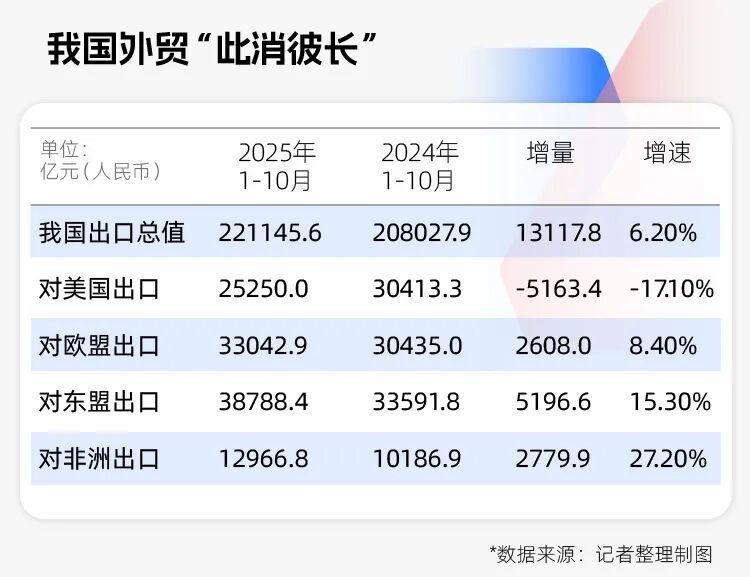
Core Insights - China's foreign trade showed unexpected resilience in the face of U.S. tariffs, with total trade value reaching 37.31 trillion yuan, a 3.6% year-on-year increase [1][2] - Exports to the U.S. declined significantly, dropping 17.1% year-on-year, while exports to the EU and ASEAN countries saw substantial growth [10][19][28] - The overall export growth was supported by diversification into new markets and an increase in high-tech product exports [9][41] Trade Performance - Total trade value for the first ten months of 2025 was 37.31 trillion yuan, with exports at 22.12 trillion yuan (up 6.2%) and imports at 15.19 trillion yuan (essentially flat) [1][2] - Exports to the U.S. fell to 2.52 trillion yuan, a decrease of 17.1%, while exports to the EU rose to 3.30 trillion yuan, an increase of 8.4% [10][19] - Exports to ASEAN countries reached 38.79 trillion yuan, marking a 15.3% increase, surpassing U.S. exports for the first time [28] Monthly Trends - Despite a 0.8% year-on-year decline in October exports, the overall trend for the year showed a V-shaped recovery with significant monthly growth [3][6] - Monthly exports exceeded 2.3 trillion yuan from June to September, with September alone seeing an 8.4% increase [3][6] Market Diversification - The decline in U.S. exports has been offset by increased exports to emerging markets, particularly in Southeast Asia and Africa [9][34] - Exports to Africa surged by 27.2%, with a notable increase in demand for industrial machinery and telecommunications products [34][40] Product Structure - The export structure is evolving, with high-end manufacturing products like industrial robots and new energy vehicles driving growth [41][46] - Exports of mechanical and electrical products accounted for over 60% of total exports, with integrated circuits and automotive exports showing significant increases [46]

机构看好证券行业2026年投资机会
Zhong Guo Zheng Quan Bao· 2025-11-12 20:18
Core Viewpoint - The securities industry is expected to see significant performance growth and a return to high value in 2026, driven by low current valuations and potential expansion in ROE for leading brokerages [1][2][4]. Market Performance - The A-share market has been on an upward trend, with the margin trading balance reaching 23,941.58 billion yuan and financing balance increasing by 5,242.45 billion yuan in the first three quarters of the year [1]. - The total trading volume of A-shares reached 301.56 trillion yuan, with an average daily trading volume of 16.5 trillion yuan, marking a historical high for the same period [1]. - Listed brokerages reported a net profit of 169.4 billion yuan in the first three quarters of 2025, a year-on-year increase of 63%, with a record quarterly net profit of 72.5 billion yuan in Q3 [1]. Business Growth - Key business segments such as brokerage, investment banking, asset management, interest income, and investment returns all experienced positive growth, with increases of 74%, 23%, 2%, 56%, and 43% respectively [1]. - Analysts highlight that retail and international businesses are contributing new growth to the industry [1]. Future Outlook - The industry ROE is projected to rise to around 7.2% by 2026, surpassing the 70th percentile since 2016, while the current industry valuation remains at the 40th percentile, indicating room for recovery [2]. - The trend of large wealth management and strong growth in new A-share and margin trading accounts is expected to continue, with daily trading volumes of 2 trillion yuan becoming the norm [2]. - The international business of Chinese brokerages is anticipated to expand, particularly in Hong Kong, with increased contributions from overseas branches [2]. Valuation Recovery - As of November 12, the PB ratio for the brokerage sector was 1.52, indicating a relatively low historical valuation [3]. - Analysts suggest that core businesses such as public funds, overseas operations, and derivatives are likely to drive profitability improvements, with a focus on strategic allocation opportunities [3]. - The current valuation of brokerages is seen as reasonable but on the lower side, with expectations for further increases as market conditions improve [3][4]. Investment Recommendations - Analysts recommend focusing on brokerages with advantages in overseas and institutional businesses, wealth management, and retail operations, particularly those benefiting from cross-border asset management trials in Hainan [3]. - The overall sentiment is positive regarding the securities industry's growth potential and value recovery opportunities leading into 2026 [4].
外资投资者:愈发看好中国市场长期配置价值
Zheng Quan Shi Bao· 2025-11-12 18:58
Group 1 - The 2025 Shanghai Stock Exchange International Investor Conference focuses on "Value Leadership and Open Empowerment - New Opportunities for International Capital Investment and M&A," attracting over 100 renowned investment institutions and nearly 400 representatives from various regions [1] - The A-share market has shown a stable upward trend this year, with major indices rising and investor confidence significantly improving, leading to continued international capital inflow into the Chinese market [1] - Global asset management institutions and sovereign wealth funds express increasing optimism about the long-term investment value of the Chinese market due to stable macroeconomic conditions, improved policy environments, and accelerated technological innovation [1] Group 2 - Temasek's China Chairman, Wu Yibing, states that China has become one of the most important markets in their international investment portfolio, representing 18% of global total assets [1] - Invesco's Asia-Pacific ETF Director, Huang Wanjun, notes that foreign investors are increasingly interested in Chinese assets, which are seen as attractive in terms of valuation and investment value [1] - Huatai Securities' Institutional Business Committee Chair, Liang Hong, believes that the revaluation of Chinese assets has begun and will deepen, with investors focusing on innovative sectors beyond just AI, including hard technology and consumer brands [1] Group 3 - The conference also marks the seventh anniversary of the Sci-Tech Innovation Board, highlighting the Shanghai Stock Exchange's progress in supporting technological innovation and new productivity development [2] - The coordinated development of the stock, bond, fund, derivatives, and REITs markets, along with effective green finance initiatives, has strengthened foreign investors' confidence in long-term investments in China [2] - The Shanghai Stock Exchange and Singapore Exchange's collaboration on the China Securities New Exchange Asian 100 Index series was announced during the conference [2]
全球资本聚焦经济转型中的投资机会
Shang Hai Zheng Quan Bao· 2025-11-12 17:51
Core Insights - China's capital market is becoming increasingly attractive to global investors due to its resilience amid economic fluctuations, valuation advantages, and industrial upgrades [1][2] - Foreign institutional investors are particularly interested in sectors aligned with China's economic transformation, such as high-end manufacturing, technology innovation, and consumption [2][3] Group 1: Market Trends - The 2025 Shanghai Stock Exchange International Investor Conference highlighted the growing interest of foreign investors in Chinese assets, with a focus on long-term growth potential and fundamental company performance [1] - International capital flows are being closely monitored, with foreign investors showing a positive attitude towards the Chinese market [1] Group 2: Investment Focus - Key investment themes identified include innovation, restructuring, and international expansion, with consumption upgrades being a significant outcome of these trends [2] - The emphasis on hard technology and the promotion of ETFs related to China's technological innovation are seen as ways to enhance interaction between domestic and foreign capital [2] Group 3: Long-term Investment Strategies - Temasek's investment strategy in China aligns with four long-term directions: digitalization, sustainable living, future consumption, and longevity, focusing on sectors like digital technology, renewable energy, and life sciences [2][3] - The belief in the growth potential of these sectors reflects the future development trajectory of the Chinese economy [3]
国际投资者聚焦中国资产 共探多元投资新机遇
Zheng Quan Ri Bao· 2025-11-12 16:54
Group 1: Economic Resilience and Investment Opportunities - Despite external pressures and internal challenges, China's macro economy remains stable and shows progress, with manufacturing PMI consistently in the expansion zone and high-tech industry investment growth maintaining double-digit rates [2] - Predictions indicate that China's GDP growth will stabilize around 5% by 2026, with a gradual decline in the real estate cycle's drag on growth and accelerated clearing of real estate company debt risks [2] - The consumption market is showing stable volume and improved quality, with service consumption recovering and new consumption trends emerging, providing stable support for economic growth [2] Group 2: Market Opening and Investment Space - China's capital market is deepening its high-level institutional opening, facilitating international capital entry and providing a broad platform for overseas investors to share in China's development dividends [4] - The number and quality of A-share listed companies are improving, covering various sectors of the national economy, with a focus on technology-leading enterprises in integrated circuits, biomedicine, and new energy [4] - The bond market in China is expanding in scale and innovating in product types, becoming an important area for foreign capital allocation [5] Group 3: Industry Upgrades and Investment Directions - High-end manufacturing is becoming the main engine of industrial upgrades, reshaping global competitiveness and attracting foreign investment [6] - China is transitioning from a "global manufacturing center" to a "global innovation center," with significant potential in innovation fields such as AI and semiconductors [6] - Companies are adopting multi-layered investment strategies, focusing on local enterprises serving the vast domestic market and supporting Chinese manufacturing to expand globally [7]
2025Q3非银板块基金持仓点评:券商板块获增配,保险持仓环比回落
HUAXI Securities· 2025-11-12 14:43
Investment Rating - The insurance industry is rated as "Recommended" [1] Core Insights - As of the end of Q3 2025, the allocation of non-bank financial sector in active funds is 1.20%, which is underweight by 8.48 percentage points compared to the total market capitalization of the CSI 300 [1] - The securities sector allocation has slightly increased to 0.41%, but remains significantly underweight by 4.28 percentage points compared to the CSI 300 [2] - The insurance sector's allocation has decreased from 0.75% at the end of Q2 to 0.61% at the end of Q3, underweight by 4.19 percentage points compared to the CSI 300 [3] - The multi-financial sector shows a marginal improvement with an allocation of 0.18%, up by 0.04 percentage points [4] - The report suggests that the current low allocation to the non-bank sector presents a value opportunity, especially with the expected market activity and reforms [5] Summary by Sections Non-Bank Financial Sector - The allocation in active funds is 1.20%, down by 0.06 percentage points from the previous quarter, and underweight by 8.48 percentage points compared to the CSI 300 [1] Securities Sector - The allocation is 0.41%, an increase of 0.04 percentage points, but still underweight by 4.28 percentage points compared to the CSI 300 [2] - Notable increases in holdings for leading firms such as Huatai Securities and Citic Securities, with significant percentage increases in both share quantity and market value [2] Insurance Sector - The allocation decreased to 0.61%, down from 0.75%, underweight by 4.19 percentage points compared to the CSI 300 [3] - Key stocks include China Ping An and China Life, with varying changes in shareholding and market value [3] Multi-Financial Sector - The allocation is 0.18%, showing a slight increase of 0.04 percentage points [4] - Significant increases in holdings for companies like Hong Kong Exchanges and Clearing and Bohai Leasing [4] Investment Recommendations - The report emphasizes the potential for value in the non-bank financial sector due to its current underweight status and the anticipated market developments [5]