
中国平安

Search documents
沪指重回4000点 保险板块领涨
Bei Ke Cai Jing· 2026-01-05 02:41
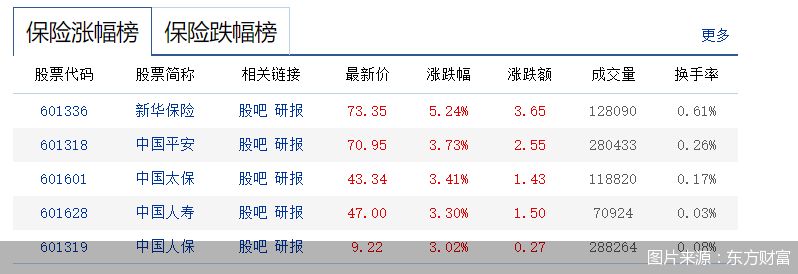
新京报贝壳财经讯 沪指重回4000点,日内涨0.78%,股价创2025年11月以来新高。脑机接口、保险、贵 金属等板块涨幅居前,新华保险涨近8%股价创历史新高,中国平安、中国太保、中国人寿、中国人保 纷纷冲高。 ...



时隔34个交易日,沪指盘中重回4000点
Feng Huang Wang Cai Jing· 2026-01-05 02:30
早盘半导体产业链震荡拉升,设备、材料、晶圆代工方向均表现不俗,中微公司、矽电股份、东微半导 涨超10%,华虹公司、中芯国际、拓荆科技、华海清科、中科飞测、盛美上海跟涨。消息面上,华虹公 司发布发行股份收购华力微97.5%股权的交易草案,中微公司披露发行股份及支付现金购买杭州众硅电 子64.69%股权的预案,并于1月5日复牌。 保险板块震荡走强,新华保险涨超5%,中国太保涨超3%,续创历史新高,中国平安、中国人寿、中国 人保涨幅靠前。消息面上,近日,国家金融监督管理总局数据显示,2025年前11个月,保险业总计实现 保费收入57629亿元,同比增长7.6%。其中,人身险公司实现保费收入41472亿元,同比增长9.1%;财 险公司实现保费收入16157亿元,同比增长3.9%。 凤凰网财经讯 1月5日,A股指数高开高走,沪指拉升涨0.82%,时隔34个交易日,上证指数盘中重回 4000点。深成指涨1.34%,创业板指涨1.58%。沪深两市成交额连续第151个交易日突破1万亿,较上一 日此时放量超1900亿,预计全天成交金额近2.6万亿。 | | | | | 户深京重要指数 | | | | | --- | --- | ...


2026年首个交易日,A股保险板块集体飘红
Bei Jing Shang Bao· 2026-01-05 02:29
| 保险涨幅榜 | | 保险跌幅榜 | | | | | 題多 | | --- | --- | --- | --- | --- | --- | --- | --- | | 股票代码 | 股票简称 | 相关链接 | 最新价 | 涨跌幅 | 涨跌额 | 成交量 | 换手率 | | 601336 | 新华保险 | 股吧 研报 | 73. 35 | 5.24% | 3.65 | 128090 | 0.61% | | 601318 | 中国平安 | 股吧 研报 | 70. 95 | 3.73% | 2. 55 | 280433 | 0. 26% | | 601601 | 中国太保 | 股吧 研报 | 43. 34 | 3.41% | 1.43 | 118820 | 0.17% | | 601628 | 中国人寿 | 股吧 研报 | 47.00 | 3.30% | 1.50 | 70924 | 0.03% | | 601319 | 中国人保 | 股吧 研报 | 9.22 | 3.02% | 0.27 | | 288264 图片来源:东方财富 | 北京商报讯(记者 李秀梅)1月5日,2026年A股首个交易日,保险板块集体飘红 ...


ETF盘中资讯|开门红!港股AI大反攻,港股互联网ETF(513770)豪涨逾4%突破年线!快手、哔哩哔哩领衔大涨
Sou Hu Cai Jing· 2026-01-05 02:19
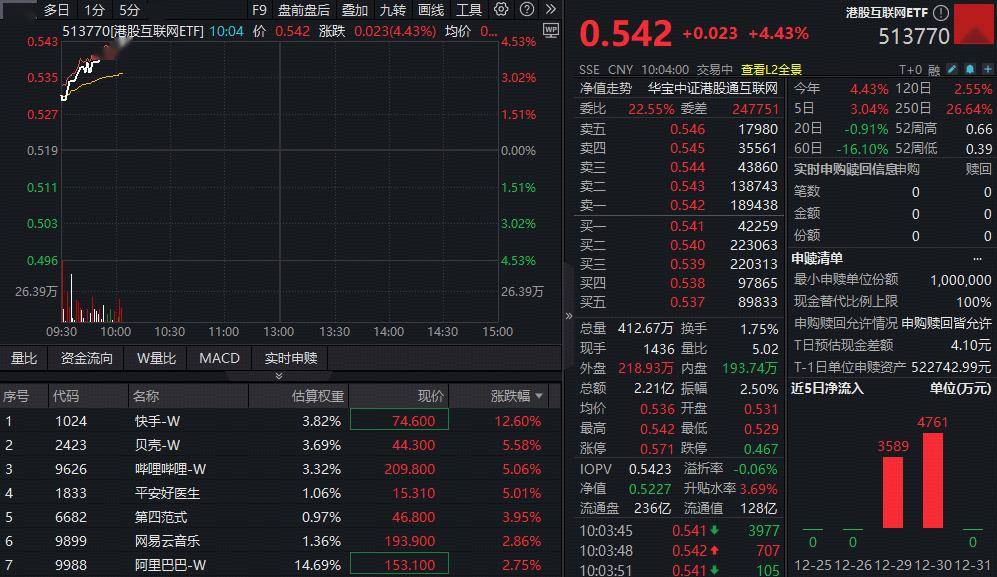
2026年A股首个交易日(1月5日),重仓互联网龙头的港股互联网ETF(513770)跳空高开,强势大涨超4%突破年线!港股科网龙头多数上 涨,快手狂飙逾12%,哔哩哔哩涨超5%,贝壳、平安好医生、第四范式等齐涨超4%。 提醒:近期市场波动可能较大,短期涨跌幅不预示未来表现。请投资者务必根据自身的资金状况和风险承受能力理性投资,高度注意仓位和 风险管理。 数据来源:沪深交易所等。中证港股通互联网指数近5个完整年度的涨跌幅分别为:2020年,109.31%;2021年,-36.61%;2022 年,-23.01%;2023年,-24.74%;2024年,23.04%。指数成份股构成根据该指数编制规则适时调整,其回测历史业绩不预示指数未来表现。 风险提示:港股互联网ETF被动跟踪中证港股通互联网指数,该指数基日为2016.12.30,发布于2021.1.11,指数成份股构成根据该指数编制规 则适时调整。文中指数成份股仅作展示,个股描述不作为任何形式的投资建议,也不代表管理人旗下任何基金的持仓信息和交易动向。基金 管理人评估的该基金风险等级为R4-中高风险,适宜积极型(C4)及以上的投资者。任何在本文出现的信息(包 ...

开门红!港股AI大反攻,港股互联网ETF(513770)豪涨逾4%突破年线!快手、哔哩哔哩领衔大涨
Xin Lang Cai Jing· 2026-01-05 02:12
Core Viewpoint - The Hong Kong Internet ETF (513770) experienced a strong opening on January 5, 2026, with a jump of over 4%, indicating positive market sentiment towards internet leaders in Hong Kong [1][4]. Group 1: Market Performance - The Hong Kong Internet ETF (513770) surged over 4% and broke through the annual line, with major internet stocks like Kuaishou rising over 12% and Bilibili increasing by more than 5% [1][4]. - The ETF's latest price-to-earnings ratio (PE) is 25.31, which is significantly lower than the 5-year average of 29.34%, highlighting its value compared to other indices like the ChiNext and Nasdaq [3][7]. - The ETF's average daily trading volume in 2025 was nearly 600 million yuan, supporting T+0 trading and indicating good liquidity [8]. Group 2: Economic Context - Recent expectations of interest rate cuts by the Federal Reserve and the peak of year-end foreign exchange settlements in China have accelerated the appreciation of the RMB against the USD [3][4]. - A weaker dollar is expected to enhance global economic recovery, which may boost domestic export growth and profit improvement [3][4]. - The overall market outlook for Hong Kong stocks in 2026 is positive, with expectations of continued net inflows from foreign and southbound capital due to a favorable monetary policy environment [7][8]. Group 3: Investment Strategy - The Hong Kong Internet ETF is passively tracking the CSI Hong Kong Stock Connect Internet Index, with significant holdings in major internet companies like Alibaba, Tencent, and Xiaomi, which collectively account for over 78% of the top ten holdings [7][8]. - For investors looking to reduce volatility while still focusing on technology, the Hong Kong Large Cap 30 ETF (520560) is recommended, which combines high-growth tech stocks with stable dividend-paying companies [8].

非银金融行业周报:公募费率改革收官,非银板块向上突破动能充盈-20260105
Shenwan Hongyuan Securities· 2026-01-05 02:05
Investment Rating - The report maintains a "Positive" outlook on the non-bank financial sector for 2026, indicating strong upward momentum for the industry [3][4]. Core Insights - The brokerage sector is expected to experience a significant upward breakthrough in 2026, driven by improved chip structure, reduced turnover rates, and a favorable valuation environment. The sector is currently undervalued compared to its earnings potential [4]. - The insurance sector shows signs of stabilization post the interest rate switch, with premium growth expected to improve in 2026, particularly in the life insurance segment [4]. - Regulatory changes, including the completion of public fund fee reforms, are anticipated to benefit the non-bank financial sector by reducing costs for investors and enhancing market participation [4][22]. Summary by Sections Market Review - The Shanghai Composite Index closed at 4,629.94 with a decline of 0.59% over the week. The non-bank index fell by 1.84%, with brokerages and insurance indices declining by 1.37% and 3.33%, respectively [8][10]. Non-Bank Financial Insights - The brokerage sector's index underperformed the Shanghai Composite Index by 0.78 percentage points in 2025, with a total decline of 2.05% for the year. In contrast, major A-share indices saw significant gains [4]. - The insurance sector's original premium income reached 5.76 trillion yuan from January to November 2025, reflecting a year-on-year growth of 7.6%. The life insurance segment grew by 9.2% during the same period [4][31]. Investment Analysis - For brokerages, the report recommends focusing on leading firms with strong competitive advantages, such as Guotai Junan and CITIC Securities, as well as those with high earnings elasticity like Huatai Securities [4]. - In the insurance sector, companies like China Life and Ping An are highlighted for their potential in the upcoming market revaluation, with a focus on the growth of new business premiums [4]. Regulatory Developments - The China Securities Regulatory Commission (CSRC) has implemented new rules for public real estate investment trusts (REITs), expanding financing options for commercial properties [21]. - The completion of the public fund fee reform is expected to lower overall fund costs by approximately 20%, saving investors around 51 billion yuan annually [22].



险企积极开展中期分红
Jing Ji Ri Bao· 2026-01-05 01:40
Group 1 - The core viewpoint of the articles highlights the strong capital strength and operational confidence of Chinese insurance companies, as evidenced by their implementation of mid-term dividends for 2025, totaling approximately 29.336 billion yuan [1] - The mid-term dividend scale for the insurance industry has increased by 8.8% compared to 2024, indicating robust financial performance [1] - China Ping An has the largest dividend distribution amounting to 17.202 billion yuan, while China Life, China Pacific Insurance, and New China Life have also announced their respective dividend distributions [1] Group 2 - The overall strength of the insurance industry has improved, with total assets reaching 40.40 trillion yuan, a year-on-year increase of 15.42% as of the end of Q3 2025 [2] - Insurance companies have adjusted their investment strategies, leading to a significant increase in investment returns, with the balance of insurance funds invested in the equity market rising substantially [2] - The optimization of liability structures within insurance companies has enhanced their risk resistance and dividend stability, transitioning from traditional life insurance products to dividend-type products [2] Group 3 - The new "National Nine Articles" policy issued in April 2024 has provided clear guidance and institutional support for insurance companies to enhance dividend stability and predictability [3] - This policy has elevated the importance of dividends in corporate strategy, transforming mid-term dividends from optional to essential for listed insurance companies [3] - Future recommendations include establishing a transparent and predictable long-term dividend framework and exploring a combination of cash dividends and stock buybacks to enhance shareholder value [3]
申万宏源研究晨会报告-20260105
Shenwan Hongyuan Securities· 2026-01-05 01:24
Group 1: Nanshan Aluminum (南山铝业) - Nanshan Aluminum is positioned as a rare growth target in the electrolytic aluminum sector, with a focus on dividends and share buybacks, reflecting confidence in its growth potential [4][12] - The company is expected to achieve net profits of CNY 5.0 billion, CNY 5.46 billion, and CNY 5.84 billion for the years 2025, 2026, and 2027, respectively, corresponding to P/E ratios of 12x, 11x, and 10x [4][12] - The report anticipates a 15% upside potential based on a target P/E of 13x for 2026, indicating a favorable valuation compared to peer companies [4][12] - Key assumptions include increased alumina production from Indonesia, with projected sales volumes of 2.76 million tons in 2025, 4.36 million tons in 2026, and 4.56 million tons in 2027 [12] - The report highlights that domestic electrolytic aluminum capacity is nearing its peak, while global supply growth is slowing, suggesting a favorable supply-demand balance for the industry [12] Group 2: Hanhigh Group (悍高集团) - Hanhigh Group is expected to achieve revenues of CNY 3.595 billion, CNY 4.525 billion, and CNY 5.653 billion for 2025, 2026, and 2027, respectively, with net profits of CNY 706 million, CNY 942 million, and CNY 1.237 billion [4][15] - The company is rated as "Buy" based on its current valuation being below the average of comparable companies for 2026 [4][15] - Hanhigh Group's growth is driven by cost reduction and brand strength, with a CAGR of 29% in revenue and 59% in net profit from 2019 to 2024 [12][13] - The company focuses on product innovation and cost efficiency, leveraging its own production capacity to enhance profitability [12][13] Group 3: Market Overview and Investment Strategy - The report identifies a favorable market environment for the spring season, with expectations of continued upward momentum in the stock market due to improved economic indicators and liquidity [22] - The "Top Ten Gold Stocks" for January 2026 include companies like Hualu Hengsheng, Lingyi Zhi Zao, and Alibaba, indicating a diversified investment strategy across sectors [14][22] - The automotive industry is highlighted for its recovery potential, particularly with the introduction of new subsidies and the expected improvement in demand for mid-range vehicles [24]
【非银金融*孙婷】公募基金降费第三阶段落地,引导权益类基金发展,平滑对短债基金的影响
Sou Hu Cai Jing· 2026-01-05 01:17
Core Viewpoint - The China Securities Regulatory Commission (CSRC) has revised the regulations on public fund sales fees, leading to a significant reduction in fees, which is expected to benefit investors and promote the development of equity funds [1][2]. Summary by Relevant Sections Fee Reduction Impact - The third phase of the fee reduction is estimated to lower overall fund sales fees by approximately 30 billion yuan, representing a 34% decrease [1]. - The maximum subscription and purchase fees for equity, mixed, and bond funds have been reduced from 1.2%/1.5% and 0.6% to 0.8%, 0.5%, and 0.3% respectively [2]. - The maximum annual sales service fee for equity and mixed funds has been reduced from 0.6% to 0.4%, while for index and bond funds, it has decreased from 0.4% to 0.2% [2]. Encouragement of Long-term Investment - The new regulations encourage long-term holding by eliminating sales service fees for funds held for over a year, except for money market funds [2]. - Redemption fees will now be fully allocated to fund assets, shifting the focus of fund sales institutions from transaction volume to asset retention [2]. Differentiated Commission Structure - The tail commission for sales to individual investors remains capped at 50%, while for non-individual sales, the cap for equity funds is set at 30% and for other funds reduced from 30% to 15% [3]. - This differentiated structure aims to promote retail business development and guide the growth of equity funds [3]. Overall Fee Reduction Strategy - The cumulative fee reduction across three phases is projected to save investors around 500 billion yuan annually, with the first two phases contributing approximately 140 billion yuan and 68 billion yuan respectively [3].

机器人租赁市场蓄势待发:今年规模或达百亿 配套保险同步探路
2 1 Shi Ji Jing Ji Bao Dao· 2026-01-05 00:42
Core Insights - The collaboration between Ping An Property & Casualty, Shanghai Electric Financial Leasing, and Shanghai Electric Insurance Brokerage marks the launch of the first insurance policy combining "insurance + leasing" for embodied intelligent robots in China [1] Group 1: Market Expansion - The robot leasing market is expected to reach a scale of 10 billion yuan in 2026, driven by mass production and platform-based operations [2] - The high unit price of leasing robots, with costs potentially reaching tens of thousands of yuan for multiple units, supports the feasibility of achieving this market size [2] Group 2: Insurance Demand - The rapid expansion of the robot leasing market has created a corresponding demand for insurance products, as incidents during performances have highlighted the need for coverage [3] - Insurance is seen as a crucial safety net for both users and operators of robots, addressing risks associated with operational mishaps [3] Group 3: Innovative Insurance Products - The newly launched insurance policy includes comprehensive coverage, such as third-party liability, product quality liability, and information leakage liability, moving beyond traditional hardware coverage [4] - The collaboration aims to create a closed-loop model of "insurance + financing leasing" in real commercial scenarios, addressing long-standing issues in the industry [4] Group 4: Collaborative Framework - The partnership establishes a "risk-sharing, data-sharing, and service co-construction" framework, enhancing the integration of financial services with industrial operations [5] - A mechanism for "data available but not visible" has been developed to protect commercial secrets while allowing for effective risk assessment [5] Group 5: Future Plans - Ping An Property & Casualty plans to expand its insurance offerings to cover various types of robots and their entire lifecycle, including development, production, testing, and operational maintenance [6] - The company aims to collaborate with industry players and academic institutions to establish risk assessment standards and guidelines for insurance services in the robotics sector [6]

