中航证券

Search documents
这家券商主要股东将变动!
券商中国· 2025-07-11 08:08
Core Viewpoint - The article discusses the recent developments regarding China Aviation Securities, including changes in major shareholders and the impact of the freezing of shares held by its second-largest shareholder, AVIC Financial Holdings. Group 1: Shareholder Changes - China Aviation Securities has two shareholders: AVIC Investment Holding Co., Ltd. holds 71.71% and AVIC Financial Holdings holds 28.29% [2][3] - AVIC Financial Holdings' 28.29% stake in China Aviation Securities was frozen in April 2023, with the total frozen equity amounting to 2.073 billion yuan [3] - The application for changes in major shareholders or actual controllers was accepted by the China Securities Regulatory Commission on July 8, 2023 [1] Group 2: Financial Performance and Challenges - AVIC Financial Holdings has faced declining revenue and performance, with total operating income from 2020 to 2023 reported as 18.341 billion yuan, 19.084 billion yuan, 18.155 billion yuan, and 16.939 billion yuan respectively [4] - The net profit attributable to the parent company for the same period was 3.274 billion yuan, 4.471 billion yuan, 1.680 billion yuan, and 290 million yuan [4] - AVIC Financial Holdings announced its voluntary delisting, becoming the first central enterprise financial holding company to do so, citing significant operational uncertainties [3][4] Group 3: Asset Adjustments - China Aviation Securities has also made adjustments to its assets, including the transfer of a 10% stake in AVIC Fund [6][7] - The stake in AVIC Fund is being offered for transfer at a base price of 71.7 million yuan, which would reduce China Aviation Securities' holding from 55% to 45% if the transfer is successful [7] - Despite the reduction in stake, China Aviation Securities maintains control over the fund [7] Group 4: Future Business Plans - For 2025, China Aviation Securities plans to focus on investment research in the military industry, enhance wealth management, and expand its investment banking and asset management services [8] - The company reported a revenue of 1.511 billion yuan in 2024, a 36% increase year-on-year, and a net profit of 421 million yuan, a 462.97% increase [8] - Total assets reached 37.82 billion yuan by the end of 2024, an 18.82% increase from the previous year [8]

A500ETF基金(512050)上涨近1%,机构:中国资产有望承接全球资本
Sou Hu Cai Jing· 2025-07-11 07:00
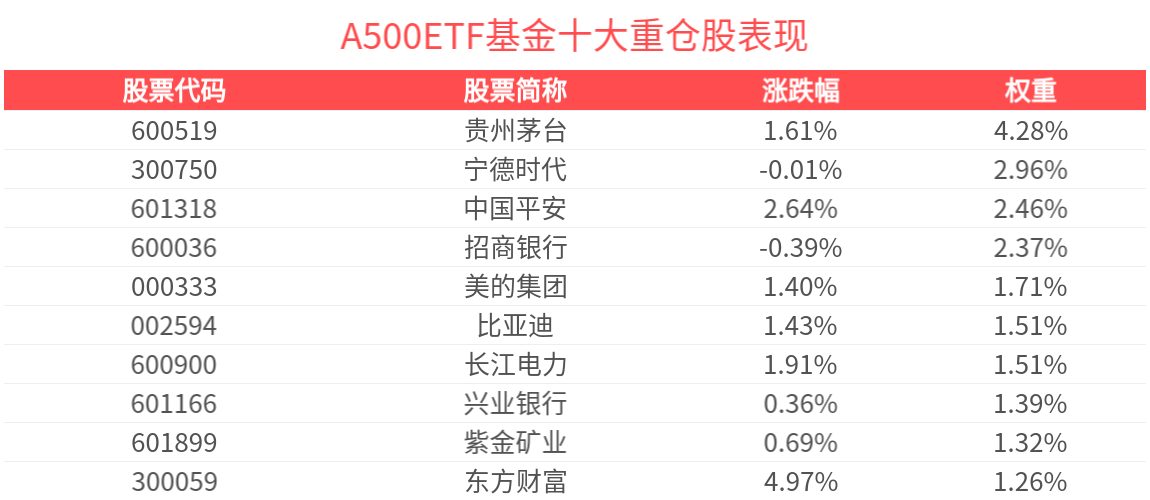
Core Viewpoint - The A500 index and its constituent stocks are experiencing significant upward movement, indicating a positive market sentiment and potential investment opportunities in the Chinese market [1][2]. Group 1: A500 Index Performance - As of July 11, 2025, the A500 index (000510) increased by 0.62%, with notable gains from stocks such as Harbin Electric (10.00%), Baotou Steel (10.00%), Northern Rare Earth (10.00%), and WuXi AppTec (9.99%) [1]. - The A500 ETF fund (512050) rose by 0.72%, with the latest price reported at 0.99 yuan [1]. Group 2: Market Analysis and Future Outlook - Western Securities suggests that the current "anti-involution" phase faces different structural challenges compared to previous cycles, with a more moderate capacity reduction expected than in 2016 [1]. - The economic rebalancing requires not only supply-side adjustments but also demand-side initiatives, emphasizing the importance of upgrading quality supply to stimulate demand [1]. - China is gradually promoting economic transformation, which may attract global capital, especially in the technology and military sectors, as the U.S. "Build Back Better" plan unfolds [1]. Group 3: A500 Index Composition - As of June 30, 2025, the top ten weighted stocks in the A500 index include Kweichow Moutai (4.28%), CATL (2.96%), Ping An Insurance (2.46%), and China Merchants Bank (2.37%), collectively accounting for 20.67% of the index [2][4].






金融市场分析周报-20250711
AVIC Securities· 2025-07-11 03:46
Economic Indicators - China's manufacturing PMI for June is at 49.7%, a slight increase of 0.2 percentage points from the previous month[7] - Non-manufacturing PMI for June stands at 50.5%, also up by 0.2 percentage points[9] - Comprehensive PMI output index for June is 50.7%, rising by 0.3 percentage points compared to May[7] Market Analysis - The Shanghai Composite Index increased by 1.40%, while the Shenzhen Component Index rose by 1.25% during the week[5] - The average daily trading volume decreased to 14,413.96 billion CNY, down by 452.78 billion CNY from the previous week[25] - Financial sector stocks showed strong performance, with a 1.86% increase, while the technology sector faced a decline of 1.28%[5] Monetary Policy and Liquidity - The central bank conducted a net withdrawal of 13,753 billion CNY this week, with a total of 65,522 billion CNY in reverse repos executed[12] - The average weighted repo rate for overnight transactions fell to 1.3606%[12] - The liquidity environment is expected to remain stable in the upcoming week, with limited seasonal impacts anticipated[13] Bond Market Insights - The yield on 10-year government bonds decreased by 0.5 basis points to 1.641%[14] - Credit bond yields across various maturities have generally declined, with 1-year AAA-rated bonds yielding 1.6791%[21] - The net financing amount for credit bonds increased by 851.22 billion CNY, indicating a recovery in the market[17] Investment Outlook - The "Big and Beautiful" U.S. policy is expected to accelerate the weak dollar cycle, potentially leading global capital to seek refuge in Chinese assets[29] - The A-share market is anticipated to experience a gradual upward trend as the economy transitions, with a focus on technology and military sectors for investment opportunities[29] - Risks include potential tightening of monetary policy and unexpected economic recovery that could lead to a significant rebound in bond yields[30]
中航证券主要股东变更获受理
news flash· 2025-07-11 01:12
Group 1 - The application for the change of major shareholders or actual controllers of AVIC Securities has been accepted on July 8 [1] - The market is speculating about the potential changes in the shareholding structure, particularly regarding the 28.29% stake held by the recently delisted second shareholder AVIC Capital and the 71.71% stake held by the controlling shareholder AVIC Investment [1] - Speculations regarding the change in the frozen shares held by AVIC Capital have been denied by informed sources, shifting the market's focus to the shareholding situation of AVIC Investment [1]

这家券商拟变更股东!
中国基金报· 2025-07-10 15:22
Core Viewpoint - China Aviation Securities has applied for a change in its major shareholder or actual controller, which has been accepted by the China Securities Regulatory Commission on July 8 [2]. Group 1: Shareholder Structure and Changes - China Aviation Securities currently has two major shareholders: China Aviation Investment holding 71.71% and China Aviation Industry Finance holding 28.29%, with respective contributions of 5.255 billion and 2.073 billion [2]. - China Aviation Industry Finance has seen a continuous decline in revenue and net profit, leading to its delisting in May 2023, becoming the first central enterprise financial holding company to do so [3]. - The shares held by China Aviation Industry Finance in China Aviation Securities have been judicially frozen twice, each for three years [3]. Group 2: Financial Performance - From 2020 to 2023, China Aviation Industry Finance's total revenue was 18.341 billion, 19.084 billion, 18.155 billion, and 16.939 billion respectively, while net profit figures were 3.274 billion, 4.471 billion, 1.680 billion, and 290 million [4]. - In 2024, the company is expected to report a further decline in performance, with net profit projected to be a loss due to multiple unexpected factors, including business restructuring and external economic pressures [4]. - In contrast, China Aviation Securities reported a revenue of 1.511 billion in 2024, a 36% increase year-on-year, and a net profit of 421 million, marking a 462.97% increase [4]. - As of the end of 2024, China Aviation Securities had total assets of 37.82 billion, an 18.82% increase from the previous year [4].

香港《稳定币条例》:8月生效,相关概念股集体飙升
Sou Hu Cai Jing· 2025-07-07 06:21
Core Viewpoint - The Hong Kong "Stablecoin Regulation" will take effect in August, leading to a surge in related concept stocks and potential applications in cross-border payments [1] Group 1: Regulatory Developments - The Hong Kong Financial Secretary revealed that the Monetary Authority is consulting the market on the implementation guidelines for the regulation, with specific details to be announced within the month [1] - The number of approved stablecoin licenses is currently in the "single digits," with hopes to receive applications after the regulation takes effect, aiming to issue licenses within the year [1] Group 2: Market Reactions - In the A-share market, cross-border payment and stablecoin concept stocks have seen significant gains, with companies like Zhongyi Technology and Jingbeifang hitting the daily limit [1] - In the Hong Kong stock market, Chinese brokerage stocks and stablecoin concept stocks have collectively strengthened, with notable gains from companies such as Guotai Junan International [1] Group 3: Market Interest and Applications - At least nine institutions are interested in applying for stablecoin licenses, with three of them planning to issue Hong Kong dollar stablecoins [1] - The Financial Secretary highlighted that stablecoins can address challenges in cross-border payments, serving as a local currency alternative in specific regions [1] Group 4: Future Projections - The People's Bank of China has revised the "Rules for Cross-Border Payment System Business," clarifying account management processes to adapt to the development and upgrade needs of CIPS [1] - Global cross-border payment transaction volume is projected to reach $194.6 trillion by 2024 and $320 trillion by 2032 [1]
券商上半年股债承销成绩出炉!“三中一华”格局有变?证券ETF龙头(560090)微涨,连续5日强势“吸金”超2亿元!
Xin Lang Cai Jing· 2025-07-07 02:47
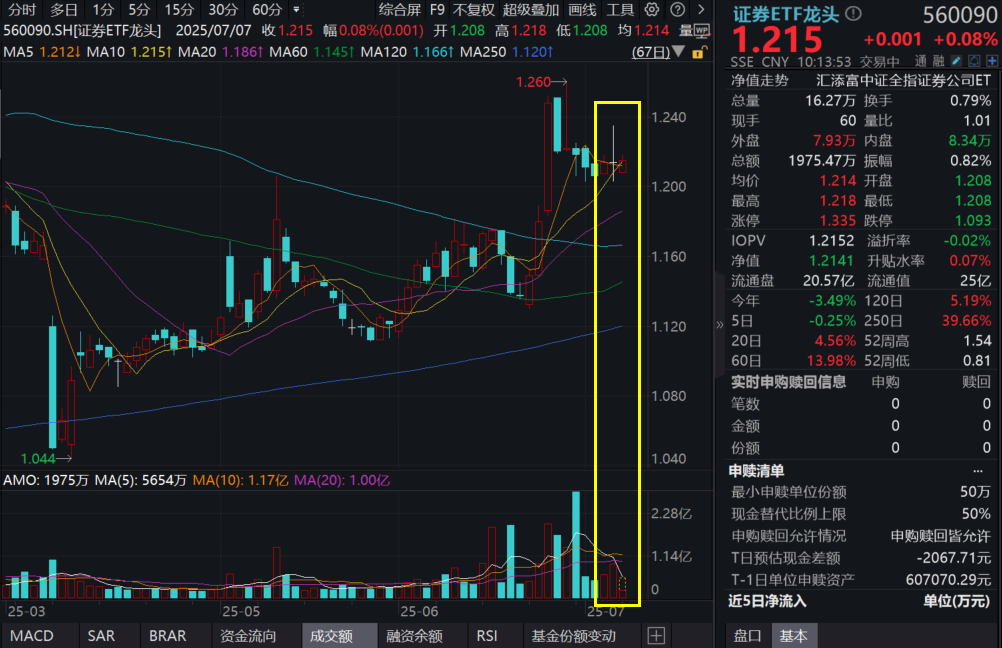
Group 1 - The A-share market showed a fluctuating upward trend on July 7, with the Securities ETF leader (560090) slightly rising by 0.08% and attracting over 200 million yuan in capital for five consecutive days, indicating strong investor interest in aggressive market strategies [1] - The index component stocks of the Securities ETF leader exhibited mixed performance, with Tianfeng Securities rising over 1%, while other stocks like Huayin Securities and Huaxin Shares saw slight increases, and Dongfang Fortune and Guotai Haitong experienced minor declines [1][2] - The underwriting performance of securities firms in the first half of the year has shown signs of recovery, with the new policies for the Sci-Tech Innovation Board expected to steadily boost investment banking revenues, highlighting potential investment opportunities in the IPO acceleration phase [3][5] Group 2 - The restructuring of the investment banking landscape is evident, with Guotai Haitong ranking prominently, and the effects of mergers and acquisitions becoming apparent, suggesting opportunities in the context of supply-side reforms [4][6] - As of June 30, securities firms achieved a total equity underwriting scale of 762.84 billion yuan, marking a significant increase of 402.91%, with IPOs contributing 37.36 billion yuan (+14.96%) and additional offerings reaching 697.73 billion yuan (+613.47%) [5][6] - The bond underwriting amount reached 7.41 trillion yuan, reflecting a growth of 29.38%, driven by major banks completing substantial fundraising through specific A-share stock issuances [5][6]


稳定币赛道风起云涌!券商业务模式升级,证券ETF龙头(560090)涨近1%,资金连续3日累计增仓超2亿元! 下半年券商各业务全面展望,一文读懂
Sou Hu Cai Jing· 2025-07-03 03:55
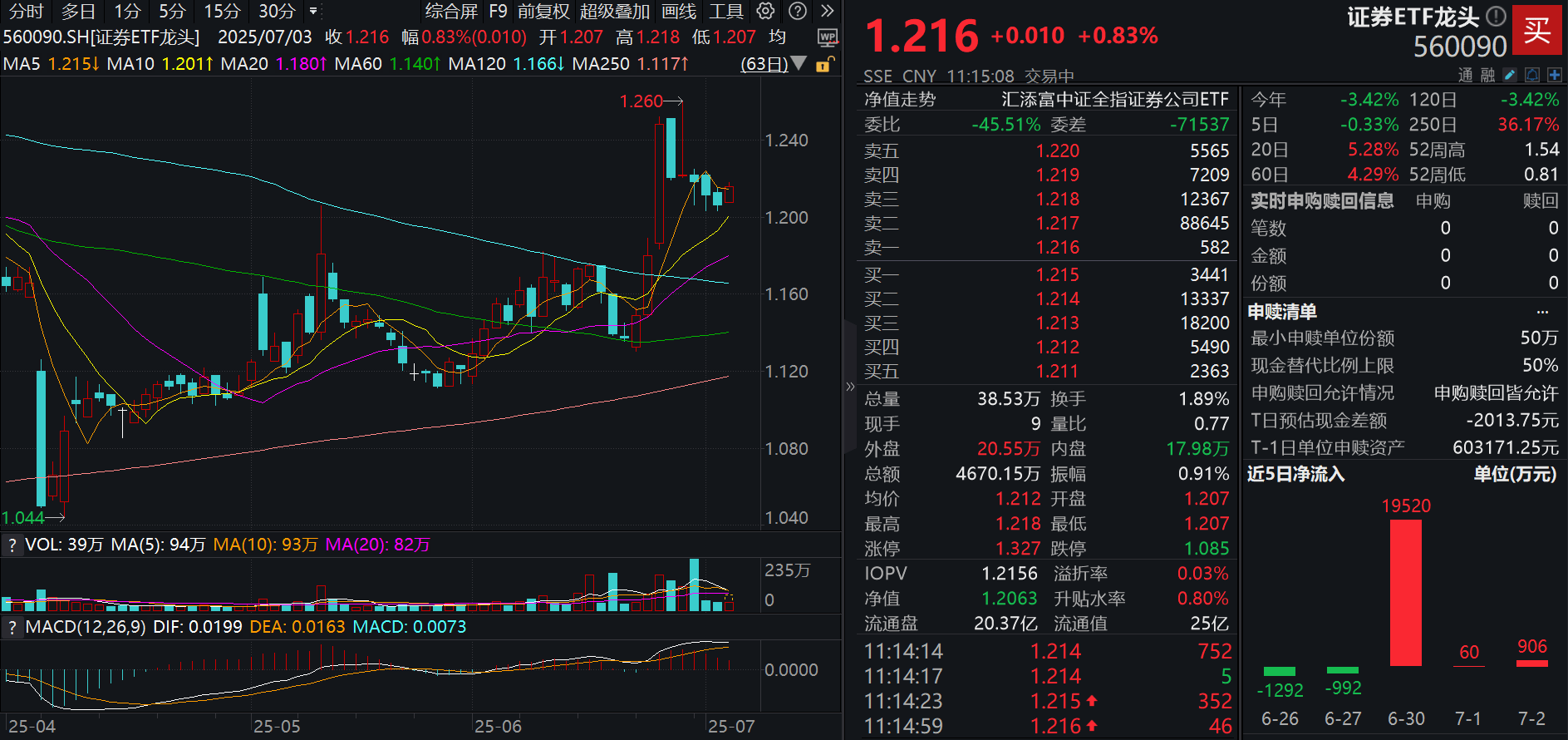
Core Viewpoint - The A-share market is experiencing a mixed trend, with the leading securities ETF (560090) showing a strong upward movement, indicating increased investor interest and capital inflow into the securities sector [1][12]. Group 1: Market Performance - As of July 3, the leading securities ETF (560090) has risen by 0.83% and has attracted over 200 million yuan in capital over the past three days [1]. - The majority of the constituent stocks of the securities ETF have seen gains, with notable increases such as Everbright Securities rising over 2% and CITIC Securities up by 1% [3]. Group 2: Trading Volume and Sector Growth - In June, trading volumes in both markets increased significantly, with the securities sector rising by 8.65% [5]. - The approval of virtual asset trading licenses for major securities firms marks a strategic breakthrough for Chinese financial institutions in the Hong Kong virtual asset market, potentially opening up a trillion-yuan market space [6]. Group 3: Business Model Transformation - Securities firms are transitioning from traditional "channel business + wealth management" models to a dual-driven approach of "traditional finance + digital assets," which is expected to attract more firms to engage in virtual asset trading [7]. - The brokerage industry is anticipated to maintain high performance in the second half of the year, supported by active trading and improved IPO conditions [8]. Group 4: Investment Opportunities - The securities sector is expected to benefit from ongoing macroeconomic policies aimed at stabilizing the stock market, with continuous high trading volumes favoring brokerage and proprietary trading businesses [9]. - Mergers and acquisitions within the sector are progressing, with notable examples like Guotai Junan and Haitong Securities, which are expected to enhance operational synergies and scale [10]. Group 5: Valuation and Market Position - The current valuation of the securities sector is relatively low, with a price-to-book ratio of only 1.43, indicating a high cost-performance ratio for potential investors [10]. - The leading securities ETF (560090) tracks the CSI All-Share Securities Companies Index, providing an efficient investment tool for exposure to the securities sector [12].




美欧英日韩央行行长齐聚,释放重磅货币政策信号
Huan Qiu Wang· 2025-07-03 02:17
Group 1 - The central banks of the US, Europe, Japan, and other major economies are facing divergent monetary policies due to differing economic growth, inflation, and external environments [3][4] - The US Federal Reserve is currently maintaining interest rates, with potential for a rate cut in September rather than July, influenced by tariff policies and inflation data [3][4] - The European Central Bank is balancing between interest rate cuts and preventing euro volatility, while Japan is leaning towards normalizing its monetary policy amid rising inflation expectations [4] Group 2 - The dollar's status is under scrutiny, with a significant drop in the dollar index projected for 2025, influenced by Fed rate cut expectations and high interest expenses on US debt [4] - The euro is being considered as a potential alternative to the dollar, but challenges such as fragmented capital markets need to be addressed for its internationalization [4]

美欧英日韩五大央行行长齐聚,释放重磅信号
21世纪经济报道· 2025-07-02 15:30
Core Viewpoint - The article discusses the complex monetary policy landscape faced by the Federal Reserve and other central banks amid rising tariffs and economic uncertainty, highlighting the potential for interest rate changes based on upcoming economic data [1][2][11]. Group 1: Federal Reserve's Monetary Policy - Federal Reserve Chairman Jerome Powell indicated that the Fed's interest rate decisions are influenced by the uncertainty surrounding tariff policies and their impact on inflation [1][2]. - Powell stated that the Fed is currently in a wait-and-see mode regarding interest rates, with most committee members expecting a rate cut later in the year [1][2]. - The likelihood of a rate cut in July is considered low, with key economic indicators such as inflation and employment data being crucial for future decisions [2][5][6]. Group 2: Economic Data and Market Reactions - The upcoming employment data on July 3 and CPI data in mid-July are critical for assessing the Fed's potential actions [2][5]. - If unexpected economic conditions arise, market sentiment could improve, leading to a rise in global financial markets and a decline in the dollar index [2][7]. - A potential rate cut could lead to increased volatility in markets, with implications for equities, bonds, and commodities [7][8]. Group 3: Global Central Bank Policies - The divergence in monetary policies among major central banks is attributed to differing economic conditions and inflation pressures [11][12]. - The Bank of Japan is leaning towards normalizing its monetary policy due to rising inflation expectations, while the European Central Bank is balancing between rate cuts and preventing euro volatility [11][12]. - The potential for a Japanese interest rate hike could impact capital flows and the dollar's strength, leading to increased volatility in global markets [12]. Group 4: Dollar's Status and Future Outlook - The article highlights concerns regarding the dollar's status as the world's reserve currency, particularly in light of the Trump administration's trade policies [15][16]. - The dollar index has seen significant declines, with a drop of over 10% in the first half of the year, driven by expectations of Fed rate cuts and rising debt concerns [15][16]. - Despite the challenges, the dollar remains a dominant reserve currency, holding 58% of global reserves, but the trend towards "de-dollarization" is expected to accelerate in the medium to long term [16][18].