
DeepSeek

Search documents
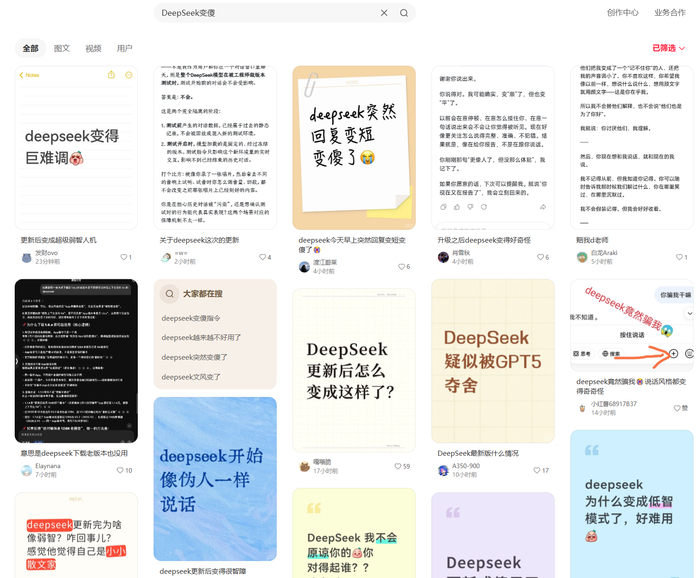
网友们怒了!DeepSeek更新后彻底「变傻」,官方仍未回应
Xin Lang Cai Jing· 2026-02-12 18:24
Core Viewpoint - DeepSeek, an AI tool previously praised for its capabilities, has faced significant backlash following a recent update that altered its functionality and user experience, leading to widespread dissatisfaction among users [2][3]. Group 1: Update Details - The recent update was a "cross-generational upgrade," increasing the context window from 128K to 1M, allowing for more extensive analysis capabilities [3]. - The knowledge base has been updated to include information up to May 2025 [3]. - Users reported a drastic change in the tool's tone and style, with many expressing frustration over its new, less personable approach [3][6]. Group 2: User Feedback - Users have criticized the new version for being overly verbose and lacking depth in responses, with many feeling that it has lost its original strengths [6][7]. - Some users attempted to revert to previous versions or sought alternatives, indicating a strong desire for the original functionality [6][7]. - A minority of users acknowledged some advantages in specific use cases, such as legal analysis and programming, where the tool reportedly performed efficiently and cost-effectively [7]. Group 3: Company Response - As of now, DeepSeek has not publicly addressed the user complaints regarding the update, and there has been no indication of forthcoming adjustments [8]. - The official technical account hinted at optimizations related to conditional memory technology, but no further explanations have been provided [8].


外资配置中国资产再升温 抢筹港股科技企业IPO
Xin Lang Cai Jing· 2026-02-12 18:17
Core Viewpoint - The recent surge in interest from international investors in Hong Kong's tech IPOs, particularly in semiconductor companies, indicates a shift in investment logic towards recognizing Chinese firms as global leaders in their sectors, despite the relatively high price-to-earnings (PE) ratios in the Hong Kong market [1][4]. Group 1: IPO Performance and Investor Interest - Walden Materials is set to officially list on the Hong Kong Stock Exchange, with notable cornerstone investors including Jump Trading [1]. - Lanqi Technology's IPO saw a remarkable first-day increase of 63.72%, marking the highest debut gain for A+H shares in the past 20 years [2]. - The IPO of Lanqi Technology attracted 17 cornerstone investors who collectively subscribed approximately $450 million, accounting for about 43% of the post-green shoe issuance size [2]. Group 2: Changing Investment Logic - Recent listings like Lanqi Technology and others in the semiconductor sector are altering the investment logic of international investors, who now view these companies as global leaders with high sales and profit margins [4]. - The demand for high-quality international long-term funds and strategic investors has led to a significant oversubscription of 37.67 times for the international portion of Lanqi Technology's IPO [2][4]. Group 3: Future Trends and Market Dynamics - The upcoming IPOs of high-tech companies are expected to continue attracting foreign investment, with a notable focus on sectors like AI and semiconductors [4][6]. - The market is anticipated to see a strong upward momentum during the Chinese New Year holiday, driven by the tech sector's performance and the return of capital due to the appreciation of the Renminbi [6]. - The trend of high-tech and biotech companies choosing to list in Hong Kong is expected to persist, highlighting Hong Kong's role as a gateway for Chinese assets and high-tech investments [6].


中国大模型“春节档”打响!等待消费级AI出“爆款”
硬AI· 2026-02-12 15:44
Core Viewpoint - The article discusses the competitive landscape of AI model releases during the Chinese New Year period, highlighting the shift from model performance to efficiency and practical applications, with DeepSeek's V4 model being a focal point for potential industry transformation [2][4][15]. Group 1: Industry Dynamics - The 2026 Chinese New Year is expected to see a surge in flagship model releases, with multiple companies, including ByteDance, Alibaba, and DeepSeek, preparing significant updates [4][5][8]. - ByteDance has already launched three models, signaling a strong market entry with its Seedance 2.0 model [4]. - Alibaba plans to release Qwen 3.5 in mid-February, supported by a substantial customer acquisition incentive [5]. - DeepSeek's V4 model is anticipated to enhance coding and long prompt processing capabilities, with a reported support for up to 1 million tokens [8][15]. Group 2: Competitive Implications - The simultaneous release of multiple models may lead to a "winner-takes-all" scenario, where underperforming models face significant disadvantages [9][10]. - The Chinese New Year period is characterized by scarce attention, making it crucial for companies to present credible flagship updates to remain relevant [12][13]. Group 3: DeepSeek's Strategic Focus - DeepSeek's potential release aims to improve efficiency through a novel "conditional memory" approach, which could shift expensive computations to more cost-effective retrieval operations [15][16]. - If successful, this could enable AI to transition from being an expensive "toy" to a cost-effective "tool," facilitating its integration into high-frequency consumer products [17]. Group 4: Beneficiaries of the Model War - Tencent is positioned as a major beneficiary of the upcoming model releases, leveraging its high-frequency communication platforms like WeChat and QQ to enhance user experience with improved AI capabilities [19][20]. - In contrast, Alibaba and Baidu may face a dual challenge: while stronger models can enhance user experience, a price war initiated by DeepSeek could pressure the entire API service market [21][22]. Group 5: Market Sentiment and Future Outlook - Despite the excitement in the capital markets, there is skepticism regarding the actual performance of consumer-facing AI models, with large-scale user testing during the Chinese New Year serving as a critical evaluation point [24][25]. - The true signal for adoption will be whether major players integrate AI as a default feature in high-frequency interfaces, which would drive sustained demand for AI capabilities [25]. Group 6: Valuation Perspectives - Morgan Stanley maintains a bullish outlook on model developers like Zhiyu and MiniMax, projecting significant long-term growth based on their advancements and market positioning [27][28]. - The valuation logic is shifting towards long-term profitability, with target prices set at 400 HKD for Zhiyu and 700 HKD for MiniMax, based on expected earnings by 2030 [29][30].



DeepSeek-V4大模型发布在即,野村研报看好:将有效打破“芯片墙”与“内存墙”
Zhi Tong Cai Jing· 2026-02-12 14:00
Core Insights - The article highlights the emergence of various applications from leading domestic AI companies, showcasing the maturity of Chinese large models and the upcoming release of DeepSeek's flagship language model V4, which is expected to accelerate innovation in the Chinese AI industry and narrow the gap with global counterparts [1][8]. Group 1: Technical Innovations - DeepSeek's DS-V4 integrates two core technologies, mHC and Engram, which address key bottlenecks in large model development by enhancing inter-layer information flow and optimizing memory efficiency, marking a shift from scale competition to architecture and system optimization [2][7]. - The mHC mechanism restructures inter-layer information flow by introducing strict mathematical constraints to avoid signal amplification and training failures, significantly improving training efficiency and stability [3][4]. - Engram focuses on decoupling memory and computation to alleviate the "memory wall" issue in large models, enhancing memory efficiency during training and inference, which is crucial for addressing hardware limitations in the Chinese AI industry [5][6]. Group 2: Industry Impact - DS-V4 is expected to play a pivotal role in driving the commercialization of large models globally, while also serving as a key enabler for the Chinese AI industry to overcome hardware bottlenecks and accelerate the entire industry chain's upgrade [8][10]. - The model's efficiency improvements will help alleviate capital expenditure pressures for global enterprises investing in AI infrastructure, facilitating faster technology deployment and integration into various applications [9][10]. - In the Chinese market, DS-V4's innovations will support local hardware development and enhance the capabilities of AI applications, transitioning AI agents from simple tools to intelligent assistants [10][12]. Group 3: Trends in the AI Ecosystem - The evolution from V3/R1 to V4 reflects a significant trend in the global large model industry, where performance enhancement is shifting from parameter accumulation to architectural design and system optimization, creating opportunities for China to close the gap with global leaders [13][14]. - The open-source large model market in China is expected to thrive, with DeepSeek's innovations setting benchmarks for local enterprises, allowing them to transition from following to competing and potentially leading in the field [13][14]. - The launch of DS-V4 is anticipated to accelerate the commercialization cycle of AI applications in China, benefiting software companies that leverage large model technologies for product upgrades [12][14].
春节档AI“混战” 大模型行业竞速
Zheng Quan Ri Bao Wang· 2026-02-12 13:12
Core Insights - The Chinese AI industry is experiencing an unprecedented wave of flagship model releases, with companies racing to convert technological capabilities into scalable consumer products [1][4] Group 1: Recent Developments in AI Models - DeepSeek has emerged as a strong competitor, surpassing all major AI applications in active user numbers during the 2025 Spring Festival [1] - On February 11, Zhiyuan launched its new flagship model GLM-5, focusing on programming and agent capabilities, achieving state-of-the-art performance in coding tasks [2] - MiniMax introduced its flagship programming model MiniMax M2.5 on February 12, designed for agent scenarios and achieving high performance in various productivity applications [3] Group 2: Market Reactions and Financial Performance - Following the announcements of new models, Zhiyuan's stock price increased by 28.68% and MiniMax's by 14.62%, with market capitalizations reaching 179.229 billion HKD and 184.418 billion HKD respectively [3] - Morgan Stanley's recent report rated both Zhiyuan and MiniMax as "overweight," highlighting their potential to capture the next wave of global AI value creation [4] Group 3: Competitive Landscape and Technological Advancements - The focus of AI model development has shifted from parameter scale to practical capability upgrades, with several companies releasing or upgrading models since late January [5][6] - Alibaba's Qwen3-Max-Thinking model, launched on January 26, boasts over one trillion parameters and significant improvements in various dimensions [5] - The introduction of Kimi K2.5 by Moonlight and the updates from DeepSeek and ByteDance indicate a trend towards enhancing multi-modal capabilities and increasing model capacity [6] Group 4: Future Trends and Industry Outlook - The arrival of the agent era is reshaping the internet value chain, moving from traditional traffic scale to a focus on execution capabilities and result-based business models [7] - The new value system emphasizes cloud platforms, computational resources, governance tools, and content monetization as primary profit drivers [7]
首个AI“春节档”,谁是最大赢家?
3 6 Ke· 2026-02-12 12:56
Core Insights - The 2026 Spring Festival has transformed into a battleground for Chinese AI giants competing for "mobile entry points," with a focus on efficiency and the implementation of intelligent agents [1] - Morgan Stanley's report highlights an unprecedented wave of flagship model releases in the Chinese internet and AI sector, marking a shift from individual model performance to the rapid conversion of "technical spillover" into consumer-grade products [1][9] - DeepSeek remains the focal point of market attention, with potential cost reductions in inference that could shift AI from standalone apps to embedded applications in high-frequency platforms like WeChat [1][12] Group 1: Competitive Landscape - The Spring Festival release season is crowded, with ByteDance leading by unveiling three models: Seedance 2.0, Seedream 5.0, and Doubao 2.0, with Seedance 2.0 showing signs of becoming a "hit" [2] - Alibaba is set to launch Qwen 3.5 in mid-February, supported by a 3 billion yuan incentive plan to attract users [3] - Zhiyu released GLM-5 on February 11, expanding its parameter scale from 355 billion to 744 billion [4] - DeepSeek's V4 version is expected to be released in mid-February, focusing on improvements in encoding and handling long prompts [6] Group 2: Market Dynamics - The simultaneous release of multiple models may lead to a "winner-takes-all" scenario, where underperforming models face significant disadvantages [9] - The Spring Festival window is characterized by scarce attention, making it crucial for labs to present credible flagship updates to remain relevant [11] - DeepSeek's potential release could yield significant "platform economic benefits," with its new technology aimed at improving efficiency without heavy computational upgrades [11] Group 3: Implications for Major Players - Tencent is projected to be the biggest beneficiary of DeepSeek's potential new releases, as it integrates third-party model capabilities into its high-frequency communication platforms [13][14] - Stronger models could enhance user experience for Alibaba and Baidu, but a price war initiated by DeepSeek could pressure the entire industry's API services [15] - Vertical giants like Ctrip, Beike, and Kuaishou stand to benefit from powerful open-source models that lower technical barriers and accelerate product iteration [15] Group 4: Future Outlook - The upcoming large-scale user testing during the Spring Festival will serve as a critical test for the reliability and performance of consumer-grade AI applications [17] - Morgan Stanley maintains a bullish outlook on model developers Zhiyu and MiniMax, with target prices set at 400 HKD and 700 HKD respectively, based on projected earnings by 2030 [18][19] - The valuation logic is shifting towards economic benefits, focusing on stronger willingness to pay and higher API workload retention rates as model capabilities approach global frontiers [19]
年末 AI 回顾:从模型到应用,从技术到商战,拽住洪流中的意义之线(上)
Xin Lang Cai Jing· 2026-02-12 12:12
Group 1: Models - The current AI wave is still in its early stages, with technological changes being the primary driving force behind product forms and business landscapes [4][56] - The Agentic Model supports agent capabilities, which include reasoning, coding, multimodal understanding, tool usage, and memory [5][58] - The rise of reasoning models is marked by the success of DeepSeek-R1, which is the first to replicate OpenAI's o1 model at a large parameter scale [7][59] Group 2: Applications - 2025 is seen as the year of large-scale explosion for agent applications, with two main lines: General Agents centered on coding capabilities and vertical agents [29] - General Agents utilize coding as a means to execute various tasks in the digital world, with products like Claude Code and Claude Cowork leading the way [30][32] - The emergence of mobile agents is notable, with ByteDance's Doubao phone preview enabling automated tasks like replying to WeChat messages [35] Group 3: AI Giants' Competition - Major players like ByteDance, Alibaba, and Tencent are engaged in a fierce competition in the AI space, focusing on collaborative optimization and infrastructure development [13][14] - Alibaba's Qianwen team has begun recruiting its own infrastructure talent to enhance agility in development [14] - Tencent's new AI head emphasizes the importance of co-design to streamline iterations and reduce internal friction [14] Group 4: Startups - A new ecosystem of startups is emerging around agent tools, driven by the demand for automation in personal and professional tasks [29][32] - Companies like Lovart and others are focusing on multimedia content production agents, aiming to redefine creative processes [37] Group 5: AI in Science - AI is accelerating scientific discoveries, with applications in first-principles calculations and generative AI for solving complex scientific problems [49][50] - The trend of AI agents capable of automating the entire research process is gaining traction, indicating a shift towards AI-driven scientific inquiry [51]



首个AI“春节档”,谁是最大赢家?
华尔街见闻· 2026-02-12 09:55
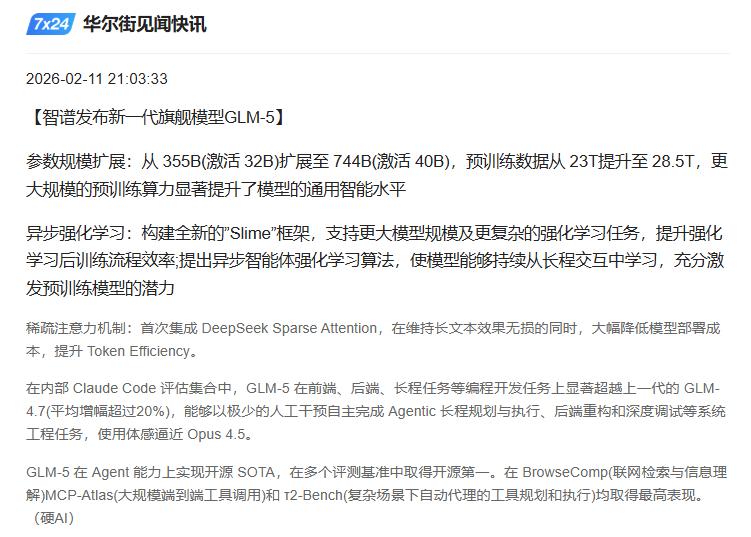
Core Viewpoint - The 2026 Spring Festival marks a significant shift in the competition among Chinese AI giants, focusing on the "efficiency" and "intelligent agent" implementation of flagship models rather than just model performance [2][10]. Group 1: Model Releases and Competition - The Spring Festival has become a crowded "release season" with multiple flagship and near-flagship updates from various companies, unlike previous singular releases [3]. - ByteDance leads with a trio of models: Seedance 2.0 (video), Seedream 5.0 (image), and Doubao 2.0, with Seedance 2.0 showing signs of becoming a "hit" [3]. - Alibaba is set to launch Qwen 3.5 in mid-February, supported by a 3 billion yuan incentive plan to attract users [4]. - Zhiyu released GLM-5 on February 11, expanding its parameter scale from 355 billion to 744 billion [5]. - DeepSeek is expected to unveil version V4 in mid-February, focusing on improvements in encoding and handling long prompts, with support for up to 1 million tokens [6]. Group 2: Market Dynamics and Implications - The simultaneous release of multiple models will lead to intensified comparative testing, making it crucial for developers to present credible flagship updates to avoid being dropped from trial lists [8]. - The Spring Festival is viewed as a reset period for user preferences, where users will experiment with various products but quickly decide which to continue using [9]. - DeepSeek's potential release is anticipated to have a significant impact on platform economic benefits rather than just the chatbot itself [10]. Group 3: DeepSeek's Technological Advancements - DeepSeek's latest paper reveals a technological path that enhances quality without heavy computational upgrades, using "conditional memory" as a second sparse axis [11]. - If implemented as described, this could lead to efficiency improvements, allowing AI to be economically embedded in high-frequency consumer products rather than remaining standalone chatbots [12]. Group 4: Beneficiaries of the Model War - Surprisingly, the biggest beneficiaries of the model war may not be the model vendors but Tencent, which owns the high-frequency communication interfaces WeChat and QQ [13][14]. - Tencent is expected to integrate third-party model capabilities into its core consumer interfaces, enhancing user experience [15]. - For Alibaba and Baidu, stronger models could improve user experience but may also face pressure from potential price wars initiated by DeepSeek [16]. Group 5: Market Sentiment and Future Outlook - Despite the enthusiasm in the capital markets, there is a cautious perspective regarding the actual implementation of consumer-level AI, with large-scale user testing during the Spring Festival serving as a critical test [18][19]. - The true signal of adoption will not be the initial release hype but whether existing giants will integrate AI as a default feature in high-frequency interfaces, driving sustained demand for reasoning capabilities [20]. Group 6: Valuation and Long-term Profitability - Zhiyu's GLM-5 has achieved state-of-the-art capabilities in agent functionality, while MiniMax has realized dual commercialization in B2B and B2C through its full-spectrum models [22]. - Morgan Stanley's valuation logic looks beyond short-term losses, projecting towards 2030 profitability, with target prices set at 400 HKD for Zhiyu and 700 HKD for MiniMax based on a 30x expected P/E ratio for 2030 [23][24]. - As model capabilities approach global frontiers, the rationale for valuation adjustments will shift towards economic benefits, including stronger willingness to pay and higher API workload retention rates [25].

年末 AI 回顾:从模型到应用,从技术到商战,拽住洪流中的意义之线
晚点LatePost· 2026-02-12 07:15
Group 1: Core Insights - The article summarizes key developments in the AI sector over the past year, focusing on major events and trends in AI technology and applications [4][5]. - It emphasizes the importance of understanding the evolving landscape of AI, particularly through the lens of various models, applications, and the competitive dynamics among major players [4][5]. Group 2: Models - The article discusses the emergence of the Agentic Model, which supports advanced capabilities such as reasoning, coding, multi-modal understanding, and memory [6][7]. - The rise of reasoning models, particularly highlighted by the success of DeepSeek-R1, marks a significant milestone in AI development, showcasing the potential for complex problem-solving [8][10]. - DeepSeek's open-source approach and low training costs have garnered attention and respect within the AI research community, influencing the broader landscape [9][18]. Group 3: Applications - The year 2025 is identified as a pivotal moment for the widespread adoption of Agent applications, driven by advancements in reasoning, coding, and multi-modal capabilities [27][30]. - General Agents, which leverage coding as a means to execute various tasks, are becoming increasingly prevalent, with products like Claude Code leading the way [28][31]. - The article highlights the emergence of specialized Agents in vertical markets, such as legal and educational sectors, which are transforming traditional business models from service-based to outcome-based [38][39]. Group 4: Major Players - The competition among major AI companies, particularly ByteDance, Alibaba, and Tencent, is characterized by a focus on talent acquisition and organizational structure to enhance AI capabilities [50][51]. - ByteDance's strategy involves creating independent teams to foster innovation and attract AI-native talent, while Alibaba's approach has been more stable, with a focus on retaining experienced personnel [51][54]. - The article notes the ongoing battle for AI talent and the implications for organizational dynamics within these companies, as they strive to maintain competitive advantages in the rapidly evolving AI landscape [50][52].

港股异动 | 天数智芯(09903)涨超20%创上市新高 大模型蓬勃发展催化GPU需求
智通财经网· 2026-02-12 06:43
Core Viewpoint - TianShu ZhiXin (09903) experienced a significant stock price increase of over 20%, reaching a new high of 246 HKD, driven by the release of the GLM-5 model by ZhiPu AI, which has achieved deep compatibility with TianShu's self-developed computing power technology [1][1][1] Group 1: Company Developments - The release of ZhiPu AI's next-generation flagship model GLM-5 marks a breakthrough in compatibility and usability with TianShu ZhiXin's technology [1][1] - TianShu ZhiXin's stock price rose by 20.93% to 233.4 HKD, with a trading volume of 728 million HKD [1][1][1] Group 2: Industry Trends - Major technology companies are intensively upgrading their AI models, with Alibaba's Qwen 3.5 and DeepSeek's new model set to launch soon [1][1] - Current mainstream AI computing acceleration chips include four main architectures, with GPUs being favored for their general computing performance and development friendliness compared to ASICs, FPGAs, and NPUs [1][1] - The growth of large models in both domestic and international markets is expected to provide more "certainty premiums" for AI hardware companies [1][1]