博时基金

Search documents
股票ETF资金净流入近70亿元,证券类ETF大举“吸金”
Zhong Guo Ji Jin Bao· 2025-08-22 06:21
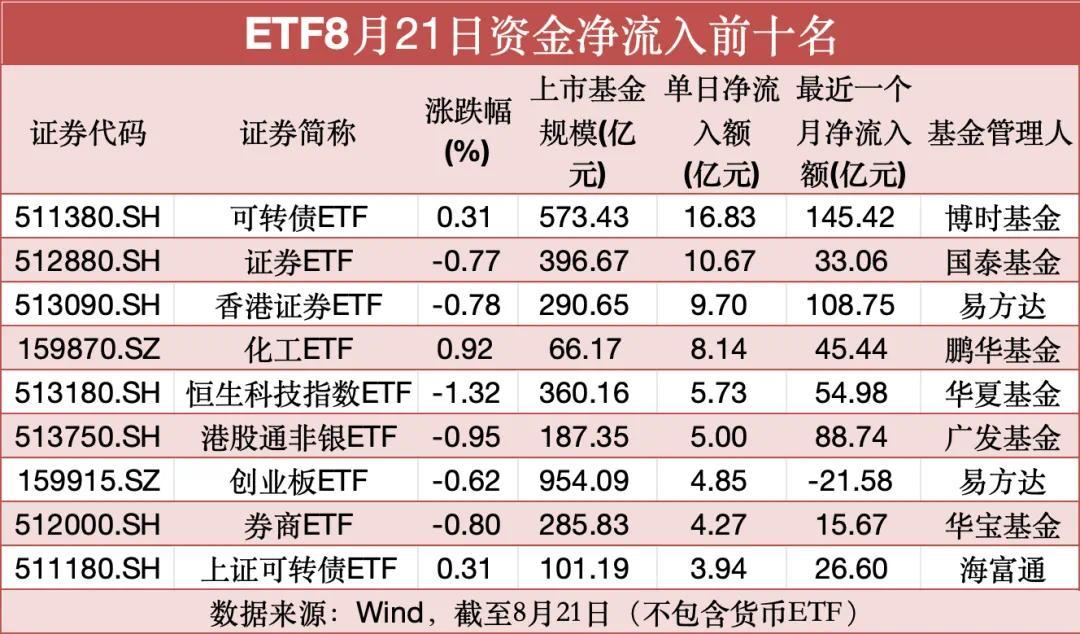
Market Overview - On August 21, the A-share market experienced significant fluctuations, with major indices showing mixed results. The Shanghai Composite Index slightly increased by 0.13% to close at 3771.10 points, marking a nearly ten-year high, while the ChiNext Index fell by 0.47% to 2595.47 points [2][3] - The total trading volume in the Shanghai and Shenzhen markets reached 2.42 trillion yuan, a slight increase compared to the previous trading day [2] ETF Fund Flows - On August 21, the total net inflow into stock ETFs (including cross-border ETFs) was approximately 69.85 billion yuan. The industry-themed ETFs and Hong Kong market ETFs saw the highest net inflows, amounting to 48.73 billion yuan and 48.51 billion yuan, respectively [2][3] - Conversely, broad-based ETFs experienced a net outflow of 29.26 billion yuan. The net inflow for industry-themed ETFs increased by 38.86 billion yuan [2] Specific ETF Performance - Several ETFs tracking the brokerage sector attracted significant capital, with the Guotai Securities ETF seeing a net inflow exceeding 10 billion yuan, and the E Fund Hong Kong Securities ETF close to 10 billion yuan [4] - The top ten ETFs by net inflow on August 21 included the Convertible Bond ETF with a net inflow of 16.83 billion yuan, and the Securities ETF with a net inflow of 10.67 billion yuan [5] Sector Insights - The brokerage sector is viewed as a "market thermometer," with expectations for continued performance despite a lag in index growth compared to projected net profit growth. The overall sentiment suggests a "slow bull" market for brokerages [6] - The chemical sector is experiencing a downturn in demand, leading to reduced profit margins and a decline in capital expenditure. However, the narrative of "anti-involution" may lead to a stabilization in prices [7] Outflows and Investor Behavior - Recent profit-taking was observed in certain sectors, particularly in the Sci-Tech 50 ETF and Chip ETF, as investors opted to secure gains following recent price increases [8]

彻底火了!资金跑步进场!
Zhong Guo Ji Jin Bao· 2025-08-22 06:14
Group 1 - On August 21, the A-share market experienced significant fluctuations, with a net inflow of nearly 7 billion yuan into stock ETFs, including cross-border ETFs [1][3] - The main inflows were observed in industry-themed ETFs and Hong Kong market ETFs, with net inflows of 4.873 billion yuan and 4.851 billion yuan respectively [3] - The total trading volume in the Shanghai and Shenzhen markets reached 2.42 trillion yuan, showing a slight increase compared to the previous trading day [2] Group 2 - Several securities-related ETFs saw substantial inflows, with the Guotai Securities ETF receiving over 1 billion yuan and the E Fund Hong Kong Securities ETF close to 1 billion yuan [5] - The Huaxia Fund's Hang Seng Technology Index ETF and Hang Seng Internet ETF led the inflows among its ETFs, with net inflows of 573 million yuan and 383 million yuan respectively [4] - The Penghua Chemical ETF also saw a net inflow exceeding 800 million yuan, indicating strong interest in the chemical sector amid changing market dynamics [6] Group 3 - The bond ETF segment also showed notable activity, with the BOCOM Convertible Bond ETF and Hai Fu Tong Shanghai Composite Convertible Bond ETF making it to the top inflow list [6] - Despite the inflows, some fund managers expressed caution regarding the convertible bond market, citing high valuation levels and a low probability of positive returns in the near term [6] - Recent trends indicate that investors are taking profits from certain ETFs, such as the Sci-Tech 50 ETF and Chip ETF, following significant price increases [6]
两市ETF两融余额减少54.11亿元丨ETF融资融券日报
Sou Hu Cai Jing· 2025-08-22 03:31
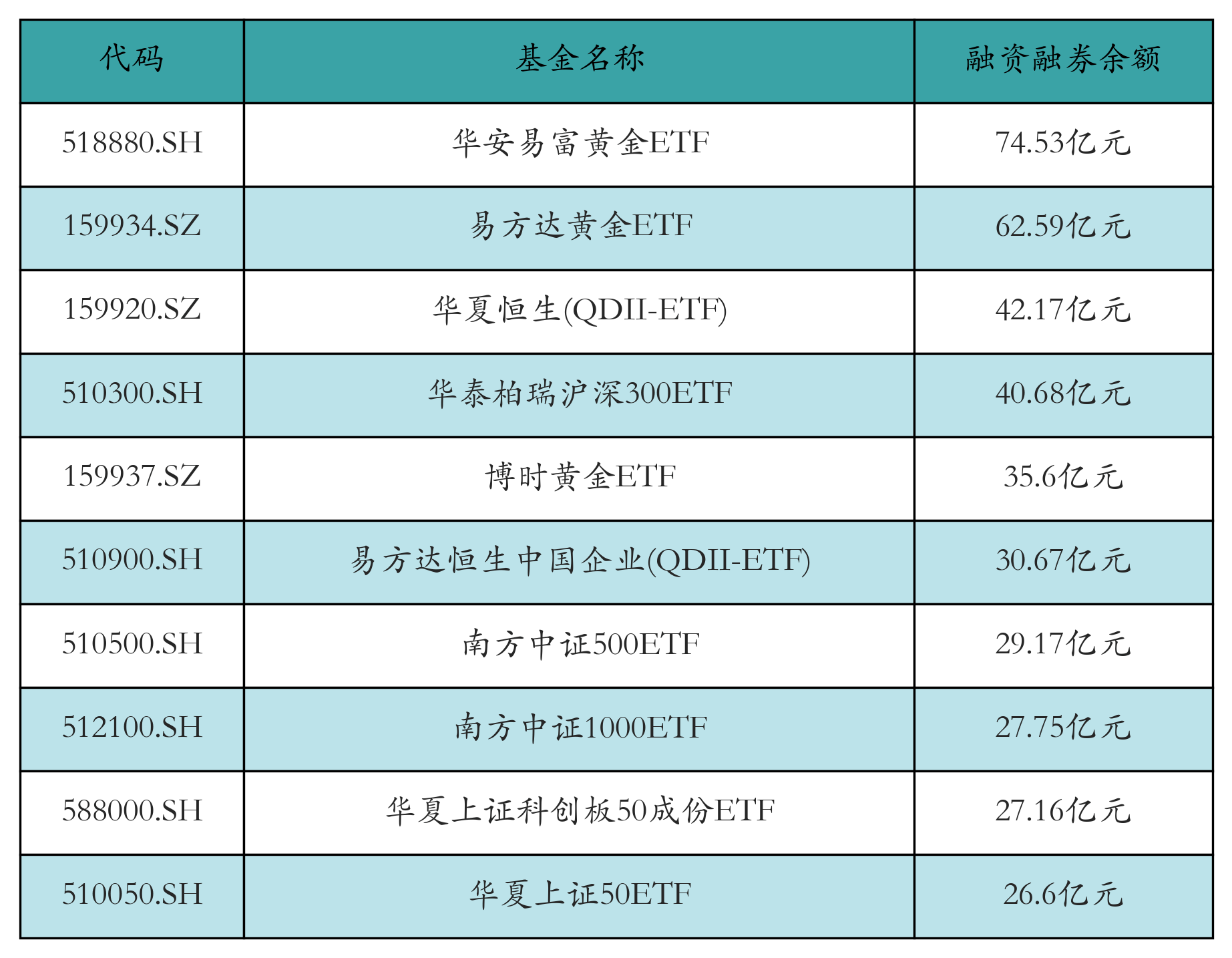
Market Overview - On August 21, the total ETF margin balance in the two markets was 101.73 billion yuan, a decrease of 5.41 billion yuan from the previous trading day [1] - The financing balance was 94.886 billion yuan, down by 5.59 billion yuan, while the securities lending balance increased by 0.175 billion yuan to 6.844 billion yuan [1] - In the Shanghai market, the ETF margin balance was 69.301 billion yuan, a decrease of 4.914 billion yuan, with a financing balance of 63.268 billion yuan, down by 5.097 billion yuan [1] - In the Shenzhen market, the ETF margin balance was 32.429 billion yuan, a decrease of 0.497 billion yuan, with a financing balance of 31.618 billion yuan, down by 0.49 billion yuan [1] ETF Margin Financing and Securities Lending - The top three ETFs by margin balance on August 21 were: - Huaan Yifu Gold ETF (7.453 billion yuan) - E Fund Gold ETF (6.259 billion yuan) - Huaxia Hang Seng (QDII-ETF) (4.217 billion yuan) [2] - The top three ETFs by financing buy-in amount were: - E Fund CSI Hong Kong Securities Investment Theme ETF (1.739 billion yuan) - Haifutong CSI Short-term Bond ETF (1.242 billion yuan) - Bosera CSI Convertible Bonds and Exchangeable Bonds ETF (816 million yuan) [4] - The top three ETFs by net financing buy-in amount were: - Fuguo CSI Hong Kong Stock Connect Internet ETF (659.563 million yuan) - Huaxia Hang Seng Technology (QDII-ETF) (545.983 million yuan) - Southern CSI 1000 ETF (535.109 million yuan) [5] ETF Securities Lending - The top three ETFs by securities lending sell-out amount on August 21 were: - Southern CSI 1000 ETF (139 million yuan) - Southern CSI 500 ETF (80.7238 million yuan) - Huatai-PB CSI 300 ETF (25.8876 million yuan) [6]
逐浪新经济,把握创业板综投资机遇——博时基金携手深交所举办ETF大讲堂
Sou Hu Cai Jing· 2025-08-22 03:25
Core Insights - The Shanghai Composite Index has reached a nearly ten-year high, with the ChiNext Index also showing strength, drawing investor attention to future market trends [1] - Key revisions to the ChiNext Composite Index include the exclusion of stocks under risk warning (ST or *ST) and those rated C or below by the National ESG rating, reducing the sample size from 1383 to 1316 stocks, covering 95% of ChiNext companies and 98% of total market capitalization [1] Group 1: ChiNext Index and Investment Value - The ChiNext serves as a crucial platform for high-tech and strategic emerging industries, making it an important area for investors focusing on technology growth [4] - The index's core weight is concentrated in key sectors such as power equipment, healthcare, and electronics, emphasizing its focus on high-tech enterprises and strategic emerging industries [4] - The ChiNext Composite Index reflects strong growth characteristics and technological attributes, with a significant portion of its constituents in high-tech sectors, accounting for 80% [8] Group 2: ETF Market Development - The Shenzhen Stock Exchange has seen rapid development in its ETF market, establishing a complete product line including stock ETFs, cross-border ETFs, and bond ETFs, which serve as important tools for investors [5] - The exchange will continue to promote the development of the ETF market through educational activities, fostering a healthy investment ecosystem [6] Group 3: Investment Strategies and Insights - Insights shared by analysts indicate that the A-share market follows a five-year cycle, with distinct phases of bull markets characterized by different driving factors [7] - The ChiNext Composite Index is highlighted for its high elasticity and growth potential, with investment themes focusing on carbon reduction, energy revolution, and advancements in AI, big data, and 5G technology [8] - The launch of the ChiNext Composite ETF by Bosera Fund aims to provide investors with diversified tools to capitalize on investment opportunities in the ChiNext market [9] Group 4: Future Outlook and Product Innovation - Bosera Fund has developed a wide range of ETF products, aiming to meet diverse investor needs and capitalize on opportunities in the index investment era [10] - The fund's strategy includes collaboration with exchanges and other institutions to enhance index innovation and investor education, promoting high-quality development in index investment [10]


两市ETF融资余额减少55.87亿元
Sou Hu Cai Jing· 2025-08-22 01:46
Core Insights - The total margin balance for ETFs in the two markets is 101.73 billion yuan, a decrease of 5.05% from the previous trading day, with a reduction of 5.56% in ETF financing balance [1][2] Group 1: ETF Margin Balance Overview - As of August 21, the total ETF margin balance is 101.73 billion yuan, down by 5.05% or 5.41 billion yuan from the previous day [1] - The financing balance for ETFs is 94.89 billion yuan, which is a decrease of 5.56% or 5.59 billion yuan from the previous day [1] - The margin balance for Shenzhen market ETFs is 32.43 billion yuan, down by 4.97 million yuan, while the financing balance is 31.62 billion yuan, a decrease of 4.90 million yuan [1] - The margin balance for Shanghai market ETFs is 69.30 billion yuan, down by 49.14 million yuan, with a financing balance of 63.27 billion yuan, a decrease of 50.97 million yuan [1] Group 2: Notable ETF Financing Balances - The ETF with the highest financing balance is Huaan Gold ETF at 7.45 billion yuan, followed by E Fund Gold ETF and Huaxia Hang Seng ETF with financing balances of 6.26 billion yuan and 4.22 billion yuan respectively [2] - The ETFs with the largest increases in financing balance include Penghua CSI 300 ETF, with an increase of 392.97%, and China Merchants STAR Market Comprehensive ETF, with an increase of 190.70% [2] - The ETFs with the largest decreases in financing balance include CSI 300 ETF Yongying, with a decrease of 98.34%, and Hai Fudong Shanghai 10-Year Local Government Bond ETF, with a decrease of 96.01% [2] Group 3: Financing Net Inflows and Outflows - The ETFs with the highest net inflows include the Fortune CSI Hong Kong Stock Connect Internet ETF with 65.96 million yuan, and Huaxia Hang Seng Technology ETF with 54.60 million yuan [3][5] - The ETFs with the highest net outflows include Fortune China Bond 7-10 Year Policy Financial Bond ETF with 2.67 billion yuan, and Hai Fudong CSI Short-Term Bond ETF with 778.21 million yuan [3][5] Group 4: Short Selling Overview - The ETFs with the highest short selling balances include Southern CSI 1000 ETF at 2.34 billion yuan, and Southern CSI 500 ETF at 1.98 billion yuan [6] - The ETFs with the largest increases in short selling balance include Southern CSI 1000 ETF with an increase of 1.09 billion yuan, and Bosera Convertible Bond ETF with an increase of 20.79 million yuan [6] - The ETFs with the largest decreases in short selling balance include Tianhong CSI All-Index Securities Company ETF with a decrease of 4.11 million yuan, and Guangfa CSI 1000 ETF with a decrease of 3.10 million yuan [6]
逾九成红利基金年内盈利
Shen Zhen Shang Bao· 2025-08-21 23:04
Core Insights - Dividend assets in the A-share market continue to attract significant attention, with over 90% of dividend funds experiencing net value increases this year [1][2] - The current low interest rate environment enhances the cost-effectiveness of dividend strategies, making it an opportune time for investors to consider dividend investment tools that align with their needs and risk preferences [1][2] Group 1: Performance of Dividend Funds - Most ETFs with "dividend" or "high dividend" in their names have seen net value increases this year, with 13 ETFs achieving over 20% growth [1] - Notable performers include the Huaxia Hang Seng China Mainland Enterprises High Dividend Rate ETF and the Bosera Hang Seng High Dividend ETF, among others [1] - Only three dividend-themed funds reported negative returns this year, primarily due to their recent establishment [1] Group 2: Market Analysis and Strategy - Analysts highlight that dividend assets offer relatively high and stable returns, making them a focal point for investors [2] - The dividend strategy is compared to a "bond-like" attribute, with current dividend yields remaining historically high compared to 10-year government bond yields [2] - A "barbell" investment strategy combining dividends and technology is recommended, where dividends provide stable cash flow while technology investments offer potential for higher returns [2] Group 3: Competitive Landscape - The concept of dividend investment is broad, with various sub-strategies emerging, including low volatility dividends and quality dividends [2] - Competition among products is intensifying, with dividend index funds being favored for their low fees and transparency [2] - The choice of index is critical for effective dividend investment [2]
6家公募出手!热门指基迎新布局
券商中国· 2025-08-21 15:41
Core Viewpoint - The article discusses the recent launch of new index funds tracking the CSI A500 Dividend Low Volatility Index, highlighting the growing interest and competition among fund companies in this segment [2][3]. Group 1: New Index Fund Launches - As of August 21, several public funds, including Huabao Fund and Ping An Fund, have initiated the issuance of the CSI A500 Dividend Low Volatility ETF, which tracks a newly introduced index in Q2 of this year [2][3]. - The CSI A500 Dividend Low Volatility Index incorporates four optimization indicators, making it a differentiated product in the broad dividend space compared to traditional dividend indices [3][4]. Group 2: Fund Company Participation - A total of 76 fund companies have engaged in the CSI A500 index fund market since September of last year, with 128 different CSI A500 index fund products established as of August 21, totaling nearly 280 billion yuan [5][6]. - The largest CSI A500 ETF is the Huatai-PB CSI A500 ETF, with a scale of 20.39 billion yuan, while six other ETFs exceed 10 billion yuan in scale [6]. Group 3: Challenges in Fund Growth - Despite the increasing number of funds, newly established funds generally have smaller scales, with many not exceeding 1 billion yuan, indicating a challenge for fund companies in marketing and scaling their products [9]. - The phenomenon of funds not growing significantly post-establishment poses a marketing challenge, particularly for smaller fund companies, as they compete with larger firms that have more resources [9][10].

宏信证券ETF日报-20250821
Hongxin Security· 2025-08-21 09:33
Report Summary Market Overview - The Shanghai Composite Index rose 0.13% to 3771.10 points, the Shenzhen Component Index fell 0.06% to 11919.76 points, and the ChiNext Index fell 0.47% to 2595.47 points. The total trading volume of A-shares in the two markets was 2.4609 trillion yuan. The top-performing sectors were agriculture, forestry, animal husbandry and fishery (1.50%), petroleum and petrochemicals (1.39%), and beauty care (0.98%), while the worst-performing sectors were machinery and equipment (-1.08%), power equipment (-0.98%), and comprehensive (-0.73%) [2][6]. Stock ETFs - The top trading volume stock ETFs were Huaxia CSI A500 ETF (down 0.09% with a discount rate of 0.18%), Huaxia Shanghai Science and Technology Innovation Board 50 ETF (unchanged with a discount rate of 0.07%), and Huatai-PineBridge CSI A500 ETF (up 0.18% with a discount rate of 0.32%) [3][7]. Bond ETFs - The top trading volume bond ETFs were Haifutong CSI Short-term Financing Bond ETF (up 0.02% with a discount rate of 0.00%), Bosera CSI Convertible and Exchangeable Bond ETF (up 0.31% with a discount rate of 0.52%), and Penghua ChinaBond 30-year Treasury Bond ETF (up 0.47% with a discount rate of 0.44%) [4][9]. Gold ETFs - Gold AU9999 rose 0.23% and Shanghai Gold rose 0.30%. The top trading volume gold ETFs were Huaan Gold ETF (up 0.27% with a discount rate of 0.23%), Huaxia Gold ETF (up 0.31% with a discount rate of 0.22%), and E Fund Gold ETF (up 0.27% with a discount rate of 0.21%) [12]. Commodity Futures ETFs - Huaxia Feed Soybean Meal Futures ETF fell 1.43% with a discount rate of -1.10%, Jianxin Yisheng Zhengzhou Commodity Exchange Energy and Chemical Futures ETF rose 0.83% with a discount rate of 1.28%, and Dacheng Non-ferrous Metals Futures ETF fell 0.12% with a discount rate of -0.09% [15]. Cross-border ETFs - The previous trading day, the Dow Jones Industrial Average rose 0.04%, the Nasdaq Composite fell 0.67%, the S&P 500 fell 0.24%, and the German DAX fell 0.60%. Today, the Hang Seng Index fell 0.24% and the Hang Seng China Enterprises Index fell 0.43%. The top trading volume cross-border ETFs were E Fund CSI Hong Kong Securities Investment Theme ETF (down 0.78% with a discount rate of 0.28%), GF CSI Hong Kong Innovative Drugs ETF (up 0.95% with a discount rate of 2.13%), and Huaxia Hang Seng Tech ETF (down 1.32% with a discount rate of -0.44%) [17]. Money Market ETFs - The top trading volume money market ETFs were Huabao Tianyi ETF, Yin Hua Rili ETF, and Jianxin Tianyi Money Market ETF [19].
超1100只主动权益基金净值创新高,冲高后公募在买啥?
2 1 Shi Ji Jing Ji Bao Dao· 2025-08-21 08:22
Core Viewpoint - The recent surge in A-share market has led to a significant rebound in fund net values, with over 98% of active equity funds achieving positive returns this year, averaging a return rate of 20.14% [3][7][8] Fund Performance - Over 1,100 active equity funds reached historical net value highs in the last three trading days, representing about 25% of active equity funds [2][8] - The Wind data indicates that the Wande偏股混合型基金指数 has increased by 21.92% this year, outperforming the沪深300指数 by approximately 15 percentage points [8] - As of August 19, 10 active equity funds have doubled their value this year, with their net values also reaching historical highs recently [9] Market Dynamics - The A-share market has seen the Shanghai Composite Index reach a nearly ten-year high, stabilizing above 3,700 points, with financing balances exceeding 2 trillion yuan [5][6] - Fund managers are generally optimistic about the medium to long-term market trends, leading to increased positions in technology and healthcare sectors [20][21] Redemption Concerns - There is growing concern among fund managers regarding potential redemption pressures as many funds have returned to breakeven levels, historically leading to about 5% excess redemptions [11][12] - Despite the recent market enthusiasm, some fund managers have begun to take profits from high-performing sectors and shift towards sectors with lower growth [22] Investment Strategies - The current market is characterized by a structural bull market supported by high-dividend and high-growth technology assets [23] - Fund managers are advised to maintain balanced allocations to mitigate potential volatility and rapid rotations in the market [24] - Key sectors for investment include AI, semiconductor manufacturing, and traditional industries like chemicals and consumer goods, reflecting a trend towards cyclical recovery [24][25][26][27][28][29]
近40亿,“跑了”
Zhong Guo Ji Jin Bao· 2025-08-21 06:14
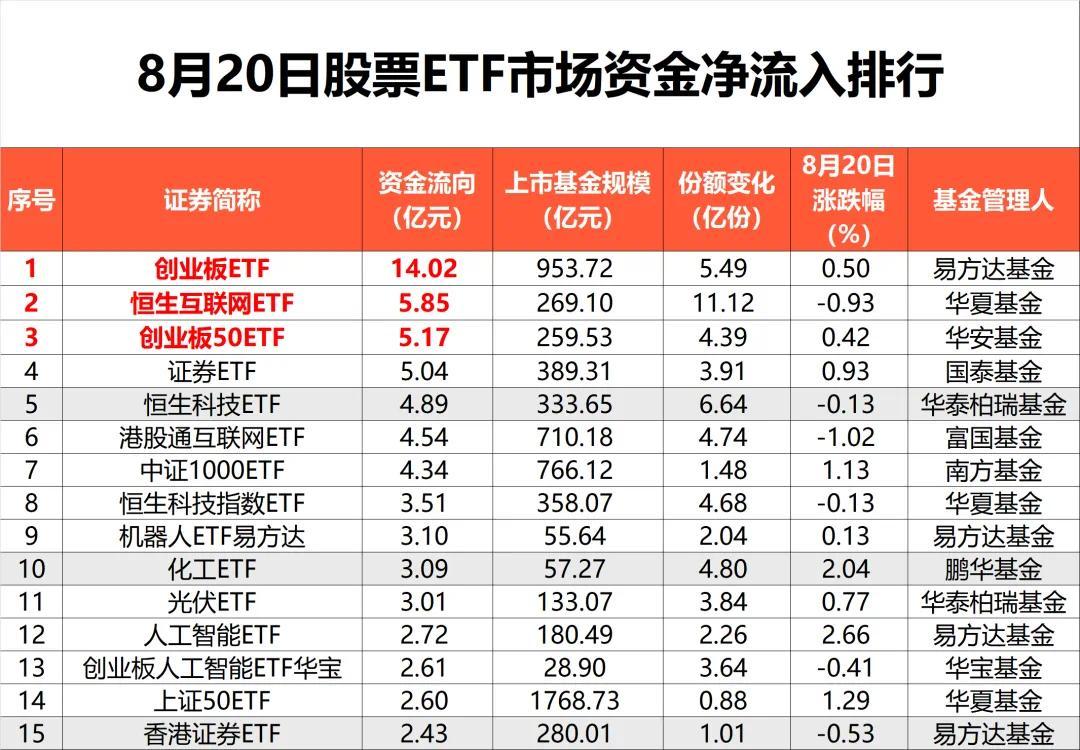
Market Overview - On August 20, the A-share market experienced fluctuations but closed strong, with consumer stocks led by liquor and semiconductor chip stocks showing significant gains [1] - The stock ETF market saw active inflows, particularly into the ChiNext Index, which had a net inflow of over 1.4 billion yuan [2] ETF Market Performance - As of August 20, the total scale of 1,177 stock ETFs (including cross-border ETFs) reached 3.99 trillion yuan, with a net outflow of 3.865 billion yuan in the recent trading session [2] - The ChiNext ETF attracted the most inflow, totaling 1.4 billion yuan, with notable contributions from E Fund's ChiNext ETF and Hua'an's ChiNext 50 ETF [2][4] Fund Inflows and Outflows - The top inflows were seen in E Fund's ChiNext ETF (1.4 billion yuan) and Hong Kong Internet ETF (585 million yuan), while the total net outflow from broad-based ETFs reached 7.376 billion yuan [5] - The CSI 300 Index faced a significant net outflow of over 4.1 billion yuan, with major products from Huatai-PB, E Fund, and others contributing to this outflow [5][6] Sector Performance - The semiconductor and consumer sectors showed resilience, with the semiconductor ETF experiencing notable outflows, while the financial technology and agricultural ETFs performed well in the market [7][8] - The Hong Kong Securities ETF led in trading volume, surpassing 12.3 billion yuan in half-day trading [7][9] Future Outlook - Institutions remain optimistic about the market, expecting a strong performance with limited adjustment potential, supported by continuous fund inflows and favorable policies [7]