
牧原股份

Search documents
养殖业板块10月15日跌0.6%,晓鸣股份领跌,主力资金净流出1.24亿元
Zheng Xing Xing Ye Ri Bao· 2025-10-15 08:27
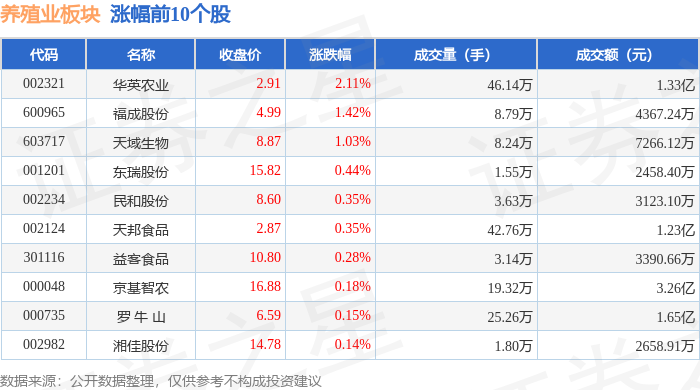
Core Insights - The aquaculture sector experienced a decline of 0.6% on October 15, with Xiaoming Co. leading the drop [1] - The Shanghai Composite Index closed at 3912.21, up 1.22%, while the Shenzhen Component Index closed at 13118.75, up 1.73% [1] Aquaculture Sector Performance - Notable gainers in the aquaculture sector included Huaying Agriculture (+2.11%), Fucheng Co. (+1.42%), and Tianyu Bio (+1.03%) [1] - Xiaoming Co. saw the largest decline at -1.75%, followed by Lihua Co. (-1.12%) and Zhengbang Technology (-1.00%) [2] Trading Volume and Capital Flow - The aquaculture sector had a net outflow of 124 million yuan from institutional investors, while retail investors saw a net outflow of 149 million yuan [2] - Conversely, speculative funds recorded a net inflow of 272 million yuan [2] Individual Stock Capital Flow - Shengnong Development had a net inflow of 13.21 million yuan from institutional investors, while it faced a net outflow of 26.16 million yuan from retail investors [3] - Tianbang Food and Fucheng Co. also saw positive net inflows from institutional investors, with 10.33 million yuan and 8.60 million yuan respectively [3]


行业轮动模型由高切低,增配顺周期板块
GOLDEN SUN SECURITIES· 2025-10-15 05:17
Quantitative Models and Construction Methods 1. Model Name: Industry Relative Strength (RSI) Model - **Model Construction Idea**: This model identifies leading industries by calculating their relative strength (RS) based on historical price performance over different time windows [10] - **Model Construction Process**: 1. Use 29 first-level industry indices as the configuration targets [10] 2. Calculate the price change rates for the past 20, 40, and 60 trading days for each industry index [10] 3. Rank the industries based on their price change rates for each time window and normalize the rankings to obtain RS_20, RS_40, and RS_60 [10] 4. Calculate the average of the three rankings to derive the final RS value: $ RS = \frac{RS_{20} + RS_{40} + RS_{60}}{3} $ [10] 5. Industries with RS > 90% by the end of April are identified as potential leading industries for the year [10] - **Model Evaluation**: The model successfully identified key annual industry trends, such as high dividend, resource products, exports, and AI, which were validated by market performance throughout the year [10][12] 2. Model Name: Industry Sentiment-Trend-Crowding Framework - **Model Construction Idea**: This framework provides two industry rotation strategies based on market conditions: 1. High sentiment + strong trend, avoiding high crowding (aggressive strategy) 2. Strong trend + low crowding, avoiding low sentiment (conservative strategy) [6][14] - **Model Construction Process**: 1. Evaluate industries based on three dimensions: sentiment, trend, and crowding [6][14] 2. Use sentiment as the core metric for the aggressive strategy, with crowding as a risk control factor [14] 3. Use trend as the core metric for the conservative strategy, avoiding low-sentiment industries [14] 4. Allocate weights to industries based on their scores in the three dimensions [6][14] - **Model Evaluation**: The framework is effective in adapting to different market conditions and has shown strong performance in historical backtests [6][14] 3. Model Name: Left-Side Inventory Reversal Model - **Model Construction Idea**: This model identifies industries with potential for recovery by analyzing sectors in distress or those with low inventory pressure and high analyst optimism [24] - **Model Construction Process**: 1. Identify industries currently in distress or recovering from past distress [24] 2. Focus on sectors with low inventory pressure and potential for restocking [24] 3. Incorporate analyst long-term positive outlooks for these industries [24] - **Model Evaluation**: The model effectively captures recovery opportunities in industries undergoing inventory restocking cycles, providing significant absolute and relative returns [24] --- Model Backtesting Results 1. Industry Relative Strength (RSI) Model - **Annualized Return**: Not explicitly mentioned - **Excess Return**: Not explicitly mentioned - **Information Ratio (IR)**: Not explicitly mentioned - **Maximum Drawdown**: Not explicitly mentioned - **Monthly Win Rate**: Not explicitly mentioned - **Performance Highlights**: - Industries with RS > 90% by April 2024 included coal, utilities, home appliances, banking, petrochemicals, communication, non-ferrous metals, agriculture, and automotive [10] - These industries showed strong performance, with key themes being high dividends, resource products, exports, and AI [10][12] 2. Industry Sentiment-Trend-Crowding Framework - **Annualized Return**: 22.1% (long-only portfolio) [14] - **Excess Return**: 13.8% (annualized) [14] - **Information Ratio (IR)**: 1.51 [14] - **Maximum Drawdown**: -8.0% [14] - **Monthly Win Rate**: 68% [14] - **Performance Highlights**: - 2023 excess return: 7.3% [14] - 2024 excess return: 5.7% [14] - 2025 YTD excess return: 2.8% [14] 3. Left-Side Inventory Reversal Model - **Annualized Return**: Not explicitly mentioned - **Excess Return**: - 2023: 17.0% (relative to equal-weighted industry benchmark) [24] - 2024: 15.4% (relative to equal-weighted industry benchmark) [24] - 2025 YTD: 7.8% (relative to equal-weighted industry benchmark) [24] - **Information Ratio (IR)**: Not explicitly mentioned - **Maximum Drawdown**: Not explicitly mentioned - **Monthly Win Rate**: Not explicitly mentioned - **Performance Highlights**: - Absolute return: - 2023: 13.4% [24] - 2024: 26.5% [24] - 2025 YTD: 26.4% [24] --- Quantitative Factors and Construction Methods 1. Factor Name: Sentiment Factor - **Factor Construction Idea**: Measures the overall sentiment of an industry to identify high-growth opportunities [14] - **Factor Construction Process**: 1. Evaluate the sentiment of each industry based on relevant metrics (not explicitly detailed in the report) [14] 2. Rank industries by sentiment scores [14] - **Factor Evaluation**: Sentiment is a core metric in the aggressive strategy of the Industry Sentiment-Trend-Crowding Framework, providing strong signals for high-growth opportunities [14] 2. Factor Name: Trend Factor - **Factor Construction Idea**: Measures the strength of market trends to identify industries with strong momentum [14] - **Factor Construction Process**: 1. Evaluate the trend of each industry based on relevant metrics (not explicitly detailed in the report) [14] 2. Rank industries by trend scores [14] - **Factor Evaluation**: Trend is a core metric in the conservative strategy of the Industry Sentiment-Trend-Crowding Framework, offering a simple and replicable approach to industry allocation [14] 3. Factor Name: Crowding Factor - **Factor Construction Idea**: Measures the level of crowding in an industry to identify overbought or underbought sectors [14] - **Factor Construction Process**: 1. Evaluate the crowding level of each industry based on relevant metrics (not explicitly detailed in the report) [14] 2. Rank industries by crowding scores [14] - **Factor Evaluation**: Crowding is used as a risk control factor in both aggressive and conservative strategies of the Industry Sentiment-Trend-Crowding Framework [14] --- Factor Backtesting Results 1. Sentiment Factor - **Annualized Return**: Not explicitly mentioned - **Excess Return**: Not explicitly mentioned - **Information Ratio (IR)**: Not explicitly mentioned - **Maximum Drawdown**: Not explicitly mentioned - **Monthly Win Rate**: Not explicitly mentioned 2. Trend Factor - **Annualized Return**: Not explicitly mentioned - **Excess Return**: Not explicitly mentioned - **Information Ratio (IR)**: Not explicitly mentioned - **Maximum Drawdown**: Not explicitly mentioned - **Monthly Win Rate**: Not explicitly mentioned 3. Crowding Factor - **Annualized Return**: Not explicitly mentioned - **Excess Return**: Not explicitly mentioned - **Information Ratio (IR)**: Not explicitly mentioned - **Maximum Drawdown**: Not explicitly mentioned - **Monthly Win Rate**: Not explicitly mentioned
牧原股份跌2.05%,成交额10.79亿元,主力资金净流出4226.48万元
Xin Lang Zheng Quan· 2025-10-15 03:29
Core Insights - The stock price of Muyuan Foods Co., Ltd. decreased by 2.05% on October 15, trading at 52.60 CNY per share with a market capitalization of 287.34 billion CNY [1] - The company has seen a year-to-date stock price increase of 38.87%, but a slight decline of 0.75% over the last five trading days and 3.63% over the last twenty days [1] Financial Performance - For the first half of 2025, Muyuan Foods reported a revenue of 76.463 billion CNY, representing a year-on-year growth of 34.46% [2] - The net profit attributable to shareholders for the same period was 10.530 billion CNY, showing a significant year-on-year increase of 1169.77% [2] Shareholder Information - As of June 30, 2025, the number of shareholders for Muyuan Foods was 209,000, a decrease of 25.13% from the previous period [2] - The average number of circulating shares per shareholder increased by 33.57% to 18,236 shares [2] Dividend Distribution - Since its A-share listing, Muyuan Foods has distributed a total of 26.576 billion CNY in dividends, with 16.594 billion CNY distributed over the last three years [3] Institutional Holdings - As of June 30, 2025, Hong Kong Central Clearing Limited was the third-largest circulating shareholder, holding 149 million shares, an increase of 20.4715 million shares from the previous period [3] - Various ETFs, including Huatai-PB CSI 300 ETF and E Fund CSI 300 ETF, have increased their holdings in Muyuan Foods, indicating growing institutional interest [3]
猪价跌至年内低位 生猪产能去化成关键
2 1 Shi Ji Jing Ji Bao Dao· 2025-10-15 02:42
Core Insights - The holiday consumption effect on pig prices is weakening, with average prices dropping to 12.90 yuan/kg in the first week of October, a decrease of 2.8% week-on-week and 29.5% year-on-year [1][3] - The overall pig price has been on a downward trend since mid-July, with a decline of over 22% compared to the beginning of the year [1][3] - Analysts suggest that the supply pressure may gradually ease as production capacity is reduced, but pig prices may still have room to decline in the near term [1][6] Supply and Demand Dynamics - The supply of pigs remains abundant, with a significant number of breeding sows still in production, leading to a situation where supply exceeds demand [4][6] - Analysts predict that as the weather cools and seasonal demand for pork increases, there may be some support for pig prices in November, but overall supply is expected to outpace demand, leading to continued price declines [2][5] - The current market conditions indicate a potential for a negative feedback loop where falling prices lead to reduced weights and increased slaughtering, further driving prices down [4][5] Production Capacity Adjustments - The Ministry of Agriculture has emphasized the need for strict production capacity controls, aiming to reduce the number of breeding sows by approximately 1 million [6][7] - Some companies have begun to take action to reduce production capacity, such as culling low-yield sows and managing slaughter weights [7] - Despite these measures, the overall impact on pig prices may be limited in the short term due to the proximity of the upcoming festive season, which may keep some producers optimistic about future prices [7][8] Profitability and Market Pressure - The ongoing decline in pig prices has led to significant losses for producers, with self-breeding operations reporting an average loss of 206.91 yuan per head and fattening operations facing even greater losses [6] - Smaller producers are experiencing the most pressure due to higher costs, while larger companies are better positioned to withstand market fluctuations [6][7] - The overall market sentiment remains cautious, with producers exhibiting reluctance to sell at low prices, which could signal a potential bottoming out of prices [5][6]
年内上市公司回购超1000亿元 498家上市公司或重要股东获得回购增持再贷款,总金额约1025亿元
Shen Zhen Shang Bao· 2025-10-15 00:43
Core Viewpoint - A-share listed companies are experiencing a surge in stock buybacks, driven by supportive policies and increasing market interest [1][4]. Group 1: Stock Buyback Trends - As of October 14, 2023, 1,374 A-share listed companies have implemented stock buybacks, totaling over 11.25 billion yuan in repurchased shares [2]. - In the latest wave, 17 companies announced stock buyback progress on October 14, with 6 companies disclosing new buyback plans and 4 completing their buyback initiatives [1][2]. Group 2: Notable Buyback Cases - Thirteen companies have repurchased over 1 billion yuan, with Midea Group leading at 6.769 billion yuan, followed by Kweichow Moutai at 6 billion yuan and Muyuan Foods at 3.002 billion yuan [2]. - The trend of "cancellation buybacks" is increasing, with companies like Baosteel announcing plans to cancel shares for equity incentive programs [3]. Group 3: Policy Support - The People's Bank of China has optimized stock buyback financing policies, reducing the self-funding ratio from 30% to 10% and extending loan terms from 1 year to 3 years [4]. - The total quota for stock buyback financing tools has been consolidated to 800 billion yuan, enhancing the flexibility and efficiency of these financial instruments [4]. Group 4: Financing and Market Impact - As of October 14, 2023, 750 companies or major shareholders have accessed buyback financing, amounting to approximately 151.85 billion yuan [5]. - The buyback financing has provided low-cost capital to companies, boosting investor confidence and market attention [5].


年内上市公司回购超1000亿元
Shen Zhen Shang Bao· 2025-10-14 23:02
Core Insights - A-share listed companies are experiencing a surge in stock buybacks, with 17 companies announcing buyback progress on October 14 alone [1] - A total of 1,374 A-share listed companies have implemented buybacks from January 1 to October 14, with over 11.25 billion shares repurchased, amounting to approximately 112.6 billion yuan [2] - The trend of "cancellation buybacks" is increasing, driven by policy guidance and market logic, with companies like Baosteel announcing significant share cancellations [3] Group 1: Buyback Trends - 17 A-share listed companies reported buyback progress on October 14, including 6 new buyback plans and 4 completed buybacks [1] - From January 1 to October 14, 1,374 companies repurchased over 11.25 billion shares, totaling around 112.6 billion yuan [2] - Notable companies with significant buyback amounts include Midea Group (6.769 billion yuan), Kweichow Moutai (6 billion yuan), and Muyuan Foods (3 billion yuan) [2] Group 2: Cancellation Buybacks - The rise of "cancellation buybacks" is notable, with companies like Baosteel planning to cancel 12.66 million shares for an amount of 543 million yuan [3] - The increase in cancellation buybacks is attributed to policy changes that include these buybacks in dividend payout calculations [3] Group 3: Policy Support - The People's Bank of China is optimizing stock buyback financing policies, reducing the self-funding ratio from 30% to 10% and extending loan terms from 1 year to 3 years [4] - As of October 14, 750 companies or major shareholders have received buyback financing totaling approximately 151.85 billion yuan, with 498 companies benefiting this year alone [5] - The stock buyback financing program is seen as a low-cost funding source that boosts investor confidence and market attention [5]
农业2025Q4策略:养猪牵牛仍为主线,把握后周期机遇
ZHESHANG SECURITIES· 2025-10-14 13:36
Group 1 - The core view of the report indicates that the pig farming industry is experiencing price fluctuations, with a shift in policy focus towards "anti-involution," leading to a potential lack of seasonal price increases in Q4 2025 [2][6][11] - For the pig sector, as of October 12, 2025, the average price of live pigs was 10.94 yuan/kg, reflecting a month-on-month decline of 17.81% and a year-on-year decline of 39.46% [6][11] - The report suggests focusing on high-quality growth stocks with efficiency barriers, particularly leading companies such as Muyuan Foods, Wens Foodstuff Group, and Dekang Animal Husbandry, as well as smaller pig companies with high elasticity [5][16] Group 2 - In the beef sector, prices have been stable with an upward trend, supported by traditional demand in Q4 and a market shortage of cattle, with prices for calves, fattened bulls, and cull cows reaching 32.19, 25.73, and 19.33 yuan/kg respectively [18][21] - The report anticipates that the beef price will continue to rise due to a combination of market shortages and seasonal demand in Q4, recommending attention to leading beef companies such as Youran Dairy, Modern Farming, and China Shengmu [21][22] Group 3 - In the poultry sector, the report forecasts a slight recovery in white feather chicken prices in Q4, despite ongoing supply pressures, with a focus on integrated industry leaders like Shennong Development [24] - For yellow feather chickens, the report notes a potential price increase supported by seasonal demand, while also highlighting the importance of cost control for profitability, recommending companies like Lihua Stock [26] Group 4 - The feed sector is expected to see increased sales, supported by rising corn prices, with a focus on the outcomes of Sino-US negotiations regarding soybean meal prices [29][33] - In the animal health sector, the report predicts an increase in sales during the high disease incidence period in Q4 2025, despite short-term price pressures due to intensified competition, recommending companies like Reap Bio and Kexin Biological [34][37]
今年以来上市公司回购总额超1000亿元 回购增持再贷款提供低成本资金
Sou Hu Cai Jing· 2025-10-14 10:49
Core Insights - A-share listed companies are experiencing a surge in stock buybacks, with 17 companies announcing buyback progress on October 14 alone [1] - From January 1 to October 14, 2023, 1,374 A-share companies have executed buybacks, totaling over 11.25 billion yuan in repurchased shares [1] - The trend of "cancellation buybacks" is gaining attention, driven by policy guidance and market logic [2] Group 1: Buyback Trends - 1374 A-share listed companies have repurchased over 11.25 billion shares, amounting to 112.596 billion yuan [1] - 13 companies have repurchased over 1 billion yuan, with Midea Group leading at 6.769 billion yuan [1] - The number of companies disclosing buyback plans and implementing them is increasing, indicating a growing trend [1] Group 2: Policy Support - The People's Bank of China has optimized stock buyback financing policies, reducing the self-funding ratio from 30% to 10% and extending loan terms from 1 year to 3 years [2] - A total of 750 companies or major shareholders have accessed buyback financing, amounting to approximately 151.854 billion yuan [3] - The merger of financing tools aims to enhance flexibility and efficiency in utilizing policy funds [3] Group 3: Market Impact - The stock buyback financing has provided low-cost capital to companies, boosting investor confidence and market attention [3] - The ongoing support for buybacks is expected to evolve from a temporary measure to a more permanent mechanism, stabilizing the market [3]



养殖业板块10月14日涨0.66%,神农集团领涨,主力资金净流入6459.18万元
Zheng Xing Xing Ye Ri Bao· 2025-10-14 08:39
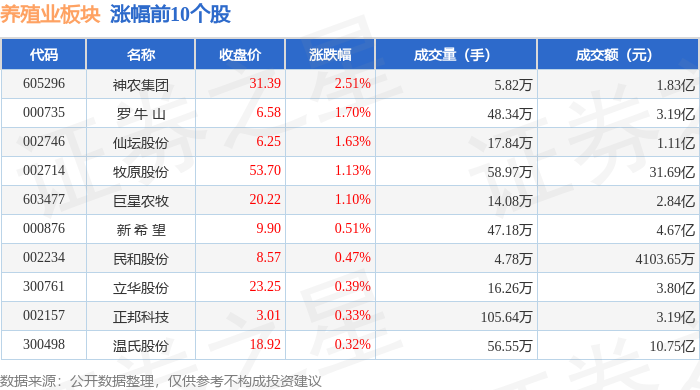
Core Insights - The aquaculture sector saw a rise of 0.66% on October 14, with Shennong Group leading the gains [1] - The Shanghai Composite Index closed at 3865.23, down 0.62%, while the Shenzhen Component Index closed at 12895.11, down 2.54% [1] Aquaculture Sector Performance - Shennong Group (605296) closed at 31.39, up 2.51% with a trading volume of 58,200 shares and a turnover of 183 million [1] - Other notable performers included: - Luoniushan (000735) at 6.58, up 1.70% with a turnover of 319 million [1] - Xiantan Co. (002746) at 6.25, up 1.63% with a turnover of 111 million [1] - Muyuan Foods (002714) at 53.70, up 1.13% with a turnover of 3.169 billion [1] Capital Flow Analysis - The aquaculture sector experienced a net inflow of 64.59 million from institutional investors, while retail investors contributed a net inflow of 71.36 million [2] - Notable capital flows included: - Muyuan Foods saw a net inflow of 89.62 million from institutional investors [3] - Luoniushan had a net inflow of 33.35 million from institutional investors [3] - Shennong Group experienced a net inflow of 29.15 million from institutional investors [3]



研报掘金丨华鑫证券:牧原股份养殖成本优势持续增强,维持“买入”评级
Ge Long Hui A P P· 2025-10-14 06:35
格隆汇10月14日|华鑫证券研报指出,牧原股份由于前期生猪减重政策等因素影响,部分生猪提前出 栏,导致公司9月出栏量有所减少。公司主动削减能繁母猪存栏至2025年9月的330.5万头,较2024年末 的351.2万头减少5.9%,已基本达成330万头的年底能繁母猪量目标。在国内生猪产能增长趋缓背景下, 牧原与BAF合作的越南高科技楼房养殖项目,或将成为公司增长的新动力。公司完全成本持续优化,目 标年底达11元/kg,全年平均成本12元/kg。在猪价下行阶段,这一成本优势将转化为显著的抗周期能 力。公司养殖规模领先,养殖成本优势持续增强。维持"买入"评级。 ...