伊利股份

Search documents
复盘106家食品企业半年报:70家公司业绩下滑,蒙牛液奶缩水40亿,农夫逆袭净赚76亿
3 6 Ke· 2025-09-03 08:50
Overall Industry Performance - In the first half of 2025, 70 out of 106 companies reported varying degrees of performance decline, with 57 experiencing revenue drops and 48 facing net profit declines, indicating a trend of prioritizing profit preservation over revenue growth [1][2] - The consumer market remains weak, leading to supply-demand imbalances, intense competition, and price wars [1] Dairy Industry - The dairy sector is significantly impacted, with 25 out of 33 listed companies reporting performance declines, primarily due to falling liquid milk sales [1][3] - Major players like Yili and Mengniu saw substantial revenue drops in their liquid milk segments, with Yili's liquid milk revenue decreasing by 7.61 billion yuan and Mengniu's by 40.48 billion yuan [3][4] - Conversely, the milk powder segment shows signs of structural recovery, with some companies reporting revenue growth due to market consolidation and subsidy policies [3][5] Snack Industry - Snack companies are largely struggling, with brands like Liuyinpuzi and Laiyifen reporting losses, while others like Qiaqia and Three Squirrels experienced significant profit declines [1][2] - The challenges stem from channel transformations and rising costs, particularly in raw materials, leading to increased customer acquisition costs [1] Beverage Industry - The beverage sector shows mixed results, with companies like Nongfu Spring and Dongpeng achieving record net profits, while others like China Resources Beverage faced revenue declines [9][10] - Nongfu Spring's tea beverage segment surpassed 10 billion yuan in revenue for the first time, indicating strong market performance [9] Seasoned Food Industry - The seasoning industry is experiencing increasing differentiation, with leading companies like Haitian maintaining stable growth while others like Zhongju Gaoxin face significant declines [7][8] - Many companies are adjusting their channel strategies in response to market saturation, with a focus on international expansion [8] Convenience Food Industry - The convenience food sector shows slight recovery among leading companies, with Shuanghui Development reporting a revenue increase of 2.97% [13] - Notably, Guoquan Foods achieved remarkable growth, with revenue and net profit increasing significantly [14] Overall Conclusion - The food industry is facing a challenging environment with more companies reporting declines than gains, but there are still structural growth opportunities for those willing to adapt and innovate [14]
饮料乳品板块9月3日跌2.3%,一鸣食品领跌,主力资金净流出2.35亿元
Zheng Xing Xing Ye Ri Bao· 2025-09-03 08:40
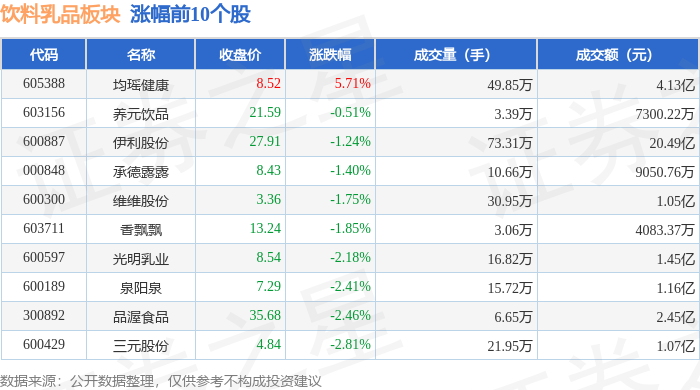
Market Overview - The beverage and dairy sector experienced a decline of 2.3% on September 3, with Yiming Food leading the drop [1] - The Shanghai Composite Index closed at 3813.56, down 1.16%, while the Shenzhen Component Index closed at 12472.0, down 0.65% [1] Individual Stock Performance - JY Health (605388) saw a closing price of 8.52, with an increase of 5.71% and a trading volume of 498,500 shares, totaling a transaction value of 413 million yuan [1] - Yili Group (600887) closed at 27.91, down 1.24%, with a trading volume of 733,100 shares and a transaction value of 2.049 billion yuan [1] - Yiming Food (605179) closed at 22.48, down 6.14%, with a trading volume of 161,700 shares and a transaction value of 374 million yuan [2] - Sunshine Dairy (001318) closed at 14.58, down 5.02%, with a trading volume of 142,500 shares and a transaction value of 213 million yuan [2] Capital Flow Analysis - The beverage and dairy sector saw a net outflow of 235 million yuan from main funds, while retail investors had a net inflow of 308 million yuan [2]


招商证券:25H1险资投资余额超去年全年 高股息OCI类配置型股票规模近万亿
智通财经网· 2025-09-03 06:57
Core Insights - The insurance industry is experiencing rapid growth in fund utilization, with a balance of 36.23 trillion yuan as of Q2 2025, reflecting an 8.9% increase from the beginning of the year, driven by premium growth and asset value appreciation [2] - Major listed insurance companies account for nearly 60% of the total investment scale, with a slight decrease in their market share to 58.7% [2] - The allocation of insurance assets is increasingly focused on high-dividend and large-cap growth stocks, with the OCI stock scale nearing 1 trillion yuan [4][5] Investment Trends - As of mid-2025, the stock investment balance for life and property insurance companies reached 3.07 trillion yuan, with a net increase of 640.6 billion yuan in H1, surpassing the total increase for the previous year [1] - The proportion of stocks in the total investment assets of major listed insurance companies rose to 9.3%, with a net increase of 418.9 billion yuan in H1, accounting for 65.7% of the industry's stock investment growth [3] - The average dividend yield of heavily held stocks by insurance funds has slightly decreased to 2.3%, attributed to rising stock prices diluting dividends [4] Regulatory and Market Changes - The insurance sector has seen a surge in shareholding activities, with 30 instances of shareholding increases recorded by the end of August 2025, primarily in high-dividend sectors such as banking and public utilities [5] - New accounting standards and low-interest rates are reshaping the investment environment for insurance funds, with a focus on long-term investments and diversified asset allocation strategies [10] Future Outlook - The insurance industry is expected to maintain double-digit growth in fund utilization, with stock and fund increments potentially approaching 1 trillion yuan [10] - Insurance companies are likely to increase their equity allocation, particularly in growth sectors and high-dividend stocks, in response to regulatory encouragement [10] - There is a growing emphasis on exploring innovative asset types and channels, including overseas investments and new business trials, to enhance portfolio diversification and reduce volatility [10]


鲁股观察|宜品乳业冲刺港股IPO:羊奶粉巨头能否破局增长挑战?
Xin Lang Cai Jing· 2025-09-03 06:16
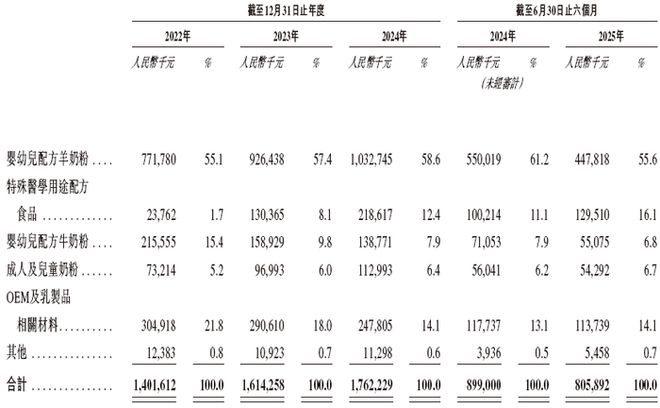
Core Viewpoint - Yipin Nutrition Technology (Qingdao) Group Co., Ltd. has officially initiated its IPO process on the Hong Kong Stock Exchange, showcasing steady revenue growth but facing short-term performance pressures in 2025 [1][4]. Financial Performance - The company's revenue increased from 1.402 billion yuan in 2022 to 1.762 billion yuan in 2024, with a growth rate of 15.1% in 2023 and a slowdown to 9.2% in 2024 [4]. - In the first half of 2025, revenue dropped by 10.36% to 806 million yuan, and net profit fell by 42.57% to 56.688 million yuan, indicating short-term challenges [1][6]. Market Position and Industry Landscape - Yipin holds a 14% market share in the rapidly growing Chinese goat milk powder market, which is projected to reach 19.25 billion yuan in 2024, with an expected growth rate of 15.2% [2]. - The company ranks second in the infant formula goat milk powder segment with a 17.6% market share and second in the special medical purpose food segment with a 4.5% market share [2]. Product Diversification - The company’s main business segments include infant formula goat milk powder, special medical purpose foods, and adult nutrition products, with infant formula goat milk powder accounting for 58.6% of total revenue in 2024 [7]. - Special medical purpose foods are the fastest-growing segment, with revenue increasing from 24 million yuan in 2022 to 219 million yuan in 2024, reflecting a compound annual growth rate of 203.3% [7]. Global Expansion and Supply Chain - Yipin has established a comprehensive supply chain, including a large dairy farm in Heilongjiang and a modern goat farm in Shandong, along with a production base in Galicia, Spain, which is expected to produce 25% of the EU's goat whey powder in 2024 [2][3]. - The Spanish factory not only ensures stable supply of core raw materials but also enables the company to export products to the European market, contributing 322 million yuan in revenue from overseas markets in 2024 [3]. Shareholder Structure - The major shareholder, Mr. Miao Shanbo, holds approximately 75.11% of the company’s shares, indicating strong control over the company [6]. Future Outlook - The company plans to use the proceeds from the IPO for research and development, supply chain upgrades, brand building, international expansion, and digital infrastructure enhancement [7][8].
险资系证券私募持仓曝光
Zhong Guo Zheng Quan Bao· 2025-09-03 05:14
Group 1 - The core viewpoint of the article highlights the increasing clarity of long-term investment paths by insurance capital-based private equity funds as they disclose their holdings following the release of listed companies' semi-annual reports [1][2] - Major energy and infrastructure companies such as China Petroleum, China Shenhua, and Daqin Railway have attracted significant investments from these funds, indicating a clear focus on long-term and value investment strategies [1][2] - As of now, there are seven insurance capital-based private equity funds with a total pilot amount of 222 billion yuan [1][6] Group 2 - The report reveals that the Guofeng Xinghua Honghu Zhiyuan Phase II private equity fund has become the sixth largest circulating shareholder of China Petroleum, holding over 217 million shares valued at approximately 1.857 billion yuan as of the end of Q2 [2] - The same fund has also entered the top ten shareholders of China Shenhua, holding over 52 million shares valued at around 2.116 billion yuan [2] - The Honghu Zhiyuan Phase III private equity fund has emerged as the eighth largest shareholder of Sinopec, holding 305 million shares valued at over 1.7 billion yuan, and as the fourth largest shareholder of Daqin Railway, holding 298 million shares valued at over 1.9 billion yuan [2] Group 3 - Recently, another insurance capital-based private equity fund, Hengyi Holding (Shenzhen) Private Fund Management Co., Ltd., has completed its registration with a first-phase fund size of 30 billion yuan, focusing on long-term and value investments [4][5] - The insurance capital long-term investment reform pilot has seen three batches approved, with a total pilot amount of 222 billion yuan [6]




险资系证券私募 持仓曝光
Zhong Guo Zheng Quan Bao· 2025-09-03 04:52
Core Insights - Long-term funds, particularly insurance capital-backed private equity, are increasingly investing in leading companies in the energy and infrastructure sectors, such as China Petroleum, China Shenhua, and Daqin Railway, indicating a clear strategy of long-term and value investment [1][3] Group 1: Investment Trends - As of now, there are 7 insurance capital-backed private equity firms with a total pilot amount of 222 billion yuan [1][9] - The recent registration of Hengyi Holding (Shenzhen) Private Fund Management Co., Ltd. under Ping An Asset Management marks the emergence of another insurance capital-backed private equity firm, with an initial fund size of 30 billion yuan [1][7] Group 2: Fund Holdings - The Guofeng Xinghua Honghu Zhiyuan Phase II private equity fund has become the 6th largest circulating shareholder of China Petroleum, holding over 217 million shares valued at approximately 1.857 billion yuan as of the end of Q2 [3] - The same fund is also the 9th largest circulating shareholder of China Shenhua, with over 52 million shares valued at around 2.116 billion yuan [3] - The Honghu Zhiyuan Phase III Fund No. 1 is the 8th largest shareholder of Sinopec, holding 305 million shares valued at over 1.7 billion yuan [3] - The same fund has also become the 4th largest shareholder of Daqin Railway, holding 298 million shares valued at over 1.9 billion yuan [3] Group 3: Fund Management and Strategy - The insurance capital long-term investment reform pilot has been approved in three batches, with a total pilot amount of 222 billion yuan [9] - The newly registered Hengyi Holding will focus on long-term and value investment strategies, targeting high-quality listed companies that align with policy directions and insurance capital allocation needs [7][8]


险资系证券私募,持仓曝光
Zhong Guo Zheng Quan Bao· 2025-09-03 04:32
Group 1 - Long-term investment strategies of insurance capital are becoming clearer as semi-annual reports of listed companies are disclosed, with significant investments in leading companies in the energy and infrastructure sectors such as China Petroleum, China Shenhua, and Daqin Railway [1][2] - As of now, there are 7 insurance capital private equity firms with a total pilot amount of 222 billion yuan, indicating a growing trend in long-term and value investment approaches [1][6] - The recent registration of Hengyi Holding (Shenzhen) Private Fund Management Co., Ltd. under Ping An Asset Management, with an initial fund size of 30 billion yuan, marks the emergence of another insurance capital private equity firm [1][4] Group 2 - The National Fund for Investment Management has reported that the Guofeng Xinghua Honghu Zhi Yuan Phase II private equity fund has become the sixth largest shareholder of China Petroleum, holding over 217 million shares valued at approximately 1.857 billion yuan [2] - The same fund has also become the ninth largest shareholder of China Shenhua, with over 52 million shares valued at around 2.116 billion yuan [2] - The Guofeng Xinghua Honghu Zhi Yuan Phase III private equity fund has been reported as the eighth largest shareholder of Sinopec, holding 305 million shares valued at over 1.7 billion yuan, and the fourth largest shareholder of Daqin Railway, holding 298 million shares valued at over 1.9 billion yuan [2] Group 3 - The holdings of the Taikang Stable Phase I fund and the Taibao Zhiyuan No. 1 fund have not yet been disclosed as of the end of the second quarter [3] - The pilot program for long-term investment of insurance funds has seen three batches approved, with a total pilot amount of 222 billion yuan [6]
绍兴宴席补贴新政出炉!吃喝板块冲高回落,食品ETF(515710)近20日吸金超1.3亿元!
Xin Lang Ji Jin· 2025-09-03 02:53
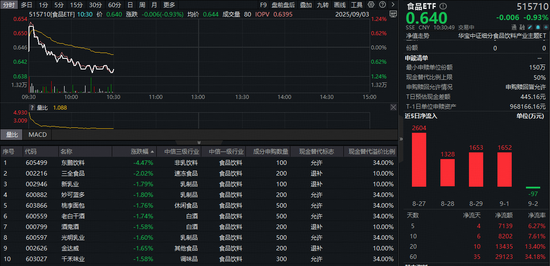
Group 1 - The food and beverage sector experienced a pullback on September 3, with the Food ETF (515710) opening high but declining, down 0.93% at the time of reporting [1][2] - Major stocks in the sector, including Dongpeng Beverage, Sanquan Food, and several liquor brands, saw significant declines, with Dongpeng Beverage dropping over 4% and Sanquan Food down over 2% [1][2] - The Food ETF has seen substantial net inflows recently, with over 70 million yuan in net subscriptions over the past five trading days and more than 130 million yuan over the last 20 days [2] Group 2 - A new consumption promotion policy was announced in Shaoxing, Zhejiang, which includes subsidies for dining events, potentially boosting demand in the food and beverage sector [3] - The current valuation of the food and beverage sector is considered low, with the Food ETF's underlying index PE ratio at 21.25, indicating a favorable time for investment [3] - Despite a weak performance in the liquor sector, some companies are actively adjusting their product channels, suggesting potential bottom-fishing opportunities [4] Group 3 - The liquor sector is viewed as having good investment value, with ongoing policy support reinforcing expectations for economic recovery, although there are still concerns about the pace of recovery [5] - The Food ETF (515710) tracks the China Securities Index for the food and beverage industry, with a significant portion of its holdings in high-end liquor stocks and other beverage segments [6]


四大证券报精华摘要:9月3日
Xin Hua Cai Jing· 2025-09-03 02:18
Group 1 - Foreign institutions are diversifying their investments through ETFs, focusing on sectors like gold, innovative pharmaceuticals, and semiconductors, with significant returns reported [1] - Private equity firms have increased their research activities, conducting over 6000 A-share company investigations in August, reflecting a positive outlook and a focus on "hard technology" and "big health" sectors [2] - The polyester filament industry has shown strong performance with a 10.15% increase in the polyester index since August 1, indicating a favorable investment opportunity as demand peaks [4] Group 2 - Leading companies in various sectors are optimistic about the second half of the year, predicting a sales peak driven by market demand and supportive policies [5] - The optical switch market is expected to grow rapidly, with a projected market size of $2.02 billion by 2031 and a compound annual growth rate of 16.3% [7] - Oil service companies are poised for growth as international oil prices remain stable, with several firms reporting solid performance in their recent half-year reports [8] Group 3 - The demand for energy storage solutions has surged, leading to a significant increase in orders for domestic battery manufacturers, with some companies reporting full production capacity [11] - A new tax policy has been introduced to support the management of state-owned equity and cash income for social security funds, which may impact investment strategies [12][13] - Institutional investors, including public funds and social security funds, have shown a consensus on 145 stocks, particularly in the new productivity sector, indicating a shared outlook on policy and industry trends [14] Group 4 - Stardust Intelligent has secured a large order for humanoid robots, marking a significant step in the commercialization of AI robots for various industrial applications [15]
持仓曝光!险资系私募基金,买了这些股票!
Sou Hu Cai Jing· 2025-09-03 01:30
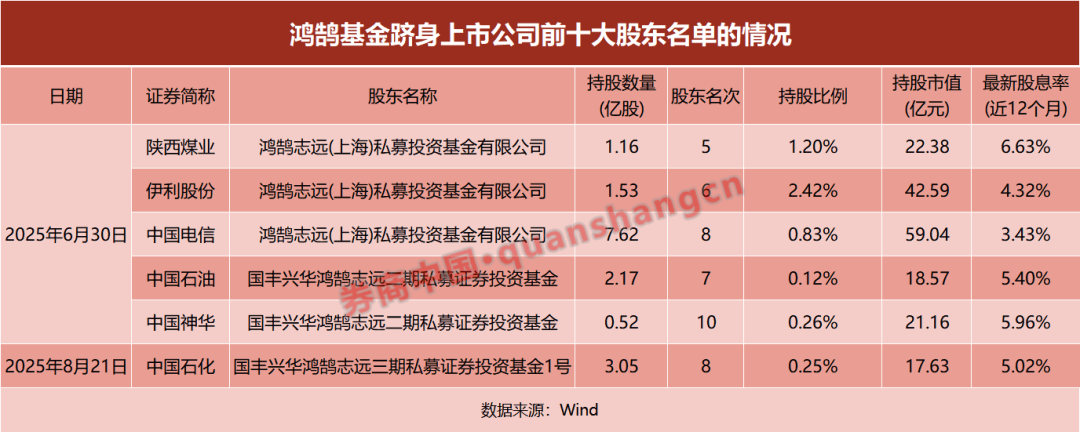
Core Viewpoint - The article highlights the emergence of Honghu Fund's second and third phases as significant shareholders in several listed companies, indicating a strategic investment approach by insurance capital in the market [1][3]. Group 1: Shareholding Information - Honghu Fund's second phase has entered the top ten shareholders of China National Petroleum and China Shenhua, with respective holdings valued at over 18 billion and 21 billion yuan [3]. - Honghu Fund's third phase, specifically the No. 1 product, has been listed as the eighth largest shareholder of Sinopec, holding approximately 305 million shares valued at 17.63 billion yuan [5]. - As of June 30, 2025, Honghu Fund's first phase maintained its positions in Shaanxi Coal and Yili Group, with no change in shareholding quantity compared to the previous quarter [6]. Group 2: Fund Structure and Management - Honghu Fund comprises three phases with a total scale of 110 billion yuan, managed by Guofeng Xinghua, a joint venture of China Life Asset and Xinhua Asset [6][8]. - The first phase of the fund has a scale of 50 billion yuan, fully invested by China Life and other contributors, achieving good returns by March of this year [6]. - The second phase has a scale of 20 billion yuan, with equal contributions from China Life and Xinhua Insurance, and has completed its main investment allocation by the end of the second quarter [6][11]. Group 3: Investment Strategy and Performance - The fund adheres to a long-term, value-oriented investment philosophy, focusing on companies with good governance and stable cash flows, particularly during market downturns [9][11]. - The average dividend yield of the six listed companies in which the fund has invested is relatively high, with four energy and coal stocks exceeding 5% [10]. - As of June 30, the first phase of Honghu Fund reported total assets of 57.11 billion yuan and a net profit of 9.68 billion yuan for the first half of the year [11][12].