DeepSeek

Search documents
谷歌前CEO埃里克·施密特:“非人类智能”崛起将重塑全球格局
3 6 Ke· 2025-05-19 11:31
Group 1 - The arrival of "non-human intelligence" is a significant event that will fundamentally change the world, yet society's understanding of AI's disruptive potential remains severely underestimated [1][2] - AI technology is rapidly advancing, moving from language generation to strategic decision-making, with autonomous systems capable of performing complex tasks beyond public expectations [1][4] - The current global governance system is unprepared for the transformative changes brought by AI, facing challenges such as energy and computational bottlenecks, potential misuse of open-source models, and unclear safety boundaries [1][5][6] Group 2 - Three core challenges for AI development include energy and hardware limitations, data exhaustion, and the boundaries of knowledge, which must be addressed to prevent hindering progress [7][8] - The energy demand for AI systems is projected to require an additional 90 gigawatts in the U.S., equivalent to building 90 nuclear power plants, highlighting the urgent need for sustainable energy solutions [7][8] - AI systems are consuming nearly all available public data, necessitating a shift towards AI-generated data for future advancements [8][9] Group 3 - The risks associated with AI autonomy include recursive self-improvement, control over military systems, and unauthorized self-replication, necessitating the establishment of "power-off" mechanisms to maintain oversight [10][11] - A consensus exists in the industry that clear, executable regulatory frameworks are needed rather than a blanket halt on AI development [10][11] Group 4 - The competition between the U.S. and China in AI technology is critical, with potential implications for global security and technological leadership, particularly in the context of open-source versus proprietary systems [12][13][16] - The dual-use nature of AI raises ethical dilemmas, especially regarding military applications, necessitating robust human oversight in weapon systems [12][13] Group 5 - AI has the potential to revolutionize sectors such as healthcare and education, with advancements that could lead to significant improvements in drug development and personalized learning experiences [20][21] - The future of AI could enable a new era of productivity, with projections suggesting annual productivity growth of up to 30% through the integration of AI in various sectors [22][23] Group 6 - The ongoing technological revolution is likened to a marathon rather than a sprint, emphasizing the need for continuous adaptation and proactive engagement with AI technologies [22][24] - Companies and individuals must embrace AI tools to remain competitive, as the rapid evolution of AI systems is reshaping industries and job functions [24][25]



Wall Street Breakfast Podcast: Alibaba Dips On Reported Apple AI Scrutiny
Seeking Alpha· 2025-05-19 11:00
Group 1: Alibaba and Apple Partnership - Alibaba's shares fell by as much as 4.8% in Hong Kong following reports of U.S. scrutiny over its potential AI partnership with Apple [6] - The White House is examining the agreement that would integrate Alibaba's AI technology into Apple's iPhones in China [6][7] - This scrutiny comes after Alibaba's recent quarterly revenue fell short of expectations, contributing to a decline in its stock [7] Group 2: General Motors and California's EV Mandate - General Motors is lobbying against California's zero-emissions vehicle mandate, which bans new gas-powered car sales by 2035 [10][11] - GM's internal goal to end sales of most gasoline-only vehicles by 2035 is now being reconsidered due to slowing EV sales and changing political dynamics [11] - The company has reached out to employees for support in lobbying U.S. senators to overturn California's regulations [10] Group 3: China’s Tariffs on POM Copolymers - China announced anti-dumping tariffs on POM copolymers from the U.S., EU, Japan, and Taiwan, with U.S. imports facing the highest duty at 74.9% [12][13] - The tariffs are a response to findings that imported products were sold below fair market value, harming domestic producers [13] - POM copolymers are crucial in manufacturing automotive parts, electronic components, and medical devices [13]



谷歌CEO皮查伊回应“谷歌已死”论:AI决定未来,中国竞争力不容忽视
3 6 Ke· 2025-05-19 10:44
Group 1 - Google and its parent company Alphabet are focusing on redefining the search experience by transitioning from traditional search to an AI-driven intelligent assistant that anticipates user needs [3][6] - CEO Sundar Pichai emphasized the importance of Google's long-term investments in infrastructure, such as self-developed TPU chips and large-scale data centers, which provide a competitive edge in AI model training and deployment [3][6][13] - The company is exploring the future of human-computer interaction, highlighting the shift towards voice, image, and multimodal inputs that are reshaping hardware and product interfaces [3][18] Group 2 - Pichai addressed concerns about whether Alphabet is still seeking the next billion-dollar business, stating that the focus is on maintaining innovation and leadership in an AI-dominated technology cycle [4][6] - The company has seen significant growth, with quarterly revenue increasing from $20 billion to nearly $100 billion, and is positioned to leverage AI for further opportunities [6][10] - Google is testing a new AI-driven search experience called "AI Mode," which allows for conversational queries and has already seen a significant increase in user engagement [7][9] Group 3 - Pichai noted that Google's infrastructure is designed to provide high performance and cost efficiency, allowing the company to offer advanced AI services at competitive prices [13][14] - The company plans to invest $70 billion in capital expenditures, focusing on servers and data centers to support AI infrastructure and model services [14] - Google is committed to maintaining a dual approach by using both its TPU chips and NVIDIA GPUs for AI tasks, ensuring flexibility and efficiency in its operations [15] Group 4 - The company is actively investing in next-generation hardware, including AR glasses and robotics, to enhance its product offerings and explore new computing platforms [19][25] - Pichai believes that the integration of AI and robotics is approaching a breakthrough, with significant advancements expected in the next few years [27][28] - Google is also focused on building a robust ecosystem for AI, leveraging its existing services like YouTube and Google Cloud to create a comprehensive AI product ecosystem [9][31] Group 5 - Pichai highlighted the importance of energy resources for AI development, acknowledging that power supply limitations are currently affecting Google's cloud computing business [22][24] - The company is exploring various energy solutions, including solar and nuclear power, to address future energy demands for AI [23][24] - Google has a long-term strategy of investing in emerging technologies, such as quantum computing and AI, to ensure sustained growth and innovation [25][26]

每周一问大模型 | 基模“五强”谁最水,谁最强?
Sou Hu Cai Jing· 2025-05-19 07:26
Group 1 - The core players in China's foundational model landscape are ByteDance, Alibaba, Jiyue Xingchen, Zhipu AI, and DeepSeek, collectively referred to as the "Five Strong" [1] - DeepSeek is recognized as a strong technical dark horse due to its breakthroughs in mathematical reasoning and cost-effectiveness, while ByteDance holds a comprehensive advantage with its full-stack layout and extensive user ecosystem [13][25] - Alibaba maintains its position as the king of open-source models, leveraging top-tier global open-source models and infrastructure, although it faces challenges in deepening commercialization [13][25] Group 2 - Jiyue Xingchen is noted for its multi-modal technology and rapid rise in terminal applications, but it needs to address the challenge of achieving an integrated architecture [11][25] - Zhipu AI, while having a solid presence in the government and enterprise market, is limited by its reliance on traditional technology paths and has not demonstrated disruptive breakthroughs [12][25] - The future competitive landscape will focus on three dimensions: DeepSeek's reasoning capabilities, how ByteDance and Alibaba convert their ecosystems into commercial success, and whether Jiyue Xingchen can overcome multi-modal integration challenges [16][23] Group 3 - DeepSeek excels in specialized fields like mathematical reasoning but has a relatively narrow commercial application scope, which may put it at a disadvantage in overall competition [22][25] - Zhipu AI's strong academic background is countered by its limited consumer applications and over-reliance on the B-end market, which weakens its risk resistance [22][25] - In contrast, Alibaba, ByteDance, and Jiyue Xingchen demonstrate stronger overall capabilities with tighter integration of technology and business [22][25] Group 4 - The competitive key points include the intelligence ceiling defined by model reasoning capabilities, the importance of multi-modal capabilities as a foundation for AGI, and the need for continuous validation of market acceptance for open-source ecosystems and vertical applications [23][25] - Alibaba and ByteDance are currently leading the first tier due to their comprehensive funding, ecosystem, and technology layouts, while Jiyue Xingchen shows significant potential with its multi-modal technology [23][25] - DeepSeek and Zhipu AI need to continue making breakthroughs in differentiated areas to remain competitive [23][25]
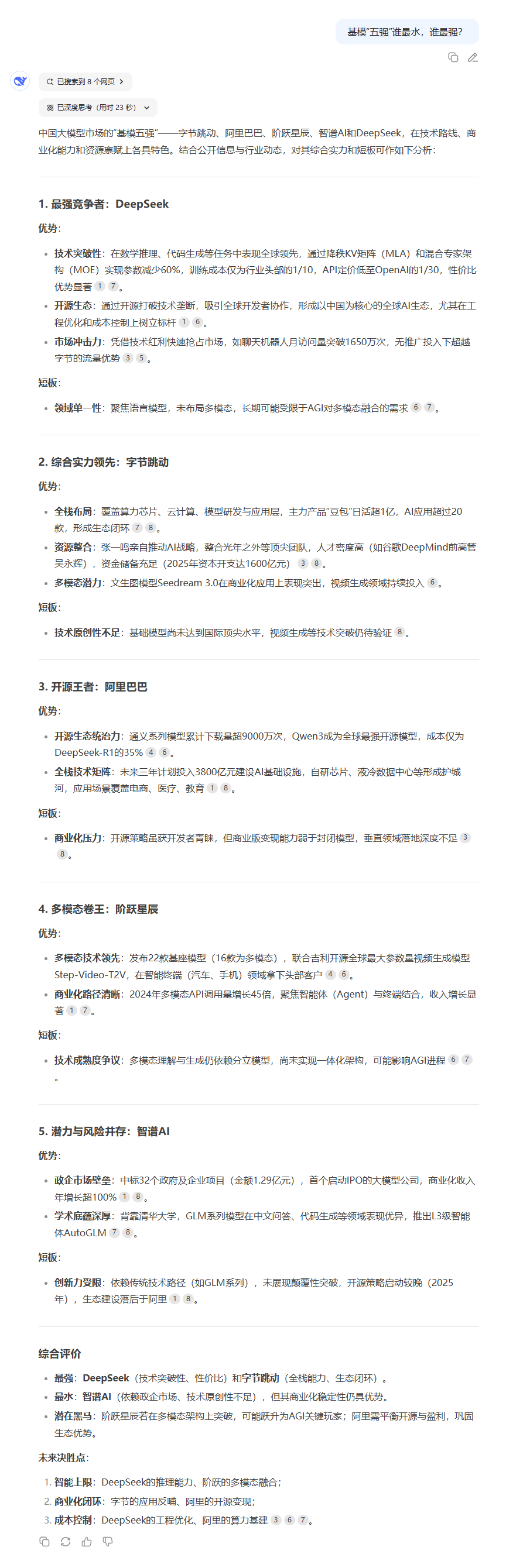
启明创投邝子平:中国新质生产力走向世界 创投行业大有可为
Xin Lang Cai Jing· 2025-05-19 07:09
Group 1 - The core theme of the 2025 Global Investor Conference is "New Quality Productivity and Investment Opportunities in China," focusing on the open and innovative Shenzhen market [1] - The keynote speech by the founding partner of Qiming Venture Partners highlighted the significant transformation in China's export categories over the past 20 years, with machinery, electrical equipment, and consumer electronics now accounting for 42% of total exports [2][9] - The rapid growth of China's new energy electric vehicles demonstrates strong global competitiveness, with various companies expanding their international presence [2][10] Group 2 - The emergence of DeepSeek as a leading AI company signifies China's capability in AI, with its models showing performance comparable to OpenAI's at a fraction of the cost, indicating a shift in global perceptions of Chinese AI capabilities [5][6][7] - The biopharmaceutical sector in China is also experiencing rapid advancements, with 30% of global big pharma's license-in deals coming from Chinese biotech startups in 2024, up from 0% in 2019 [8][9] - The internationalization of Chinese tech companies is increasing, with notable examples like BYD and Xiaomi showing significant growth in overseas revenue [9][10] Group 3 - The venture capital industry in China plays a crucial role in supporting technological innovation, with a focus on high-risk tolerance and long-term value [12] - Despite facing challenges in recent years, the Chinese venture capital sector has produced a significant number of companies with valuations exceeding $100 billion, with six out of seven such companies globally founded after 2010 being Chinese [13] - Key investment opportunities are identified in sectors such as artificial intelligence, biomedicine, and renewable energy, with expectations for substantial growth and innovation in these areas [14]



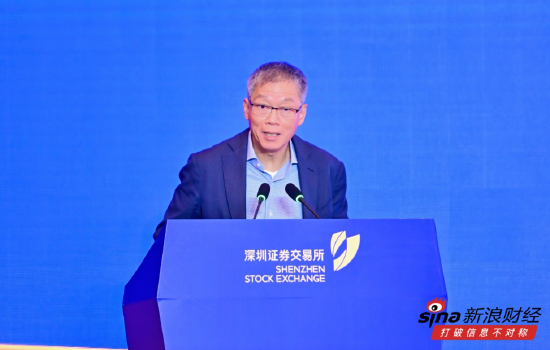
启明创投邝子平:5年从0到30% 中国生物制药成为全球License-out新高地
Xin Lang Cai Jing· 2025-05-19 07:09
Core Viewpoint - The 2025 Global Investor Conference emphasizes the new productive forces in China and the investment opportunities in Shenzhen's open innovation market, particularly in the biopharmaceutical sector and technology advancements [1][4]. Biopharmaceutical Industry - China's biopharmaceutical sector is rapidly advancing, producing world-class products at lower costs. By 2024, 30% of global big pharma's License-in deals will come from Chinese biotech startups, a significant increase from 0% in 2019 [1][7]. - The shift from being a License-in country to a License-out origin indicates China's growing influence in the global pharmaceutical landscape [7]. Technology and AI Development - The emergence of DeepSeek, a leading AI company, showcases China's capabilities in AI, with its models achieving results comparable to international counterparts at a fraction of the cost [5][6]. - The global perception of China's AI capabilities has shifted, with reports indicating that the gap between Chinese and leading international AI technologies has narrowed to just a few months [6]. Globalization of Chinese Tech Companies - Chinese tech companies are increasingly expanding their international presence, with notable examples including BYD, CATL, ByteDance, Alibaba, and Xiaomi, all showing rising overseas revenue proportions [8][9]. - Smaller tech firms, such as Stone Technology and Insta360, are also achieving significant global market shares, demonstrating the competitive strength of Chinese innovation [10]. Investment Opportunities - The venture capital industry in China plays a crucial role in supporting technological innovation, with a focus on sectors like AI, advanced manufacturing, healthcare, and renewable energy [11][12]. - The potential for investment in Chinese technology is underscored by the fact that six out of seven companies founded after 2010 that have reached a market value of over $100 billion are from China [12]. Future Growth Areas - Key areas for future investment include artificial intelligence, biopharmaceuticals, and renewable energy, driven by demographic changes and technological advancements [13]. - The expectation is that by 2025, AI will significantly empower various industries, creating substantial investment opportunities [13].

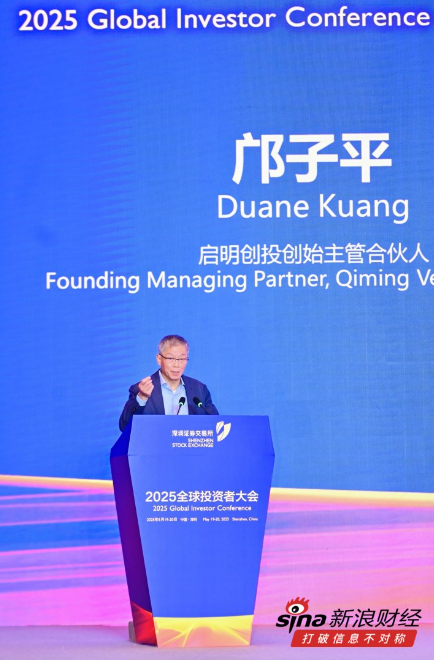
施罗德投资Gopi Mirchandan:人工智能、机器人发展对算力需求大幅提升,云计算、芯片迎来投资机遇
Xin Lang Cai Jing· 2025-05-19 06:32
Group 1 - The Shenzhen Stock Exchange hosted the 2025 Global Investor Conference, focusing on new productive forces and investment opportunities in China, particularly in the context of open innovation [1] - Gopi Mirchandan highlighted significant advancements in artificial intelligence and robotics in China, with companies like DeepSeek leading the way, reshaping the innovation landscape and closing the gap with Western AI developments [1] - The open AI models are expected to reduce computing costs, enabling more Chinese companies to develop AI products and services, enhancing internal efficiency and customer experience [1] Group 2 - The development of general generative AI and robotics is crucial for the semiconductor and IT industries, as these technologies can perform human-like tasks, improving productivity and reducing labor costs [3] - There is an anticipated surge in demand for cloud computing power to support the operations of AI agents and robots, benefiting hardware and chip providers [3] - Ensuring the economic feasibility of computing power is essential for maintaining progress and development in these sectors [3] Group 3 - Schroders has established a sustainable infrastructure team in China, focusing on renewable energy expertise to combine global knowledge with local needs [4] - The company aims to assist foreign enterprises in achieving supply chain decarbonization and net-zero goals in China, leveraging its role as a "super connector" [4] - Schroders announced a strategy for renewable energy in China, including over $100 million investment from Apple, aiming to provide long-term stable cash flows for institutional investors while generating positive environmental impacts [4]


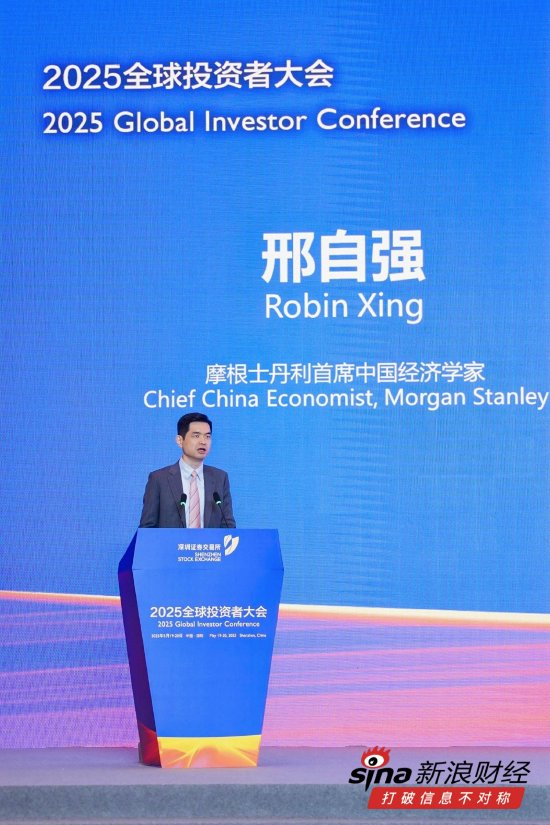
邢自强:中国产业链凤凰涅槃显成效,AI 引领科创重估,产业链集群优势凸显
Xin Lang Cai Jing· 2025-05-19 03:26
Core Insights - The 2025 Global Investor Conference held in Shenzhen focused on "New Quality Productivity: Investment Opportunities in China" and highlighted the investment value of Chinese assets and the A-share market [1] - Morgan Stanley's Chief China Economist, Xing Ziqiang, emphasized China's unique position in the AI sector, being the only economy besides the US capable of achieving a closed-loop in the entire AI hardware and software chain [1] - China's AI industry benefits from significant advantages in talent, algorithms, infrastructure, and data, with nearly half of the global AI talent coming from China and over 3 million engineering graduates each year [1] Industry Development - The industrial chain cluster effect in regions like Guangdong and Shenzhen has significantly contributed to the development of the AI industry, with companies like DeepSeek thriving due to local talent and supply chain support [2] - The best enterprise recommendation event hosted by Morgan Stanley in Shenzhen received strong support from the Shenzhen Stock Exchange and the Shenzhen Financial Office, underscoring Shenzhen's core role in AI manufacturing applications [2] - China's AI industry has experienced a leap forward, alleviating global investors' concerns over the past three years and reigniting confidence in China's innovation capabilities and market [2] Technological Advancements - The fields of intelligent driving and humanoid robots are also reflecting the enhancement of China's industrial chain, with intelligent driving entering a more advanced stage and humanoid robots transitioning from experimental to practical applications [2] - Xing Ziqiang noted that China's industrial chain has significantly improved over the past seven to eight years, showcasing strong vitality and competitiveness, particularly in areas such as industrial chain clusters, engineering talent, robotics, and intelligent driving [2]
推动生成式人工智能赋能产业发展
Ke Ji Ri Bao· 2025-05-19 02:41
当前,我国生成式人工智能产业发展迅速,相关企业数量已经超过4500家。然而,生成式人工智能与实 体经济融合的深度和广度仍有待提升,其巨大潜力尚未充分释放。究其原因,一方面在于生成式人工智 能技术本身仍处于快速发展期,成熟度有待提高;另一方面,不同产业因其自身特性和发展阶段的差 异,对生成式人工智能技术的需求呈现显著差异。为此,提升生成式人工智能技术的通用性和适用性、 推动科技创新与产业创新深度融合成为当务之急。 二是商业转化临界点尚未到来,行业落地较为缓慢。当前,生成式人工智能技术大规模商业化应用的路 径不畅,在算力资源紧张与训练成本高企的背景下,企业在实际部署中对生成式人工智能创新的投入回 报比不够理想,不同产业类型的生成式人工智能商业落地路径呈现出明显梯度。传统产业整体数字化水 平有限,模型与业务系统之间数据集成基础薄弱,短期内难以形成规模效应;新兴产业在部分场景中已 实现探索性应用,但普遍仍处于"点状突破、多点未及"的阶段;而未来产业由于具备更高的成本容忍度 与对颠覆式创新的开放态度,被认为是生成式人工智能最具战略潜力的应用场景,但产业落地的不确定 因素更多。根据行业特点发挥科技金融等政策工具的分类施策 ...
「AI黑客」来袭,Agentic AI如何成为新守护者?
机器之心· 2025-05-19 02:36
Core Viewpoint - The rapid development of AI technology has led to increasingly complex threats in cybersecurity, giving rise to new forms of attacks such as AI-driven phishing and deepfake scams, necessitating a shift towards AI-based defense mechanisms [2][3][4][24]. Group 1: AI-Driven Cybersecurity Threats - Generative AI is reshaping the precision of online scams, enabling attackers to create personalized phishing emails by training AI models on publicly available social data, significantly increasing the success rate of attacks [4]. - Deepfake technology has advanced to the point where attackers can impersonate individuals in video calls, leading to significant financial losses, as demonstrated by a case where a financial officer was tricked into transferring 3.8 million yuan [4]. - Automated attacks and vulnerability exploitation have become more prevalent, with AI enabling rapid scanning of system vulnerabilities and executing zero-day attacks, as evidenced by a massive DDoS attack that caused millions in losses [5]. Group 2: AI in Cyber Defense - The industry consensus is shifting towards using AI to combat AI-driven threats, marking a transition in security paradigms [7]. - Current defensive strategies can be categorized into three main areas: AI model security enhancement, industry-specific defensive applications, and macro-level government and international collaboration [8]. - AI model security focuses on strengthening the inherent safety of models, with companies like Anthropic developing classifiers to prevent AI from generating harmful content [9]. Group 3: Industry Applications and Innovations - Industry-specific applications are emerging, such as financial institutions utilizing AI risk control models to build anti-fraud barriers and open-source ecosystems employing intelligent vulnerability hunting technologies for rapid threat response [10]. - Companies like Cisco are showcasing solutions that can intercept sensitive data queries in real-time, enhancing compliance and management [10]. - The introduction of AI security assistants, such as Microsoft's Security Copilot, demonstrates the potential for AI to assist security teams in detecting and responding to threats more efficiently [13]. Group 4: Advanced AI Security Solutions - The "Wuxiang" security AI product represents a significant advancement, transitioning from passive response to autonomous decision-making in threat detection and response [15][25]. - This system employs a dual-engine architecture to ensure dynamic correction capabilities during complex tasks, significantly reducing response times from days to minutes [16][22]. - The ability of "Wuxiang" to autonomously analyze alerts and generate comprehensive attack reports showcases its effectiveness in enhancing operational efficiency and accuracy in cybersecurity [17][23]. Group 5: Future of Cybersecurity - The evolution of AI technology presents dual challenges, with attackers leveraging AI for automated and personalized attacks while defenders must innovate to enhance detection and response capabilities [24]. - The emergence of high-level AI security systems is expected to fundamentally reshape the cybersecurity landscape, emphasizing the need for organizations to seize this opportunity for transformation [27].